7 Ways AI Improves Patent Quality Control
Intellectual Property Management
Aug 3, 2025
Explore how AI is enhancing patent quality control through automation, error detection, and data-driven insights, revolutionizing patent management.

AI is transforming patent quality control by addressing inefficiencies, reducing errors, and improving decision-making. Patent offices process over 500,000 applications annually, yet 40% of litigated patents are invalidated. With tools like automated prior art searches and smart error detection, AI helps streamline workflows, saving time and ensuring higher accuracy. Here's how AI is making a difference:
Automated Prior Art Search: Cuts search times by 80% using NLP and ML to analyze millions of documents, even across languages.
Smart Error Detection: Identifies inconsistencies in drafts, saving 10–15 hours per application and reducing office actions.
Semantic Classification: Automatically categorizes patents with 90% accuracy, speeding up reviews and uncovering non-obvious links.
Real-Time Monitoring: Tracks portfolios, deadlines, and competitor filings, ensuring no updates are missed.
Data-Driven Insights: Analyzes patent data for trends, portfolio value, and competitive intelligence.
Project Management Tools: Simplifies team collaboration, task tracking, and reporting with platforms like Patently.
Continuous Learning: AI evolves with user feedback to align with organizational workflows and improve over time.
These advancements allow patent professionals to focus on high-level strategies while AI handles repetitive tasks, ensuring better outcomes and stronger patents.
Essential AI Tools to Boost Your Patent Attorney Practice in 2024
1. Automated Prior Art Search
Prior art searches consume a staggering 40% of examiners’ time, making it one of the most time-intensive parts of patent quality control. Traditional keyword-based searches often fall short, as they can miss critical references due to differences in terminology. This creates vulnerabilities that could lead to patent invalidation later. AI is changing the game by introducing smarter, more efficient search methods.
With the power of Natural Language Processing (NLP) and Machine Learning (ML), AI can analyze millions of documents in seconds. These tools go beyond simple keyword matching, understanding the context and relationships between concepts. Large Language Models excel at decoding complex technical text, spotting patterns, and identifying links that even skilled human searchers might miss. The result? A faster, more effective workflow.
"AI is transforming prior art search from a tedious, complex process into a streamlined, reliable, and efficient solution, helping innovators focus on what truly matters - innovation." – XLSCOUT
The benefits aren’t just theoretical. One Am Law 100 firm saw an 80% reduction in the time spent on complex patent searches and counseling work after adopting AI search tools. Similarly, a collaboration between CAS and The National Institute of Industrial Property (INPI) in Brazil led to a 50% reduction in examination times.
AI tools can even create search strategies automatically by analyzing a patent’s claims and identifying potentially invalidating references simultaneously. This holistic approach ensures no relevant prior art is overlooked - even if it’s located in a different database or uses alternative terminology.
Another standout feature? Multilingual capabilities. AI systems can interpret patents and technical documents in multiple languages, offering a truly global perspective on prior art.
Thomas Sütterlin, a patent expert, explains how AI is leveling the playing field:
"PQAI suggests appropriate classes based on text, saving time and broadening search scope."
Beyond speed and thoroughness, AI tools also provide real-time insights into an invention’s strengths, potential challenges from prior art, and areas for improvement. This allows patent professionals to refine their prosecution strategies and draft stronger claims before filing, enhancing patent quality right from the start.
2. Smart Error Detection in Patent Drafts
Even small mistakes in patent drafts can lead to expensive office actions or, worse, invalidation. While traditional manual reviews are thorough, they might overlook subtle inconsistencies that advanced AI systems can catch with precision. Using Natural Language Processing (NLP) and Machine Learning (ML) algorithms, these tools can identify issues like unsupported claims, missing antecedents, and inconsistent terminology (e.g., swapping between "processor" and "controller" without consistency). AI also ensures formatting compliance by checking document structures, section headings, and reference numerals, minimizing the likelihood of formal rejections.
These advanced error-detection tools save both time and resources. For instance, a Chief IP Counsel at a major biotech company shared that their team saved 10–15 hours per application by generating accurate claim sets and catching errors early in the process. AI doesn’t stop there - it cross-references patent drawings with their textual descriptions to confirm that reference numerals in figures align with those in the specification and claims. Additionally, these systems evaluate Section 112 compliance, ensuring that the specification provides sufficient written description and enablement for every claim element. By flagging potential issues before filing, AI helps strengthen patent quality and reduces the risk of rejections.
That said, while AI is excellent at identifying formal errors, it can sometimes miss contextual subtleties. This is where human expertise comes in. Combining AI’s efficiency with a skilled attorney’s review ensures that both straightforward mistakes and more nuanced issues are addressed, resulting in well-prepared, compliant patent applications ready for submission.
3. Advanced Semantic Classification and Categorization
AI is reshaping how patents are classified, taking what was once a time-consuming and error-prone process and turning it into something far more efficient. With around 3.55 million patents filed globally each year - that’s about 9,700 patents every single day - the sheer volume alone makes accurate categorization a monumental task. But thanks to Natural Language Processing (NLP) and machine learning algorithms, AI is now capable of automatically classifying patents into highly specific categories, while also identifying related technologies with impressive precision.
Unlike traditional keyword-based systems, AI-powered semantic classification goes beyond surface-level terms. It understands the context and intent behind the language, linking related technologies even when they’re described using different terminology. For instance, it can associate "microprocessor" with "central processing unit" seamlessly.
The European Patent Office (EPO) has been testing automated classification systems that achieve over 90% accuracy at the team level. Their AI-assisted Cooperative Patent Classification (CPC) system, trained on a dataset of 7 million patents from 2000 to 2022, can suggest classifications from a staggering pool of 117,175 CPC codes. Similarly, the French Patent and Trademark Office and the Korean Intellectual Property Office began using AI-driven pre-classification and recommendation tools back in 2019.
One of the most practical benefits of this technology is the dramatic reduction in review time. Tasks that used to take months can now be completed in mere days - or even hours. Beyond speed, AI enhances accuracy by cross-referencing and consolidating data, minimizing the risk of overlooking critical connections.
Perhaps the most groundbreaking aspect is AI’s ability to reveal non-obvious links between patents across unrelated fields. This capability is vital for uncovering unexpected prior art that could impact a patent’s validity. These advancements are paving the way for real-time insights and more robust data analysis, which will be explored further in upcoming sections.
With the NLP market projected to hit $1.58 billion in 2023 and grow at an annual rate of 14.81% through 2030, AI-driven semantic classification is becoming a cornerstone of maintaining high patent quality and conducting thorough prior art analysis.
4. Real-Time Monitoring and Alerts
Managing patent portfolios used to be a game of catch-up, with critical deadlines or filings often discovered too late. But thanks to AI, this dynamic is changing. AI enables continuous, proactive monitoring, giving patent professionals the tools to stay ahead rather than playing defense. This shift is reshaping how decisions are made in patent management.
AI-powered tools now keep tabs on patent portfolios by analyzing filings, litigation updates, and market trends. They send timely notifications about newly published inventions, changes in legal status, and competitor patent registrations. This ensures no critical updates slip through the cracks. By delivering this real-time intelligence, AI is becoming a cornerstone of stronger patent quality control.
The numbers back this up. The global patent analytics market is projected to hit $2.36 billion by 2030, showing that organizations increasingly value automated monitoring. Take IamIP’s AI Patent Categorizer, for instance. It has slashed the time spent on categorizing patents by up to 80% while improving success rates by over 90% compared to older methods.
A standout example of AI in action came in October 2024 when NLPatent introduced NLPatent | Monitor, an AI-powered tool for tailored patent intelligence alerts. During beta testing, the platform proved invaluable, helping organizations stay informed about new filings, uncover monetization opportunities, and keep up with industry trends.
"NLPatent | Monitor has opened up a new avenue for us to enhance our clients' IP strategies, enabling us to offer cost-effective post-grant monitoring services that were previously out of reach."
Peter Finnie, Partner & Patent Attorney at Potter Clarkson LLP
What sets tools like this apart is their ability to deliver customized alerts and adapt through continuous learning. AI algorithms can be trained to send highly specific notifications - tracking competitor activities, emerging technologies, or developments in targeted technology areas. This kind of tailored intelligence aligns with business objectives, making it easier for teams to act strategically.
But it doesn’t stop at alerts. These systems also integrate collaborative workspaces, eliminating the need for manual tracking and boosting accuracy. By transforming monitoring into a proactive process, AI shifts patent management from a defensive stance to an offensive strategy. Teams can now anticipate market trends and competitor moves rather than reacting after the fact.
5. Data-Driven Insights and Analytics
Patent data becomes valuable only when it's converted into actionable insights, and this is where AI shines. By processing massive datasets, AI uncovers patterns and trends that would be impossible to detect manually. This ability is reshaping how organizations make decisions about their patent portfolios and competitive strategies. Essentially, AI takes raw data and transforms it into tools that guide strategic asset management.
One of AI's key strengths is its ability to evaluate portfolio performance and value. It can rank patents by analyzing factors like underlying technology, citation trends, litigation history, and overall relevance. This automated system helps patent managers prioritize high-value assets while identifying underperforming patents that might need further review or even abandonment.
AI also leverages predictive analytics to forecast the future value and performance of patents. By examining citation trends, market relevance, and evolving technologies, AI enables organizations to make smarter decisions about renewals, licensing, and portfolio optimization.
Staying Ahead of Competitors
AI-powered analytics provides a significant edge in competitive intelligence. It can analyze competitors' patent portfolios to reveal their R&D priorities, overlapping technologies, potential infringement risks, and areas where differentiation is possible.
"I want a solid strategy built on real data and access to analytics that can support insights on technology trends and activity at a granular level. Sources of digital innovation are very fragmented so the more useable the information you have, the more sensible the decisions you make."
Calum Smyth, Global Head of IP, Barclays
AI systems also track global patent filings to detect emerging technologies and innovation clusters. For instance, green AI patent filings increased by 35% in 2023 - a trend AI can identify and quantify in real time. These insights allow businesses to align their innovation strategies, allocate resources effectively, and secure a competitive edge in evolving markets.
AI goes a step further by identifying technological gaps, often referred to as "white space" analysis. This helps R&D teams focus on areas with the highest potential for strong patent protection and successful commercialization.
Risk Management and Legal Strategy
AI-driven insights significantly enhance risk management. The technology identifies weaknesses in patent portfolios, flags potential infringement risks, and uncovers licensing opportunities. By analyzing vast amounts of data, AI can map patent claims against emerging trends to detect vulnerabilities or declining areas of innovation.
Google offers a prime example of how advanced analytics can be put into action. Mike Lee, Director and Head of Patents at Google, highlights this:
"Data science and machine learning helps us better manage and shape our portfolio; and operate more efficiently and at scale so that we can execute on our patent strategy."
Mike Lee, Director and Head of Patents, Google
Geographic and Strategic Insights
AI also provides valuable insights into geographical trends by identifying regions with high innovation output and advantageous filing environments. This is particularly useful for companies planning international patent strategies or seeking a better understanding of regional innovation dynamics.
Additionally, AI facilitates competitive benchmarking by comparing an organization's patent activities with those of global industry leaders. This helps companies evaluate their market position and identify areas where they are excelling or falling behind.
The impact of AI-powered analytics is hard to ignore. It reduces time-to-market by 10–20%, lowers development costs by 20–30%, and boosts the number of viable innovation projects by 30%, all while enabling quicker and more informed decision-making.
6. Better Project and Portfolio Management with Patently
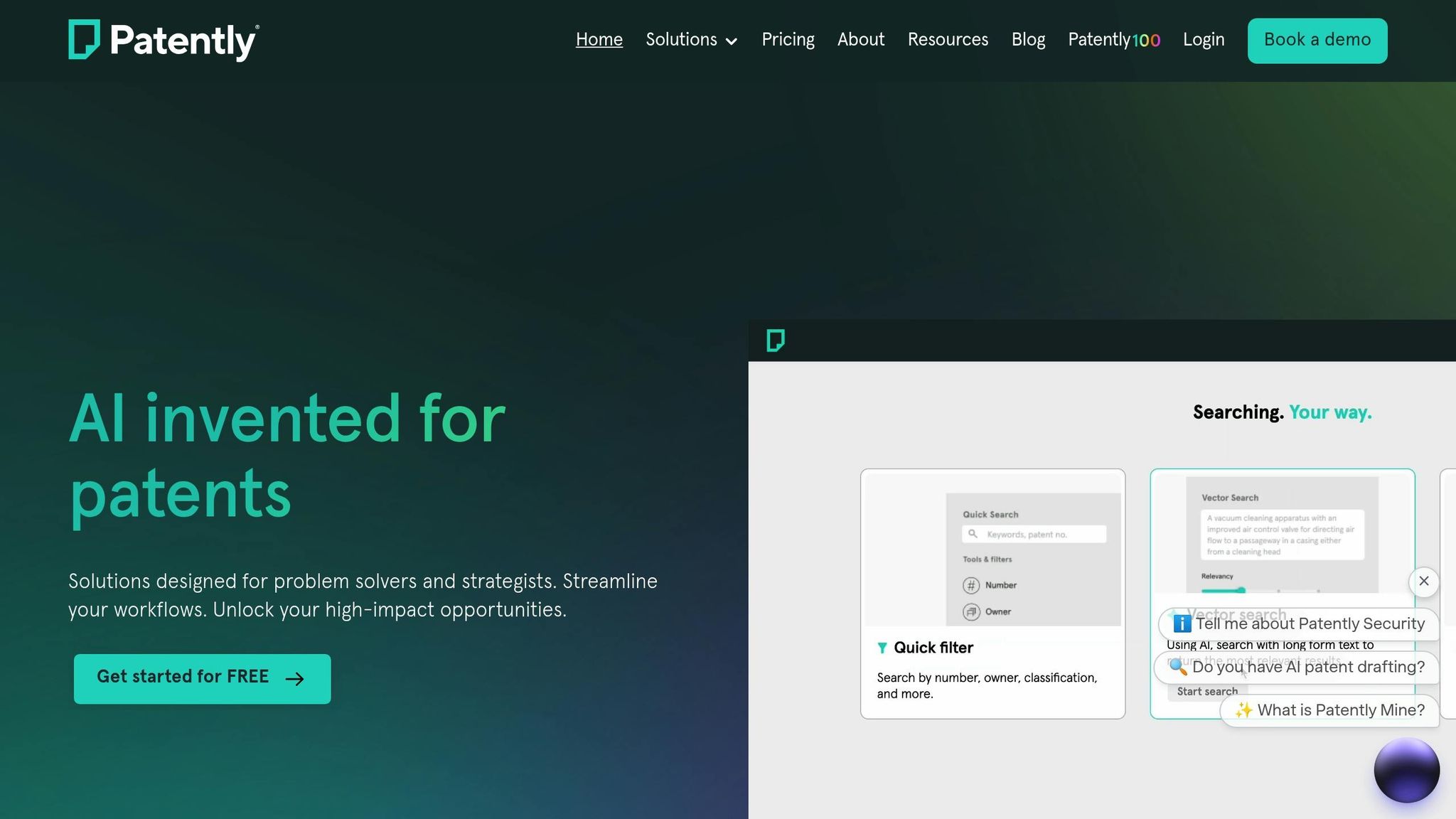
AI isn't just about spotting errors or monitoring in real-time - it’s also revolutionizing how projects and portfolios are managed. When it comes to patents, effective management demands teamwork, up-to-date data, and smooth workflows. That’s where Patently’s AI-powered platform steps in, offering a blend of automation and collaborative tools designed specifically for patent professionals.
Comprehensive Data Access and Real-Time Updates
Patently provides users with access to a massive dataset: 176 million individual assets and 80 million patent families collected from 166 patent offices worldwide. This database is fully indexed and refreshed every 30 days, ensuring decisions are based on the most current information available. Thanks to its cloud-based SaaS setup, the platform integrates AI with patent office data, making it easy to create, search, analyze, and manage patents - all from one interface. No more outdated data, no more guesswork.
Collaborative Workflow Management
Teamwork is at the heart of Patently’s platform. Its collaborative tools let users comment, rate, sort, and share information at both the patent family and individual asset levels. Projects can be organized by department, client, or case using hierarchical categories, while user access controls ensure sensitive information stays secure. This structured approach makes it easy for teams to work together while maintaining confidentiality.
Customizable Review Processes
Every organization has its own way of handling patent reviews, and Patently recognizes that. The platform allows teams to customize workflows for tasks like evaluating novelty, validity, freedom to operate (FTO), and competitor analysis. Junior team members can focus on research while senior professionals oversee critical decisions, creating a balance between efficiency and quality control.
Seamless Integration and Reporting
Patently doesn’t just stop at patent management - it simplifies reporting, too. By integrating with the MS Office suite, users can export branded reports in Word format, making it easy to share results with stakeholders. Controlled access for external parties like inventors, legal counsel, or business partners ensures that collaboration remains both secure and efficient. This integration eliminates manual data transfers, reducing errors and saving time.
Automated Project Management
One standout feature is Patently’s ability to automatically update projects with the latest data. This reduces the tedious administrative work often associated with patent management while ensuring accuracy remains a top priority.
"With Elastic, it's like having a patent attorney with decades of experience guiding every search." - Andrew Crothers, Creative Director at Patently
Scalable Pricing for Different Needs
Patently’s pricing starts at $125 per month per user, with advanced features available through custom plans. This flexible pricing model ensures organizations can improve their patent management without stretching their budgets too thin. Whether you’re a small team or a large enterprise, there’s an option that fits your needs.
7. Continuous Learning and Customization
AI's ability to learn continuously and adapt has taken patent quality control to the next level. Unlike traditional software that remains static, AI evolves over time by learning from user interactions, feedback, and organizational workflows. This shift moves patent management away from a rigid, one-size-fits-all model to a personalized system designed to meet specific needs.
Learning from User Behavior and Feedback
Modern AI tools track user interactions, from search queries to document reviews, and use this data to refine their performance. For example, when patent professionals consistently flag certain types of prior art as relevant or irrelevant, the AI adjusts its future searches to align with these patterns. These feedback loops ensure results match both organizational standards and expert expectations. Companies using machine learning for feedback analysis have reported a 25% increase in customer satisfaction. Tools like rating systems and detailed comments on AI suggestions play a crucial role in refining these systems.
Adapting to Organizational Workflows
Every organization has its own unique approach to patent management. Some prioritize speed in initial searches, while others focus on thorough prior art analysis. AI systems learn to recognize these preferences and adapt accordingly. For instance, if a team frequently requests broader semantic searches in specific technology areas, the AI will automatically adjust its parameters for similar tasks in the future.
AI also adjusts to the specific writing styles and terminology used within different teams or technology sectors. This customization addresses a common frustration - 74% of consumers express dissatisfaction when content isn’t tailored to their needs - a principle that applies equally to professional tools.
Real-Time Performance Optimization
AI systems don’t just improve over time; they also optimize their performance in real time. For instance, when a patent examiner marks an AI-suggested classification as incorrect, the system immediately updates its confidence levels for similar classifications. This real-time adjustment boosts efficiency, with studies showing that real-time analytics can increase profitability by 20%. In the world of patent management, this means faster prosecution timelines, shorter examination cycles, and better portfolio decisions informed by continuously refined insights.
Capturing and Preserving Institutional Knowledge
AI doesn’t just improve workflows - it also becomes a repository for your organization’s expertise. By embedding feedback from senior professionals, AI helps preserve institutional knowledge that might otherwise be lost due to staff turnover. Junior team members benefit from this accumulated wisdom, creating a more efficient and informed workforce. Research indicates that 85% of employees feel regular feedback enhances their performance and job satisfaction. AI systems create structured feedback loops, allowing experienced professionals to mentor both their colleagues and the technology itself.
Customizable Training for Specific Domains
AI platforms can also be trained on an organization's specific patent portfolio and prosecution history. This domain-specific training allows AI to grasp industry nuances, regulatory requirements, and competitive dynamics unique to the business. Instead of offering generic insights, the system delivers tailored recommendations that align with the organization’s strategic goals.
As patent laws evolve and new technologies emerge, AI continues to adapt, ensuring it remains a valuable tool rather than requiring constant overhauls. This ongoing evolution makes AI an increasingly effective partner in patent quality control, offering tools that grow smarter and more aligned with organizational needs over time.
Comparison Table
Here’s a breakdown of seven AI methods, evaluated for their impact on patent quality, time efficiency, ability to manage large portfolios, and their most effective use cases. This table builds on earlier discussions of AI-driven processes, showcasing how different methods excel in specific patent-related tasks.
AI Method | Patent Quality Impact | Time Savings | Large Portfolio Handling | Best Use Case |
|---|---|---|---|---|
Automated Prior Art Search | High – Reduces missed references by analyzing vast databases | 77% reduction in examiner search time | Excellent – processes thousands of patents | Initial patent research and examination support |
Smart Error Detection | Very High – Identifies compliance issues and drafting errors | 40–60% productivity gains reported by patent attorneys | Good – scales with document volume | Patent drafting and quality assurance |
Semantic Classification | High – Ensures consistent categorization standards | Moderate – reduces manual sorting time | Excellent – analyzes 4,000 patents in 3 days versus 2–3 weeks manually | Portfolio organization and technology mapping |
Real-Time Monitoring | High – Prevents deadline violations and status oversights | High – automates routine tracking tasks | Excellent – handles large patent volumes | Deadline management and portfolio oversight |
Data-Driven Analytics | Very High – Provides strategic insights for decision-making | Reduces analysis time from months to days | Excellent – handles complex multi-patent analysis | Strategic planning and monetization decisions |
Project Management | Moderate – Improves workflow consistency | High – streamlines administrative tasks | Very Good – supports team collaboration at scale | Team coordination and client management |
Continuous Learning | Very High – Adapts to organizational standards over time | Increasing – performance improves by 20% with real-time optimization | Excellent – learns from large dataset interactions | Long-term system optimization |
This comparison highlights how different AI methods address specific challenges in patent management. For instance, data-driven analytics significantly cuts down analysis time, transforming months of work into just days. Similarly, smart error detection has proven to boost efficiency, with patent attorneys reporting productivity improvements of 40–60% when using AI-assisted drafting tools. Meanwhile, continuous learning systems evolve over time, achieving a 20% performance improvement through real-time optimization.
For organizations managing portfolios of over 1,000 patents, semantic classification and continuous learning become critical, offering scalability without compromising quality. By combining automated prior art search with data-driven analytics, firms can tackle both initial research and strategic decision-making, creating a well-rounded approach to patent quality control and management.
Conclusion
AI has revolutionized patent quality control, transforming what was once a manual and time-intensive process into a streamlined, data-driven system. The methods discussed in this article highlight how AI can enhance every phase of patent management, from initial research to making strategic decisions about portfolios.
With automated prior art searches, examiners can significantly reduce their workload, while smart error detection tools help ensure drafts are thorough and defensible. Advanced semantic classification systems make it possible to process large patent datasets quickly, slashing the time needed for analysis when compared to traditional manual reviews. This efficiency directly feeds into smarter and more strategic portfolio management.
What makes AI particularly powerful is its ability to complement human expertise. By automating repetitive tasks, it allows professionals to focus on higher-level strategic decisions. AI tools can analyze enormous volumes of prior art, identify patterns, and interpret complex semantic relationships, all while leaving the control of the drafting process firmly in the hands of patent practitioners.
For those aiming to stay competitive, leveraging AI's capabilities provides a clear edge. It enables informed, data-driven decisions that align with shifting market demands and technological progress. To make the most of this, patent professionals should prioritize tools with proven reliability, strong security protocols, and customizable features, ensuring that the technology enhances rather than replaces their expertise.
As outlined, adopting AI early can reshape the patent landscape. It equips professionals with the precision and agility needed to navigate the ever-changing intellectual property space confidently.
FAQs
How does AI make prior art searches faster and more accurate in patent quality control?
AI has transformed how prior art searches are conducted by automating the review of massive patent databases and technical documents. With the help of machine learning algorithms, it can sift through vast amounts of information at lightning speed, pinpointing relevant prior art with impressive accuracy. This not only reduces the chance of human error but also saves a significant amount of time.
On top of that, AI tools are capable of analyzing invention disclosures and drafting patents with greater efficiency. This leads to a more thorough and dependable search process, ultimately refining the quality of patents. By streamlining workflows, cutting costs, and enhancing the precision of prior art evaluations, AI is reshaping the way the U.S. patent system operates.
How does AI help identify and fix errors in patent drafts compared to traditional methods?
AI is transforming how errors in patent drafts are identified and corrected. With advanced algorithms, it can pinpoint issues such as §112 errors, inconsistencies in claims, and structural problems. These tools deliver real-time feedback, streamlining the drafting process and minimizing the chance of errors slipping through.
Traditional methods often depend on manual reviews, which can be time-consuming and prone to human oversight. AI, on the other hand, brings a higher level of precision, speed, and uniformity. By automating the error detection process, it not only improves the quality of drafts but also frees up patent professionals to focus on more complex and strategic aspects of their work.
How can AI-powered data analytics improve decision-making in patent portfolio management?
AI-powered data analytics is reshaping how businesses approach patent portfolio management by offering practical insights into patent landscapes and market trends. These tools can pinpoint valuable patents, anticipate upcoming technologies, and refine strategies for filing, licensing, and even litigation.
With the ability to monitor patent activities and competitor moves in real time, AI equips companies to respond swiftly to market shifts and minimize potential risks. By tapping into these insights, businesses can make more informed, strategic choices to get the most out of their patent portfolios.