Top 7 Countries Leading in Carbon Capture Patents
Intellectual Property Management
Jun 25, 2026
US leads in patent impact while China dominates filing volume; seven countries each specialize across the carbon capture value chain.

If you want the short answer, it’s this: the United States, Japan, China, South Korea, Germany, the United Kingdom, and Australia lead this patent race, but they do not lead in the same way.
I’d boil the article down like this:
China leads on filing volume, with 24,101 patent families from 2005–2022 and about 68% of 2022 filings.
The United States leads on impact, with 6,076 patent families, strong citation data, and a top spot in DAC and sorbent-based work.
Japan stands out in solid sorbents and industrial CO2 recovery.
South Korea is one of the fastest-growing players, with a strong position in bio-based and marine-related work.
Germany leans into solvents, DAC systems, and process control.
The U.K. has lower filing volume, but strong research output and a policy-backed role in storage, DAC, and industrial decarbonization.
Australia matters less for raw filing count and more as a place where firms seek patent protection, especially for cement, mineralization, and storage.
The main point is simple: patent leadership depends on what you measure. If I look at total filings, China is far ahead. If I look at citation impact and patent reach, the U.S. looks stronger. And if I focus on narrow segments like sorbents, marine systems, or storage, other countries move up.
Part 2/4 press conference 'Patents and clean energy' study
Quick Comparison
Country | Main Strength | What Stands Out |
|---|---|---|
United States | DAC, absorbents, adsorbents | Top impact, strong policy support, deep private-sector activity |
Japan | Solid sorbents, industrial CO2 recovery | High citation quality, heavy-industry focus |
China | Filing volume, plant-level systems | Huge domestic filing base, AI-linked control systems |
South Korea | Bio-based and marine-related work | Fast filing growth, shipbuilding link |
Germany | Solvents, DAC equipment, system control | Strong chemistry base and process focus |
United Kingdom | Research, storage, DAC | Lower filing count, strong publication output |
Australia | Cement use cases, mineralization, storage | Common filing destination for global firms |
So if you’re reading this to see who is “winning,” my take is: there is no single winner across every CCS segment. The field splits between high-volume countries and specialist countries, and that split shapes where patent activity is heading next.
How This Ranking Works
This list includes both high-volume filers and high-impact innovators for a reason. The ranking looks at priority-filing volume, patent family breadth across jurisdictions, and citation impact and H-index - not application counts alone.
That distinction matters. Volume and quality don't always move together. China leads in total CCUS patents, while the U.S. leads in citations and H-index.
Patent family strength also says a lot about market intent. When a company files across multiple jurisdictions, it's often a sign that it wants reach beyond its home market. Firms like Mitsubishi and Baker Hughes put more effort into international protection across multiple jurisdictions, while some large Chinese filers put more weight on domestic coverage.
Specialization can also change the picture. A country may have a smaller total patent count but still rank well if its CCS work is concentrated in areas like Direct Air Capture or geological storage.
There’s also a timing issue with patent data. It usually lags by 18–24 months, so this ranking puts its main focus on filings from 2004–2024, with extra weight on 2019–2023. Using those criteria, the ranking begins with the United States.
1. United States
The U.S. ranks first on this list, with 6,076 patent families filed between 2005 and 2022.
That lead is easiest to see in capture patents. U.S. patentees span the CCUS value chain, but capture tech stands out as the country's main strength. In 2023, the U.S. accounted for about 38% of all CO₂ absorbent-related patent filings across the five major innovator regions. The country is also one of the top two global leaders in Direct Air Capture (DAC) filings, alongside China.
The groups behind this range from major energy companies to more specialized firms. ExxonMobil has been identified as a dominant global player in absorption- and adsorption-based capture over the last decade. In August 2023, Occidental Petroleum acquired Carbon Engineering for $1.1 billion to deploy large-scale DAC tech at a Texas facility designed to capture 500,000 metric tons of CO₂ per year.
Policy has helped keep that momentum going. The Inflation Reduction Act of 2022 expanded the 45Q tax credit and is expected to drive future growth in patent activity using specialized tools.
Even with more competition around the world, the U.S. still sets the pace in DAC and sorbent-based capture.
2. Japan
Japan filed 1,140 CCS-related patents in 2021, which put it third worldwide. It also posted a strong citation impact, with an H-index of 25. So while Japan’s CCS portfolio is narrower than the U.S. mix, its filings still carry weight.
Japan’s clearest edge is solid-sorbent capture. In 2023, Japan and the United States ranked as the top two countries for CO₂ adsorbent patent filings. Japan has also helped push the global move toward adsorbent-based methods. That shift is easy to see in the numbers: worldwide, adsorbent-based filings now outnumber liquid absorbent-based filings by 2.5 to 1.
A lot of this patent activity comes from firms tied to heavy industry and power generation. The Mitsubishi Group is the world’s top CCUS patentee, with 164 patent families and 1,191 citations as of late 2022. Its work centers on industrial CO₂ recovery for steel and power production. Kansai Electric Power Company stands out on patent influence, leading top global patentees in citation rate at 12.02 citations per patent.
That gives Japan a pretty clear lane. Its strength sits in industrial point-source capture, not in the broader DAC work seen in some other countries. The result is a patent profile that looks more focused than the countries that come next.
3. China
If Japan stands out for tight focus, China stands out for sheer scale.
China leads this field by volume. From 2005 to 2022, it filed 24,101 carbon-capture and storage patent families. That’s far ahead of the United States, with 6,076, and Canada, with 3,387. In 2022 alone, China accounted for 3,555 patent filings out of 5,267 global filings. That works out to nearly 68% of all filings that year. The jump points to strong climate policy, state funding, and a clear industrial IP push.
A big part of that story is Sinopec. The company holds about 600 patent families, and 83% of them are still active. Huaneng CERI has nearly 300, with its filing activity hitting a high point in 2020–21. In August 2022, Sinopec completed the Qilu-Shengli Oilfield million-tonne CCUS demonstration project, which serves as a main use case for much of its patent work.
But this isn’t just a numbers game. China’s patent mix is also moving toward plant-level control and system coordination. Recent filings from groups such as the State Energy Group New Energy Technology Research Institute and Guangdong Power Grid focus on AI-based control systems. This trend mirrors the rise of generative AI patent tools currently reshaping how such complex filings are managed. These systems adjust capture rates in real time based on plant loads and grid frequency. That kind of work shows a shift from basic capture hardware to the day-to-day job of running CCUS inside large power and industrial systems.
There’s movement in another area too: ship emissions capture. In 2025, Hudong-Zhonghua Shipbuilding filed a patent that uses boiler waste heat to capture CO₂ from ship diesel exhaust.
Even with all this activity, most Chinese patent families remain domestic, with limited filing outside China. Questel’s Sarah Fguira ties the filing surge to emissions pressure and industrial policy. That helps explain why China’s patent count is so high, while its reach across other patent offices is still more limited.
4. South Korea
South Korea sits in an interesting middle ground between China’s sheer scale and Japan’s more targeted approach. But it has carved out its own place in CCS through specialization. In 2023, it became the second-largest source of new global carbon capture patent filings. It also ranks fourth overall in cumulative CCUS patent applications, with 615 patents and an H-index of 16.
That position comes from doing a few things very well, not trying to do everything at once.
South Korea stands out most in a couple of niches. As of 2023, it accounts for about 50% of new biological capture filings among major global regions, which puts it clearly out front in that area. It also ranks just behind the U.S. and Japan in adsorbent-based capture, showing that its patent base has depth across more than one capture path. That focus is backed by heavy filing activity from both companies and research groups.
Hanwha Ocean and Samsung Heavy Industries make up a big share of the industrial filing base, which fits South Korea’s push in maritime and heavy-industry capture. KIGAM is a major filer in CO₂ capture and utilization for cement, with work centered on mineralization and building materials. Korea Electric Power Corp. also ranks among the top 20 global CCUS patentees. Put together, those names show why South Korea’s patent portfolio looks focused rather than broad.
South Korea has a smaller DAC portfolio and puts more of its effort into point-source capture and biological methods. The country has also set a goal to capture and store 1 billion metric tons of CO₂ by 2030, which helps explain the jump in filings since 2019.
5. Germany
Unlike South Korea, which leans hard into a narrower set of niches, Germany brings a broader CCUS mix. Even so, chemistry still sits at the center. Germany ranks fifth for annual CCUS patent filings, with 131 patents in 2021 and 230 total CCUS patents. Its H-index is 18, and it averages 4.84 citations per patent.
A lot of that strength shows up in chemical absorption and Direct Air Capture (DAC). BASF is a major name on the absorbent side, with work on amine blends and phase-changing solvents that lower the energy needed for CO₂ regeneration. On the DAC side, Robert Bosch and Siemens Energy were among the top global DAC filers in 2023. That says a lot about where Germany is placing its bets: not just on lab chemistry, but also on DAC equipment and systems.
Linde AG adds to that picture as a major filer in adsorbent-based capture. Its work uses porous materials like zeolites and MOFs to trap CO₂. German patentees are also active in methane and nitrous oxide capture, which gives the portfolio more range than a CO₂-only play.
German-based entities are also pushing active emission control, tying CCS systems into grid management to support the grid itself. That blend of chemistry, DAC, and grid-linked systems helps Germany stay ahead of peers that are more narrowly focused.
6. United Kingdom
The U.K. files fewer CCUS patents than some other countries, but its research output tells a different story. Analyzing these trends is easier with AI-enabled patent platforms. In a 2023 patent study of 11,915 patents, the country ranked 10th for CCUS priority filings while still staying among the top three for academic publications. That points to a clear split: the U.K. punches above its weight in research, even if filing volume is lower.
Part of that split comes down to policy. The U.K.'s legally binding 2050 net-zero target and its £20 billion CCUS commitment have helped turn the country into a policy-backed filing hub and a draw for patent activity.
A lot of that filing activity comes from foreign companies rather than local players. Mitsubishi Heavy Industries stands out here, which shows the U.K.'s role as a deployment market. By contrast, domestic filings peaked around 2010 and have stayed flat since.
You can also see that policy support in the kinds of CCUS work tied to the U.K. It spans capture, transport, and storage, with strong activity in non-CO₂ greenhouse gases, BECCS, DACCS, and North Sea storage.
7. Australia
Australia ranks seventh not because it leads in filing volume, but because it matters as a key jurisdiction for CCS patent protection. For many international CCS patentees, it’s a smart place to file.
One area stands out: carbon capture and utilization for cement and building materials, especially mineralization. Australia ranks among the top countries for patent protection tied to CO₂ capture and utilization in the cement sector, and more of that work is now focused on using captured CO₂ in building materials.
You can see that interest in who files there. The Mitsubishi Group and Baker Hughes both treat Australia as one of their core filing jurisdictions. General Electric has also filed patents in Australia that cover system interoperability across capture, compression, and transport. That pattern comes through clearly in the comparison table below.
Country Comparison at a Glance
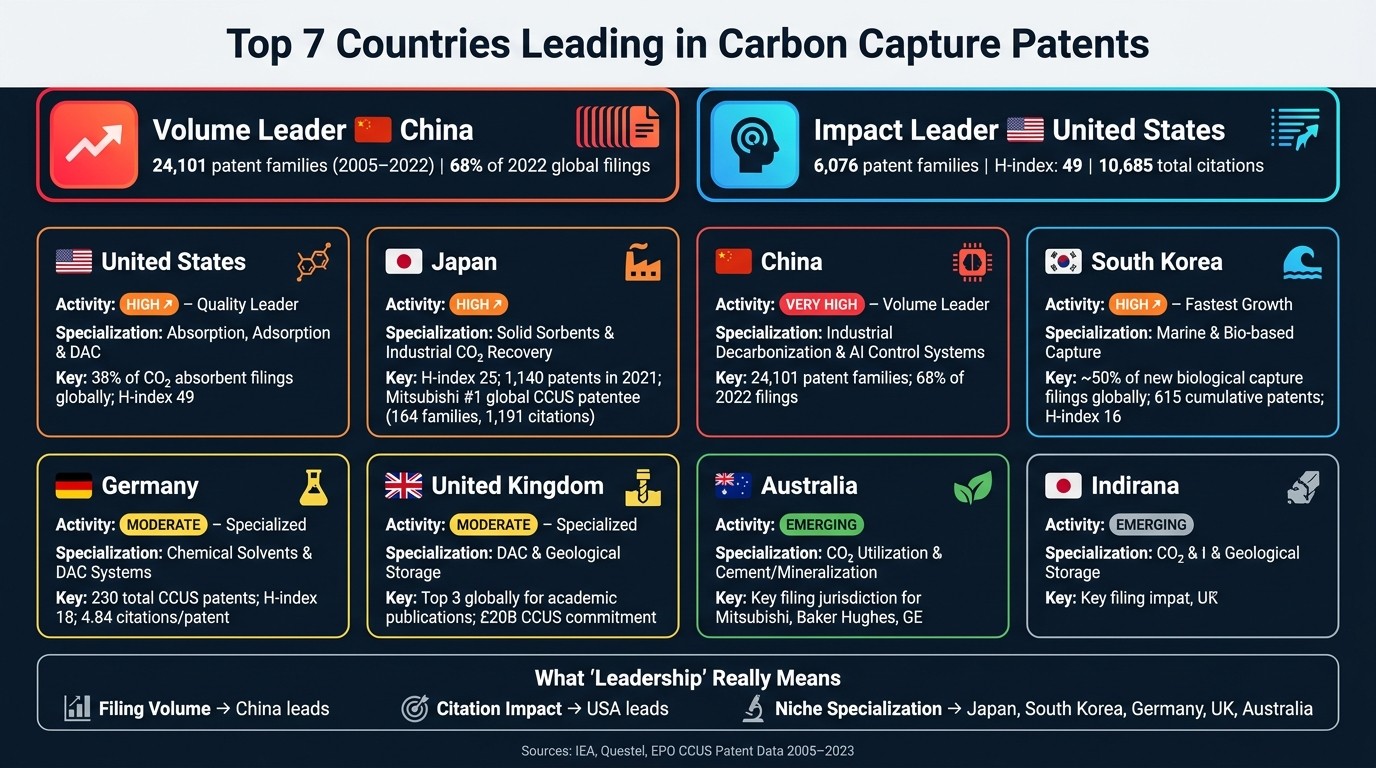
Top 7 Countries Leading in Carbon Capture Patents: Volume vs. Impact
The snapshot below splits the field into volume leaders and niche specialists. To keep things simple, the table looks at each country through three lenses: activity, specialization, and main use case.
Country | Patent Activity | CCS Specialization | Key Themes |
|---|---|---|---|
United States | High - quality leader | Absorption/Adsorption & DAC | Pipeline infrastructure, solvents, DAC |
Japan | High | Solvents & Materials | Steel and power CO2 recovery, cement, solid sorbents |
China | Very high - volume leader | Industrial Decarbonization & DAC | AI-driven control systems, marine capture, energy integration |
South Korea | High - fastest growth | Marine & Bio-based Capture | Shipbuilding capture, bio-trapping, point-source capture |
Germany | Moderate - specialized | Geological capture and storage & Solvents | Chemical solvents (amines), BECCS/DACCS integration, non-CO2 greenhouse gases |
United Kingdom | Moderate - specialized | Direct Air Capture & Geological | DAC infrastructure, geological carbon removal, industrial decarbonization |
Australia | Emerging | CO2 Utilization & Storage | Cement-related capture, building materials, geological sequestration |
Two patterns stand out.
China leads on sheer volume, with an H-index of 25. The United States leads on impact, with an H-index of 49 and 10,685 total citations.
South Korea is the fastest riser in this group. That growth comes largely from its shipbuilding base and its strong position in bio-based capture patents.
Conclusion
Carbon capture work is spread across seven leaders, and each one leads in a different part of the value chain. Put simply, this isn't a winner-take-all market. The rankings show a split between countries that lead on sheer scale and countries that stand out in tighter areas.
China and the United States lead on volume. Japan, South Korea, Germany, the U.K., and Australia stand out in more focused areas like capture chemistry, marine systems, biological capture, and storage. That blend of broad reach and narrow strength is shaping where future patents are likely to cluster.
Global CCS patent activity has climbed fast since 2018, and the IEA and IPCC still frame carbon capture and storage as important for 1.5°C pathways. For patent teams, that shifts CCS strategy toward two things: pace and focus. The main takeaway is simple: track both volume and specialization, because leadership in CCS depends on the sub-technology, not just the filing count.
FAQs
Why does the U.S. rank first if China files more patents?
Because rankings often matter more than filing volume alone. China leads in total filings, but many analysts split domestic-only filings from international filings. Why? International filings can say more about who’s trying to compete and sell on the global stage.
The U.S. also holds a bigger share of granted, established patents, while China’s totals include many pending applications and university-led research. On top of that, long-term policy support, including the 45Q tax credit, has helped keep U.S. innovation moving.
What makes a carbon capture patent high-impact?
A carbon capture patent is seen as high-impact when it points to strong R&D and meets demand for emissions-cutting technology.
In plain English: it’s not just a technical filing sitting on a shelf. It usually signals commercial upside beyond lab or plant use, aims for international protection to support global rollouts, and fits with climate targets, policy incentives, industrial capacity, and the stage the technology has reached.
Patently can help professionals spot these patterns through semantic search and SEP analytics.
Which countries lead in DAC, storage, and marine capture?
China and the United States lead global patent filings for direct air capture (DAC) and carbon capture as a whole.
The United States remains a major DAC innovator, backed by strong R&D and policy support like the 45Q tax credit. That mix matters. Good lab work is one thing, but incentives help move ideas closer to deployment.
China is also a leading DAC innovator and is putting more effort into securing patent protection outside its home market. In plain terms, it’s not just filing at home. It’s also looking outward.
South Korea plays a stronger role in the broader carbon capture space than in DAC itself. Its edge shows up most in industrial uses and shipbuilding, where it has built deep know-how.