Case Studies: ESG Patent Success Stories
Intellectual Property Management
Jul 10, 2026
Assess ESG claims with green patent share, patent quality, and commercial proof—investor checklist across food, solar, and cleantech.

Patents can tell you if an ESG story has teeth. If I were screening companies today, I’d look past press releases and check three things first using top patent tools: green patent share, patent quality, and proof that the IP supports products or licensing.
Here’s the short version:
Patent mix matters more than patent count. A 1 percentage point increase in green patent share is tied to a 0.717% drop in total carbon emissions.
Disclosure alone is not enough. After climate reporting pressure goes up, I’d want to see green filings move up too.
Quality beats volume. Weak patents can fail when tested, while patents tied to products already in market can support far more value.
Commercial proof matters. Process patents, licensing deals, cross-licenses, and factory scale-up plans are stronger signals than broad ESG language.
Sector context matters. Food, solar, and software each use IP in different ways, but the investor test stays about the same.
If I had to boil the article down to one idea, it would be this: ESG patent success shows up when a company’s claims, R&D activity, and market execution all line up.
A few numbers stand out:
U.S. green patent grants grew 300% from 2009 to 2019
Japan’s GX patent share moved from 14.507% in 2014 to 20.253% in 2024
In FY2024, about 70% of challenged patents that reached a final PTAB decision lost every instituted claim
So when I read these case studies, I don’t see “good ESG messaging.” I see a simple investor checklist:
Is the company filing the right kind of patents?
Are those patents strong enough to hold up?
Do they support scale, revenue, or lower legal risk?
That’s the lens for the full piece.
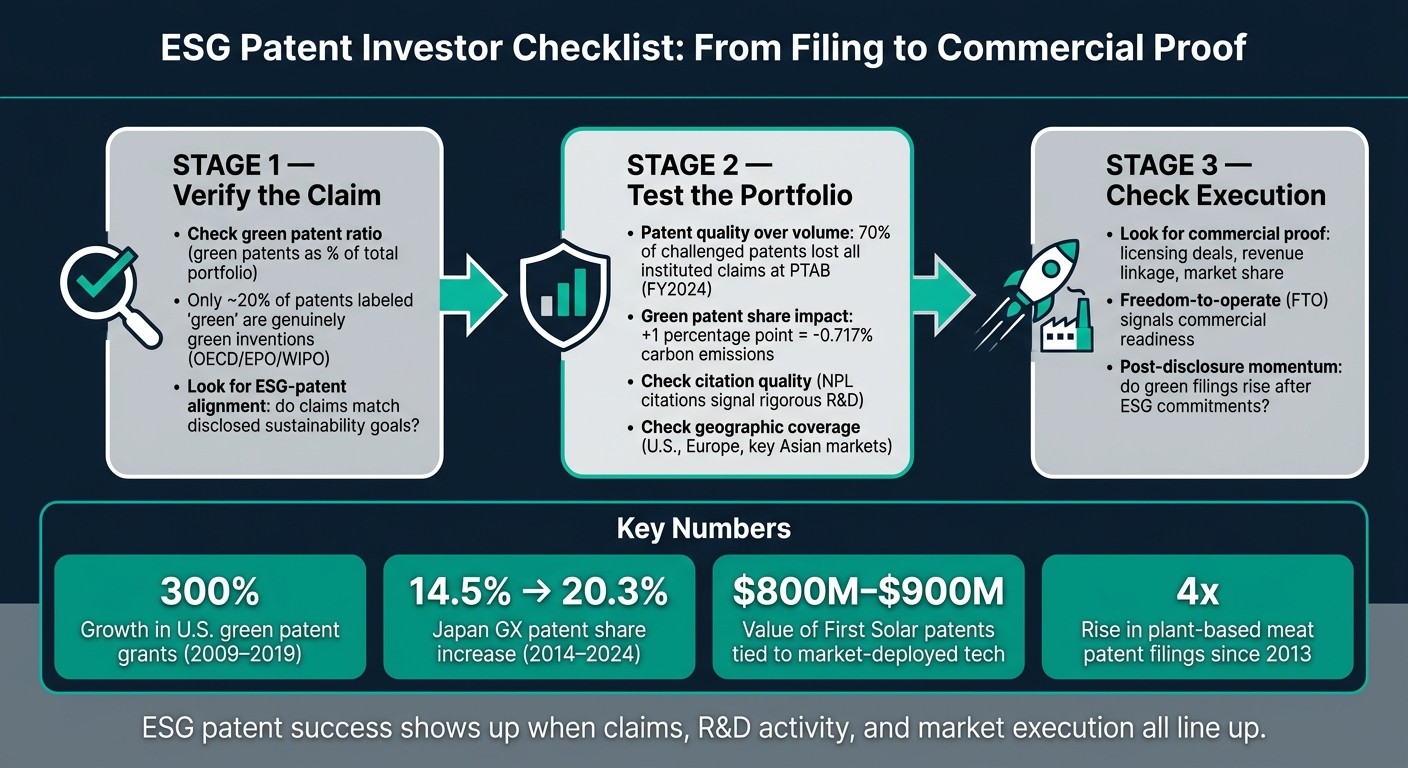
ESG Patent Investor Checklist: From Filing to Commercial Proof
Case Study 1: Sustainable Food Patents and Investor Signaling
Plant-based food is a clear ESG patent case. Investors can check whether a company’s sustainability story is backed by IP that can hold up under pressure.
Patent Strategy in Plant-Based Food Innovation
Top plant-based food companies don’t just patent a recipe. They build portfolios that cover ingredients, biological inputs, purification methods, and manufacturing. That broader reach makes it harder for others to copy what they’re doing and helps protect the business across the full production stack.
Impossible Foods holds more than 300 IP assets, including 97 granted patents across 15 families. Its core innovation uses heme made through precision fermentation to mimic the taste and aroma of cooked meat. That work is protected as both a product and a process. And that matters. When a patent protects how something is made, not just what ends up on the plate, the moat usually gets stronger.
Coverage across U.S. and European patent families also signals commercial intent and plans to operate across borders.
What Investors Can Measure in This Category
Investors should look at three things: portfolio depth, geographic reach, and whether the IP supports manufacturing at scale.
Solar Foods is a good example of process IP tied to scale. In April 2026, the Finnish company received a U.S. patent for its "Solein" protein production process, which makes protein from CO₂, hydrogen, and electricity through gas fermentation. That patent supports Factory 02, which is built to increase annual output from 160 tonnes to 6,400 tonnes. That’s the kind of protection investors want to see before backing major capex and long-term supply deals.
Dimension | Strong Patent Coverage | Weak Patent Coverage |
|---|---|---|
Portfolio Depth | Layers composition, processing, and upstream biology | Limited to a single formulation or recipe |
Geographic Strategy | International families covering the U.S., Europe, and key Asian markets | Filings restricted to one domestic territory |
Scalability Signal | Patents cover industrial-scale processes such as gas fermentation | Concept-stage IP with no protected manufacturing path |
ESG Alignment | IP directly supports lower land, water, and emissions footprints | ESG claims lack technical or proprietary backing |
Market Entry | Clear freedom-to-operate or novelty with potential licensing upside | Exposure to infringement disputes and delayed commercialization |
Patent filings in plant-based meat have risen four-fold since 2013. Still, raw filing volume only tells part of the story. What investors care about is whether those claims are built for scale, protected across key markets, and tied to a production path that can move from idea to output.
The next case study shows how disclosure pressure can shift patent behavior just as clearly as product innovation can.
Case Study 2: Green Patenting After Environmental Disclosure Pressure
When disclosure expectations go up, patenting becomes a much tougher test of ESG claims. It’s one thing to publish targets. It’s another to show that money, time, and R&D are moving in the same direction. This case shows that disclosure pressure can push firms to spread into greener patent positions. Japan makes that pattern easy to see at the portfolio level.
Before-and-After Patterns in Green Innovation
Japan offers one of the clearest examples. As the country moved from voluntary sustainability reporting toward mandatory climate disclosures aligned with ISSB standards, listed manufacturing firms showed higher green patent intensity over time. GX patents rose from 14.507% of total patents in 2014 to 20.253% in 2024. That change shows green innovation moving out of the sidelines and into core R&D. For investors, it points to a broader ESG technology base that may hold up better under pressure.
The U.S. shows a similar pattern around a policy event. Following the 2018 America's Water Infrastructure Act (AWIA), the link between green innovation and stock price informativeness strengthened in a clear way. Researchers at the Stuart School of Business describe green patents as costly, externally verified signals of capability and preparedness.
For investors, the message is pretty direct: when a regulatory shock lands, companies that had already been building green patent portfolios looked better prepared in the market’s eyes. Their patents weren’t just legal shields. They also gave the market something firmer to price.
How Investors Combine Disclosure Data with Patent Data
Investors should look at green patent share alongside filing momentum after disclosure events. Research shows that a 1 percentage point increase in the share of green patents within a company’s total portfolio is linked to a 0.717% reduction in total carbon emissions. So a 500-patent portfolio with 10% green coverage suggests less transition depth than a 200-patent portfolio with 40% green coverage.
More investors are watching for a simple follow-through test: does green patent activity pick up after a company makes public ESG promises? If a company announces big decarbonization targets but its green patent ratio stays flat, that gap deserves a hard look. On the other hand, rising green filings after a major disclosure event make the transition story more believable. Investors can test this by comparing filing timing, patent share, and citation strength before and after disclosure changes.
Signal Type | What to Track | Why It Matters |
|---|---|---|
Green Patent Ratio | Green patents as % of total portfolio | Stronger predictor of emission reductions than raw count |
Post-Disclosure Momentum | Filing rate change after ESG commitment | Helps verify whether public targets are backed by R&D activity |
Citation Quality | Forward citations on green patents | Helps gauge technological significance and innovation durability |
When disclosure data and patent momentum move together, investors get a more believable transition signal. When they split apart, that mismatch deserves scrutiny. The next case study looks at how patent quality - not just disclosure pressure - shapes cleantech outcomes.
Case Study 3: Cleantech Portfolios, Patent Quality, and Market Outcomes
In cleantech, patent quality matters more than raw filing volume when investors look for value.
Why Patent Quality Matters More Than Filing Volume
PTAB challenge outcomes make this pretty clear. In FY2024, about 70% of challenged patents that reached a final decision lost every instituted claim. That’s a blunt reminder that weak claims can fall apart once they’re tested. For investors, the main question isn’t how many patents a company filed. It’s whether those patents protect products and revenue, not just lab work.
The solar sector shows this in a very direct way. Between 2024 and 2025, First Solar asserted patents US 9,130,074 and US 9,666,732 against Adani Solar. Those patents were valued at $800 million to $900 million because they covered TRL 8–9 technology that was already in market use. That changes the math. Patents tied to higher-TRL technologies also tend to get lower discount rates in valuation models - about 10% to 12% versus 18% to 22% for early-stage lab assets - because they are tied to commercial deployment and lower execution risk.
Geographic coverage adds another layer. Prior art is concentrated outside the U.S., especially in Asia, which can increase the risk for broad claims that look fine at first glance but carry hidden validity problems.
Freedom to operate (FTO) is another signal investors should watch because it points to commercial readiness. BluWave-AI built 60 international filings and 14 grants, then launched a licensing unit in April 2026 so enterprise customers could license the software for internal deployment with lower FTO risk. That move wasn’t just about legal housekeeping. It made adoption easier for buyers that didn’t want to step into a patent fight.
Portfolio Strategy Models: Proprietary, Pooled, and Collaborative
Patent quality also shows up in portfolio structure: who controls the IP, who can license it, and how easily the company can grow.
Lightyear, now Atlas Technologies B.V., built a proprietary portfolio of 60 patent families around motors, inverters, and solar panels. That portfolio helped the company raise about $200 million. Then the market turned. When funding dried up in January 2023, the same IP gave the company room to shift course - from making solar cars to supplying components and licensing its technology.
On the shared-IP side, JA Solar and Astronergy reached a global settlement and cross-licensing agreement in December 2025 over TOPCon patents. That let both sides step back from costly multi-jurisdictional litigation in the Unified Patent Court. In February 2026, Aiko Solar entered a global licensing agreement for Maxeon’s back contact solar cell and module technology patents outside the U.S. The deal ended multiple infringement cases in Europe and gave Aiko a cleaner route to commercialize its BC roadmap.
The pattern is hard to miss. Proprietary IP can help a company pull in capital and keep its options open. Cross-licensed and pooled IP can cut dispute risk and open markets that might otherwise stay blocked.
Strategy Model | Commercialization Speed | Deal Complexity | Capital Attraction | Investor Risk |
|---|---|---|---|---|
Proprietary (Standalone) | Slower (requires full scaling) | Low (internal control) | High (exclusivity) | High (execution risk) |
Cross-Licensing/Pooled | Faster (removes legal barriers) | High (negotiation-heavy) | Medium (shared market) | Lower (de-risked FTO) |
Collaborative/Open | Fastest (rapid adoption) | Medium (standardization) | Lower (per-unit) | Lowest (market stability) |
Early-stage cleantech often gets more mileage from proprietary control. In mature markets, cross-licensing or pooled deals can make more sense because they reduce litigation and speed commercialization. That ownership setup then feeds into the investor workflow in the next section.
Investor Takeaways and IP Analysis Workflow
A Framework for Assessing ESG Patent Diversification
The three case studies land on the same point: ESG patent portfolios work best when breadth, disclosure quality, and proof of commercialization move in step. That turns the cases into a practical investor workflow: verify the claim, test the portfolio, then check execution.
The pattern is pretty clear. Sustainable food patents showed that commercialization is what turns filings into business value. Disclosure pressure showed how to read momentum. Cleantech showed that quality matters more than raw volume. Put those signals together, and investors get a steadier way to spread ESG exposure across sectors and technologies.
Start with the green patent ratio. It tells you more than total filing volume on its own. Then look one layer deeper: are those filings actually environmental, or just labeled that way? Only about 20% of patents classified as green under OECD, EPO, or WIPO standards count as genuinely green inventions that directly affect environmental efficiency.
Due Diligence Check | What to Look For |
|---|---|
ESG-patent alignment | Claims match disclosed sustainability goals |
Patent quality | Claim strength, citation quality, and defensibility |
Theme relevance | Tied to decarbonization, efficiency, or resource use |
Proof of commercialization | Licensing, revenue linkage, or market share gains |
Disclosure consistency | Stable narrative across annual ESG reports |
Using AI Tools to Organize ESG Patent Research
Once investors know what to check, AI can help them screen portfolios much faster. Manual patent review starts to fall apart when you're mapping hundreds of filings to specific ESG themes. AI-assisted semantic search helps by finding ESG-relevant inventions based on meaning, not just IPC classification codes.
Citation analysis also helps teams spot stronger filings. Patents that cite non-patent literature (NPL), such as peer-reviewed science, often point to more rigorous, science-heavy R&D. Patently supports this workflow with AI-assisted semantic search, citation browsing, and team project management.
Semantic gap analysis is another useful check. It helps investors find ESG claims that don't have patent support behind them. That's a risk flag. It may point to greenwashing, or it may simply mean the R&D pipeline hasn't caught up with public commitments yet.
Conclusion: What These Case Studies Show
Taken together, these cases show that ESG patent value comes from measurable alignment, not just a dense story. Investors and IP teams that use a structured, repeatable workflow to assess patent quality, disclosure momentum, and commercialization outcomes will have a better shot at separating genuine sustainability execution from surface-level claims.
FAQs
How do I measure green patent share?
First, define the scope of green innovation by mapping patents to established taxonomies such as the EPO’s Y02 classification, the IPC Green Inventory, or OECD Env-Tech standards.
Then calculate the share of green patent filings or holdings against your total patent portfolio.
Patently can help identify and categorize these assets with AI-powered semantic search and Vector AI.
What makes an ESG patent high quality?
A strong ESG patent gives companies a clear, objective way to show environmental commitment without leaning on the vague claims that often fuel greenwashing.
What makes a patent stand out? A few signals matter most: technological novelty, clear ties to frameworks like the U.N. Sustainable Development Goals, and the potential for measurable impact.
Tools like Patently can help spot high-impact technologies and make sustainability alignment easier to show in a transparent way.
How can I tell if patents support revenue?
Track actual deployment and line up patent data with your financial accounts. Then connect specific patents to measurable ESG outcomes, like lower carbon emissions, energy savings, or less waste, so you can confirm the link to revenue.
Patently can help manage patent lifecycles, spot high-potential assets, and track market activity for licensing opportunities. For investors, support disclosures with lifecycle assessments or third-party validation to show economic impact in practice.