How AI Automates Prior Art Identification
Intellectual Property Management
Aug 8, 2025
AI revolutionizes prior art identification in patent applications, streamlining searches and enhancing accuracy through advanced technologies.
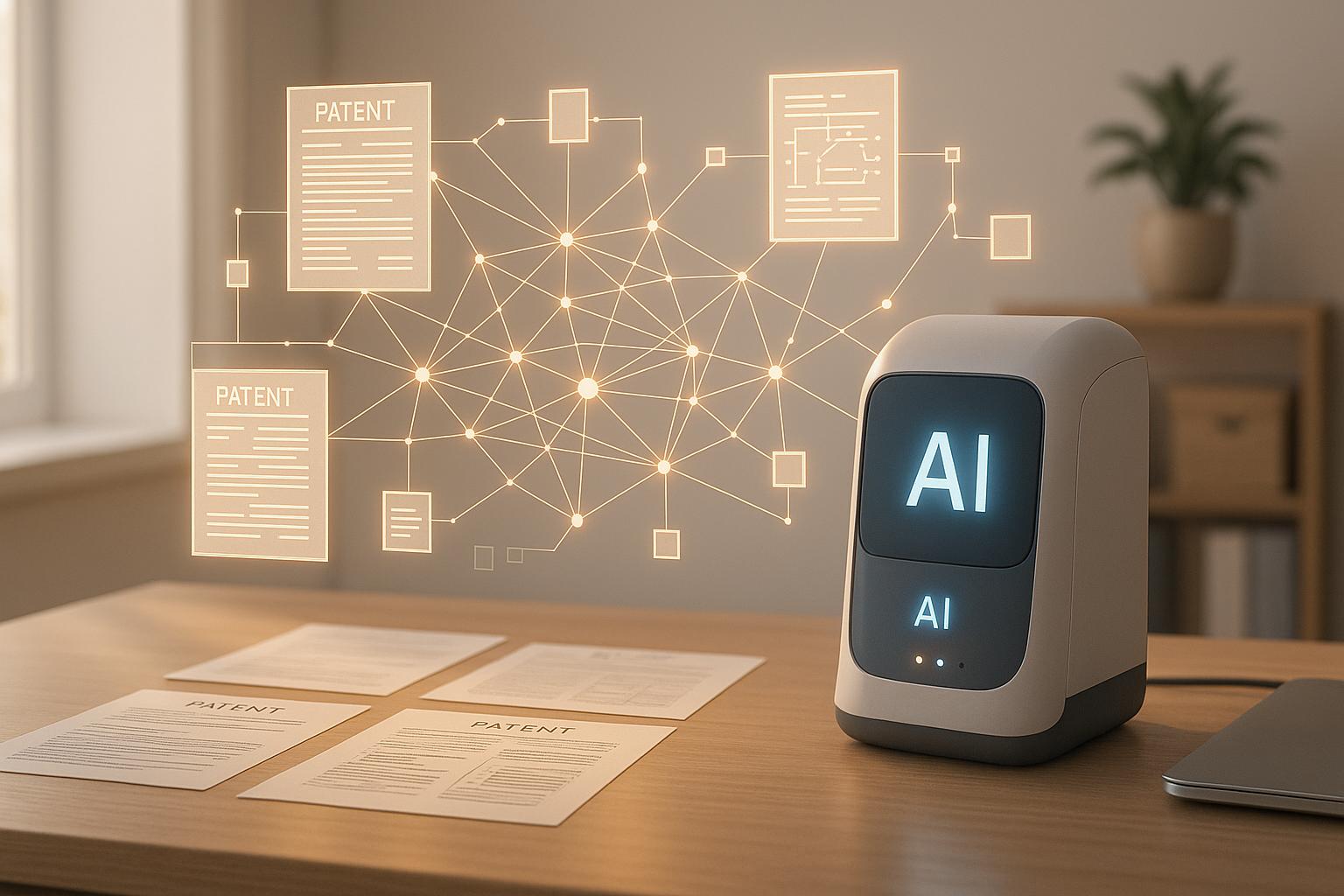
AI is transforming how we identify prior art in patent applications. Here’s the deal: Prior art is any evidence showing an invention was publicly available before a patent’s filing date. Finding it manually is tedious, error-prone, and time-consuming. AI changes the game by analyzing millions of documents in seconds, understanding context, and breaking language barriers.
Key points:
What’s prior art? Published papers, patents, products, or public demonstrations that predate your invention.
Why it matters: It determines if your idea is novel and patentable.
Manual searching issues: Keyword limitations, language barriers, and missed references.
How AI helps: Speeds up searches, understands context, analyzes visuals, and ensures global coverage.
AI leverages machine learning, natural language processing, semantic search, and image recognition to streamline the process. While it boosts efficiency and accuracy, expert review remains essential for legal and strategic decisions. This hybrid approach is reshaping patent research.
AI-Powered Patent Search: Find Prior Art Faster & Smarter with IP Author
AI Technologies That Power Prior Art Identification
The shift from manual to automated prior art searches hinges on three key AI technologies working together. These tools address longstanding challenges in traditional search methods, making the process faster and more precise.
Machine Learning and Natural Language Processing
At the heart of AI-driven prior art searches are machine learning (ML) and natural language processing (NLP). These technologies tackle the "vocabulary problem" that often complicates traditional Boolean searches - where the same concept might be described in multiple ways. For example, ML algorithms can identify that terms like "wireless communication device", "mobile handset", and "cellular apparatus" all refer to similar technologies.
NLP dives deep into the language patterns within patent texts, helping to identify relevant prior art even when different terminology is used. Meanwhile, ML continuously improves its ability to detect subtle similarities between patents by learning from vast datasets. As a bonus, these systems can uncover patterns that might escape human searchers, such as consistent terminology within specific technological fields.
The results speak for themselves: AI-powered patent search platforms can boost efficiency by as much as 80%.
Semantic Search for Better Accuracy
Semantic search takes things up a notch by moving beyond keyword matching to truly understand the context of a query. Instead of simply counting how often a word appears, this approach interprets the meaning behind the phrases. For example, it can link terms like "battery technology", "energy storage systems", and "power cells", even if the exact words don’t match.
To achieve this, semantic search engines use knowledge graphs to map relationships between concepts and entities. This makes them particularly effective for complex or ambiguous queries, uncovering connections within prior art that traditional methods might miss. Some systems can even match conceptually similar patents across databases containing millions of documents, making them a powerful tool for researchers. While this approach may sacrifice some transparency in how results are generated, its ability to reveal hard-to-find yet relevant information is invaluable.
Image Recognition for Patent Drawings
Patent drawings often hold critical details that text-based searches can overlook. That’s where AI-powered image recognition steps in. By analyzing diagrams and visuals, these tools can identify similar concepts that might otherwise go unnoticed. Using a combination of computer vision, language models, and rule-based logic, these systems can transform sketches or CAD files into refined drawings for analysis. They also categorize images - such as graphs, circuit diagrams, or technical illustrations - and even recognize different viewing angles.
One standout feature is text-to-drawing translation, where AI can generate visual representations from natural language descriptions, inferring layouts and process flows. Another is query-by-image searches, which allow users to upload a patent drawing and find visually similar documents in the database. This is especially useful for mechanical inventions, circuit designs, or processes where visuals are key.
Looking ahead, AI advancements may include tools like semantic figure editing and adaptive modeling, along with tighter integration with prior art databases to automatically flag visual similarities or redundancies.
These AI technologies collectively pave the way for an automated and precise approach to prior art identification, setting the stage for the next steps in this evolving process.
Step-by-Step Guide: How AI Automates Prior Art Identification
Let’s break down how AI reshapes the prior art search process, cutting down manual effort while delivering thorough results. Here's a step-by-step look at how it works.
Entering Technical Details or Invention Descriptions
The process begins with inputting details about your invention into the AI system. Unlike traditional keyword-based searches, where you meticulously craft search terms, this method allows you to describe your invention in plain language - just as you would to a colleague.
AI platforms today are flexible with input formats. You can paste a full patent application, upload technical drawings, or simply type out an invention disclosure. The more detailed your description, the better the AI can understand the nuances of your invention. For instance, instead of searching for "wireless + communication + device", you might describe: "A mobile device that uses advanced antenna technology to improve signal reception in crowded urban environments by automatically switching between different frequency bands."
"The quality of the initial input remains crucial, even though AI reduces reliance on precise keywords".
To get the best results, provide a clear explanation of what your invention does and why it’s different. Include specifics like technical specs, materials, or process steps. This detailed input sets the stage for the AI to conduct a more effective search.
Automated Search and Result Analysis
Once you’ve entered your invention details, the AI gets to work. It processes your description to extract key concepts, technical relationships, and innovative elements. Unlike traditional systems that rely on keyword matches, AI understands the broader context and technical essence of your invention.
The system then queries multiple international patent databases simultaneously. Thanks to its semantic capabilities, it can find relevant prior art even if different terms or phrasing were used across regions or time periods.
Next, the AI ranks the results based on relevance. It doesn’t just count keyword matches; instead, it evaluates conceptual similarities, technical overlaps, and how these might impact your invention’s patentability. This ensures the most relevant prior art is prioritized, even if it’s worded differently.
The AI also performs citation network analysis, mapping connections between patents to uncover additional references. For example, if a highly relevant patent cites other documents, the system evaluates those citations and includes them if they meet relevance criteria. This step often reveals critical prior art that might otherwise remain hidden. Once the analysis is complete, the system organizes the findings for easy review.
Summarizing Results and Finding Key References
The final step is all about making the results actionable. Instead of overwhelming you with a long list of documents, the AI generates concise summaries of the most critical references. These summaries explain why each reference is relevant to your invention.
Using advanced language models designed for intellectual property, platforms like Patently can turn dense patent data into clear, legally significant summaries. These highlight key claims, technical diagrams, or embodiments that overlap with your invention, saving you time and effort.
The AI also categorizes the results by relevance, grouping them into "highly relevant", "moderately relevant", or "background references." Some systems even create visual maps to show how your invention fits into the broader prior art landscape. This makes it easier to spot gaps or potential challenges.
Additionally, the system flags any patents or inventions that could block your application. These flagged references come with detailed explanations of overlaps, helping you quickly understand their importance for your patentability analysis.
Benefits of AI-Powered Prior Art Searches vs Manual Methods
Switching from manual to AI-powered prior art searches isn’t just about adopting new technology - it’s reshaping how patent professionals handle their tasks. AI brings speed, accuracy, and cost reductions to the table, fundamentally changing the way searches are conducted.
Faster Searches with Greater Efficiency
Manual searches often take weeks, but AI can sift through millions of documents in just hours. This speed comes from its ability to automatically access and query international databases, ensuring both quick results and thorough coverage. By cutting research time by up to 80%, AI frees up intellectual property (IP) teams to focus on strategic tasks rather than spending countless hours reviewing documents. With over 3.4 million patent applications filed globally in 2022, the sheer volume of prior art makes manual searches increasingly impractical.
Improved Accuracy and Broader Coverage
AI’s ability to understand semantics offers a major advantage over traditional keyword-based searches. While manual methods can miss critical prior art due to differences in terminology, AI identifies conceptual similarities, even when phrasing varies. It scans vast datasets in seconds, delivering consistent and unbiased results. AI algorithms can even uncover subtle connections that manual analysis might overlook. However, it’s worth noting that fully automated AI searches often achieve precision rates of 30% to 50% without human oversight. This highlights the importance of pairing AI’s comprehensive reach with expert review to maximize accuracy and reliability. The combination of these capabilities not only improves search quality but also leads to measurable cost savings.
Reduced Costs and Enhanced Global Reach
Traditional methods demand significant investment in specialized research teams, not to mention the high opportunity costs tied to lengthy review periods. For instance, in 2025, a report revealed that a Director of IP spent between $20,000 and $50,000 on a single manual claim chart, a cost significantly reduced with AI-powered searches.
AI also simplifies global searches by analyzing international patent databases and translating documents seamlessly. This global functionality is crucial, especially in regions like China, where the CNIPA rejects nearly 48% of filings annually. Thorough prior art searches are essential to meet strict novelty requirements. AI’s consistency and precision not only reduce errors but also enhance the clarity of patent applications, increasing approval chances and strengthening patent portfolios. Its scalability means organizations - whether individual inventors or large corporations - can adjust search efforts based on their needs, making comprehensive searches more affordable.
Best Practices for Using AI in Prior Art Identification
AI has revolutionized the process of prior art searches, offering unmatched speed and breadth. But to truly harness its potential, you need a solid strategy and thorough validation. Patent professionals who effectively integrate AI into their workflows can enhance accuracy while steering clear of costly mistakes.
Preparing Clear and Detailed Invention Descriptions
A successful AI-driven prior art search begins with how well you describe your invention. Unlike traditional keyword searches that can lose precision with too much detail, semantic AI thrives on context-rich inputs. Start by crafting a clear, technical description of your invention. Don’t focus on precise search terms - focus on explaining the problem your invention addresses and the innovative solution it offers. The more precise and detailed your description, the better the AI can perform.
For inventions involving AI, include specifics like the component setup, the type of AI model used, and details about its training process. This might include mathematical formulas, flow charts, or pseudocode. Mention the types of data used for training, any learned parameters like coefficients and weights, and how the system processes and outputs data. If your training data isn’t proprietary, sharing information about the dataset can also improve the AI’s understanding.
Avoid vague terms like "high" or "low" unless they are clearly defined within the context of your invention. Your language should be technically precise but also legally savvy - specific enough to capture the essence of your invention without giving competitors an easy way to replicate it.
Some advanced AI platforms even allow you to input entire draft patent applications, invention disclosures, or technical specifications. This enables the AI to extract key concepts directly from detailed documents. Once you’ve prepared a robust description, the next step is ensuring the AI-generated results meet professional standards.
Checking AI-Generated Results
Even though AI can process vast datasets and uncover connections with incredible efficiency, human validation is critical. While AI excels at data analysis, it can’t replace human expertise in making legal judgments, developing strategies, or interpreting nuanced results. Combining AI’s computational power with human insight leads to the most reliable outcomes.
For high-stakes searches, follow strict validation protocols. Patent professionals should carefully review AI-generated results for relevance, accuracy, and completeness. Human judgment is essential for interpreting these results and shaping legal strategies. This combination of AI and human expertise ensures that your searches are both thorough and dependable.
Working Effectively with AI-Powered Tools
Once you’ve nailed the input and validation steps, it’s time to maximize the potential of AI-powered tools. Modern platforms like Patently go beyond basic searching, offering features like project management and team collaboration to streamline complex prior art analyses. These tools combine semantic search capabilities with collaborative functions, helping teams work more efficiently.
Collaboration is key. By combining AI’s analytical capabilities with the diverse expertise of your team, you can enhance both validation and strategic decision-making. Many advanced platforms offer tools for organizing projects and enabling real-time collaboration, ensuring that everyone contributes effectively while maintaining oversight.
To get the most out of AI tools, understand their strengths and limitations. Use AI for tasks like analyzing documents and generating initial results, but rely on human expertise for validation, legal interpretation, and strategic planning. This hybrid approach balances efficiency with accuracy, ensuring critical decisions remain in expert hands.
For high-stakes searches, maintain clear documentation practices. Track AI-generated results alongside human validation steps to create an audit trail. This not only demonstrates thoroughness but also strengthens the credibility of your prior art analysis in legal proceedings or during patent prosecution.
Conclusion: The Future of Prior Art Identification with AI
AI is reshaping the way prior art is identified, signaling a major shift in patent research. By processing millions of documents in just hours, AI is redefining the competitive landscape and paving the way for new patent strategies.
With over 150 million patent documents worldwide and an annual filing growth of 3–5%, manual searches are no longer practical. AI tackles this challenge with features like semantic understanding, multilingual processing, and contextual mapping that connect prior art to specific patent claims.
"AI is fundamentally changing patent validity searches, moving beyond traditional keyword-based approaches to deliver deeper insights more efficiently."
This statement highlights the growing reliance on automation. In fact, more than 60% of intellectual property professionals believe AI will boost their efficiency and research capabilities, reflecting the widespread confidence in these advancements.
Platforms like Patently combine semantic search with collaborative tools, enabling teams to work efficiently while maintaining essential human oversight. The integration of Vector AI technology alongside collaboration features offers a scalable solution for everyone - from solo practitioners to large enterprises. This shift from manual searches to AI-driven methods exemplifies the evolution discussed throughout this guide.
Looking ahead, AI promises to further optimize the patent lifecycle. As Hitesh Dadri of XLSCOUT notes:
"AI is transforming prior art search from a tedious complex process into a streamlined, reliable, and efficient solution, helping innovators focus on what truly matters - innovation"
This transformation isn’t just about improving search efficiency - it’s creating strategic advantages in patent prosecution and portfolio management.
The message is clear: embracing AI-powered tools offers tangible benefits like faster results, greater accuracy, and reduced costs. These technologies make advanced search capabilities accessible, even for those unfamiliar with complex search techniques. As AI evolves toward predictive insights and personalized support, adopting these tools early will be key to staying competitive in the world of intellectual property.
FAQs
How does AI accurately identify prior art when different terms are used in various documents?
AI excels at identifying prior art by utilizing semantic understanding and advanced language processing. Unlike traditional methods that depend heavily on exact keyword matches, AI dives deeper, analyzing the meaning and context of terms. It can pick up on synonyms, technical language, and different ways of phrasing the same idea.
This means AI can uncover conceptually similar prior art, even when the terminology varies across documents. By focusing on the core ideas rather than just the specific words, AI minimizes the risk of missing relevant prior art, streamlining the process and enhancing search accuracy.
Why is human expertise still essential in AI-powered prior art searches?
The Importance of Human Expertise in AI-Driven Prior Art Searches
AI has revolutionized the speed and scale of prior art searches, processing enormous datasets in record time. But even with its impressive capabilities, human expertise remains essential to ensure these searches are both accurate and meaningful.
Why? Because while AI excels at crunching numbers and identifying patterns, it often struggles with interpreting the finer details - like technical intricacies, legal context, and the subtle nuances of a patent's language. These are areas where human judgment is irreplaceable.
Experts also play a critical role in refining AI's outputs. They address potential biases in the system, correct errors, and validate results to minimize issues like false positives. This partnership between human insight and AI efficiency creates a more reliable, well-rounded patent search process. Together, they strike the balance needed for thorough and dependable results.
How do AI-powered tools like Patently improve collaboration during prior art searches?
AI-powered tools, such as Patently, transform the way patent professionals collaborate during prior art searches. With its secure, shared workspace, teams can work together in real time, seamlessly sharing search results, insights, and claim charts. This ensures everyone involved stays aligned and informed.
On top of that, Patently's AI-driven features provide smart suggestions that simplify decision-making, cutting down on manual work while improving search accuracy. By enhancing communication and fostering teamwork, this tool not only saves time but also increases productivity for professionals navigating the patent process.