Top AI Tools with Customizable Patent Search Filters
Intellectual Property Management
Sep 7, 2025
Explore how AI tools with customizable patent search filters enhance research efficiency, accuracy, and collaboration for IP professionals.
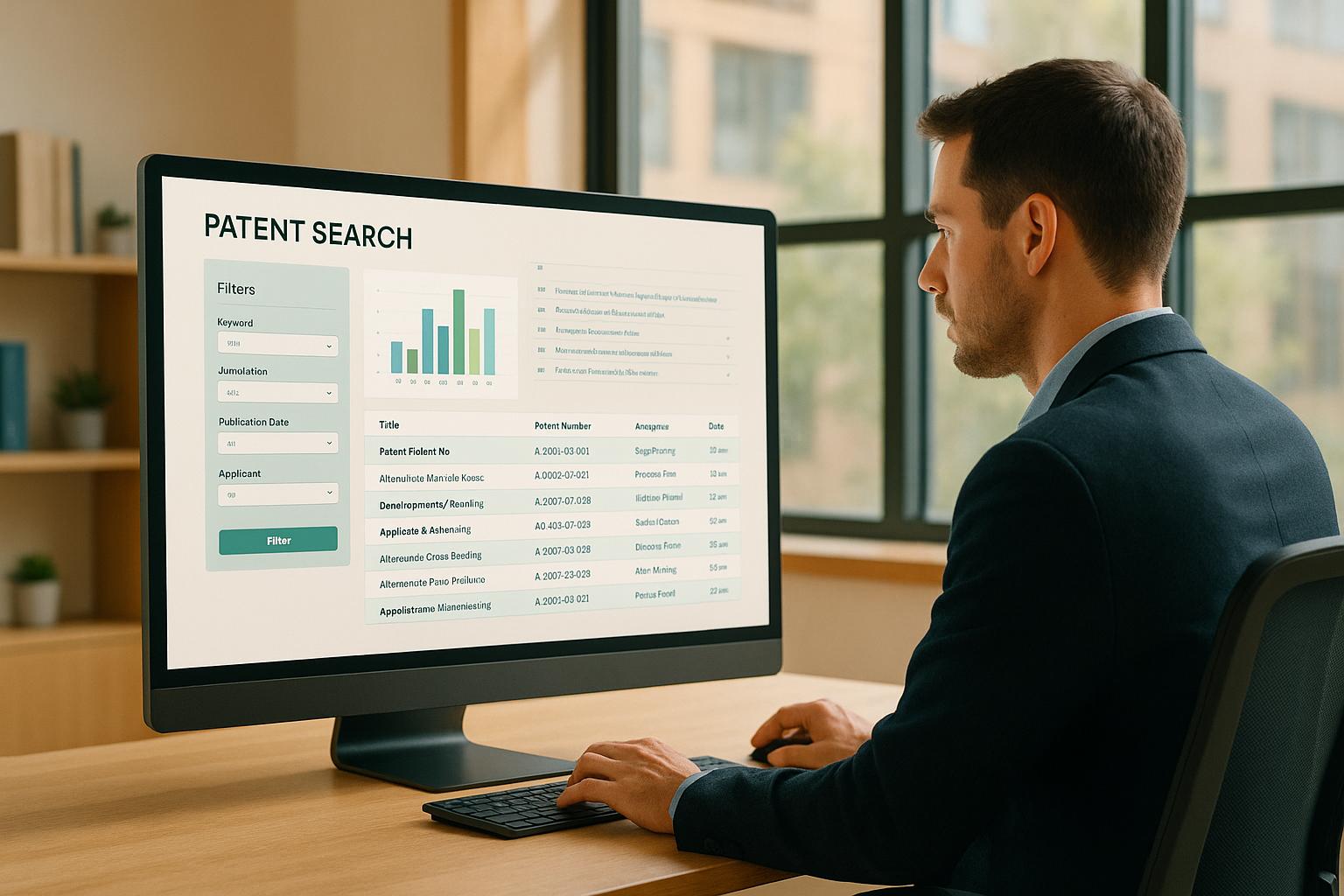
AI-powered tools have transformed patent research, making it faster and more precise. These tools use advanced filters - like semantic search, Boolean logic, citation analysis, and legal status tracking - to help professionals refine vast patent databases. Key features include:
Semantic Search: Understands intent and related terms for broader results.
Boolean Logic: Allows precise queries using operators like AND, OR, and NOT.
Citation Analysis: Maps relationships between patents via forward and backward citations.
Legal Status Filters: Focuses on active, expired, or pending patents.
Temporal Filters: Searches by filing, grant, or priority dates.
Patently stands out with its Vector AI technology, offering deep semantic search, citation mapping, and team collaboration tools. Plans range from a free tier to $125/month per user, with options for larger teams and firms.
AI tools save time, improve accuracy, and streamline workflows for tasks like prior art searches, competitive analysis, and portfolio management. By combining these customizable filters with a structured approach, patent professionals can achieve better results in less time.
How Enterprises Uses Generative AI for Patent Search, Drafting & Classification | IP Author Webinar
What Are Customizable AI Patent Search Filters
Customizable AI patent search filters are powerful tools designed to streamline the process of finding relevant U.S. patents and applications. Think of them as intelligent sieves that let you sort through vast amounts of patent data by applying specific criteria you define. These filters leverage artificial intelligence to align with your parameters, delivering highly targeted results.
For IP professionals in the U.S., these tools make it easy to zero in on patents based on factors like time periods, technology fields, assignees, or legal statuses - while filtering out irrelevant information. The ability to customize, save, and tweak filters sets these modern AI tools apart from traditional search engines. For example, a patent attorney might create filters to exclude expired patents, focus on particular CPC codes, or limit results to recent filings.
Let’s break down the key types of customizable filters that make this advanced search functionality possible.
Main Types of Customizable Filters
Semantic search filters are among the most sophisticated options. They use AI to understand technical synonyms and related terms to ensure you don’t miss relevant patents. For instance, if you search for "wireless communication", semantic filters might also bring up patents discussing "radio frequency transmission" or "cellular data transfer", sparing you the need to manually include every possible term.
Boolean logic filters give you precise control over your search by using operators like AND, OR, and NOT. These filters allow you to create complex queries, such as finding patents that mention "battery technology" AND "electric vehicles" but NOT "hybrid systems." This level of precision is especially useful for tasks like freedom-to-operate searches, where accuracy is critical.
Citation-based filters help map out the relationships between patents by analyzing forward and backward citations or patent families. These filters are invaluable for understanding the technological environment surrounding a particular invention and identifying influential patents that have shaped subsequent developments.
Technology categorization filters use AI to classify patents into specific technical areas automatically. You can filter results by broad categories like "artificial intelligence" or "biotechnology", or drill down into more specific subfields, such as "machine learning algorithms for image recognition" or "CRISPR gene editing techniques."
Legal status filters focus on a patent's lifecycle stage. These filters can isolate patents based on their application status - whether they’re pending, granted, or abandoned - or by details like maintenance fee status or geographic coverage. For U.S. practitioners, this means you can quickly identify enforceable patents or applications still under examination.
Temporal filters offer advanced date-based search capabilities. Beyond simple filing date ranges, you can search by priority dates, publication dates, or grant dates. You can even create complex queries, such as "patents filed in the last 18 months that cite applications from 2020–2022."
How AI Enhances Search Filters
AI takes these filters to the next level by improving search accuracy and efficiency. With natural language processing, AI can interpret plain-English queries, removing the need to master complex Boolean syntax or classification codes. For instance, you could ask, "Show me recent patents for smartphone battery improvements by Samsung competitors", and the AI would automatically apply the appropriate filters.
Real-time adaptation is another game-changer. If your search returns too many irrelevant results, the AI can adjust parameters, such as tightening semantic matching or refining classification weightings, to improve relevance on the fly.
Predictive filtering uses historical search data to recommend filter combinations tailored to your needs. Drawing on patterns from similar searches, it suggests effective filters that could save time and effort.
Cross-language capabilities ensure consistency when working with international patents. AI can apply the same filtering criteria across documents filed in different languages, making it easier for U.S. companies to analyze global patent landscapes.
The learning component of AI-driven filters makes them increasingly effective over time. As you interact with search results - clicking on relevant patents, dismissing irrelevant ones, or refining your queries - the AI adapts, improving its ability to deliver accurate results in future searches. This personalized approach not only saves time but also enhances the overall search experience, as seen in platforms like Patently, which leverage these advancements to deliver superior performance.
Patently: Advanced Customizable Patent Search Filters
Patently is an AI-powered platform designed specifically for patent professionals, seamlessly combining advanced search capabilities with project management tools. Founded by Heather McCann and Jerome Spaargaren, Patently is tailored to meet the needs of patent attorneys, IP researchers, and corporate innovation teams across the United States. By leveraging AI-driven customization, it sets a new standard for patent search tools.
At the heart of Patently is its Vector AI technology, which powers semantic search features that go far beyond basic keyword matching. This advanced AI understands the context and meaning behind technical terms, ensuring you uncover relevant patents even when the language differs from your search query. Let’s dive into the standout features that make Patently an indispensable tool.
Main Features of Patently
Patently's semantic search with Vector AI is a game-changer in patent research. Unlike traditional Boolean searches, Vector AI analyzes conceptual relationships, allowing users to identify related patents automatically - no need to manually account for every possible variation in terminology.
The platform also includes a Forward and Backward citation browser, offering a visual map of patent connections. This tool helps you trace the development of technologies or pinpoint key patents in a specific field. You can easily see which patents cite your target (forward citations) and which ones it references (backward citations), giving you a thorough view of the technological landscape.
Hierarchical categorization is another standout feature, enabling users to organize patent research into structured projects with custom fields. This is especially useful for law firms juggling multiple client matters or corporations monitoring various product developments. Custom fields can track details like technology readiness levels, competitive threats, or licensing opportunities.
The platform’s patent family sorting and browsing feature automatically groups related patents from the same invention family. This eliminates duplicate analysis and ensures you have a complete view of patent protection for any given technology.
With legal status filtering, users get real-time updates on patent statuses, including maintenance, prosecution, and geographic data. For U.S. practitioners, this means you can quickly determine which patents are enforceable, which applications are pending, and which have lapsed due to unpaid maintenance fees.
Team Collaboration and System Integration
Patently transforms patent research into a collaborative process with features designed for teamwork. Its access control settings allow project managers to decide who can view, edit, or comment on patent searches and analyses. Team members can share results and work together on tasks like freedom-to-operate studies or competitive intelligence projects. Shared workspaces and direct links make it easy for multiple researchers to contribute to patent landscape analyses, with automatic change tracking for seamless collaboration.
The platform also includes project management tools like comment systems, task assignments, and progress tracking to keep teams aligned.
For sharing insights, Patently offers export options that generate comprehensive, shareable reports. It also integrates with external data sources, allowing users to enrich patent information with additional business or technical data.
Patently's flexible pricing ensures it works for both individuals and teams, making it accessible to a wide range of users.
Pricing Plans for US Users
Patently offers a tiered pricing model to meet the diverse needs of its users, from solo researchers to large organizations:
The Free plan provides essential search functionality, including filters, full patent details, and family browsing. It’s perfect for individual researchers or small projects but is limited to a single user.
The Starter plan, priced at $125 per month per user, includes full semantic search capabilities, analytics tools, and the Forward and Backward citation browser. With support for up to 10 users, this plan also includes team collaboration features, making it a great fit for small IP teams or boutique law firms.
For organizations needing advanced tools, the Business+ plan offers custom pricing and includes Patently's AI patent drafting assistant, Onardo. This plan also features custom fields, fee tracking, and patent challenge monitoring, with unlimited user access.
The Law Firm+ plan builds on the Business+ features, adding matter-centric management tools and client access controls tailored for law firms handling multiple client relationships.
The Enterprise plan is fully customizable, with pricing based on individual requirements and implementation needs. It’s designed for organizations seeking a tailored approach.
This pricing structure reflects the needs of U.S. patent professionals, where team-based workflows and scalability are essential. The monthly per-user pricing model aligns with standard budgeting practices in legal and corporate environments, making it easier to manage costs while meeting organizational goals.
Top AI Tools with Customizable Patent Search Filters
Modern AI tools are taking patent research to the next level by interpreting context and identifying relevant patents, even when terminology varies. By combining semantic understanding, citation analysis, and collaborative features, these tools are tailored to meet the needs of U.S. patent professionals. The table below highlights how these customizable features are implemented in leading AI tools.
Feature Comparison Table: AI Tools and Their Customizable Options
Tool Category | Filter Types | U.S.-Specific Features | Collaboration Features | Pricing | Key Limitations |
|---|---|---|---|---|---|
Patently | Semantic search with Vector AI, Boolean, citation (forward/backward), legal status, patent family, hierarchical categorization | USPTO integration, U.S. maintenance fee tracking, geographic filtering, custom fields for U.S. legal matters | Team access control, shared workspaces, project management, comment systems, export options | Free to $125/month/user (custom pricing for advanced plans) | Free plan limited to 1 user; Starter plan supports up to 10 users |
Patently stands out with its robust set of features, including seamless integration with existing workflows. Its export options, API access, and compatibility with project management systems allow patent professionals to weave search results directly into broader analyses and reports.
AI-driven customizable filters are reshaping patent research by automating the discovery process through advanced semantic understanding. This evolution enables professionals to focus more on detailed analysis and strategic decisions, making patent research more efficient and effective.
How to Use Customizable AI Filters Effectively
Customizable AI filters can significantly enhance patent research when tailored to specific goals. By combining different filter types and applying them strategically, professionals can streamline their workflows and achieve more precise results. Let’s dive into practical ways to use these filters effectively.
Common Use Cases for Customizable Filters
Prior art searches often benefit from combining semantic filtering with citation analysis. For example, when conducting freedom-to-operate analyses, patent professionals might start with broad semantic searches using natural language descriptions. They can then narrow down results by applying legal status filters to focus on active patents. Hierarchical categorization is also useful here, especially for identifying related technologies that fall under similar classifications but use different terminology.
Patent landscape analysis is another area where these filters shine. Legal teams frequently use geographic filtering and patent family grouping to assess competitive positioning. For example, filtering by U.S. maintenance fee status helps distinguish active portfolios from lapsed ones, offering a clearer picture of the competitive environment.
Prosecution support workflows benefit from a combination of Boolean operators and semantic search tools. Patent attorneys often use inventor filters alongside forward citation analysis to track competitor activities. This approach is especially helpful for continuation applications and responding to office actions.
Portfolio management relies heavily on tools like custom field filtering and legal status tracking. IP teams use these filters to monitor patent families, track renewal deadlines, and identify licensing opportunities. Consistent filtering criteria across projects ensures a streamlined and effective workflow.
Tips for Better Search Results
Start broad, then refine. Begin your search with natural language descriptions of your technology to cast a wide net. As you analyze initial results, apply more specific filters to narrow the focus. This method helps you avoid missing relevant patents that may use unexpected terminology while still arriving at precise results.
Leverage citation networks. Forward citations can highlight how newer patents build on existing technologies, while backward citations trace the origins of an innovation. Combining these insights with legal status filters provides a complete view of active patent landscapes around specific technologies.
Group patent families to avoid duplicates. For global searches, grouping by patent family prevents duplicate results across jurisdictions. However, for U.S.-specific analyses, examining individual family members can reveal differences in prosecution history or claim language that may influence patentability or infringement risks.
Filter by timeframes based on technology maturity. For emerging fields like artificial intelligence or biotechnology, focus on patents filed within the past 5-7 years to capture recent innovations. In more established industries, extending the timeframe to 15-20 years can help identify patents that remain commercially relevant.
Combine semantic and Boolean searches. Start with a semantic search to identify conceptually related patents, then refine the results using Boolean operators to meet specific technical criteria. This hybrid approach ensures you capture both broad and precise matches.
Use collaborative filtering for team consistency. When multiple team members are involved in related searches, create shared filter templates and custom field definitions. This ensures consistency across searches and simplifies the process of combining results from different team members.
Export and iterate. Export your search results into a spreadsheet for deeper analysis. Reviewing the data in this format can reveal patterns and suggest additional filter combinations. Iterating on your search strategy often uncovers insights that might not be immediately visible in the search interface.
Conclusion
AI-powered patent search tools are reshaping how U.S. patent research is conducted by using semantic analysis to understand context and meaning, rather than just matching keywords. These tools are designed to improve the quality and accuracy of patent research while significantly cutting down the time it takes to find relevant information.
By integrating advanced features like natural language processing, citation browsing (both forward and backward), and flexible filtering options, these platforms provide precise results tailored to specific research needs. For example, users can filter patents by criteria such as owners, filing dates, legal status, and even geographic scope, creating a highly adaptable research environment.
Patently stands out in this space due to its use of Vector AI, which identifies conceptual relationships and goes beyond simple keyword searches. Its semantic search capabilities ensure deeper insights, while its customizable filters refine results based on a variety of parameters, including ownership and legal status. The platform also supports collaborative work through project management tools and hierarchical categorization, making it particularly effective for teams handling complex research tasks.
The key to effective patent research lies in combining these customizable filters with a structured approach. Starting broad with semantic searches and narrowing down results through targeted filters - alongside tools like citation browsing and patent family grouping - helps achieve both comprehensive coverage and pinpoint accuracy. This methodology, powered by AI, represents a forward-thinking solution for navigating the increasingly intricate world of intellectual property.
Ultimately, these tools not only streamline research but also enhance prior art detection and inform strategic decisions in patent prosecution and portfolio management. They’re paving the way for a more efficient and precise future in patent research.
FAQs
How do AI-powered patent search filters make patent research faster and more accurate?
AI-driven patent search tools significantly improve the research process by enabling users to craft tailored, highly specific queries that pinpoint exact patent data. This approach can cut search times by up to 50% and ensures fewer important documents slip through the cracks compared to basic keyword searches.
By refining the search process, these tools not only save time but also boost accuracy. This allows professionals to concentrate on evaluating essential information rather than wading through irrelevant results. Customizable searches make patent research quicker, sharper, and more efficient overall.
What makes semantic search filters better than Boolean logic for patent searches?
Semantic search filters stand out because they focus on understanding the meaning and context of your query, rather than just matching exact keywords. This approach delivers results that are more relevant - even when the wording or terminology varies.
Unlike traditional Boolean searches, which depend on specific operators and rigid keyword combinations, semantic search lets you use natural language. This makes searching easier, quicker, and more intuitive, especially for broader or more complex topics. By eliminating the need for perfectly crafted queries, it helps surface insights that might otherwise go unnoticed.
How do AI tools like Patently enhance collaboration and streamline project management in patent research?
AI tools such as Patently enhance teamwork and streamline project management by providing shared access to search results, centralized project folders, and real-time collaborative editing. These tools make it easier for inventors, legal teams, and R&D professionals to work in sync, cutting down on duplicated efforts and improving overall communication.
Patently also brings powerful features to the table, including AI-assisted patent drafting, semantic search, and in-depth analytics. These capabilities help teams stay organized and speed up the patent development process. By simplifying complex workflows, such tools free up time and resources, allowing teams to concentrate on innovation and strategic goals.