AI in Desalination: Patent Trends
Intellectual Property Management
Apr 7, 2026
Analysis of AI patents that cut energy use, detect membrane fouling in real time, extend membrane life, and shape global desalination innovation.
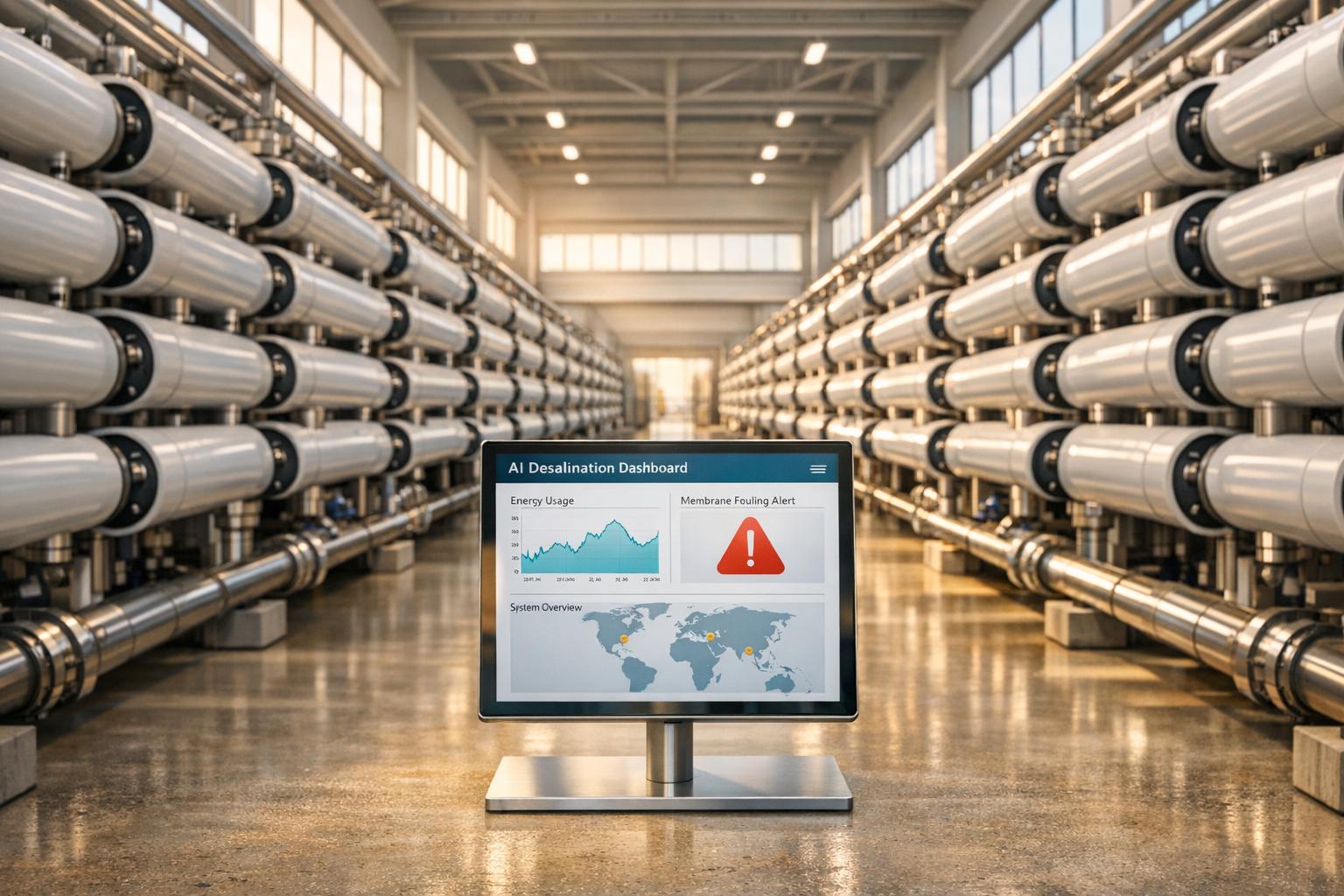
AI is transforming desalination by addressing challenges like high energy costs and membrane fouling. Recent patents show how machine learning improves efficiency, reduces costs, and extends equipment lifespan. Key highlights:
AI-driven systems cut operating costs by 16% and double membrane lifespan.
Machine learning enables real-time fouling detection, reducing energy use by up to 30%.
Innovations like AttnDesal neural networks improve water recovery and salt rejection accuracy.
Reverse Osmosis (RO) dominates, but AI is also advancing methods like Multi-Stage Flash (MSF) and Electrodialysis (ED).
Countries like China and the U.S. lead in AI patent filings, with the Middle East heavily investing in desalination tech.
AI-powered digital twins and renewable energy integration are shaping the future, making desalination more efficient and cost-effective. This shift addresses global water scarcity, benefiting nearly 2 billion people lacking safe drinking water.
How Artificial Intelligence Will Solve The World’s Water Crisis
Patent Trends in Desalination Technology
Recent patents in desalination are taking a smarter approach by incorporating machine learning to tackle two major challenges: membrane fouling and energy consumption. Instead of focusing solely on hardware improvements, these innovations aim to optimize operations using AI. Why? Because fouling can increase energy use by 20–40% in typical systems, and machine learning-based real-time fouling detection can cut energy consumption by up to 30% over a system's lifetime.
The trend is shifting away from traditional mechanical solutions like spacers and filters. Instead, AI-powered, real-time monitoring systems are becoming the go-to solution. For example, brackish reverse osmosis systems typically consume between 1.0 and 2.5 kWh per 1,000 gallons of treated water. Even small efficiency improvements here can lead to noticeable cost savings. This tech-driven evolution is fueling a wave of AI-enabled patent analysis is fueling a wave of AI-focused patent activity.
Rise of AI-Related Desalination Patents
AI is now a cornerstone of desalination innovation, reshaping the intellectual property landscape. Anwur Alenezi, Associate Research Scientist at the Kuwait Institute for Scientific Research, highlights the impact:
"AI offers promising solutions to the challenges in water treatment and desalination, resulting from the ability of AI to process large datasets, to predict outcomes, and to optimize complex systems".
This capability has led to patents centered on predictive maintenance, fault detection, and real-time optimization of desalination plants , often requiring teams to draft patent applications with AI to keep pace with rapid innovation.
Take, for instance, U.S. patent No. 11,938,450, granted in March 2024. It introduced a membrane-based in-line fouling monitor for brackish water desalination. This system uses a specially designed permeate flow path to collect time-sensitive data, which is then processed by a machine learning controller to detect fouling and activate corrective measures. Another breakthrough came in January 2025 with AttnDesal, a neural network model combining Gated Recurrent Units (GRU) and Long Short-Term Memory (LSTM) with attention mechanisms. Tested on real desalination facility data, it achieved impressive accuracy, forecasting water recovery with a mean squared error (MSE) of 0.0024 and salt rejection with an MSE of 0.0019, boasting an R-squared value of 0.9818 for water recovery.
These AI-driven advancements are being applied across a range of desalination methods, not just one.
Main Desalination Technologies in Patents
While Reverse Osmosis (RO) dominates patent filings, AI is also being integrated into other methods like Multi-Stage Flash (MSF), Multiple-Effect Distillation (MED), and Electrodialysis (ED). Here’s how AI is transforming these traditional methods:
Technology Feature | Conventional Method | AI-Integrated Trend (Recent Patents) |
|---|---|---|
Fouling Detection | Manual observation of pressure increase | Real-time ML-based in-line monitoring |
Energy Management | Fixed production points | Dynamic optimization (up to 30% savings) |
Maintenance | Scheduled or reactive CIP cycles | Predictive scheduling via AI forecasting |
Performance Tracking | Normalized flux data (often slow/muted) | High-sensitivity "membrane element monitors" |
AI techniques like Artificial Neural Networks (ANN), Deep Neural Networks (DNN), and Genetic Algorithms (GA) are also being used to optimize energy use. These approaches have shown potential to reduce Specific Energy Consumption (SEC) by as much as 20%. Hybrid systems that combine RO with Nanofiltration (NF) and use AI to fine-tune interactions between stages are gaining traction as well. These innovations are critical for improving water recovery (WR) and salt rejection (SR) - key metrics in addressing the global water scarcity crisis, which affected nearly 2 billion people lacking access to safe drinking water as of 2023.
How AI Is Used in Desalination Technologies
AI is reshaping desalination by improving efficiency and cutting costs. It helps identify problems early, reduces energy consumption, and extends the lifespan of equipment, making water production more efficient. Below, we explore how AI is enhancing various desalination methods.
AI in Reverse Osmosis (RO) Systems
Reverse osmosis is the most widely used desalination technology, and AI is making it even more effective. For instance, U.S. Patent No. 11,938,450, issued in March 2024, introduced a machine learning-driven RO system for brackish water. This system monitors individual membrane elements instead of the entire system, increasing fouling detection sensitivity by up to 25 times compared to traditional methods. By analyzing real-time flow data, the system identifies fouling's onset, rate, and cause, triggering automatic corrective actions to manage flux decline.
The energy savings are impressive. Conventional brackish RO systems use 1.0 to 2.5 kWh per 1,000 gallons of treated water. This patented system reduces energy use by up to 30% over its lifetime by minimizing flux decline and cutting down on chemical cleaning needs.
AI models like AttnDesal also play a key role in performance forecasting. Developed in January 2025 by researchers at Tanta University, this model uses advanced neural networks, including Gated Recurrent Units (GRU) and Long Short-Term Memory (LSTM) networks, to predict water recovery and salt rejection in hybrid RO plants. Lead researcher R. Habieeb highlighted its benefits:
"positions it as a tool for optimizing desalination plant operations, ultimately enhancing efficiency and cost-effectiveness".
Additionally, Genetic Algorithms optimize chemical dosing, ensuring a balance between operational costs and water quality standards.
AI in Thermal Desalination Processes
Though reverse osmosis dominates, thermal desalination methods like Multi-Stage Flash (MSF) and Multi-Effect Distillation (MED) also benefit from AI advancements. These systems require precise heat transfer management, as they often operate at temperatures exceeding 120°C. AI tools, including reinforcement learning and physics-informed neural operators, enhance these processes by combining mechanistic models with real-time data.
One notable development is the integration of AI into solar-powered thermal systems. In July 2013, Hangzhou Dianzi University patented a solar-collecting MSF device with a feedback control loop. This system adjusts motor and pump speeds in real time based on flow and temperature data, compensating for variations in solar energy and improving heat utilization. Such approaches are especially effective in hybrid systems that merge thermal and membrane technologies.
Explainable AI methods like SHAP (SHapley Additive exPlanations) are also being applied to thermal desalination. These techniques help clarify how variables like top brine temperature and vapor compression rates influence costs and efficiency, making operations more transparent and manageable.
AI in Newer Desalination Methods
Emerging desalination technologies are increasingly incorporating AI from the start. Examples include hybrid nanofiltration (NF)/RO systems, wave-actuated desalination, and Brine-Forward MSF concepts.
Hybrid NF/RO systems use AI to fine-tune salt rejection and improve water recovery. The AttnDesal model showcases its accuracy in forecasting, helping operators optimize the interaction between nanofiltration and reverse osmosis stages.
Wave-actuated RO systems are another innovative approach. These offshore setups use wave energy for pumping, while AI manages the fluctuating dynamics of wave-driven pressure. AI-controlled flush valves periodically lower pressure, increasing flow rates and protecting membranes from damage.
The Brine-Forward MSF concept, developed by Mansour S. Bader, eliminates the need for brine recycling and cooling seawater return. Bader notes that this design:
"provides tremendous savings in pumping power"
compared to traditional Recycle-Brine MSF systems. AI further enhances the system by reducing brine waste, lowering energy consumption, and minimizing environmental impact.
Geographic and Institutional Patent Trends
Where Patents Are Filed
China dominates the global landscape for AI patent filings, accounting for over 70% of all applications worldwide. In 2024 alone, China submitted 1.8 million AI patent applications - 49.1% of the global total - nearly three times the number filed by the United States. This surge is driven by aggressive government policies and significant funding aimed at fostering innovation.
The United States, however, emphasizes quality over sheer quantity. While China leads in applications, the U.S. holds the top spot for granted AI patents, with 54,022 approved in 2024 - a 56% jump since 2020. This reflects a rigorous review process and a focus on higher-quality patents.
The Middle East has carved out a niche in desalination-related innovations. The region accounts for 46.9% of the world's contracted desalination capacity (60.1 million m³/day) and has invested $53.4 billion in desalination projects from 2006 to 2024, representing 47.5% of global spending. These investments address water scarcity and have led to advancements in energy-efficient membranes and brine management technologies. Such trends highlight how regional strengths influence innovation in sustainable water solutions.
India is also emerging as a key player, with AI patent filings growing by 400% over the past five years. In 2024, the country saw a 19.1% increase in filings, marking the sixth consecutive year of double-digit growth [20, 23]. Meanwhile, Germany leads in European patent activity.
This regional breakdown helps set the stage for understanding the organizations driving these trends.
Leading Patent Filers
Global corporations and institutions are at the forefront of AI patent innovation, with strategies varying by region. Huawei holds the title of the largest AI patent applicant worldwide, with over 10,000 patents filed. In China, over 80% of AI-related patents come from corporations such as Huawei, Tencent, and Baidu, with universities playing a smaller role. In the U.S., companies like IBM, Google, and Microsoft dominate, focusing heavily on areas like deep learning and neural networks.
Desalination technology also sees contributions from specialized research institutions. For instance, the Tianjin Institute of Seawater Desalination and Multipurpose Utilization has developed patents like a submersible self-priming filter head (CN112387005B) that uses a three-stage filtration process and cyclone separation to boost efficiency and reduce maintenance.
In the Middle East, organizations such as the Saline Water Conversion Corporation (SWCC), King Abdulaziz City for Science and Technology (KACST), King Abdullah University of Science and Technology (KAUST), and the Masdar Institute are leading desalination R&D. These groups are advancing energy-efficient membrane technologies and exploring brine mining, with Saudi Arabia planning $2.1 billion in investments by 2030 to extract valuable minerals like lithium and magnesium from brine.
Regional strengths also shape innovation in AI. Japan leads in robotics and industrial automation, holding 40% of global AI patents in this category. South Korea focuses on semiconductors and consumer electronics, driven by companies like Samsung and LG. Germany, on the other hand, excels in industrial AI applications through firms like Siemens and Bosch. Together, the top five AI patent-filing countries - China, the U.S., Japan, South Korea, and Germany - account for more than 90% of global AI patents.
Future Trends and Opportunities
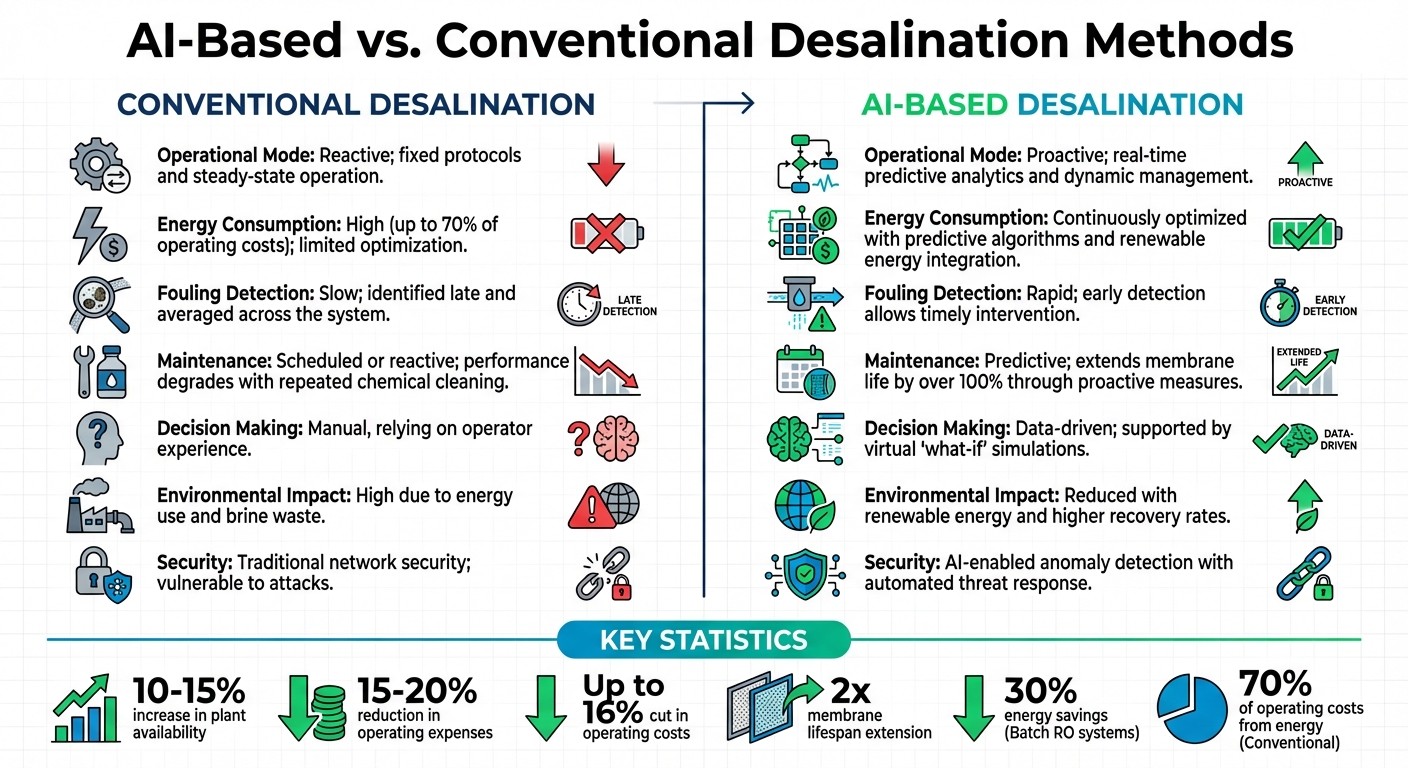
AI vs Conventional Desalination: Key Performance Metrics
Recent advancements in AI-powered desalination technologies hint at even more transformative changes on the horizon. One key development is the growing use of digital twins, which create virtual models of physical systems to simulate real-time conditions. These tools not only improve operational efficiency but also strengthen AI’s role in managing water resources.
AI Digital Twins and Cloud-Based Systems
Tedagua's Digital Twin Platform, partially funded by NextGenerationEU, is a standout example. It combines IoT sensors, AI algorithms, and Building Information Modeling (BIM) to optimize energy efficiency by fine-tuning operating pressure and production schedules. This system uses real-world data collected from multiple Tedagua facilities.
"The implementation of the digital twin has delivered measurable benefits across energy efficiency, cybersecurity, and decision-making." – Tedagua
Cloud and edge computing play a critical role here, processing massive amounts of sensor data and enabling rapid responses to urgent scenarios. AI models integrated into these platforms can predict equipment failures before they happen, effectively doubling the lifespan of reverse osmosis membranes in industrial applications. Additionally, machine learning enhances security by detecting and neutralizing threats in real-time, safeguarding vital water infrastructure.
Operators also benefit from "what-if" simulations, which allow them to test operational adjustments in a virtual setting before applying them to physical systems. However, challenges like high initial costs for infrastructure, limited long-term datasets for AI training, and difficulties in integrating with existing SCADA systems have slowed widespread adoption.
Combining AI Desalination with Renewable Energy
The fusion of AI-driven desalination with renewable energy offers exciting possibilities for sustainable water production. For example, Oneka Technologies filed Patent Application #20250035081 in January 2025 for a wave-powered reverse osmosis (RO) system. This innovative design uses offshore wave energy converters equipped with floats and hydraulic cylinders to pump seawater into RO cells, eliminating the need for external electricity. An integrated line management system further optimizes energy capture from waves.
Energy costs can make up as much as 70% of a desalination plant’s operating expenses. AI-powered wave-actuated RO systems address this by dynamically adjusting pressure based on wave energy availability. Advanced techniques like reinforcement learning and physics-informed neural operators are being explored to handle the fluctuating dynamics of renewable energy systems. Unlike traditional desalination, which operates at steady production levels, AI can manage variable processes like Closed-Circuit RO (CCRO) and Batch RO (BRO). For instance, AI-driven Batch RO systems have reduced energy use by roughly 30% for brackish water treatment at a 95% recovery rate, while flow-reversal RO retrofits have cut energy consumption by about 14%.
That said, technical hurdles remain. High-recovery cycles like CCRO can achieve up to 98% recovery but still leave around 11% residual brine per cycle. Integrating computational fluid dynamics (CFD) with AI frameworks is another challenge. These advancements highlight the industry's shift from reactive, conventional methods to proactive, AI-driven systems.
AI-Based vs. Conventional Desalination Methods
Feature | Conventional Desalination | AI-Based Desalination |
|---|---|---|
Operational Mode | Reactive; fixed protocols and steady-state operation | Proactive; real-time predictive analytics and dynamic management |
Energy Consumption | High (up to 70% of operating costs); limited optimization | Continuously optimized with predictive algorithms and renewable energy integration |
Fouling Detection | Slow; identified late and averaged across the system | Rapid; early detection allows timely intervention |
Maintenance | Scheduled or reactive; performance degrades with repeated chemical cleaning | Predictive; extends membrane life by over 100% through proactive measures |
Decision Making | Manual, relying on operator experience | Data-driven; supported by virtual "what-if" simulations |
Environmental Impact | High due to energy use and brine waste | Reduced with renewable energy and higher recovery rates |
Security | Traditional network security; vulnerable to attacks | AI-enabled anomaly detection with automated threat response |
The trend is moving toward modular and scalable solutions adaptable to a range of plant sizes, from small municipal systems to large industrial operations. Looking ahead, AI models are expected to factor in external influences like energy market changes, supply chain dynamics, and waste management. These advancements could lead to fully autonomous systems capable of anticipating and addressing challenges before they arise.
Conclusion
The patent landscape surrounding AI-driven desalination is showcasing a transformative shift in tackling water scarcity. Recent patent filings illustrate a move away from traditional, manual operations toward systems that leverage AI to predict failures, enhance energy efficiency, and extend the life of critical equipment. For example, U.S. Patent #11,938,450 highlights this evolution, focusing on proactive, AI-driven maintenance strategies instead of reactive approaches.
The data speaks volumes about AI's impact. Platforms like Aquatech's DesalPro™ have achieved 10-15% increases in plant availability and 15-20% reductions in operating expenses by optimizing power and chemical usage. Machine learning has further demonstrated its ability to cut operating costs by up to 16% while more than doubling membrane life in industrial settings. Innovations such as Batch RO systems have delivered approximately 30% energy savings with 95% recovery rates in brackish water treatment. These advancements are paving the way for even more ambitious developments in the field.
Collaboration is also playing a key role in pushing the boundaries of desalination technology. Companies like Aquatech and Pani Energy are working together to integrate AI solutions aimed at addressing global water challenges. Similarly, Oneka Technologies is leading efforts to develop wave-powered desalination systems that eliminate the need for external electricity, tackling energy costs that often account for 70% of operating expenses. Researchers are also exploring digital twin frameworks, blending mechanistic and data-driven methods. As Y.Y. Liang and M. Li explain:
"By bridging mechanistic and data-driven approaches, this review outlines opportunities to develop digital twin frameworks for resilient, efficient, and intelligent unsteady desalination".
The concentration of patents in water-scarce regions like the Middle East and South Asia underscores the urgent need for these technologies. As climate change exacerbates water shortages, AI-driven desalination provides a promising path forward. By incorporating renewable energy, predictive maintenance, and greater efficiency, these innovations are reshaping the way freshwater demands are met. The shift from steady-state operations to AI-managed systems signals a crucial step toward meeting the challenges of a water-scarce future.
For those monitoring developments in this space, Patently's AI-powered platform (https://patently.com) offers advanced tools for uncovering trends and identifying opportunities in desalination patents.
FAQs
What data does AI need to detect membrane fouling early?
AI relies on data from membrane surface images and critical fouling factors, such as mineral scaling, particulate matter, colloidal matter, and biofouling. These inputs are essential for detecting early signs of membrane fouling, allowing for timely action to prevent further issues.
Which desalination method benefits most from AI today?
Reverse osmosis is seeing significant gains thanks to AI, particularly in areas like water recovery and salt rejection. Breakthroughs such as neural network models like AttnDesal show how AI can fine-tune these processes, making them more efficient and environmentally friendly.
What prevents wider adoption of AI and digital twins in plants?
The broader use of AI and digital twins in desalination plants faces several hurdles, including high energy demands, cybersecurity risks, and a shortage of large-scale, real-world testing. These challenges drive up operational expenses and introduce additional risks, making large-scale implementation a tough task.