Semantic Search in Prior Art Classification
Intellectual Property Management
Apr 7, 2026
AI-powered semantic search improves patent prior art discovery, boosting recall by 20–30% and cutting search time and costs significantly.

Semantic search is transforming how patent professionals find prior art. Unlike keyword-based searches that rely on exact matches, semantic search uses AI to understand the meaning and context of patent documents. This approach reduces missed results caused by terminology differences and improves accuracy by 20–30%, saving time and costs.
Key Takeaways:
Keyword Search Limitations: Fails with vocabulary mismatches like "autonomous vehicles" vs. "self-driving cars."
How Semantic Search Works: AI models create vector embeddings to group similar concepts, regardless of wording.
Time and Cost Savings: Cuts search time by up to 60%, saving $18,000–$60,000 monthly for firms handling 20 applications.
Cross-Language Discovery: Identifies prior art in multiple languages without manual translation.
Real-World Use: Tools like Patently streamline patent searches, offering features like automated relevance ranking and citation mapping.
Semantic search combines AI efficiency with human expertise, enabling faster and more accurate patent analysis.
Semantic Patents Search Engine
From Keywords to Semantic Search in Patent Analysis
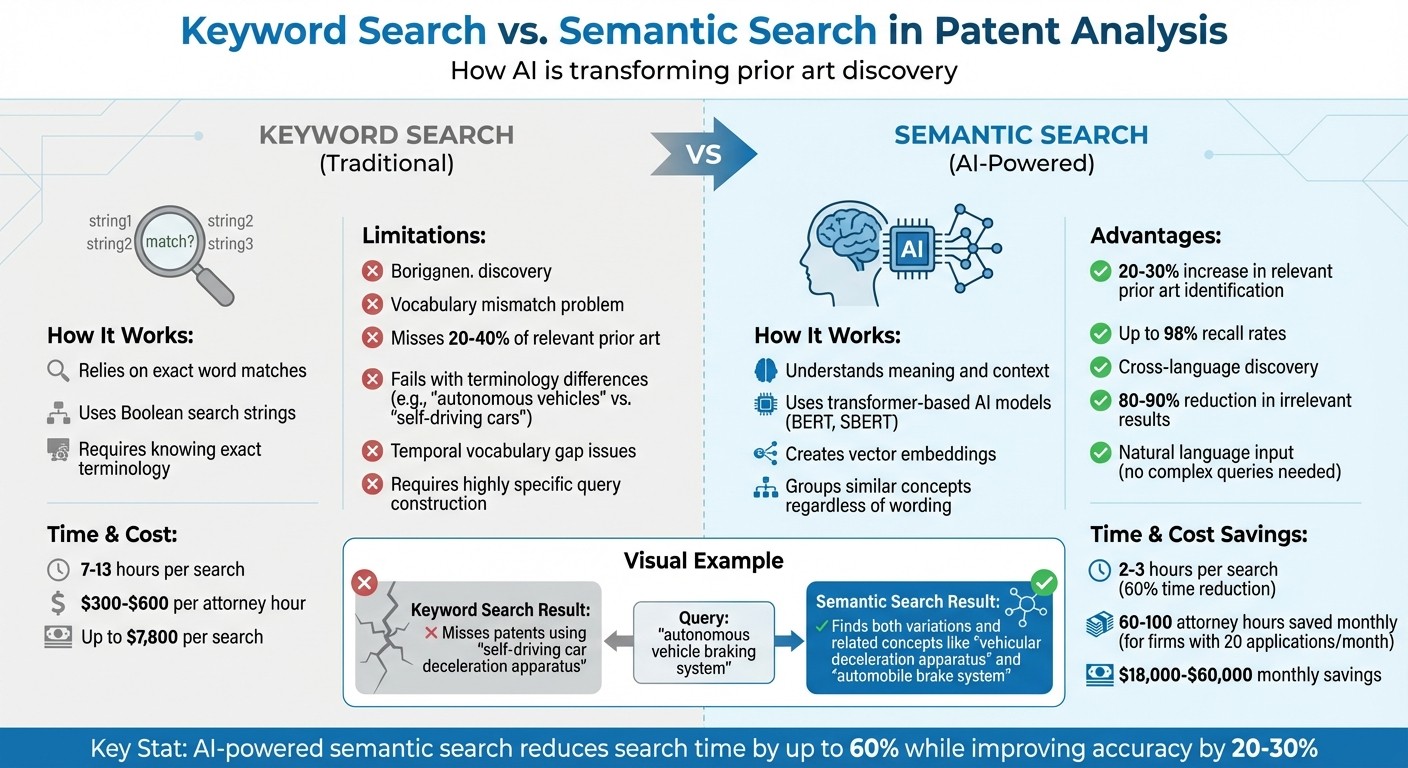
Keyword vs Semantic Search in Patent Prior Art Classification
This section compares traditional Boolean search methods with newer semantic search techniques, highlighting how they simplify the process of finding prior art.
Problems with Keyword-Based Search
For years, patent professionals have relied on Boolean search strings to identify prior art. However, this method has a major flaw: it only works if you know the exact terms used by the inventor. For instance, if an invention is described as "autonomous vehicles" but older patents refer to "self-driving cars", keyword searches fail to connect the dots.
"The vocabulary mismatch problem is perhaps the most significant challenge. Inventors and patent attorneys often describe the same technical concept using completely different terminology." - PatentScanAI
This issue isn't just theoretical - it has real-world consequences. Patent attorneys charge between $300 and $600 per hour, and a thorough search can take anywhere from 7 to 13 hours. That means a single search could cost as much as $7,800. Missing critical prior art can lead to expensive legal challenges and months of wasted effort during patent prosecution. On top of that, Boolean search requires highly specific query construction, which often misses related concepts.
Another challenge is the rapid pace of technological change. New patents often use terms that didn’t exist when older patents were written. Researchers call this the "temporal vocabulary gap". To complicate things further, patent terminology often includes "overloaded vocabulary", where the same word can mean entirely different things depending on the technical field. These issues make it nearly impossible for keyword-based searches to deliver a comprehensive result.
These limitations highlight the need for semantic search, which addresses these vocabulary mismatches and reduces the need for constant manual adjustments.
How Semantic Search Solves These Problems
Semantic search takes a different approach by focusing on what you mean rather than the exact words you use. It employs transformer-based AI models trained specifically on patent texts to understand legal language, claim structures, and technical relationships. These models convert patent documents into vector embeddings - essentially mathematical representations of meaning - so the system can recognize that "automobile brake system" and "vehicular deceleration apparatus" refer to the same concept.
The results are impressive. Internal trials at patent offices showed that integrating AI reduced search times by up to 60%. For law firms handling 20 applications a month, semantic search can save 60 to 100 attorney hours each month. The U.S. Patent and Trademark Office has already adopted this technology, incorporating "Similarity Search" into its PE2E (Patent End-to-End) platform. This upgrade enhances recall in crowded technical fields by moving beyond rigid Boolean syntax. Now, patent professionals can input full invention descriptions in natural language, and the system automatically identifies key technical concepts and finds related patents - even across multiple languages.
Machine Learning Techniques Behind Semantic Search
Building on how semantic search overcomes vocabulary mismatches, let's dive into the machine learning techniques that make this possible.
Vector Representations and NLP
At the heart of semantic search is the ability to convert text into numerical formats. Advanced systems rely on transformer-based models, such as BERT and Sentence-BERT (SBERT), which are trained on massive patent datasets. These models are fine-tuned to grasp the specific language of patents, including their unique structures, claim formats, and legal nuances (like differentiating between "comprising" and "consisting of").
The process begins with vector embeddings. Here, the AI turns entire patent descriptions or claims into multi-dimensional vectors that capture their semantic meaning. Patents describing similar technical ideas, even if worded differently, end up with vectors that cluster closely together. For example, the system can recognize that terms like "wireless communication device" and "portable telecommunications unit" describe the same invention.
"The technology converts patent text into mathematical vectors that capture semantic meaning. Patents with similar technical concepts cluster together in this vector space, regardless of the specific words used." - PatentScanAI
This technique effectively resolves vocabulary mismatches that traditional search methods struggle with. A good example is the PatentSBERTa model, which achieved a multi-label prediction accuracy of 54% and an F1 score exceeding 66% when classifying 1,492,294 patents at the CPC subclass level. Furthermore, these models can bridge language differences, identifying that "Datenverarbeitung" in German and "data processing" in English refer to the same concept.
Once text is converted into numerical representations, clustering and classification methods refine the search process even further.
Clustering and Classification Models
After patents are transformed into vectors, clustering and classification models step in to organize them into meaningful groups. For example, the K-Nearest Neighbors (KNN) algorithm identifies vectors closest to a search query in multi-dimensional space. Clustering algorithms group patents with similar semantic content, even when they use entirely different terminology to describe the same technology.
Classification models take it further by automating patent categorization. These models predict a patent's classification, such as within the Cooperative Patent Classification (CPC) system, by analyzing the classifications of its closest neighbors. For complex inventions spanning multiple domains, advanced systems perform multi-label classification, assigning patents to several relevant technical subclasses.
Some platforms go a step beyond with knowledge graphs, which map explicit relationships between concepts. For instance, the system understands that a "lithium-ion battery" is a type of "rechargeable energy storage device", creating a hierarchy that sharpens search results. By combining clustering with structured knowledge, semantic search delivers results that keyword-based methods simply can't match.
Benefits of Semantic Search for Patent Professionals
The machine learning techniques behind semantic search bring practical advantages to patent professionals, especially in prior art classification. These benefits go beyond theory, transforming everyday tasks and delivering measurable improvements.
Better Accuracy in Prior Art Discovery
Semantic search addresses the common problem of vocabulary mismatches, increasing the identification of relevant prior art by 20–30%. Traditional keyword searches often miss 20–40% of relevant prior art because inventors use varying terms to describe similar technologies. By focusing on conceptual similarities, semantic search tools uncover inventions that might otherwise be overlooked due to differences in terminology.
The improvement in accuracy is significant. Some AI-driven tools report recall rates as high as 98%. These tools analyze the full context of patent documents, understanding how individual claims fit into larger technical frameworks, rather than just matching isolated keywords.
Semantic search also excels in cross-language discovery, identifying patents that discuss the same concepts in different languages. Additionally, it minimizes irrelevant results by up to 80–90%. Instead of wading through hundreds of unrelated documents, professionals receive a concise, ranked list of the most relevant results.
This enhanced accuracy translates directly into time saved during prior art reviews.
Time Savings Through Automation
By integrating machine learning, semantic search streamlines patent workflows, delivering dramatic efficiency gains. Traditionally, a thorough prior art search takes 7–13 hours of attorney or staff time. With AI-powered tools, this can be reduced to just 2–3 hours, cutting total search time by 40–60%.
These time savings are achieved through several advancements. Natural language input eliminates the need for complex Boolean queries, allowing users to work more intuitively. The AI can scan millions of documents across global databases in minutes - a task that would otherwise take days or weeks. Automated relevance ranking prioritizes results based on conceptual similarity, further simplifying the process.
For firms managing around 20 applications per month, these efficiencies can save between 60 and 100 attorney hours monthly, translating to $18,000–$60,000 in billable time. Internal patent office trials show that AI tools not only reduce search time by up to 60% but also improve the retrieval of cross-disciplinary prior art.
Beyond initial searches, AI tools offer claim-level evidence mapping, which highlights overlapping aspects within documents, speeding up comparisons. Continuous monitoring features provide automated alerts for new filings, enabling ongoing patent searches. This means professionals can conduct searches at multiple stages - from early concept development to pre-launch - ensuring that strategies remain aligned with the latest developments in the patent landscape.
How Patently Uses Semantic Search
Patently has embraced the power of semantic search to revolutionize how patents are analyzed and managed. By using advanced Vector AI, the platform integrates semantic search into its workflow, making it easier to discover and assess prior art. This system, built on Elastic's Search AI Platform, enables Patently's Vector AI to analyze data relationships and conduct context-aware searches across a massive database of 82,000,000 patent families (135,000,000 individual patents).
Semantic Search with Vector AI
Patently's Vector AI takes patent searches to a new level by going beyond basic keyword matching. Instead, it deciphers the meaning and intent behind patent language. For example, it can recognize that terms like "fastening mechanism" and "clip assembly" are functionally equivalent, ensuring users find relevant results even when terminology differs.
"With Elastic, it's like having a patent attorney with decades of experience guiding every search."
Andrew Crothers, Creative Director at Patently
This semantic intelligence is woven throughout Patently's workflow. The platform's AI drafting assistant, Onardo, automatically searches for prior art during the drafting process, flagging potential issues before they become problems. A real-world example from late 2024 illustrates its efficiency: Laurence Brown, a patent leader, used Patently's Vector AI to search for "In-ear headphones with noise isolating tips" with a priority date before 2000. In under five minutes, the tool delivered 300 relevant results, which he narrowed down to Sony patents, successfully identifying the target documents.
In addition to improving search accuracy, Patently ensures these capabilities are seamlessly integrated with its broader suite of patent management tools.
Integration with Other Patent Management Tools
Patently's semantic search works hand-in-hand with other tools to streamline and enhance patent workflows. For example, its interactive citation browser allows users to dynamically explore forward and backward citation networks, helping them trace the evolution of technologies and uncover hidden connections between patents. Collaborative features enable IP attorneys and R&D teams to annotate findings, track progress, and coordinate strategies effectively.
The platform also offers visual analysis tools, such as heatmaps and 3D technology landscapes, which help users identify innovation clusters and areas of untapped potential. For those working with Standard Essential Patents (SEPs), Patently License uses Elastic's Search AI and Vector AI to support analytics for 4G and 5G technologies.
"Vector AI... has positioned Patently as one of the most innovative platforms for semantic patent search and is core to our technology stack."
Jerome Spaargaren, Founder and Director of Patently
The Future of Semantic Search in Prior Art Classification
Semantic search is reshaping how professionals approach patent analysis and prior art classification. Traditional keyword searches often fall short because they rely heavily on exact word matches, which can overlook relevant prior art due to differences in terminology or phrasing. However, with advancements in AI, models are now moving beyond simple keyword matching. They’re leveraging technologies like vector embeddings and transformer models to grasp deeper meanings, technical intent, and contextual relationships.
One exciting development is the push toward cross-language discovery. Today, more than 70% of patent applications are filed outside the United States. Multilingual semantic models are making it possible to identify similar patents in languages like German, Chinese, and Japanese - without the need for manual translation. This advancement is turning prior art searches into a truly global effort, bridging linguistic barriers and expanding the scope of discovery.
Patent offices are already integrating these tools into their workflows. For instance, the USPTO’s PE2E "Similarity Search" tool, along with similar systems at the EPO and Israel Patent Office, showcases how AI is becoming a key part of the examination process. Early trials suggest that AI can cut search times by up to 60% while improving the retrieval of information across multiple disciplines. Looking ahead, AI could also scan non-patent literature - like academic journals, technical manuals, and even blogs - to identify emerging prior art.
The most effective approach combines AI with human expertise. AI excels at broad, conceptual searches and filtering out irrelevant results, reducing the manual review workload by as much as 80% to 90%. Meanwhile, experts can focus on critical legal and strategic decisions. As the USPTO points out, AI is designed to "assist, not replace" human judgment. For firms, this hybrid model offers substantial time and cost savings.
Platforms like Patently are positioning patent professionals to thrive in this evolving landscape. A thorough patent search is essential - missing relevant prior art can derail entire legal strategies. By adopting these innovations, professionals can enhance their search processes while strengthening their legal and strategic analyses for the future.
FAQs
What is semantic search in prior art?
Semantic search in prior art relies on machine learning and natural language processing (NLP) to go beyond simple keyword matching. Instead of just looking for exact terms, it focuses on the meaning and concepts behind the text. By examining technical details, relationships, and core ideas, this method addresses the shortcomings of traditional keyword-based searches. The result? More accurate results, a lower chance of overlooking critical prior art, and better insights for making informed decisions during patent prosecution and strategy planning.
How do vector embeddings find similar patents?
Vector embeddings transform patents into high-dimensional vectors within a semantic space, reflecting their meaning and context. To determine how closely related two patents are, similarity metrics like cosine similarity or Euclidean distance come into play. These metrics help identify patents that are conceptually similar, even if they don't share exact keywords.
Machine learning models trained specifically on patent data are responsible for generating these embeddings. This approach goes beyond traditional keyword searches, allowing for more precise prior art searches by uncovering deeper conceptual connections between patents.
How do I validate AI results for legal use?
When using AI to generate prior art findings, ensuring accuracy and relevance is critical, especially in legal contexts. Start by carefully reviewing the identified patents and literature to confirm they are both applicable and impactful for the case at hand.
To fine-tune the results, leverage semantic search tools. These can help filter out irrelevant data, narrowing the focus to what's truly meaningful. However, don't rely solely on AI outputs - cross-check the findings with traditional search methods or consult experts. This added layer of review boosts confidence in the results, particularly when assessing legal validity or patentability.