How AI Analyzes Patent Trends for Benchmarking
Intellectual Property Management
Apr 7, 2026
Explains how AI (ML and NLP) analyzes patent filings to spot trends, benchmark portfolios, and deliver real-time competitive insights.

AI is transforming how businesses analyze patents to stay competitive. By using advanced tools like machine learning and natural language processing (NLP), companies can quickly identify trends, assess competitors, and pinpoint innovation opportunities. Here's what you need to know:
Patent Trend Analysis: AI examines filing patterns, technology shifts, and "white spaces" (areas with little patent activity) to predict industry directions.
Benchmarking: Businesses compare their patent portfolios to competitors to find strengths, weaknesses, and untapped areas.
AI Tools: Machine learning categorizes patents, while NLP interprets complex legal language, ensuring no key insights are missed.
Real-Time Monitoring: Continuous updates keep strategies current, offering instant alerts on competitor activities.
AI-powered tools like semantic search and clustering simplify complex data, turning it into actionable insights for R&D and business planning. These methods save time, reduce risks, and help companies make informed decisions in fast-changing markets.
Using AI to Transform and Unlock Your IP Landscape
AI Techniques Used in Patent Trend Analysis
Modern patent analysis leverages machine learning and natural language processing (NLP) to extract insights from massive volumes of patent documents quickly and effectively.
Machine Learning for Patent Classification
Machine learning plays a key role in automating the grouping and classification of patents, allowing researchers to handle enormous datasets with ease. To put the scale into perspective, the World Intellectual Property Organization (WIPO) reported over 3.3 million patent applications filed globally in 2019 alone. Analyzing this volume manually would be nearly impossible.
Supervised learning models use labeled training data to categorize patents into predefined technology types, while unsupervised learning methods like clustering reveal hidden patterns and group similar patents without prior labels. These techniques make it possible to assign patents to International Patent Classification (IPC) codes automatically. They also enable "whitespace analysis", which identifies underexplored areas in the patent landscape where innovation opportunities may exist.
Beyond classification, predictive analytics uses historical data, citation patterns, and market trends to forecast the likelihood of patent approvals and estimate their value. This helps businesses anticipate competitor strategies and make informed R&D decisions proactively.
While machine learning efficiently organizes patent data, NLP addresses the challenge of interpreting the complex language found in patent texts.
Natural Language Processing (NLP) in Patent Analysis
NLP enhances the understanding of technical language in patents, going beyond simple keyword searches to uncover the intent behind specific terms. For instance, searching for "autonomous vehicle" might miss patents that use alternative phrases like "self-directed mobile platform." NLP bridges this gap, ensuring more comprehensive results.
Using NLP, unstructured text is processed through techniques like tokenization (breaking text into smaller units), lemmatization (reducing words to their root forms), and the removal of "stop words" to streamline analysis. Named Entity Recognition (NER) identifies key entities such as inventors, organizations, chemical compounds, and technologies within patent documents. This allows companies to track which materials or innovations competitors are focusing on in their latest filings.
"NLP allows machines to understand and extract meaning from human language, making it invaluable for deciphering the often complex and technical language used in patents." - PowerPatent
Additionally, topic modeling algorithms like Latent Dirichlet Allocation (LDA) identify overarching themes across vast patent collections, helping to uncover technological trends. Semantic search employs vector embeddings to measure conceptual similarities, rather than relying solely on keyword matches. This approach is especially useful for identifying related innovations across different languages and technical vocabularies. Considering that over 70% of patent applications are filed outside the United States, cross-linguistic analysis is essential for global competitiveness.
Steps for AI-Powered Patent Trend Analysis
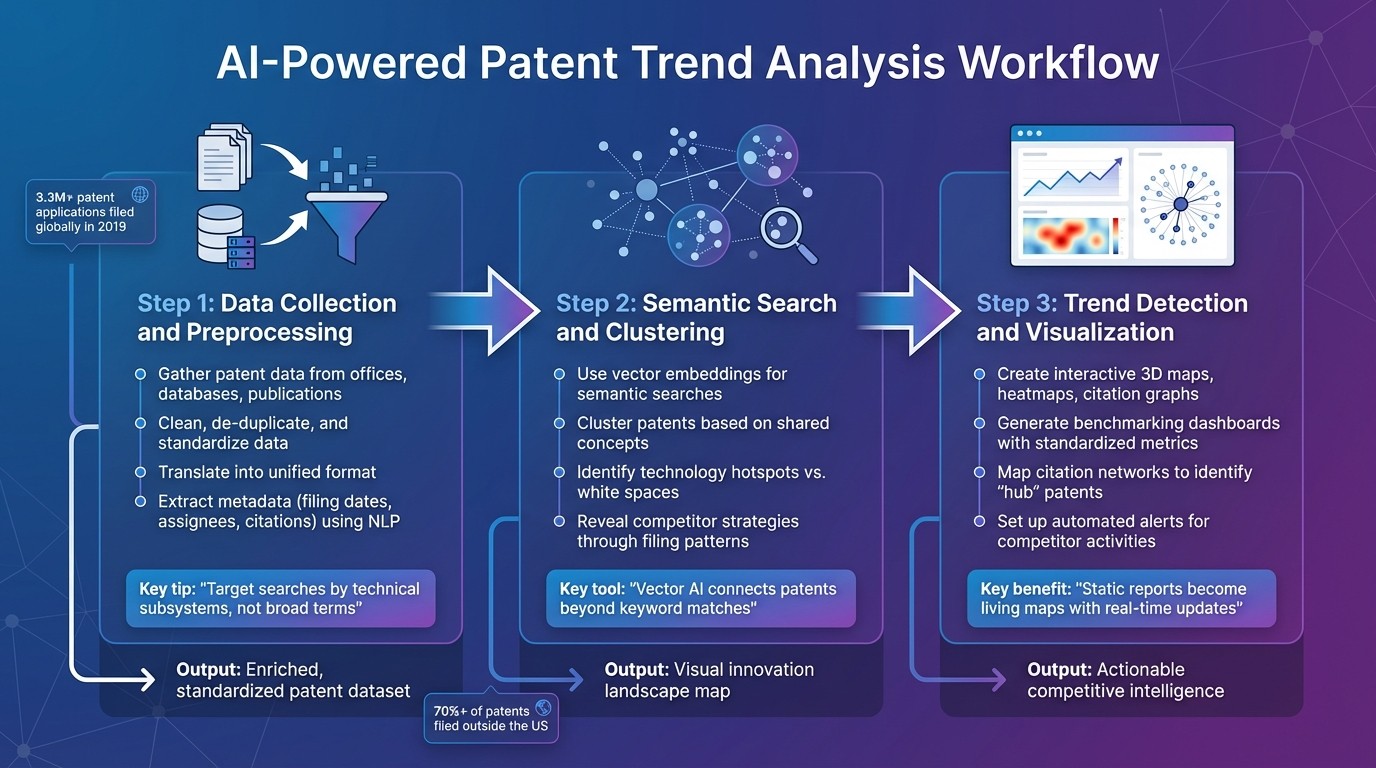
AI-Powered Patent Trend Analysis: 3-Step Workflow from Data Collection to Competitive Insights
AI-powered patent trend analysis follows a systematic approach, turning raw patent data into insights that can guide competitive strategies. This workflow starts with gathering and preparing data and ends with visual tools that highlight competitor investments and potential opportunities.
Step 1: Data Collection and Preprocessing
AI systems gather patent data from a variety of sources, including patent offices, commercial databases, and relevant publications. The data is then cleaned, de-duplicated, and standardized to ensure consistency across classification systems. It’s also translated into a unified format, consolidating records when the same invention is filed in multiple jurisdictions.
Metadata enrichment plays a key role here. Natural Language Processing (NLP) tools extract essential details like filing dates, priority dates, assignee names, and citation networks - even when this information is buried in dense legal text. For effective data collection, it’s better to target searches by technical subsystems (e.g., model architecture or deployment methods) rather than using overly broad terms like "Generative AI." This approach avoids creating disorganized datasets. Including scientific publications and market reports alongside patents adds depth to the analysis, offering context that patent documents alone may lack.
Once the data is prepped and enriched, the system moves on to identifying deeper patterns.
Step 2: Semantic Search and Clustering
Using vector embeddings, AI enables semantic searches that cluster patents based on shared concepts, even if different terminology is used. This step produces a visual representation of the innovation landscape, showing areas of dense patent activity (technology hotspots) and areas with little activity (potential opportunities).
Clustering algorithms also identify links between technology groups, helping to spot trends as they emerge. By monitoring filing patterns within these clusters, AI can reveal competitor strategies - whether they’re entering new markets or shifting focus to different technologies. Tools like Patently leverage Vector AI to connect patents that traditional keyword searches might overlook.
These insights set the stage for the next step: visualizing trends.
Step 3: Trend Detection and Visualization
AI tools create interactive visualizations - such as 3D maps, heatmaps, and citation graphs - that display clusters based on semantic relationships. These visual tools highlight innovation hubs and provide a clear view of emerging competitor strategies. Citation network graphs are particularly powerful, mapping forward and backward citations to identify "hub" patents that serve as critical foundations for future innovations.
Benchmarking dashboards offer another layer of insight. These dashboards standardize metrics like allowance rates and office action counts, adjusting for variables like examiner workload and art unit speed to ensure fair comparisons. By clustering results by both technical subsystems and assignees, you can pinpoint where competitors are focusing their R&D efforts. Automated alerts can also be set up to notify you when competitors file in new technology areas or when office action counts deviate from the norm.
This combination of semantic analysis and dynamic visualizations transforms static patent reports into continuously updating "living maps", offering a real-time view of the innovation landscape.
How AI Enables Competitive Benchmarking
Once the patent landscape is mapped and trends are identified, AI takes those insights a step further by turning them into competitive benchmarks. These benchmarks, built on detailed visualizations, help businesses directly assess their position in the market.
Generating Comparative Insights
Using natural language processing (NLP), AI uncovers connections between technologies, even when they're described differently. This ability translates into clear benchmark comparisons. Automated clustering and mapping make it possible to compare patent portfolios, revealing "patent walls" created by competitors and identifying gaps - or "white spaces" - where patent protection is lacking.
For example, a clean-tech company used this approach to study competitor patents in water purification. They discovered that rivals' membrane technologies had durability issues and filed patents for improved alternatives. This benchmarking insight helped the company double its capital raise during investor presentations. Such cases show how targeted benchmarking can uncover market opportunities and lead to strategic, revenue-boosting decisions.
AI also tracks the movement of inventors between companies, offering early signals of strategic changes before new products hit the market. A fintech startup, for instance, noticed a shift in patent filings by a traditional bank - from backend settlement systems to real-time transaction verification. Acting quickly, the startup secured patents in this area to capture market share.
"Patents are forward-looking indicators of a competitor's strategy." – PowerPatent
Customizable Benchmarking with AI
AI doesn't just generate insights - it customizes them to meet specific strategic goals. Platforms like Patently provide tailored benchmarking reports based on user-defined metrics. Instead of offering generic data, these tools allow users to focus on criteria like technology clusters, filing speed, claim breadth, and geographic coverage. This helps businesses pinpoint market leaders and identify new opportunities.
Patently's Vector AI takes this further with semantic search capabilities, uncovering patent connections that traditional keyword searches might miss. Its analytics also transform complex legal data into easy-to-understand visual maps and dashboards, making the information accessible to product managers, engineers, and investors alike.
Real-time monitoring adds another layer of value. AI can send automated alerts when competitors file new patents or when activity spikes in a specific tech area. For example, a robotics startup detected a surge in patent filings by a major logistics company. By mapping dependencies, they realized the larger company needed their protected designs. This early insight allowed the startup to refine its competitive positioning.
These tailored benchmarks empower stakeholders to craft precise IP strategies that strengthen their market advantage.
Turning Insights into Action with AI Reports
Once the patent landscape is mapped and benchmarks are established, the next step is turning those insights into strategic actions. AI-powered benchmarking reports play a key role in this process, helping to translate raw data into clear strategies tailored for R&D teams, investors, and executives. These reports cut through the complexity of patent documents, providing actionable guidance.
Automated Reporting and Recommendations
Top AI patent tools simplify the process of converting patent data into business intelligence. These reports highlight the strengths and risks associated with potential moves, offering clarity on whether to invest in emerging technology areas, steer clear of saturated markets, or fast-track filings to secure untapped opportunities.
For investors, AI-generated reports provide "proof of defensibility" by comparing a company’s IP portfolio with its competitors. This approach shifts patent analysis from being a purely legal task to a strategic tool that can drive revenue. Additionally, AI supports proactive freedom-to-operate evaluations, enabling product teams to design around existing patents and avoid potential legal conflicts before committing significant resources.
"A patent landscape is not just a collection of documents. It is a living map of where innovation has already happened, where it is happening right now, and where it is likely to happen next." – PowerPatent
Traditional, manually created reports often lag behind market changes as new filings emerge. AI eliminates this delay by analyzing thousands of patents in seconds, summarizing complex legal language into easy-to-digest insights. This evolution transforms patent analysis into a forward-looking, strategic tool, capable of providing immediate, actionable intelligence. The result? A foundation for continuous, real-time monitoring.
Continuous Monitoring for Real-Time Insights
Beyond automated reports, continuous monitoring ensures that insights stay current as the patent landscape evolves. The most effective AI reports are no longer static documents but dynamic dashboards that update automatically with every new patent filing. These systems provide "always-on awareness", notifying teams immediately when competitors file new patents or when activity spikes in key technology areas.
Patently’s project management tools take this a step further by integrating real-time insights directly into workflows. This integration shifts patent strategy from a reactive, defensive measure to a proactive approach that helps shape innovation from the start.
"Instead of relying on occasional research reports or industry rumors, you can see in real time how competitors are positioning themselves through their filings." – PowerPatent
Conclusion
AI-driven methods have reshaped the landscape of patent strategy, streamlining processes like patent trend analysis and competitive benchmarking. By leveraging Natural Language Processing to interpret the often complex technical language of patents, AI eliminates the need for outdated keyword-based searches. This ensures no critical connections are missed, turning what used to take weeks of manual effort into tasks completed in mere seconds.
One of the most impactful changes is the move from static reports to continuous, real-time monitoring. AI-powered platforms now offer an "always-on" approach, alerting teams instantly when competitors file patents in crucial technology areas or when citation activity spikes around emerging standards. This evolution shifts patent strategy from being purely defensive to a proactive force that drives growth, influences product planning, and identifies untapped opportunities before markets become saturated.
Platforms like Patently integrate these capabilities into a single, user-friendly tool tailored for patent professionals. Features such as semantic search with Vector AI, automated clustering, and visualization tools ensure insights aren't confined to legal teams. Instead, R&D departments, engineers, and executives can access the same real-time intelligence, making intellectual property strategy a shared, cross-functional asset rather than a siloed function.
The numbers speak volumes: AI can process thousands of patents in seconds - something humans simply cannot match. Beyond speed, AI combines diverse data sources - like citation trends, litigation histories, and filing patterns - to forecast which innovations are likely to shape future industry standards. This isn't just about efficiency; it's about making smarter, evidence-backed decisions in a constantly shifting landscape.
For patent professionals, the opportunity to integrate AI into their strategies is now. Those who embrace these tools can transform traditional legal workflows into engines of growth, gaining a competitive advantage by spotting trends, mitigating risks, and securing strategic opportunities before others even recognize them.
FAQs
What data do I need to start AI patent trend analysis?
To kick off an analysis of AI patent trends, the first step is collecting the right data. This includes patent documents, filing records, citation data, and technical claims specific to your industry or technology focus. Having a detailed dataset allows AI tools to uncover connections, spot emerging patterns, and outline the competitive landscape with precision.
How does semantic search find relevant patents without exact keywords?
Semantic search helps uncover relevant patents by analyzing the core concepts and technical terminology within them. Unlike traditional keyword-based methods, it allows AI to grasp the ideas behind the text, going beyond exact word matches. This means the focus shifts to understanding the meaning of inventions rather than simply relying on specific keywords.
How can I use AI benchmarking results to choose R&D priorities?
AI benchmarking results play a key role in shaping research and development (R&D) strategies. By analyzing patent trends, competitive positioning, and the broader technological landscape, these tools highlight areas of growth and innovation. They help pinpoint emerging technologies, identify innovation hubs, and reveal gaps or overly saturated spaces in the patent ecosystem. This insight enables you to target high-potential opportunities, steer clear of crowded markets, and allocate resources more effectively to achieve better results.