10 Features of AI Semantic Search for Patents
Intellectual Property Management
Apr 7, 2026
Semantic AI patent search finds prior art by meaning, not keywords—improving recall, speeding searches and matching across languages and citations.
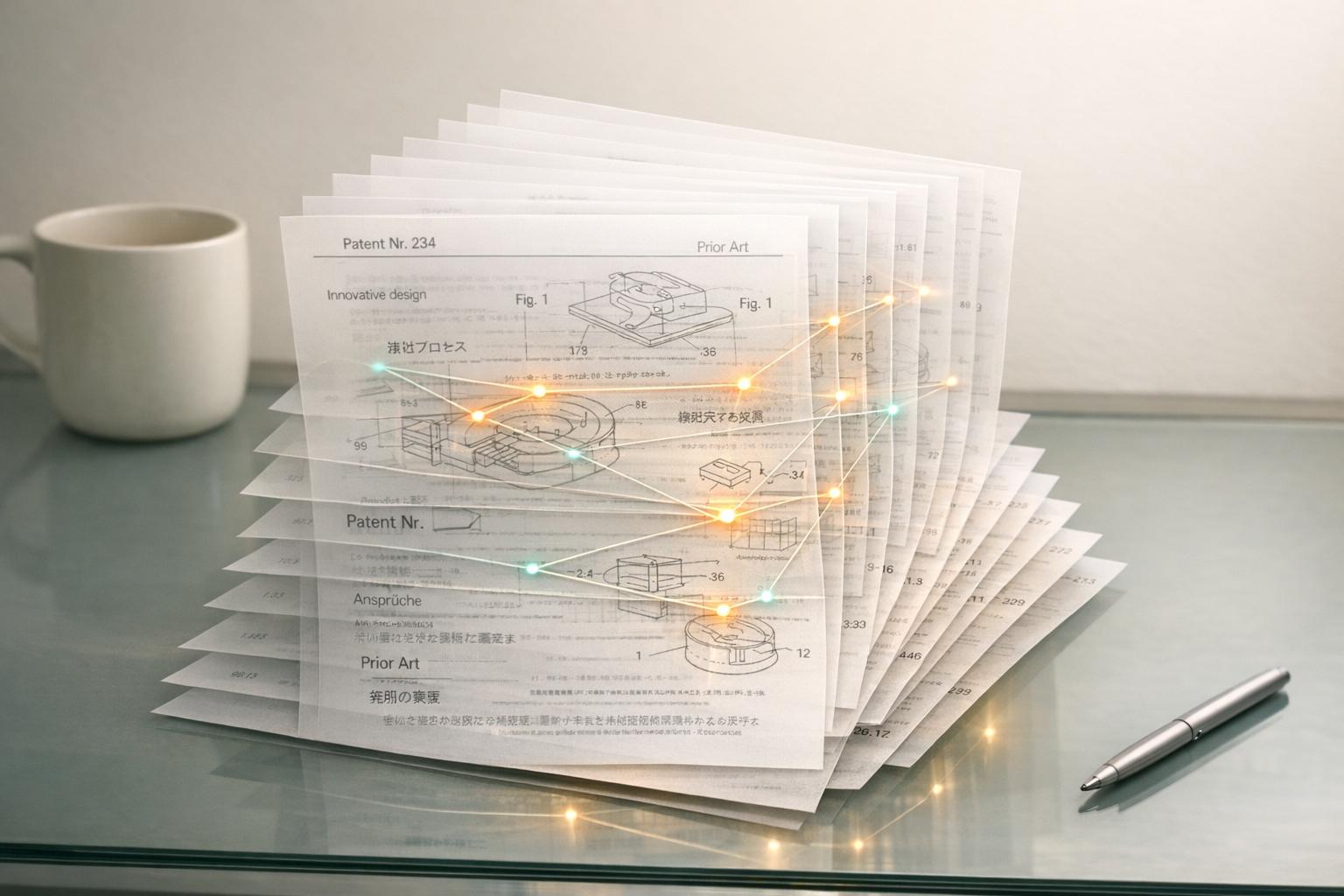
AI semantic search is transforming patent discovery by focusing on meaning rather than exact keywords. Traditional searches often miss 20–40% of relevant results due to vocabulary mismatches, but semantic search bridges these gaps. Here’s a quick overview of its key features:
Natural Language Query Processing: Search with plain English instead of complex Boolean strings.
Concept-Based Matching: Finds patents using similar ideas, even with different terminology.
Semantic Relevance Ranking: Prioritizes results based on conceptual similarity, not keyword frequency.
Synonym and Terminology Expansion: Automatically includes related terms and translations.
Citation Network Integration: Maps backward and forward citations to uncover connected patents.
Multi-Jurisdictional Coverage: Consolidates global patent databases and handles language differences with AI-enabled patent analysis.
Image and Multimodal Search: Matches technical drawings and images with text for precise results.
Classification Code Suggestions: Recommends relevant IPC/CPC codes based on your input.
Highlighting Key Sections: Pinpoints the most relevant parts of long patent documents.
Combined Search Modes: Merges semantic and keyword searches for better accuracy and efficiency.
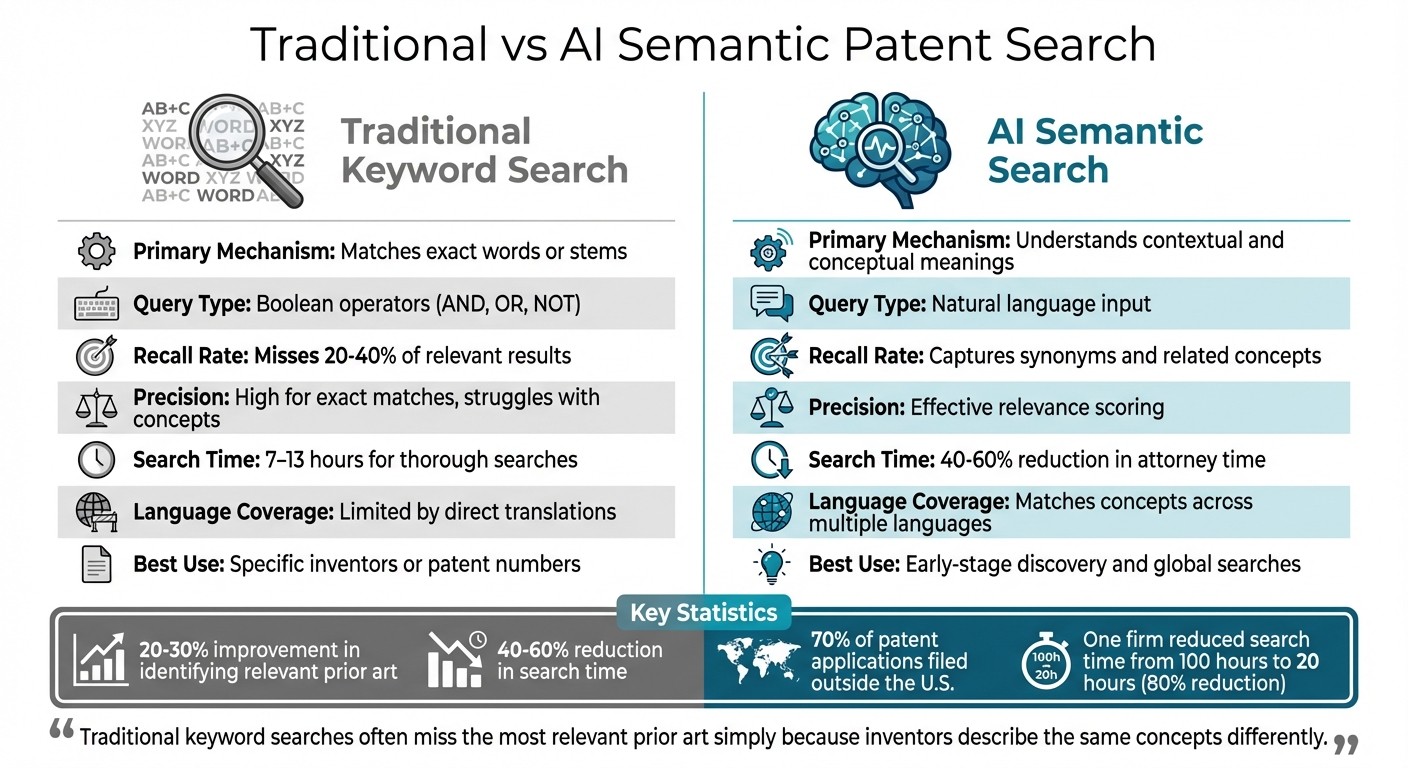
AI Semantic Search vs Traditional Keyword Search for Patents
Understanding PatSeer's AI Patent Search: A Guide to LLM-Driven Technology
1. Natural Language Query Processing
One of the biggest challenges in patent searches is dealing with vocabulary mismatches. For instance, one inventor might refer to their creation as a "mobile apparatus", while another simply calls it a "phone." Traditional keyword searches treat these terms as entirely unrelated, often leading to incomplete results. Natural Language Query Processing (NLQP) changes the game by focusing on the meaning behind your words, rather than just the exact terms you use. This allows for faster and more precise searches using top patent tools.
With NLQP, you can skip complicated Boolean operators and instead describe what you're looking for in plain English. For example, you could type, "Find patents about AI systems that improve industrial process efficiency", and the system will interpret your intent. It translates your query into multi-dimensional vector representations, enabling it to locate patents that are conceptually similar - even if they don’t share the same keywords.
This method is particularly useful for bridging the gap between current terminology and the language found in older patents. By focusing on concepts rather than exact wording, NLQP ensures that modern and historical patents can be connected seamlessly. Research shows that using semantic AI search can boost the identification of relevant prior art by 20-30%, while cutting down search time by 40-60% compared to traditional approaches.
"Semantic search understands what you mean, not just what you say - finding critical prior art that keyword searches leave hidden." - PatentScanAI
To get the best results, include specific details in your query. This helps the system quickly zero in on the most relevant patents.
2. Concept-Based Matching
Natural Language Query Processing helps decipher what you're asking, but concept-based matching takes it further by focusing on how answers are found. Instead of relying on exact word matches, AI tools transform your query and patent documents into numerical vectors that represent their meanings. Algorithms like K-Nearest Neighbors (KNN) then calculate the distances between these vectors to uncover patents that are conceptually similar. By incorporating structured knowledge graphs, the system also identifies relationships within hierarchies - like recognizing that a "lithium-ion battery" falls under the broader category of "rechargeable energy storage devices". This approach expands the semantic connections beyond what natural language processing alone can achieve.
One standout benefit is its ability to tackle the vocabulary mismatch problem. For example, a search for "autonomous vehicle navigation" might overlook a patent describing "computerized path planning for self-directed mobile platforms", even though both address the same challenge. Similarly, terms like "wireless power transmission" and "contactless energy transfer" describe identical concepts but might be treated as unrelated in traditional keyword searches.
By bridging these gaps, concept-based matching improves both precision and recall. It excels at linking modern technical terms with older patents that used different language, ensuring no relevant prior art is missed. This even extends across languages, connecting phrases like the English "data processing" with the German "Datenverarbeitung" based on their shared conceptual meaning.
For patent professionals, this means uncovering a wider range of relevant prior art, especially during critical stages like the early invention disclosure phase, when technical terms are still evolving. It’s also invaluable for global freedom-to-operate searches, where terminology varies across jurisdictions.
The core distinction lies in how matching works. Traditional searches focus on exact character strings, while concept-based matching interprets the technical intent and function behind the words. This contextual understanding allows it to link terms like "battery management" with "power optimization", even when no keywords overlap.
3. Semantic Relevance Ranking
Advances in natural language processing and concept-based matching have made semantic relevance ranking a game-changer for refining search results. Instead of relying solely on keyword frequency, this approach prioritizes patents that align closely with your technical intent. Here's how it works: AI measures the semantic distance between your query and the content of each patent. The closer the match, the higher the patent appears in the results. This ensures that the most relevant patents - those that truly match your intent - are front and center.
Traditional keyword-based searches often fall short, missing 20–40% of relevant prior art due to mismatched vocabulary. Plus, these searches typically take 7–13 hours of attorney or staff time. By incorporating a semantic discovery phase, you can cut that time down to 4–6 hours while also improving accuracy. This method increases the identification of relevant prior art by 20–30%. For instance, the AI recognizes that terms like "deceleration actuator" and "brake pedal" describe the same function, even if they share no keywords.
"The system then calculates similarity scores to rank results by conceptual relevance rather than keyword frequency."
– PatentScanAI
Modern systems go a step further by offering relevance scores and confidence indicators for each result. These features explain why a patent ranks highly, even if it uses completely different terminology to describe the same technical solution. This transparency not only saves time but also ensures that critical prior art doesn't slip through the cracks.
4. Synonym and Terminology Expansion
Synonym and terminology expansion builds on semantic relevance ranking to make searches more precise by addressing language differences. In patent searches, vocabulary mismatches are a common challenge - different people often use different terms to describe the same idea. For example, while one patent might mention "machine learning", another might use terms like "statistical pattern recognition" or "artificial neural networks" to describe the same technology.
AI-powered semantic search simplifies this by automatically including synonyms and technical equivalents in queries. Instead of crafting complex Boolean strings like (wireless OR contactless) AND (power OR energy), you can simply search for "wireless charging for electric vehicles", and the AI will handle the rest . By converting your query into mathematical vector embeddings that focus on meanings rather than specific words, the system can identify documents with similar concepts even if they don’t share any keywords .
This technology bridges linguistic gaps by recognizing functional equivalents, evolving terminology, and even translating across languages. For instance, it links terms like "brake pedal" with "deceleration actuator" and connects English "brake system" with German "Bremssystem" . It seamlessly handles cross-language queries, mapping terms across different languages without additional effort .
"The breakthrough is the shift from lexical matching (specific words) to conceptual understanding (relevant ideas, regardless of terminology)." – Patlytics
This enhanced approach not only improves search precision but also significantly speeds up the process. Traditional methods for comprehensive prior art searches typically take 7–13 hours of attorney time. With AI-powered semantic tools, search time can be cut by 40–60%, all while improving accuracy. For example, one Am Law 100 firm managed to reduce the time spent on complex patent searches from 100 hours to just 20 billable hours - an 80% reduction. This efficiency ensures that important prior art isn’t overlooked due to differences in wording.
5. Citation Network Integration
Citation network integration takes the insights from semantic matching and language processing a step further by uncovering relationships that traditional methods often overlook. With AI-driven semantic search, static reference lists transform into dynamic networks that include backward citations (older patents referenced by the current one) and forward citations (newer patents that cite the current one). This dynamic approach adds depth to earlier techniques, offering a richer understanding of patent relevance.
This method is particularly useful for identifying key "hub" patents - those foundational inventions that have significantly influenced subsequent developments within a specific technology domain. By examining these networks, professionals can trace the evolution of early ideas into modern applications. It also helps uncover connections between patents that might use different terminology but share underlying concepts.
Backward citation analysis focuses on foundational technologies and highlights gaps in research and development.
Forward citation analysis tracks later references to measure a patent's influence on technological advancements.
These insights are invaluable for strategic decision-making, such as identifying high-value patents for licensing or gathering evidence for litigation. For example, backward citation analysis can pinpoint areas in a technology field that are underexplored, offering opportunities for innovation. On the other hand, monitoring forward citations can help identify emerging competitors or potential collaborators.
Modern AI tools, like Patently's forward and backward citation browser, simplify this process by normalizing data. This eliminates issues like variations in assignee name spellings, which can disrupt traditional citation tracking.
Interactive citation graphs further enhance this analysis by visually mapping critical connections. These graphs are particularly useful for building invalidity cases or understanding the broader impact of a patent.
However, it's important to note that citation counts alone don't always reflect quality. A citation might be procedural, examiner-driven, or strategically placed. To truly assess a patent's value, cross-check citation data with scientific literature and industry reports to gauge its practical significance.
6. Multi-Jurisdictional Coverage
Patent professionals dealing with international filings face a daunting reality: over 70% of patent applications are filed outside the United States. This means that critical prior art is scattered across a staggering 130–200 million documents worldwide. AI semantic search simplifies this complexity by consolidating data from multiple jurisdictions - such as the USPTO, EPO, WIPO, and various Asian patent offices - into one unified search platform. This approach helps navigate the challenges posed by linguistic and legal differences.
One of AI's strengths lies in breaking down language and legal system barriers. Traditional keyword searches often fall short when technical terminology varies across regions. For instance, a German patent might use "Datenverarbeitung", while a U.S. patent refers to "data processing." AI models trained on multilingual patent datasets recognize these terms as equivalent through semantic vector embeddings. This capability is especially important since about 25% of Chinese patents contain technical details that are unavailable in English.
"Semantic models trained on multilingual patent corpora can find conceptually similar patents across language barriers, understanding that German 'Datenverarbeitung' and English 'data processing' represent the same concept." - PatentScanAI
AI also extends its capabilities beyond text. Using computer vision, AI-powered image search can match design patents across global jurisdictions, bypassing the limitations of language-based descriptions. This multimodal approach is invaluable for tasks like Freedom to Operate (FTO) analyses or creating comprehensive patent landscapes that span multiple countries.
When choosing an AI tool for international patent work, ensure the platform covers the regions you need. Some tools provide excellent coverage for the U.S. and Europe but may lack depth in Asian jurisdictions. Additionally, using natural language descriptions instead of complex Boolean strings can improve results, as they translate more effectively across different legal frameworks and filing systems. While AI-powered platforms may cost 20%–40% more than traditional databases, they often deliver a 3x to 5x ROI by significantly reducing attorney hours.
7. Image and Multimodal Search
Sometimes, words just don’t do justice when describing an invention. That’s where AI-powered image search steps in, letting patent professionals upload technical drawings, diagrams, or photos to uncover patents with visually similar content. This is especially useful for areas like mechanical designs, chemical structures, or engineering schematics - fields where visuals often capture details that text alone can’t fully convey. By adding this layer to text-based analysis, image search makes patent discovery even more effective.
Modern tools go beyond simple image processing. Using multimodal models like GPT-4o, GPT-4o mini, and advanced systems like Microsoft’s UDOP and Pix2Struct, both text and images are translated into multi-dimensional vectors. This means you can now run combined visual and textual searches for highly precise results. For instance, you could query a diagram directly or pair it with a written description to refine your search.
Platforms have also introduced features like interactive legends, tooltips, and a "Drawings Only" view, which simplify the review of design patents and make tasks like Freedom to Operate analyses more efficient.
AI takes it further by interpreting specialized visuals that traditional tools might miss. Think chemical structures, technical diagrams, or even mathematical formulas - these are automatically analyzed for patterns, much like how semantic matching works for text. Some platforms even extend this capability to external materials, such as product images or demo videos, to help identify prior art in invalidity cases.
To get the most out of these tools, consider setting up image-based alerts to track newly filed patents with similar designs. For complex inventions, combining a natural language description with an uploaded technical drawing ensures a thorough search. This multimodal approach makes it easier to catch relevant prior art that might not match textually but shares visual similarities.
8. Classification Code Suggestions
AI has made navigating the immense world of patent classification much easier, leveraging advanced semantic and multimodal search capabilities. With approximately 70,000 IPC codes spread across 130 million patents, manual navigation is overwhelming. Now, AI tools can analyze your search query or technical disclosure and automatically suggest relevant classification codes.
These tools work by converting your input into vectors that capture its underlying meaning. They then match these vectors with classification codes tied to similar concepts, focusing on the technical content rather than just the words used. For instance, they can distinguish between the term "battery" as it applies to electronics versus its use in artillery by examining the surrounding context.
"The breakthrough is the shift from lexical matching (specific words) to conceptual understanding (relevant ideas, regardless of terminology)." - Patlytics
AI models are trained using millions of previously categorized patent documents, which helps them understand the relationship between technical descriptions and specific classification codes. Some tools take this further by asking clarifying questions - like whether your focus is on hardware or software - to refine their suggestions. They often include confidence scores for each recommendation, giving insight into how well the suggested IPC or CPC codes align with your technical field.
The time savings are substantial. For example, biotechnology companies can save an estimated 10–15 hours per patent application with AI-assisted tools. Similarly, reports show these tools can cut the time spent on complex patent searches and counseling by up to 80%. To improve accuracy, it’s best to provide a detailed abstract or full technical disclosure rather than just a title. While AI simplifies the process of narrowing down classification codes, it’s crucial to have a human expert review the final selections to ensure they meet all legal and technical standards.
9. Highlighting Key Sections
AI-powered semantic search takes things a step further by automatically highlighting the most relevant sections of a patent document, making it easier to zero in on critical details. Patent documents can be lengthy, filled with dense technical jargon and intricate claim structures. Instead of wading through dozens of pages, this technology identifies and highlights sections that align with your query - saving time and effort. This streamlined approach allows for detailed analysis at the paragraph and claim level.
Here’s how it works: the system converts both your query and the patent text into vector embeddings, which essentially capture the meaning of the text. By comparing the semantic distance between these embeddings, it can locate relevant sections even when different terminology is used.
On top of that, the technology refines the process by narrowing down relevance to specific paragraphs or claims, rather than evaluating the entire document. This means you’re directed straight to the technical descriptions or claim elements that match your search intent. Many tools also provide similarity scores and KWIC (Key Word In Context) snippets to give you a clearer picture of why a section was highlighted.
"The best semantic search tools provide... concept highlighting showing which parts of patents match your query intent." – PatentScanAI
Titles and abstracts of patents can often be vague, leaving out critical technical details. AI highlighting bridges this gap by bringing those details to the forefront. Take patent US9486553B2, for example, titled simply "Method." The title alone doesn’t reveal much, but with AI-powered highlighting, you can quickly see the technical specifics that caused it to match your query. Traditional keyword searches tend to miss 20% to 40% of relevant prior art due to mismatched vocabulary. Semantic highlighting, on the other hand, improves recall by uncovering conceptually related sections that might otherwise go unnoticed.
10. Combined Search Modes
Blending the strengths of semantic and keyword searches can create a more efficient and effective search process. By combining these methods, you can harness the precision of Boolean operators while also capturing the broader, conceptual insights that AI-powered semantic search provides.
Here’s why this matters: keyword searches are excellent for pinpointing exact technical terms. However, they can miss a significant portion - 20% to 40% - of relevant prior art because inventors often use different terminology. On the other hand, semantic search excels at uncovering conceptual matches and alternative language variations. By merging these two approaches, you can ensure a more thorough and accurate discovery process.
A practical way to implement this is through a three-phase workflow:
Begin with broad semantic searches to identify alternative terms and concepts.
Narrow your focus using targeted keyword searches.
Validate and refine results with precise Boolean logic.
This hybrid approach not only improves accuracy but also saves time. It can cut total search time from 7–13 hours to just 4–6 hours while increasing the identification of relevant prior art by 20% to 30%.
The efficiency gains are impressive. For a firm handling 20 patent applications monthly, this method can save 60–100 attorney hours, translating to $18,000–$60,000 in billable time. One Am Law 100 firm reported reducing the time spent on complex patent counseling by 80%, slashing 100 billable hours down to just 20 with the help of AI tools.
As PatentScanAI emphasizes:
"The question isn't whether to adopt semantic search technology - it's how quickly you can integrate it into your workflow." – PatentScanAI
Comparison Table
Here's a breakdown of how traditional keyword-based patent searches stack up against AI-driven semantic searches:
Feature | Keyword-Based Search | AI Semantic Search |
|---|---|---|
Primary Mechanism | Matches exact words or stems | Understands contextual and conceptual meanings |
Query Type | Uses Boolean operators like AND, OR, NOT | Allows natural language input |
Recall | Misses 20–40% of relevant results | Captures synonyms and related concepts, improving recall |
Precision | High for exact matches but struggles with concepts | Scores relevance effectively for better precision |
Search Time | Takes 7–13 hours for thorough searches | Reduces attorney time by 40–60% |
Language Coverage | Limited by direct translations | Matches concepts across multiple languages |
Best Use Case | Ideal for specific inventors or patent numbers | Perfect for early-stage discovery and global searches |
AI semantic search offers clear advantages, cutting search time by nearly half while identifying 20–30% more relevant prior art. Its ability to bridge language gaps is especially critical, as over 70% of patent applications are filed outside the U.S.. For instance, it can find relevant patents in German or Japanese that keyword searches might miss.
"Traditional keyword searches often miss the most relevant prior art simply because inventors describe the same concepts differently." – PatentScanAI
This mismatch in vocabulary can lead to critical prior art being overlooked, potentially delaying prosecution efforts by months. The comparison highlights how AI semantic search improves both speed and accuracy, making it a powerful tool for comprehensive patent analysis.
Conclusion
AI semantic search is transforming how patent prior art is discovered. By moving beyond exact keyword matching to a deeper conceptual understanding, these tools uncover relevant patents that traditional Boolean searches often overlook. This shift not only improves recall but also significantly reduces the time spent on searches. The ability to cross language barriers and identify functionally similar concepts, even when different terminology is used, makes semantic search a crucial tool in today’s global patent environment.
The impact on productivity is clear. For instance, a leading firm cut down complex patent counseling time from 100 hours to just 20. Likewise, a biotechnology company saved 10–15 hours per patent application by incorporating AI-assisted search and generative AI patent drafting tools into their processes. These advancements free up patent professionals to concentrate on strategic and higher-value tasks instead of time-consuming manual reviews.
Patently exemplifies these advancements with its robust platform. Patently's Vector AI combines these capabilities into a seamless system tailored for patent professionals. Managing an extensive database of over 82 million patent families and 135 million individual patents, the platform delivers real-time search results paired with automated relevance scoring. As Andrew Crothers, Creative Director at Patently, describes:
"With Elastic, it's like having a seasoned patent attorney guiding every search".
FAQs
When should I use semantic search vs keyword search for patents?
When dealing with complex language, synonyms, or abstract terms, semantic search is your go-to tool for identifying relevant prior art or related patents. It focuses on the meaning and context of the terms rather than just the exact wording. This approach minimizes the risk of overlooking results caused by differences in terminology, giving you more accurate and inclusive findings.
On the other hand, keyword search is ideal for simpler tasks, such as locating a specific patent number or searching for an exact phrase. However, if your goal is a deep and thorough analysis, semantic search stands out by better understanding the intent and context behind your query.
How does semantic search handle non-English patent documents?
Semantic search leverages AI-powered translation to transform patent documents written in other languages into English. This makes it easier for patent professionals to search for and understand prior art across various languages, ensuring more thorough and accurate results.
What should I type to get the best semantic patent search results?
When working with AI for patent searches, clear and detailed prompts are key. For example, instead of a broad query like "foldable smartphone", include specific details. Mention aspects like the type of technology, distinct features, intended applications, or the problem you're aiming to solve.
This approach provides the AI with the necessary context to better understand your request. As a result, it can produce patent search results that are far more relevant and targeted than what you'd get from basic keyword searches.