AI in Forward Citation Analysis: What to Know
Intellectual Property Management
Dec 10, 2025
AI streamlines forward citation analysis, mapping citation networks and using NLP/ML to speed patent insight, valuation, and monitoring.
AI is transforming forward citation analysis by making patent research faster, smarter, and more efficient. Forward citation analysis tracks patents that reference a specific patent in later filings, helping assess its impact on future innovations. Here's what you need to know:
Why it matters: A high forward citation count indicates influence, reveals trends, and highlights potential opportunities or risks in emerging fields.
AI's role: AI tools automate citation mapping, identify patterns, and analyze relationships between patents. They use natural language processing (NLP) and machine learning to find hidden links and evaluate patent value.
Key benefits:
Faster analysis: Tasks that took weeks can now be done in hours.
Better insights: AI highlights influential patents and emerging technologies.
Improved accuracy: AI uncovers implicit references and related prior art.
AI-powered forward citation analysis is reshaping how patent professionals monitor competitors, assess patent value, and make strategic decisions. While AI simplifies complex tasks, human expertise remains essential for interpreting results.
How AI Improves Forward Citation Analysis
AI is reshaping forward citation analysis by making patent research faster, smarter, and more visually accessible.
AI Capabilities for Citation Mapping
AI takes forward citation analysis to a whole new level, turning what used to be a tedious spreadsheet task into an automated, interactive process. Today’s AI tools create visual graph models where patents are represented as nodes, and their citations form the connecting edges. This approach makes it easier to spot patterns, like clusters of related patents, key "hub" patents, and how technologies evolve across different jurisdictions. For U.S. patent teams, these tools provide a clear picture of which newer patents cite their foundational assets, identify the most active competitors in similar fields, and even highlight "bridging" patents that link separate technology areas.
Using techniques like unsupervised learning and semantic embeddings, AI clusters forward-citing patents and calculates impact scores based on multiple factors, including graph metrics and the source of citations. For instance, imagine a U.S. patent on battery management. It might have fewer citations overall than a competitor's patent, but if its citations come from major automakers or utility companies in fast-growing sectors like EVs or grid storage, AI algorithms will flag it as strategically important.
Platforms like Patently incorporate semantic search powered by Vector AI alongside citation browsers, allowing users to explore forward and backward citation networks seamlessly within the same workflow. This advanced mapping not only provides a clearer view of a patent’s influence but also makes subsequent analysis much more efficient.
Efficiency Gains from AI
Beyond better mapping, AI dramatically boosts efficiency by cutting review times. What used to take days - or even weeks - can now be done in hours, or sometimes just minutes. Automated alerts notify teams in real time about new forward citations for U.S. patents, eliminating the need for manual periodic checks that risk missing key updates.
AI also ensures more thorough and accurate results by scanning the full text of patents, not just the structured citation fields, to uncover implicit references and related prior art that might otherwise go unnoticed. With natural language processing, AI can identify technically related patents even when they use different terminology or classifications - a common issue in both U.S. and international filings. To make things even better, AI typically narrows down results to the most relevant 1–5% of citations, which can then be reviewed by attorneys or junior staff. This pre-screening process reduces the workload for outside counsel and cuts costs significantly.
These efficiency gains mean faster competitive intelligence and quicker decision-making, giving patent teams a real edge in their workflows.
AI Techniques Used in Forward Citation Analysis
Modern forward citation analysis relies on three key AI techniques: citation network graph analysis, natural language processing (NLP), and machine learning for patent valuation. These methods work together to help patent professionals make more informed decisions, offering efficiency and clarity through visual tools and advanced analytics.
Citation Network Graph Analysis
Graph analysis treats patents as nodes and citations as edges, uncovering hidden connections within the patent ecosystem. Metrics like PageRank and betweenness centrality help refine how influence is measured. For example:
In-degree (or forward citation count) provides a basic measure of a patent's impact.
PageRank-style centrality assigns greater weight to citations from influential patents, helping teams prioritize which assets to maintain or license.
Betweenness centrality identifies "bridge" patents that connect different technology clusters, which is especially useful for cross-licensing or standard-essential patent (SEP) analysis.
Community detection algorithms further group patents into technology clusters, simplifying tasks like competitor analysis, domain-specific work allocation, and spotting gaps in innovation. Many U.S. patent teams now use interactive dashboards to visualize these metrics, filtering data by factors like filing year, technology class, or jurisdiction. This enables more strategic decision-making.
While graph analysis excels at mapping relationships, NLP adds another layer by interpreting the language within patents.
Natural Language Processing for Patent Text
NLP analyzes the text of patents - claims, specifications, and abstracts - to evaluate semantic similarities and technical relationships. Using methods like tokenization, lemmatization, and domain-specific embeddings (e.g., transformer models trained on patent data), NLP can identify related inventions even when they use different terminology.
This approach offers several practical benefits:
Claim-level parsing pinpoints specific elements referenced in other patents, aiding detailed freedom-to-operate assessments.
It identifies patents that are conceptually related but lightly cited, helping reveal design-around strategies and reducing manual review time.
NLP can also track how terminology evolves in citing patents, uncovering new subtopics or application areas.
With these capabilities, NLP enhances the efficiency of patent analysis while uncovering insights that might otherwise go unnoticed.
Machine Learning for Patent Valuation
Machine learning takes things further by combining citation and semantic data to assess a patent's value. These models integrate features like:
Citation-based metrics: Forward citation counts, citation trajectory, and network centrality.
Textual and semantic insights: NLP-derived similarity scores, claim complexity, and cluster membership.
Additional metadata: Family size, jurisdiction coverage, prosecution duration, and litigation history.
Using techniques like gradient-boosted trees and neural networks, machine learning models analyze historical data (like licensing revenue, litigation outcomes, and citation trends) to predict patent value and future citations. U.S. corporations use these probabilistic scores to:
Identify undervalued but strategically important patents for licensing.
Decide which patents to maintain or prune from their portfolios.
Estimate damages in infringement cases.
Practical Applications of AI-Driven Forward Citation Analysis
Competitor Monitoring and Patent Influence
AI tools are reshaping how patent teams monitor competitors by automatically identifying which patents cite a competitor's key assets. This process highlights crucial dependency links and provides valuable insights into a competitor's technological influence. For instance, when a competitor's patents receive a high number of forward citations, it often indicates that these patents have become central to ongoing technological advancements. If, for example, a competitor's patents in artificial intelligence are heavily cited, it could suggest their focus on that technology - opening opportunities to explore complementary or alternative innovations.
These AI systems go a step further by scoring patents based on citation strength and their network of relationships, covering a staggering 106 million patents globally. This capability allows companies to pinpoint a competitor's most strategically important patents and better understand their technological priorities. Regularly tracking forward citations can also uncover emerging players or disruptive innovators frequently citing key patents, offering early insights into shifting industry dynamics. Such intelligence becomes critical for evaluating patents' value in licensing or acquisition decisions.
Patent Valuation and Licensing Decisions
AI's advanced citation mapping techniques bring precision to patent valuation. A high forward citation count often signifies a patent's foundational role, enhancing its value for licensing or acquisition. By combining citation data with semantic analysis, AI provides more accurate patent valuations compared to traditional methods.
This AI-driven approach streamlines licensing decisions and strategic acquisitions by identifying high-impact patents quickly and effectively. It also categorizes patents based on their citation influence, helping companies allocate their resources to defend and maintain their most critical assets. Beyond valuation, AI's ability to analyze citations also improves risk assessments by uncovering overlooked prior art, ensuring a more comprehensive evaluation process.
Freedom-to-Operate and Prior Art Searches
AI's strengths in text and network analysis significantly enhance freedom-to-operate assessments. Traditional citation analysis often struggles with terminology inconsistencies, which can lead to missed prior art. AI-powered citation network analysis overcomes this limitation by mapping how patents reference one another, uncovering conceptual links that keyword searches might miss. For example, a patent titled "neural network for pattern recognition" could be relevant to "machine learning-based image analysis", demonstrating the value of AI in revealing hidden connections.
Natural Language Processing (NLP) further elevates AI's capabilities, enabling it to sift through vast amounts of patent text to identify relevant references. By analyzing citation links in both directions, AI can uncover prior art that might otherwise go unnoticed, resulting in a more thorough risk assessment. Additionally, focusing on dense forward-citation clusters and patents with strong influence metrics can help identify potential blocking risks and pinpoint assets requiring licensing agreements.
Adding AI Forward Citation Analysis to Patent Workflows
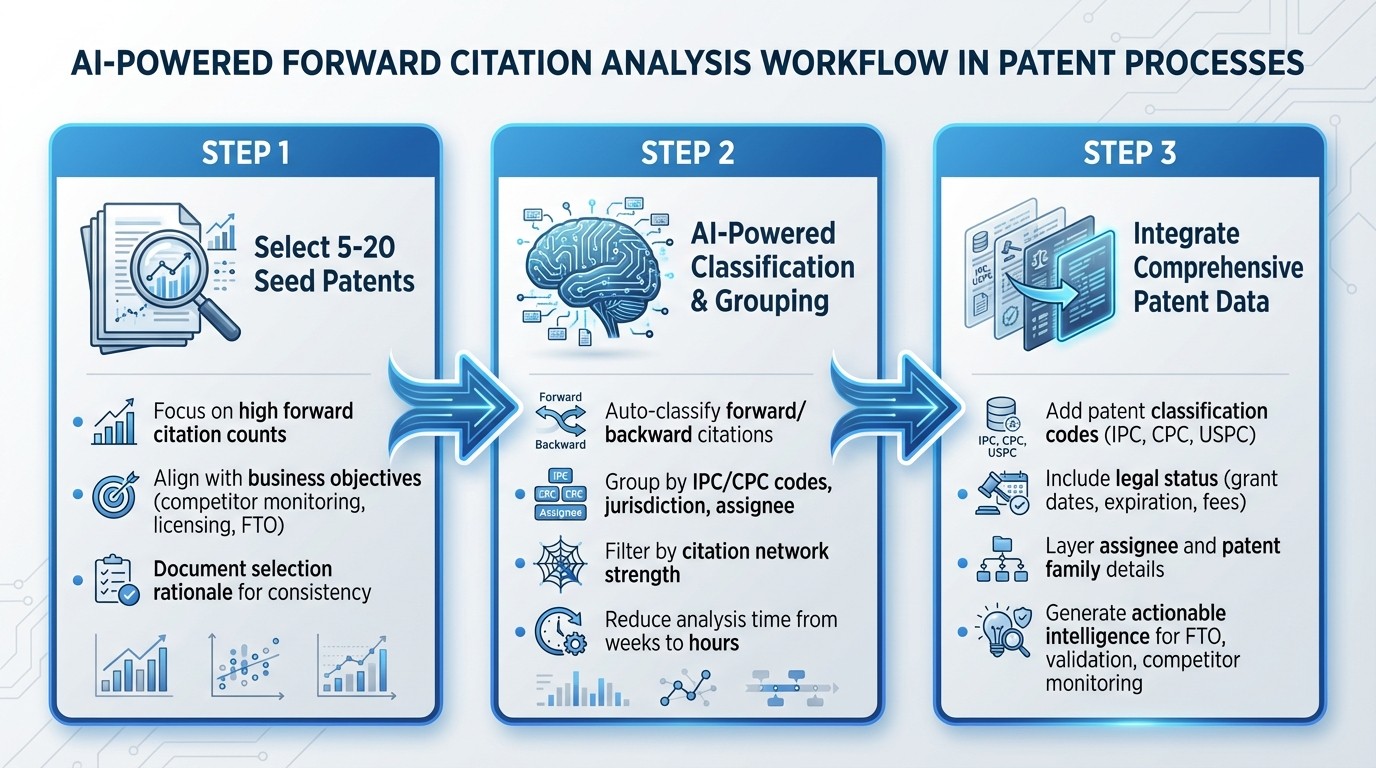
How to Integrate AI Forward Citation Analysis into Patent Workflows: 3-Step Process
Starting with a Core Patent Set
The first step is selecting 5–20 seed patents that align with your specific business objectives. Focus on patents with a high number of forward citations. These are patents frequently referenced by later filings, indicating their relevance and influence in the field. When making your selections, consider your goals - whether it's monitoring competitors, evaluating licensing opportunities, or conducting freedom-to-operate analyses. Documenting the rationale behind your choices is crucial. It ensures consistency in future comparisons and keeps the analysis centered on relevant technological advancements.
Using AI Tools for Citation Grouping and Filtering
AI-powered tools can streamline the process of analyzing patent citations. Using machine learning, these platforms automatically classify citations as forward or backward, helping professionals trace the flow of ideas and technology between patents. They also group citations based on criteria like IPC/CPC codes, jurisdiction, assignee type, and citation network strength.
For example, filtering citations by jurisdiction reveals which geographic regions are most active in developing your technology. Grouping by assignee can highlight which competitors or research institutions are building on your work. Additionally, technology-based grouping can uncover emerging trends. If a particular field starts generating more forward citations, it may signal a growing area with significant potential. These tools drastically cut down analysis time, turning what used to take weeks into a matter of hours. This efficiency paves the way for integrating citation insights with broader patent data.
Combining Citation Data with Other Patent Information
Once AI tools have grouped and filtered citation data, combining it with other patent information can provide a deeper understanding of the technology landscape. For instance, integrating forward citation data with patent classification codes (IPC, CPC, USPC) offers a standardized view of technological categories. Adding information about patent families, legal statuses (such as grant dates, expiration dates, and maintenance fees), and assignee details can reveal how patent portfolios evolve over time and whether patents are still enforceable.
Platforms like Patently enhance this process by offering features like AI-assisted patent creation and advanced semantic search powered by Vector AI. These tools allow users to visually explore patent families, apply targeted filters (e.g., by owner or date), and collaborate through shared comments and ratings. By combining citation data with broader patent insights, this approach turns raw information into actionable intelligence. It supports thorough analyses for tasks like assessing novelty, validating patents, evaluating freedom-to-operate, and monitoring competitors effectively.
Conclusion
Key Takeaways
AI has revolutionized forward citation analysis, turning a time-intensive manual task into a streamlined, automated process. Patent professionals can now pinpoint influential citing documents and detect emerging clusters of technological innovation with far greater efficiency. Beyond just speeding up the process, AI offers deeper insights by mapping citation networks, analyzing semantic links, and assessing the influence of patents - going well beyond simple citation counts.
This AI-powered approach enhances key tasks like freedom-to-operate searches, prior art discovery, portfolio management, and competitive analysis. It uncovers patents connected by concepts that traditional keyword searches might overlook. By analyzing citation networks, professionals can identify foundational patents, spot crowded tech spaces, and even locate untapped opportunities. For U.S. patent teams, this means making better-informed, evidence-backed decisions based on richer data.
However, human expertise remains irreplaceable. While AI highlights patterns and potential candidates, attorneys and analysts must interpret the legal, technical, and business implications - especially in high-stakes areas like litigation or licensing. Tools like Patently demonstrate how forward citation intelligence can seamlessly integrate into daily workflows, making these insights more accessible than ever.
As AI continues to evolve, its role in patent research is only expected to grow.
Future of AI in Patent Research
AI is poised to become a strategic partner for patent professionals, helping them anticipate technological trends and identify emerging risks. For instance, graph neural networks are already capable of predicting future citations by analyzing patent text and citation structures. This capability could help forecast which applications will gain significant attention, guiding decisions on continuations and licensing strategies. With advancements like semantic graphs, full-text similarity analysis, and predictive tools, forward citation analysis is likely to become a seamless part of routine patent work rather than a specialized task.
Teams that invest in AI tools and skill development today will be better positioned to leverage these advancements. Rather than replacing attorneys, agents, or analysts, AI will enhance their ability to handle complex, data-intensive tasks like forward citation analysis - allowing them to deliver deeper insights within tight timeframes and budgets. The future promises a more dynamic and efficient approach to patent analytics, with AI amplifying human expertise every step of the way.
FAQs
How does AI enhance the precision of forward citation analysis?
AI significantly improves the accuracy of forward citation analysis through the use of sophisticated semantic search tools and smart error detection techniques. It can process massive datasets, merge various search parameters, and uncover valuable links between patents with impressive precision.
By spotting inconsistencies, examining patent families, and reducing false positives, AI delivers more dependable citation data. This not only provides a clearer picture of a patent's influence and technological reach but also supports more informed decisions in research, innovation planning, and licensing negotiations.
What AI technologies are commonly used in forward citation analysis?
Forward citation analysis uses advanced AI tools to extract meaningful insights from patent data. With techniques like Vector AI, it becomes possible to interpret the text semantically, making it easier to pinpoint relationships between patents. These tools simplify research and improve decision-making by revealing trends, uncovering connections, and identifying potential opportunities with greater accuracy.
How does AI-powered forward citation analysis influence patent valuation and licensing decisions?
AI-driven forward citation analysis offers a more detailed look at a patent's impact and importance by examining citation trends and pinpointing influential patent families. This approach sharpens valuation models, leading to more precise evaluations of a patent's potential in the market.
By diving into citation data, AI can also identify critical standard-essential patents (SEPs) and provide valuable, data-backed insights for licensing discussions. This empowers both patent holders and licensees to make smarter, more strategic decisions that align with their objectives.