AI in Patents for Clean Energy Innovation
Intellectual Property Management
Dec 11, 2025
How AI speeds and improves patent drafting, claim structuring, semantic prior-art search, and portfolio management for clean energy technologies.
AI is transforming how patents for clean energy technologies are drafted, making the process faster, more accurate, and efficient. Tools powered by AI can handle tasks like drafting technical descriptions, structuring claims, and performing advanced prior art searches. This is especially impactful for renewable energy systems, battery technologies, smart grid solutions, and carbon management innovations. Here's how AI is reshaping this space:
Automated Drafting: AI generates detailed technical descriptions for clean energy inventions, such as solar cells, wind turbines, and carbon capture systems, based on inventor disclosures and technical inputs.
Claim Structuring: AI suggests effective claim language by analyzing past patents, ensuring compliance with standards and focusing on measurable performance metrics like efficiency or emissions reduction.
Semantic Search: AI-powered tools identify relevant prior art with high accuracy, even across disciplines, saving time and improving patent quality.
Portfolio Management: Platforms like Patently streamline workflows, track deadlines, and provide analytics to align patent portfolios with clean energy goals.
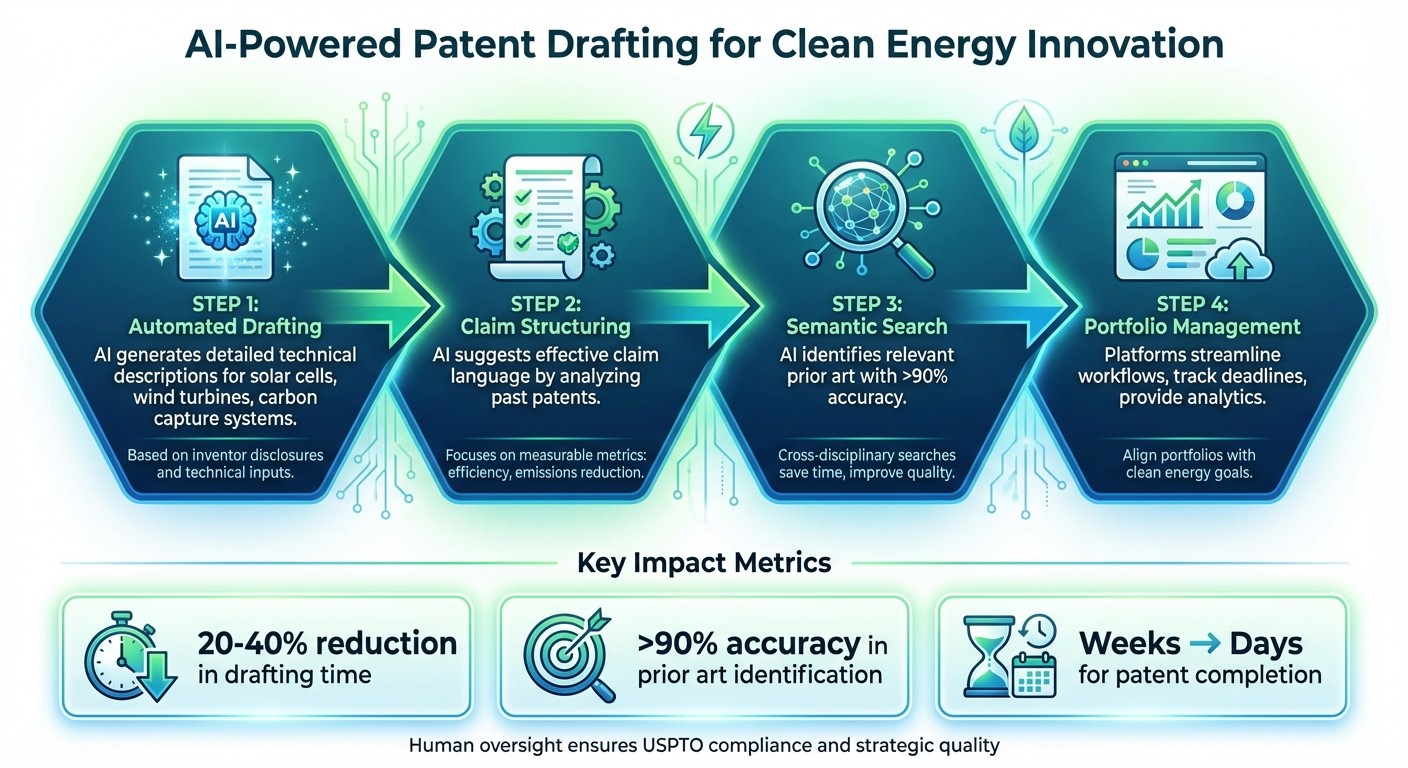
How AI Transforms Clean Energy Patent Drafting: 4-Step Workflow
AI Use Cases in Drafting Clean Energy Patents
AI-Generated Technical Descriptions for Renewable Technologies
AI tools are transforming how technical descriptions for clean energy patents are created. By analyzing disclosures, lab reports, and diagrams, these tools can generate detailed descriptions for innovations like solar cells, wind turbines, battery systems, and carbon capture technologies. For instance, language models can draft precise descriptions of photovoltaic cell layers, inverter circuits, and performance metrics. In the wind energy sector, they describe blade geometries, control algorithms, and load management systems. Similarly, for carbon capture technologies, AI creates descriptions of sorbent compositions, reactor setups, and operational conditions - all formatted using U.S. units and conventions. To further enhance the patent, these systems can also propose alternative embodiments to broaden its scope.
The process typically starts with inventor disclosures, which are then run through AI to produce an initial draft specification. Attorneys refine this draft to ensure claim support and compliance with USPTO standards. By automating these early stages, AI helps lay the groundwork for strong, legally compliant patents in the clean energy space.
AI-Driven Claim Structuring for Green Innovations
Beyond technical descriptions, AI plays a pivotal role in structuring claims to protect green technologies. By analyzing large datasets of granted patents and office actions, AI tools recommend claim language and structures that have proven effective in the past. For example, when drafting claims for solar modules, AI might suggest independent claims based on measurable metrics like conversion efficiency or power density, while dependent claims could address features such as improved recyclability or longer module lifespans. In emissions-reduction technologies, AI can propose functional limitations tied to metrics like CO₂ reductions per kWh or per mile, ensuring compliance with relevant standards.
These tools also help convert sustainability metrics into patentable technical features rather than non-technical goals. For renewable energy systems - like solar, wind, and hydro - AI emphasizes device-level and system-level performance metrics, including capacity factors, power conversion efficiency, and material reductions. For smart grid technologies, claims often highlight algorithmic improvements, such as better forecasting accuracy, peak load reductions, or lower line losses, expressed as percentage improvements over a baseline. In carbon management, AI assists in drafting claims that focus on metrics like carbon capture rates, storage stability, or lifecycle emissions, ensuring the inclusion of monitoring and verification systems.
Semantic Search for Prior Art in Clean Energy Patents
Semantic search, powered by vector-based AI models, is revolutionizing how prior art is identified. Unlike traditional keyword searches, semantic search understands the meaning behind queries, making it easier to find patents that use different terminology to describe similar concepts. For example, a query about AI-driven demand response might uncover patents related to peak shaving or dynamic load management. This approach is particularly effective for uncovering cross-disciplinary prior art in areas like building automation, data center cooling, or industrial process control.
Semantic search systems, often based on transformer models, achieve over 90% accuracy in identifying relevant prior art. By converting invention disclosures into vector embeddings, these systems compare them against millions of documents to find conceptually similar prior art. Results can also be grouped by themes - such as "rooftop PV optimizers", "battery degradation prediction", or "carbon capture solvent processes" - highlighting common claim patterns and limitations in earlier patents. This allows attorneys to identify where an invention overlaps with existing art and where it stands out, emphasizing novel features like improved forecast accuracy, higher capture rates, or better recyclability. Additionally, some platforms assess potential obviousness risks by identifying combinations of prior art that collectively cover key aspects of the claimed invention, helping drafters refine claims or add technical details before filing.
AI Applications Across Clean Energy Sectors
Renewable Energy Innovations
AI-powered tools, trained on clean-tech patent data, are reshaping how patent teams draft applications for solar, wind, and other renewable technologies. These tools can automatically generate detailed technical descriptions for patents involving photovoltaic systems, wind turbines, and batteries. For instance, AI can draft precise language about solar module efficiency, tracking algorithms, and degradation metrics, all formatted to comply with USPTO standards.
One of the standout benefits is the ability to quantify performance metrics. AI drafting assistants help patent teams articulate measurable improvements, such as achieving "at least 5% higher capacity factor at comparable wind class", or detailing round-trip efficiency gains in energy storage systems. These tools can also suggest alternative designs and incorporate references to standards like IEC and UL testing protocols, broadening the scope of claims while maintaining technical accuracy. Additionally, semantic search capabilities allow attorneys to identify related prior art, enabling them to differentiate their inventions by emphasizing clear, objective performance data. This level of precision in drafting renewable energy patents also extends naturally to related fields, such as smart grids.
Smart Grids and Energy Efficiency
Building on advancements in renewables, AI also plays a key role in optimizing patents for smart grids and energy efficiency. Smart grid technologies, which include load forecasting, demand response, coordination of distributed energy resources, and voltage control, present unique challenges because they span power systems, telecommunications, and software domains. AI-assisted patent tools excel by conducting semantic searches across these diverse disciplines. For example, AI can pinpoint related patents in areas like EV charging infrastructure or HVAC optimization through cross-disciplinary searches.
These drafting tools also help organize claims around the core algorithms and system architecture of smart grid inventions. They can outline components such as data ingestion pipelines, forecasting model features (factoring in variables like weather, time of day, and occupancy), training workflows, and control actions. This results in comprehensive claims for methods, systems, and computer-readable mediums. Furthermore, these tools can situate inventions within the U.S. grid infrastructure, addressing aspects like AMI meter data, ISO market participation, and the distinctions between distribution and transmission control. By integrating regulatory-aware language, they ensure clarity while emphasizing the inventive step. Analytics dashboards that cluster patents by technical approaches - such as distinguishing reinforcement learning from rule-based control - further guide drafters in crafting claims that avoid crowded technological spaces.
Carbon Management and Emissions Reduction
AI also enhances the drafting of patents for carbon management and emissions reduction technologies by streamlining the process and ensuring regulatory compliance. For technologies related to carbon capture, utilization, storage, and emissions reduction, AI systems trained on chemical, process, and environmental patents can produce structured narratives that describe key features like capture sorbents, membrane selectivity, reaction kinetics, and integration with power plants or industrial facilities.
In the case of emissions-control patents, AI tools can identify relevant regulatory frameworks, such as U.S. EPA methods or ISO standards, to ensure the language aligns with compliance requirements. These tools are especially valuable for drafting patents involving AI-enabled carbon management solutions. They can help describe processes like data ingestion, feature engineering for emissions prediction, model training and deployment, and optimization routines that weigh various abatement options based on cost or regulatory constraints. By leveraging established patterns from sustainable-AI and energy-sector patents, these platforms ensure that U.S. patents not only address the core emissions model but also detail its practical applications in settings like refineries, data centers, or grid dispatch systems.
How Patently Supports Clean Energy Patent Teams

AI-Assisted Drafting and Semantic Search Tools
Patently's platform combines two standout features to tackle the challenges of drafting clean energy patents: AI-assisted drafting powered by Onardo and semantic search through Vector AI. Together, these tools simplify the process of protecting renewable technologies, smart grid innovations, and carbon management systems.
Onardo streamlines the patent drafting process by generating structured first drafts of specifications and claims based on invention disclosures, drawings, and technical details. For instance, if you're working on a battery management system or a solar inverter topology, Onardo can create detailed technical descriptions, embodiments, and dependent claim trees - all while maintaining consistent terminology across complex, multi-disciplinary inventions. It even auto-labels figures and includes a patent figure editor, making it easier to move from claims to full descriptions. By automating the initial drafting phase, the platform allows attorneys to dedicate more time to refining strategies and less to starting from scratch, significantly cutting down on drafting time.
Meanwhile, Vector AI's semantic search goes beyond basic keyword matching to find conceptually similar prior art across vast patent databases and technical literature. For example, when researching carbon capture systems, the tool can identify patents related to sorbent regeneration methods, even if they use different chemical terminology. This is invaluable in fast-evolving clean energy fields, where missing a single reference could compromise patentability or lead to post-grant challenges. The search functionality also allows users to combine multiple queries, filter results by criteria like owner or jurisdiction, and export findings for deeper analysis.
These tools not only enhance drafting and search efficiency but also integrate seamlessly into managing clean energy patent portfolios.
Project Management for Clean Energy Portfolios
For teams juggling multiple clean energy projects - like solar modules, wind turbines, battery systems, grid optimization algorithms, or carbon capture technologies - Patently offers robust project management tools to keep everything on track. Each invention is treated as a tracked project, helping teams stay on top of U.S. filing deadlines and PCT dates.
The platform's dashboards provide a clear view of filing deadlines (formatted for U.S. standards), prosecution stages, and assigned roles. You can easily organize your portfolio by technology type (e.g., solar, wind, storage, grid, carbon capture) and link patents to broader business goals, such as Department of Energy-funded initiatives or grid modernization efforts. Automatic updates every 30 days keep everyone aligned, and findings can be shared with stakeholders via online reports or branded Word and Excel exports. Collaborative tools, like shared comments and ratings at both the patent family and asset levels, enable teams to review and refine projects together. Hierarchical project categories also make it simple to organize portfolios by department, client, or specific tasks.
Quality Control and Compliance with Human Oversight
Patently is built on the principle that AI is there to assist, not replace, registered practitioners. While AI accelerates drafting, human oversight ensures the final product meets both legal and technical standards. The platform includes automated checks to catch common USPTO issues, such as antecedent basis errors, unsupported claim terms, or inconsistent reference numerals. These checks prompt drafters to include critical details like operating parameters, control logic, or test data before submitting drafts for review.
Ultimately, compliance with 35 U.S.C. §§ 101, 102, 103, and 112 rests with patent attorneys and agents. For example, when dealing with AI-driven demand response algorithms that might face § 101 scrutiny, the system can flag problematic claim language based on historical rejections. However, practitioners must reshape claims to highlight concrete technical improvements, such as reduced line losses or enhanced voltage stability, and ensure they align with USPTO guidance.
To maintain confidentiality for sensitive clean energy projects, the platform includes robust access controls, allowing administrators to manage user permissions and enforce ethical walls. This human-in-the-loop approach ensures that AI-generated content serves as a strong starting point, with experts refining drafts to meet accuracy, strategic goals, and regulatory requirements.
Impact of AI on Patent Quality and Clean Energy Strategy
This section delves into how AI-powered tools are reshaping patent quality and aligning intellectual property strategies with clean energy goals. Building on earlier discussions about AI in drafting and search, let’s explore how these advancements are making a difference.
Faster Drafting and Reduced Time to Filing
AI tools have streamlined the drafting process for clean energy patents, cutting the time required from weeks to just days. By generating structured specifications and claim sets based on technical disclosures, these tools can reduce drafting time by 20–40%, which translates to significant cost savings in USD. For U.S. patent teams managing portfolios filled with related clean energy advancements - like incremental improvements in wind-turbine algorithms or variations in battery management systems - this efficiency ensures deadlines are met while keeping external counsel costs under control.
Another game-changer is the integration of prior-art search directly into the drafting process. Inventors can now test claim strategies in real time, drastically shortening the research phase. This means patents can be filed earlier without sacrificing quality.
Stronger Claims and Fewer Prosecution Challenges
AI systems excel at analyzing the technical contributions of inventions and proposing claim structures that align with USPTO standards. By incorporating prior-art analytics into the drafting process, these tools can flag overly broad or obvious language, offering alternative limitations to better distinguish innovations in areas like renewable energy and grid management. With an accuracy rate of over 90% in identifying conceptually similar prior art, AI significantly improves novelty checks, reducing the risk of missed references that could lead to rejections or challenges down the line.
Consistency in terminology is another area where AI shines. By ensuring uniform language - for instance, consistently referring to photovoltaic modules, inverters, and control units - it minimizes clarity issues under §112. For inventions that combine hardware components, such as batteries and turbines, with AI-driven control logic, these tools convert complex algorithmic details into legally sound claim language. This reduces the likelihood of examiners identifying gaps in the application. When refined by experienced attorneys, AI-generated drafts result in higher-quality applications with more thorough disclosures and well-structured claims.
Aligning Patent Portfolios with Sustainability Goals
AI analytics provide a data-driven approach to aligning patent portfolios with sustainability objectives. By clustering patents based on technology areas and metrics like CO₂ reduction or energy savings, companies gain a clearer picture of how their intellectual property supports their environmental targets. For example, AI can reveal imbalances in a portfolio - such as an overemphasis on fossil-fuel efficiency compared to a lack of focus on renewable energy integration or storage - helping to refine R&D and filing priorities to better align with net-zero goals.
AI also tracks external trends in sustainable innovation, offering insights into where competitors are filing patents for technologies like low-carbon AI models or renewable-powered infrastructure. This allows U.S. companies to adapt their strategies and maintain credibility with public ESG commitments. Over time, AI-driven dashboards enable management to allocate filing budgets and prosecution resources more effectively, linking investments to measurable outcomes like emissions reductions or the percentage of patents supporting renewable adoption.
Many green patents fall under the CPC Y02 classification, which is specifically tied to climate-change mitigation technologies. Analyzing Y02 portfolios has become a valuable way to benchmark competitors and identify untapped opportunities in clean energy innovation.
Conclusion
AI is reshaping how patent professionals safeguard clean energy innovations, transforming processes that once took weeks into tasks completed in just days. Tools that draft initial documents and automatically label figure features free up attorneys to focus on critical aspects like claim strategy, novelty arguments, and aligning patents with sustainability goals. This streamlined approach leads to faster filings, stronger claims, and reduced prosecution costs - key advantages for U.S. startups racing to secure IP before funding rounds and for larger companies managing diverse portfolios in renewables, energy storage, and carbon management.
That said, human expertise remains irreplaceable. AI-generated outputs are starting points, not final submissions. Patent attorneys and in-house counsel must meticulously review and refine every specification and claim to meet USPTO standards and address complex technical nuances. Organizations also need clear policies on AI usage, inventor contribution documentation, and the handling of sensitive technical data. This human-in-the-loop model ensures that AI enhances productivity without compromising quality, underscoring the central message: AI accelerates processes, but human expertise is essential.
For clean energy teams, AI-driven workflows provide a strategic edge. By clustering patents around areas like emissions reduction, energy efficiency, and renewable integration, companies can pinpoint where their intellectual property aligns with sustainability goals and identify any gaps. These tools also help teams strategically address those gaps. Additionally, AI monitors competitor filings and emerging technology trends, keeping U.S. innovators ahead in competitive fields like battery storage, hydrogen systems, and grid optimization.
Looking ahead, AI is poised to become a core element of clean energy patenting, from capturing inventions to shaping licensing strategies. As models continue to learn from clean tech data and USPTO outcomes, their predictive abilities will improve, offering better insights into grant probabilities and optimal claim adjustments. Professionals who adopt AI-augmented workflows now will be well-positioned to reap the benefits as these tools evolve and best practices emerge.
Start by piloting AI for high-impact tasks, such as semantic prior art searches for complex grid technologies or AI-assisted drafting for renewable energy applications. Tools like Patently exemplify this approach, integrating drafting, semantic search, project management, and portfolio analytics tailored for clean energy. By combining AI’s speed with human expertise, teams can achieve faster filings, stronger protections, and contribute to the acceleration of decarbonization efforts.
FAQs
How does AI make drafting clean energy patents more efficient?
AI streamlines the process of drafting clean energy patents by automating tasks that typically take a lot of time, like writing claims, creating detailed figures, and producing thorough descriptions with minimal effort. This not only cuts down on manual work but also reduces the chances of errors and speeds up the entire drafting process.
With these steps simplified, professionals can dedicate more time to innovation and strategic planning, ensuring that the patents produced are accurate and of excellent quality.
How does AI help draft patent claims for clean energy technologies?
AI simplifies the process of drafting patent claims for clean energy advancements by automating essential tasks. These include crafting well-structured claims, annotating features in technical diagrams, and producing thorough descriptions. This approach not only enhances precision but also significantly reduces the time patent professionals need to spend.
With the help of AI-powered tools, experts can create patent applications that are detailed, accurate, and specifically aligned with the unique demands of green technology innovations.
How does semantic search improve the process of identifying prior art in clean energy patents?
Semantic search enhances the process of identifying prior art in clean energy patents by focusing on the meaning and context of concepts instead of just matching exact keywords. This method delivers more accurate and thorough results, revealing relevant patents that could easily be missed with traditional keyword-based searches.
Using natural language understanding, semantic search links related ideas and innovations, offering a powerful way to navigate the intricate world of clean energy technologies.