Checklist for Choosing AI Patent Similarity Tools
Intellectual Property Management
Dec 12, 2025
Practical checklist for choosing AI patent similarity tools: semantic search, data coverage, usability, scalability, pricing, security, and trial testing.
AI patent similarity tools are transforming how patent professionals search and analyze prior art. These tools use advanced semantic search, machine learning, and natural language processing to find related patents by understanding context, not just keywords. This approach saves time, improves accuracy, and helps uncover patents that traditional searches might miss. Key considerations when selecting a tool include:
Core Features: Look for semantic search, citation analysis, and specialized capabilities (e.g., image or chemical structure searches).
Data Coverage: Ensure access to global patent databases with frequent updates and strong translation features for non-English patents.
Usability: Prioritize user-friendly interfaces, collaboration tools, and integration with existing workflows.
Scalability: Test performance with large datasets to ensure the tool handles growing portfolios efficiently.
Pricing and Security: Understand the pricing structure, ensure compliance with regulations, and verify strong security measures.
The right tool should align with your team’s needs, streamline workflows, and provide reliable insights for tasks like prior art searches, clearance reviews, and portfolio management. Start with a trial, involve your team, and evaluate tools based on measurable outcomes like time saved and result relevance.
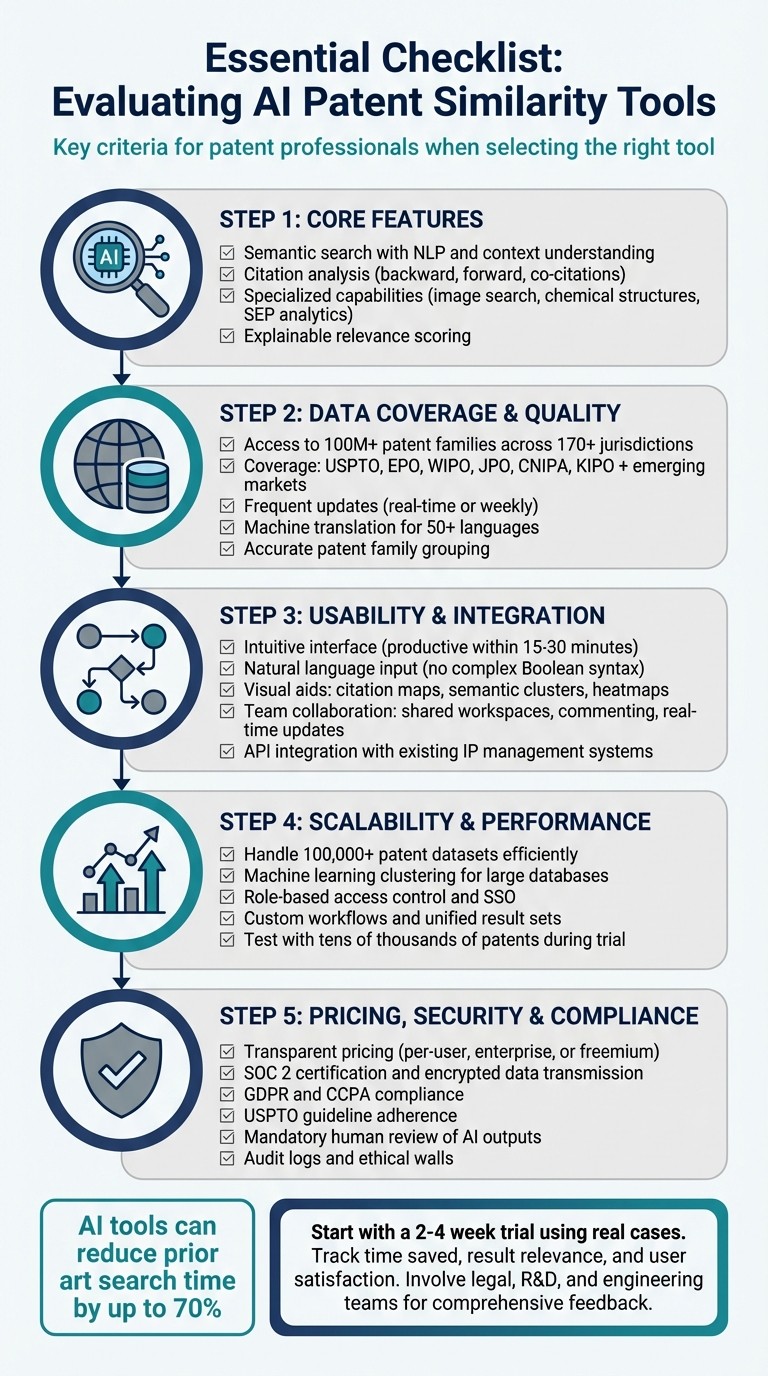
5-Step Checklist for Evaluating AI Patent Similarity Tools
AI-Powered Patent Search: Find Prior Art Faster & Smarter with IP Author
Core Features to Look For
When selecting an AI patent similarity tool, focus on options that deliver advanced semantic search, in-depth citation analysis, and specialized non-text search capabilities. These features ensure efficient prior art identification and streamline the review process.
Semantic and Text-Based Search
Semantic search goes beyond simple keyword matching by leveraging natural language processing (NLP) and transformer models to understand the context and intent behind queries. For instance, a search for "wireless communication device" should also surface related terms like "user equipment", "mobile terminal", or "handheld transceiver." The best tools allow you to input full claims, invention disclosures, or patent numbers, extracting key concepts automatically.
Features like concept decomposition and synonym suggestions are key. For example, a query for "lithium-ion cell" might also pull up results for "secondary battery" or "rechargeable accumulator", minimizing the chance of overlooking critical prior art. High-performing tools also provide explainable relevance views, showing which claim segments influenced similarity scores. Cross-lingual matching with integrated machine translation ensures you can find relevant patents in multiple languages.
While semantic search handles text-based queries effectively, citation analysis adds another layer of discovery.
Citation Analysis
Citation analysis helps uncover valuable insights by mapping relationships between patents. This includes backward citations (references cited in a patent), forward citations (later patents that cite a given document), co-citations (frequently cited together), and family citations across jurisdictions. These capabilities are especially useful for U.S. workflows, like finding strong prior art under 35 U.S.C. §§ 102 and 103, identifying crowded technology spaces for freedom-to-operate reviews, or assessing a patent's global significance.
Top platforms combine semantic similarity with citation graph analytics, broadening results to include patents central to citation networks. This approach uncovers earlier filings or alternative technical solutions that might not be captured through text searches alone. For example, Patently's Forward and Backward citation browser lets users explore citation relationships while running semantic searches with tools like Vector AI.
In some industries, however, text and citation search alone may not be enough.
Specialized Search Capabilities
Certain fields, such as design patents, chemical compounds, or biotechnology, require more tailored search methods. For design patents, tools with image-based similarity search can be invaluable. These systems use computer vision models to compare design figures, enabling users to upload images and find visually similar prior art across key offices like the USPTO, EUIPO, and CNIPA.
In chemical and biotech sectors, advanced search features include 3D chemical structure searches, Markush structure searches for related compound families, and sequence similarity searches for DNA, RNA, or protein sequences. The ideal tool should support normalized formats like SMILES and InChI, allowing users to search by either structure drawings or sequence inputs.
For telecommunications and connected technologies, specialized SEP (standards-essential patent) analytics are crucial. These tools analyze SEPs across 4G and 5G networks, aiding in licensing negotiations and shaping portfolio strategies.
Data Coverage and Quality
The reliability of similarity searches hinges on the scope and accuracy of the data. If the data is incomplete or inaccurate, there's a risk of missing critical prior art or generating misleading results. This is especially true for global freedom-to-operate analyses. Without extensive jurisdictional coverage, a tool might miss patents from key offices, potentially jeopardizing the entire search process. To make the most of advanced similarity search features, maintaining strong data integrity is essential.
Global Patent Database Access
An effective AI tool should provide access to major patent offices like the USPTO, EPO, WIPO (PCT), JPO, CNIPA, and KIPO, while also covering emerging markets such as INPI (Brazil) and ARIPO. Including provisional applications and utility models is equally important since these early filings often hint at future developments that could turn into fully realized patents. The best systems incorporate over 100 million patent families across more than 170 jurisdictions, ensuring a comprehensive capture of prior art.
Data Updates and Accuracy
Frequent updates are vital to reflect new filings and changes in patent statuses, such as grants, expirations, or lapses. Whether updates happen in real time or on a regular schedule (like weekly), keeping the database current helps prevent outdated results. Additionally, accurate patent family grouping is critical. By linking related applications across jurisdictions, it minimizes fragmented searches and avoids duplicate results, while also offering a complete view of patent protection. Advanced tools often use machine learning to refine family grouping and boost accuracy.
Language Support and Translation
Strong machine translation capabilities are crucial for handling patents filed in different languages, especially when it comes to preserving technical details for accurate cross-lingual semantic matching. With Chinese and Japanese patents making up over 40% of global filings, robust translation features are a must to ensure no critical prior art is overlooked. Top-tier tools support more than 50 languages, using neural machine translation to retain specialized terminology. When assessing a tool, it’s a good idea to test how well it handles non-English patents by running bilingual queries and evaluating the relevance of the results.
Usability and Workflow Integration
No matter how advanced an AI tool is, its value diminishes if it's difficult to use or doesn't fit into existing workflows. A well-designed interface, collaborative features, and smooth technical integration can significantly boost productivity and minimize delays for U.S. patent professionals.
Interface and User Experience
An intuitive, user-friendly interface can make all the difference by keeping the learning curve short. The best tools allow users to perform meaningful similarity searches within just 15–30 minutes using their own inventions, rather than relying solely on vendor-provided demonstrations. Look for tools that accept natural language inputs to describe inventions, avoiding the need for complex Boolean syntax. Many platforms also include automated concept extraction and customizable relevance thresholds, enabling users to fine-tune results without requiring extensive technical know-how.
Visual aids like citation maps, semantic clusters, heatmaps, and timeline views are invaluable for quickly understanding patent relationships, especially when dealing with large datasets. For U.S.-based teams, ensure that the interface accommodates USPC/CPC navigation and presents dates, numbers, and pricing information in familiar, localized formats. A well-thought-out design like this not only simplifies individual tasks but also sets the stage for effective teamwork.
Team Collaboration Features
A solid interface is just the beginning; effective collaboration tools are essential to turn shared insights into actionable outcomes. Patent work often involves multiple stakeholders, and relying on endless email threads or redundant spreadsheets can be a productivity killer. Shared workspaces with integrated commenting, real-time updates, and secure sharing options can streamline the process.
Patently exemplifies this collaborative approach by offering features like customizable comments, ratings, and insights at both the family and asset levels. These tools are tailored to support various analyses, such as novelty, validity, and freedom-to-operate evaluations. Teams also benefit from automatic updates every 30 days to keep projects current. Findings can be shared online with stakeholders or exported as company-branded Word reports. Additionally, Patently’s hierarchical project categorization system allows work to be organized by department, profit center, or client. Robust access controls ensure permissions are managed effectively, supporting ethical walls and confidentiality needs.
Technical Integration and Scalability
As patent portfolios grow, seamless integration with existing systems becomes increasingly important. Check whether the tool supports REST APIs, webhooks, or standard export formats like CSV, Excel, or PDF to connect with IP management, document management, or matter management systems.
Scalability is another key factor, especially for large portfolios. Some tools can analyze and group datasets of up to 100,000 patents using advanced analytics, while others utilize machine learning clustering to manage databases with hundreds of millions of records. Test the tool’s performance with tens of thousands of patents to ensure quick responses and easy navigation. For larger organizations, features like role-based access control, single sign-on (SSO), and administrative tools for user provisioning and auditing are essential. Patently stands out with its custom workflows and the ability to combine various searches - including data from external sources - into unified result sets. This level of technical flexibility ensures that even expansive patent portfolios can be managed efficiently without compromising search performance.
Pricing, Security, and Compliance
When evaluating AI tools for patent similarity, pricing, security, and compliance are key considerations. These factors influence your budget, data protection, and ability to meet legal obligations under U.S. patent law.
Pricing Structure
Understanding the pricing model is essential to avoid unexpected costs. Many tools offer options like per-user subscriptions, enterprise-level plans with custom pricing, or freemium tiers that provide basic functionality before requiring an upgrade. Compare the tool's database coverage and features against its cost - some tools claim to reduce search time by as much as 70%.
Don’t just focus on the base price. Factor in the total cost of ownership, which includes training, integration, and scalability expenses. Use trial periods to test the tool with large datasets and evaluate potential efficiency gains. If your organization is larger, ask about volume discounts or unlimited enterprise licenses. A transparent pricing structure ensures you can strike a balance between functionality and budget for more effective patent searches.
Now, let’s turn to the critical issue of data security.
Data Security and Privacy
Patent-related work often involves handling sensitive and confidential information, making robust security measures non-negotiable. Look for tools that meet high security standards like SOC 2 certification, encrypted data transmission, and role-based access controls. For example, Patently includes features like ethical walls and detailed access controls to support confidentiality requirements.
Additionally, confirm that the vendor complies with major regulations such as GDPR and CCPA. Ask for certifications like SOC 2 and review the tool’s audit logs to verify its data protection capabilities. Strong security measures are essential to safeguard your intellectual property.
Regulatory Compliance and AI Oversight
Beyond security, regulatory compliance ensures that the tool’s outputs are legally defensible. The tool should adhere to USPTO guidelines by employing transparent AI methodologies that generate defensible results. It’s also crucial that AI-generated outputs undergo mandatory human review, ensuring the technology complements - rather than replaces - the expertise of qualified professionals.
Seek tools that support a hybrid workflow between human and AI oversight. Features like adjustable semantic thresholds, structured reports tailored for legal review, and clear documentation explaining AI processes are invaluable. This level of transparency helps you defend search strategies during patent examinations or litigation. Patently, for instance, emphasizes collaborative oversight, enabling attorney verification at every stage to align with U.S. patent law requirements and protect your professional responsibilities.
Conclusion
Picking the right tool comes down to aligning it with your specific needs. The key criteria - search quality, data integrity, workflow compatibility, scalability, and security - should guide your decision. Think about the essentials: search quality (like semantic and citation analysis), data coverage and timeliness, workflow integration, scalability, and transparent pricing with security. Even the most advanced tool will fall short if it doesn’t fit your team’s daily operations or budget.
Once you’ve identified the core features you need, focus on how the tool fits into your workflow. Create a simple one-page checklist of must-haves (e.g., semantic similarity, U.S. and EP coverage, SSO) and nice-to-haves. Narrow your choices down to 2–4 tools and test them over a few weeks with real U.S. cases. During this trial, track measurable outcomes like time saved on searches, relevance of results, and user satisfaction. Involve team members from legal, R&D, and engineering to ensure the tool works for everyone, and gather structured feedback before making a final decision.
The right tool can make a huge difference. For example, a U.S.-based medical device company using an AI-powered platform with strong semantic search and citation mapping was able to cut prior-art review from days to hours. This not only sped up the process but also uncovered previously overlooked family members cited in litigation, helping attorneys refine claims before filing. By collaborating in one shared workspace, the R&D team, in-house counsel, and external legal partners streamlined their efforts.
As mentioned earlier, an integrated platform can enhance every step of the patent lifecycle. Tools like Patently combine features like similarity search, drafting assistance, and project management into a unified system. If you’re looking for a solution that checks multiple boxes, this kind of all-in-one platform might be the way to go.
Finally, don’t stop at the initial selection. Keep an eye on how well your tool performs over time. Regularly review its effectiveness and adjust your requirements as your portfolio evolves. Monitor internal metrics to spot when performance plateaus, and be ready to explore new options as your portfolio expands into different jurisdictions or technologies. Continuous oversight ensures your tool remains a valuable asset.
FAQs
What advantages do AI-powered tools offer for patent similarity analysis compared to traditional methods?
AI-powered tools for patent similarity offer a smarter and quicker alternative to old-school methods. Using semantic search, these tools go beyond simple keyword matching by grasping the context and meaning behind patent language. This not only cuts down on manual work but also reduces the chances of errors.
What’s more, they provide a deeper look into patent relationships, revealing links that traditional approaches might overlook. By simplifying the process, these tools free up professionals to concentrate on making strategic decisions rather than getting bogged down in tedious tasks.
What should I look for to ensure an AI patent similarity tool covers global patent data?
To ensure an AI patent similarity tool delivers broad global data coverage, it's important to verify that it incorporates the latest patent databases from key international authorities, such as the USPTO, EPO, WIPO, and other regional offices. The tool should also offer semantic search capabilities across multiple countries, along with detailed insights into factors like ownership, geographic trends, and technology classifications - particularly when it comes to standards-essential patents (SEPs).
For instance, platforms like Patently provide extensive global patent analysis and include specialized SEP data for technologies like 4G and 5G. This enables users to make informed and strategic decisions.
What factors should I consider for pricing and security when selecting AI tools for patent similarity analysis?
When considering pricing, focus on the tool's cost structure, available subscription plans, and whether its features justify the expense. Make sure the pricing fits your budget and aligns with your long-term goals.
For security, choose platforms that emphasize robust data protection. Look for features like encryption, secure access controls, and adherence to industry standards to safeguard sensitive patent data. Always confirm the tool meets your organization's specific security protocols.