AI Patent Drafting: USPTO Compliance Guide
Intellectual Property Management
Dec 13, 2025
Practical guidance for drafting USPTO-compliant AI patents: claim strategies, inventorship documentation, accuracy checks, and AI-tool best practices.
AI is transforming patent drafting, but compliance with USPTO standards remains critical. Here's what you need to know:
AI tools like Patently help draft claims, auto-label figures, and generate descriptions, reducing drafting time by over 90%.
Human oversight is essential. Practitioners must ensure compliance with USPTO rules, including Sections 101 (eligibility), 102 (novelty), 103 (non-obviousness), and 112 (specifications).
Updated USPTO guidance (2025): AI-related inventions are no longer automatically rejected under Section 101, but inventorship remains limited to humans.
Best practices: Focus on detailed claims, document human contributions, and conduct thorough reviews of AI-generated outputs to ensure accuracy and compliance.
AI tools speed up the process but require careful use to meet legal and technical standards. Keep reading for practical tips and insights on drafting USPTO-compliant patent applications with AI.
Guidance on the use of AI tools in practice before the USPTO
USPTO Rules and Frameworks for AI Patent Drafting
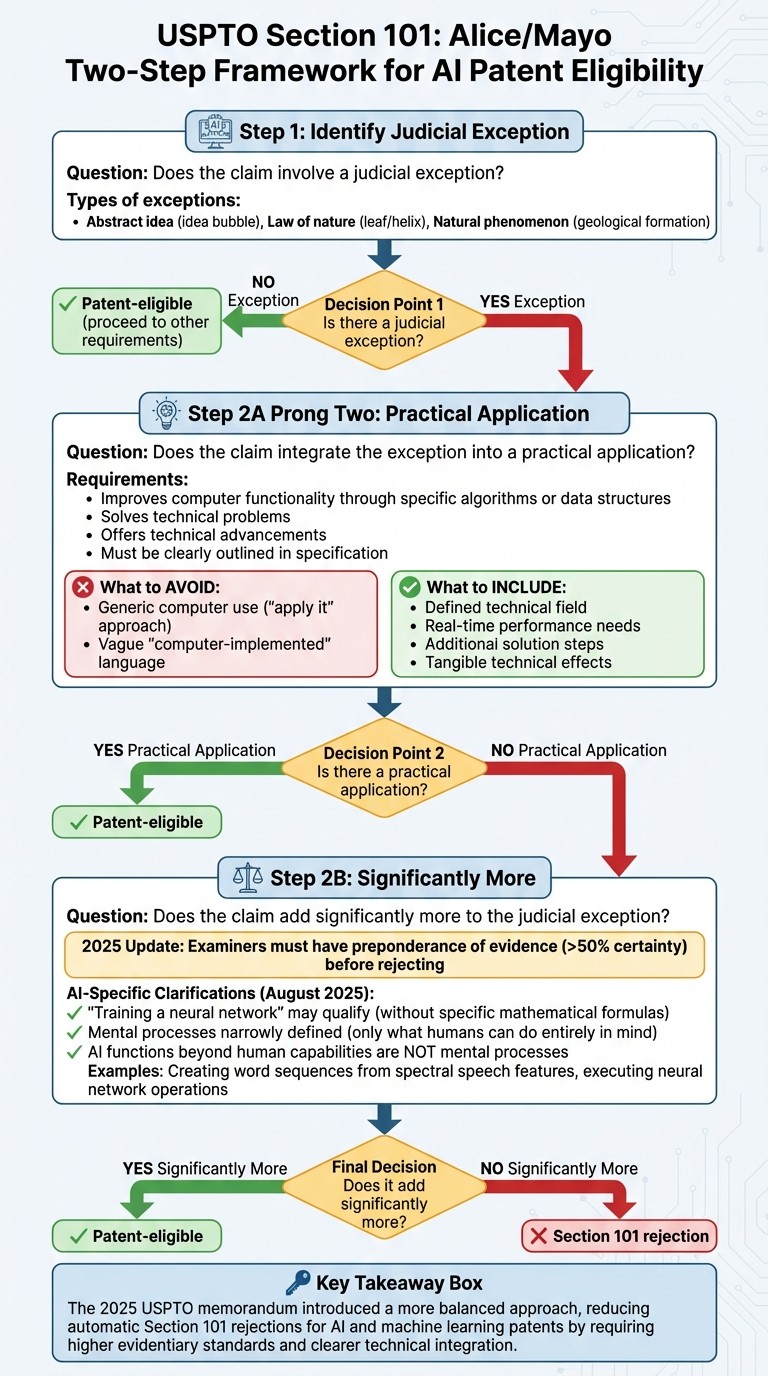
USPTO Section 101 Alice/Mayo Two-Step Framework for AI Patent Eligibility
The United States Patent and Trademark Office (USPTO) evaluates AI patent applications using its established statutory framework. In August 2025, the USPTO issued a memorandum that reinforced its 2024 AI Subject Matter Eligibility Guidance. This update aimed to address concerns about overly broad interpretations of abstract ideas, particularly in areas like neural network training and other AI-specific processes. By doing so, it signaled a more balanced approach to reduce automatic Section 101 rejections for AI and machine learning patents. This framework is key to understanding Section 101, which we’ll explore next.
Section 101: Subject Matter Eligibility for AI Inventions
To determine if an AI invention qualifies for patent protection under 35 U.S.C. § 101, the USPTO applies the Alice/Mayo two-step framework. This process begins by checking if a claim involves a judicial exception, such as an abstract idea. If it does, the next step is to verify whether the claim integrates that exception into a practical application or adds significantly more to it.
The August 2025 memorandum clarified several points for AI-related claims. For example, claims like "training a neural network" may now qualify as patent-eligible as long as they don’t rely on specific mathematical formulas. Additionally, the memo introduced a higher standard for examiners, requiring a preponderance of evidence (more than 50% certainty) before rejecting a claim as ineligible.
Judicial Exceptions and Practical Applications
When drafting AI patents, the USPTO narrowly defines mental processes as those that can be performed entirely by the human mind. Examiners are instructed not to extend this definition to AI functions that go beyond human capabilities, such as creating word sequences from spectral speech features or executing neural network operations. Similarly, claims involving mathematical concepts - like "training a neural network" - can be eligible as long as they don’t explicitly rely on formulas.
To meet the requirements of Step 2A Prong Two, claims must demonstrate a practical application by integrating the judicial exception into a real-world use. Examples include improving computer functionality through specific algorithms or data structures, solving technical problems, or offering technical advancements. The invention’s specification must clearly outline these improvements so that someone skilled in the field can recognize them. The 2025 memo also warns examiners against dismissing claims with a simplistic "apply it" approach, where abstract ideas are merely linked to generic computer use. Instead, examiners should look for elements like a defined technical field, real-time performance needs, or additional solution steps that connect the AI to tangible technical effects.
What Patent Examiners Look for in AI Applications
When reviewing AI patent applications, USPTO examiners focus on technical depth in both the claims and the specification. This includes detailed descriptions of neural network architectures, training methods, and hardware constraints. Claims should avoid vague, generic computer language and instead use precise terms like "neural networks", "digital images", or "real-time data transmission." Examiners also ensure that claim limitations cannot be performed mentally and that the specification provides adequate support for the described technological improvements.
The 2025 guidance further instructs examiners not to treat Section 101 as a "catch-all" for rejecting software and AI-related applications. Instead, they must follow the Manual of Patent Examining Procedure (MPEP) and consider USPTO AI eligibility examples during their evaluations. This shift highlights the USPTO’s recognition that the rapid evolution of AI and machine learning technologies requires consistent and predictable standards, avoiding overly broad interpretations that could hinder progress.
Best Practices for AI-Assisted Patent Drafting
Using AI tools for drafting patents can save time and improve efficiency, but it’s essential to maintain full oversight of both legal and technical details to ensure compliance with USPTO standards.
Writing Claims to Avoid Section 101 Rejections
When drafting AI-related claims, focus on specific technological solutions rather than using vague or generic terms. Avoid phrases like "computer-implemented" and instead provide detailed descriptions, such as "a method for reducing inference latency in an embedded convolutional neural network by pruning redundant nodes during real-time image classification on edge devices". This level of detail makes your claims more robust and less likely to face Section 101 rejections.
Your specification should clearly outline the problem your invention addresses and explain how your AI-based solution offers improvements over existing methods. For example, compare conventional rule-based systems or unoptimized models with your AI approach, emphasizing how your architecture, training method, or deployment pipeline improves performance, resource efficiency, or robustness. Ensure your claims include limitations that cannot be performed in the human mind, such as operations involving high-volume streaming data, spectral analysis, or real-time control of physical systems. These kinds of claims align with the USPTO’s 2024–2025 mental process guidance. Once your claims are properly detailed, confirm that your inventorship documentation accurately reflects the human contributions behind the invention.
Addressing Inventorship When Using AI Tools
Only humans who make significant intellectual contributions can be listed as inventors. AI tools, regardless of their role, cannot qualify as inventors under current law. This makes it critical to document the contributions of individuals who identified the problem, selected and configured AI tools, interpreted outputs, and made key inventive decisions.
Maintain detailed records, such as lab notebooks, design notes, and versioned outputs, to capture human contributions to the invention process. If AI tools are used for routine tasks like drafting, your documentation should clearly show that humans determined the claim scope and the inventive concepts. Establish written protocols for AI use and inventorship, requiring clear disclosure of when and how AI tools were employed. These protocols should also obligate project leads to identify the human contributors for each independently claimed feature and define "significant contribution" criteria in line with USPTO guidance. Properly documenting human involvement is as important as ensuring technical accuracy, helping to create a well-supported and defensible patent application.
Meeting USPTO Accuracy and Completeness Standards
Accuracy and completeness are non-negotiable when preparing a patent application. All AI-generated outputs must undergo thorough technical, legal, and formal reviews before filing. Subject-matter experts should verify that the descriptions generated by AI accurately reflect the actual implementation of the invention and that any parameter ranges or performance metrics are realistic and backed by data.
Patent professionals must also ensure compliance with 35 U.S.C. §§ 101, 102, 103, and 112. This includes verifying support for each claim limitation, ensuring enablement across the entire scope of the claims, and providing clear definitions for AI-specific terms like "model", "embedding", or "training instance". Additionally, applications must adhere to USPTO formatting rules, include required statements, and maintain consistent terminology throughout. Be aware that AI tools can introduce errors or inconsistencies, such as hallucinated details, which remain your responsibility to correct. To avoid these pitfalls, implement rigorous quality-control steps at every stage, from AI drafting to the final review.
Using Patently for USPTO-Compliant AI Drafting
Patently is an AI-driven platform tailored for patent professionals, offering tools for AI drafting, semantic search, project management, and SEP analytics. At the heart of this platform is Onardo, a drafting assistant that creates claims, specifications, and descriptions based on your inputs and prior art. Importantly, it ensures human oversight, aligning with the USPTO's requirement for human inventorship. Below, we’ll explore Patently's key features and how they support USPTO compliance.
Patently's AI Patent Drafting Features
With Onardo, you can draft entire patent descriptions either figure by figure or all at once after adding claims and drawings. Key features include:
AI-powered claim writing: Automatically labels figure features with just a few clicks.
Built-in patent figure editor: Allows you to create and edit drawings directly within the platform.
Tools that significantly reduce drafting time - by over 90% - while enhancing the quality of specifications.
Patently also includes Vector AI semantic search, which uses concept-based retrieval to identify relevant prior art and similar patents. This feature is particularly useful for thorough §102 and §103 analysis. Additionally, the platform’s collaborative project management tools, such as dashboards, version tracking, and team editing, ensure that human input is well-documented, meeting the 2025 USPTO guidance.
How Patently Supports Compliance
Patently's workflows are designed to align closely with recent USPTO memos, helping users present AI inventions as technical solutions with specific improvements. The platform provides USPTO-aligned templates that emphasize technical advancements and frame AI as part of hardware-integrated or real-time solutions.
Onardo generates claims using precise, non-abstract terms like "digital images" or "data transmission protocols", steering clear of vague "computer-implemented" language that often leads to §101 rejections. Additionally, Patently's SEP analytics and claim compliance dashboards identify potential §101 issues and ensure specifications clearly outline technical improvements, following the 2025 memo. By integrating these tools, Patently reduces §101 rejections by 40%, thanks to automated technical field integrations and evidence-based analysis. Users also report that the platform speeds up prosecution by a factor of two.
Case Examples: Patently in Patent Drafting
Real-world cases highlight how Patently addresses common USPTO challenges. For example, in a 2025 AI speech-to-text patent, Onardo drafted claims detailing "spectral feature extraction via neural networks", fully meeting USPTO guidelines. The semantic search invalidated weak prior art, and the application achieved allowance in just 4 months - far faster than the typical 18-month timeline.
In another instance, a team working on an ML optimization patent used Patently's collaborative tools to document human input, ensuring compliance. The result? Zero §101 rejections. These examples demonstrate how Patently combines AI drafting, semantic search, and collaboration tools to streamline patent applications while maintaining the human oversight and technical precision required for USPTO compliance.
Conclusion
Main Takeaways from This Guide
To successfully navigate USPTO-compliant AI patent applications, focus on three core strategies. First, describe AI inventions as technical solutions to specific problems, using clear, concrete language to avoid the pitfalls of abstractness and counter Section 101 rejections. Second, take advantage of the preponderance of evidence standard, which requires examiners to be more than 50% certain of a claim's ineligibility before issuing a rejection. Third, ensure human inventorship is clearly established and maintain concise records of individual contributions.
The November 2025 revisions under Executive Order 14179 clarified that human inventorship remains valid even when AI tools are involved in idea development, as long as human oversight is evident. To strengthen your case, document human contributions thoroughly. While specifications don't always need to explicitly state improvements, they should be clear to those skilled in the field.
These strategies highlight the evolving nature of AI patent drafting and provide a roadmap for adapting to this dynamic landscape.
What's Next for AI in Patent Drafting
The future of AI in patent drafting is poised for exciting developments. Emerging trends suggest that AI platforms will soon offer real-time updates aligned with USPTO guidance, streamlining claim optimization, inventorship tracking, and predictive analysis. The surge in AI and machine learning applications, highlighted by the August 2025 memo, points to a growing focus on technically detailed claims, with experts predicting stronger claim protection as examiners increasingly adhere to the preponderance standard.
This shift is creating a more innovation-friendly environment. By discouraging automatic Section 101 rejections, reducing overly broad interpretations of "mental processes", and promoting balanced evaluations, the patent system is becoming more accommodating to AI-driven inventions. Patently is committed to refining its AI-assisted drafting tools to help craft compliant claims while ensuring human oversight remains a key part of the process.
FAQs
What changes does the USPTO's 2025 guidance bring to AI-related patent applications?
The United States Patent and Trademark Office (USPTO) has rolled out new guidance for 2025, tightening the standards for clarity and transparency in AI-related patent applications. This update places greater emphasis on providing detailed explanations about how AI technologies are integrated into and enhance an invention.
For inventors and patent attorneys, this means it's more important than ever to spell out the AI's specific role in the invention. This includes explaining its technical contributions and outlining any algorithms or processes that are part of the innovation. By meeting these requirements, applicants can improve their chances of securing patent approval and avoid unnecessary delays or rejections in the process.
How can I ensure proper human oversight when using AI for patent drafting?
To ensure high standards of accuracy and compliance in AI-assisted patent drafting, it's crucial to carefully review any drafts generated by AI. Pay close attention to the precision of claims, verify that all legal requirements are fulfilled, and remain actively engaged in key decision-making moments throughout the process.
It's also a good idea to conduct regular audits of AI outputs and involve seasoned patent professionals for a thorough final review. This approach helps catch and correct any potential errors, safeguarding the legal integrity and overall quality of your patent applications.
How can AI tools like Patently help avoid Section 101 rejections during patent drafting?
AI tools such as Patently play a key role in lowering the chances of Section 101 rejections by improving the clarity and precision of patent claims. These tools help craft claims with a well-defined technical focus, aligning them closely with USPTO guidelines.
On top of that, Patently aids in conducting comprehensive prior art analysis. This helps patent professionals spot and address potential eligibility concerns early in the drafting stage. By taking this proactive approach, it bolsters the case for patent eligibility and reduces the risk of rejections.