AI-Powered Workflow Hierarchies for IP Teams
Intellectual Property Management
Dec 14, 2025
AI hierarchical workflows streamline IP operations by automating docketing, task routing, drafting, and real-time dashboards to cut errors and speed filings.

Managing intellectual property (IP) projects is complex, with tight deadlines, global filings, and growing portfolios. Traditional tools like spreadsheets and email often lead to inefficiencies, missed deadlines, and errors. AI-powered hierarchical workflows solve these issues by organizing tasks into structured layers, automating repetitive processes, and improving collaboration.
Key benefits include:
Breaking down large projects into smaller, connected tasks for better oversight.
Automating docketing, deadline tracking, and document drafting.
Centralizing task management with real-time updates and shared dashboards.
Reducing inefficiencies, boosting productivity by up to 20%.
Patently's platform exemplifies this approach, combining AI tools like Onardo and Vector AI to automate workflows, manage patent portfolios, and simplify collaboration. Their tiered plans cater to solo practitioners, corporate teams, and law firms, offering features like semantic search, fee tracking, and customizable project setups. AI workflows not only save time but also improve accuracy, ensuring IP teams can focus on strategic priorities.
Streamlining FoundationIP®: Revolutionizing IP Management with Black Hills IP
What Are Hierarchical Workflows in IP Management?
Hierarchical workflows in IP management create a structured system where complex projects are broken down into interconnected layers. Think of it as a tree: at the top is your overall IP portfolio, followed by branches representing individual patent families grouped by technology or business unit, and at the base are specific tasks like invention disclosure reviews, prosecution, and renewals. This layered structure provides IP teams with a centralized view of all assets, clearly linking related tasks. It simplifies tracking deadlines across jurisdictions and ensures all activities align strategically with broader goals.
For patent families, hierarchical workflows help synchronize deadlines across continuations, divisions, and foreign counterparts in different regions. When dealing with standard-essential patent (SEP) projects, this structure organizes assets into hierarchies that reflect licensing pools and compliance needs. This approach ensures risks are monitored effectively and strategic oversight is maintained.
The Structure of Hierarchical Workflows
Hierarchical workflows typically operate on three levels. At the top is the parent level, representing the overall IP portfolio or a major project. The mid-level includes patent families or SEP clusters, while the bottom level focuses on specific tasks like claim amendments, office action responses, and examiner interviews.
For instance, a biotech company might create a parent workflow for a new drug compound. The child level could include tasks like U.S. and European patent prosecution. Under the U.S. prosecution, sub-tasks might involve claim amendments, responding to office actions, and conducting examiner interviews. Automated routing can assign these tasks to the right attorneys based on their expertise and workload. This smart routing ensures tasks are handled efficiently, even in high-pressure environments, reducing the risk of delays or missed deadlines.
Problems with Traditional Workflow Management
Traditional IP workflows often come with significant challenges. Manual tracking can lead to missed deadlines, especially when managing filings across multiple jurisdictions. Communication gaps between R&D and legal teams may result in misaligned invention disclosures, causing delays and rework.
These older methods also lack the centralized visibility that hierarchical workflows provide, which can increase error rates and make it harder to manage growing portfolios. For law firms, the sheer volume of patent applications often leads to bottlenecks, as manual processes struggle to keep up with tight deadlines.
As portfolios grow, these inefficiencies become even more pronounced. For example, managing 50 foreign filings manually can take hours, whereas automation could complete the same task in minutes. Studies suggest that these inefficiencies can reduce productivity in drafting and prosecution by up to 20%.
Here’s a quick comparison of the challenges with traditional workflows versus AI-driven solutions:
Challenges with Traditional Workflows | AI-Driven Solutions |
|---|---|
Manual tracking of tasks and deadlines | Automated docketing and deadline notifications across jurisdictions |
Siloed communication between R&D and legal teams | Shared dashboards and real-time routing of invention disclosures |
Difficulty scaling to handle high volumes of filings | Automated hierarchical task management with smart routing and summaries |
AI simplifies these processes by automating parent-child task routing, tagging assets intelligently, and offering real-time dashboards for portfolio health. Features like AI-driven docketing, semantic search, automated summaries, and deadline alerts make it clear why modern IP teams are moving away from traditional workflows and embracing hierarchical, AI-powered systems.
How Patently Enables AI-Powered Workflow Hierarchies
Patently combines AI automation, adaptable project structures, and real-time collaboration tools to simplify workflow management. The platform reduces manual effort and allows teams to tailor project setups to meet their specific needs.
AI-Driven Workflow Automation
Patently uses Onardo and Vector AI to handle key patent-related tasks efficiently. Vector AI organizes related patents into hierarchical folders through semantic analysis, while Onardo drafts patent documents and tracks deadlines.
For instance, when starting a new patent family project, Vector AI maps existing patents and identifies overlaps. Simultaneously, Onardo generates initial drafts for tasks like office action responses or claim amendments. This integration slashes drafting time by over 90% and minimizes the manual work involved in managing prosecution timelines.
Additionally, it automates the creation of claim charts by linking patents to technical documentation in just minutes. These streamlined processes form the backbone of Patently's flexible project management system.
Customizable Project Management Tools
Patently's project management features allow teams to organize work into hierarchical folders. Users can set up parent folders for patent families and create sub-folders for tasks such as drafting, prosecution, and renewals. These folders can be categorized based on department, client, profit center, or other criteria, giving teams the flexibility to align workflows with their specific business needs.
Role-based permissions ensure that tasks are clearly assigned, while custom fee tracking provides visibility into budgets. The platform also delivers automatic updates every 30 days, keeping all patent projects current without requiring manual input. Smart reporting tools offer an overview of portfolio health, helping teams quickly identify bottlenecks or approaching deadlines.
Collaboration and Real-Time Updates
Patently enhances collaboration with shared comments, ratings, and insights available at both the patent family and individual asset levels. These tools support activities like novelty searches, validity checks, and competitor analysis. Real-time updates ensure everyone stays informed, reducing the communication gaps that often arise in traditional workflows.
The platform also integrates SEP analytics for 4G and 5G technologies, offering insights into standard-essential patents within project hierarchies. Shared dashboards highlight licensing opportunities or potential expiration risks, empowering teams to make data-driven decisions for large-scale projects. Secure access controls enable external sharing with outside counsel or licensing partners while maintaining ethical walls and confidentiality standards.
Best Practices for Scaling Workflow Hierarchies
Patently Pricing Plans Comparison for IP Teams
Scaling IP workflows successfully means aligning your tools with your team’s size and workload. Teams often realize they’ve outgrown ad-hoc management when each attorney handles more than 30–50 patent families, deadlines feel like constant pressure, or meetings shift from strategic discussions to task delegation. Friction between R&D, legal, and business teams - like delays in moving from invention disclosures to filing decisions - also highlights the need for structured workflows with clear roles and automated processes.
Selecting the Right Plan for Your Team
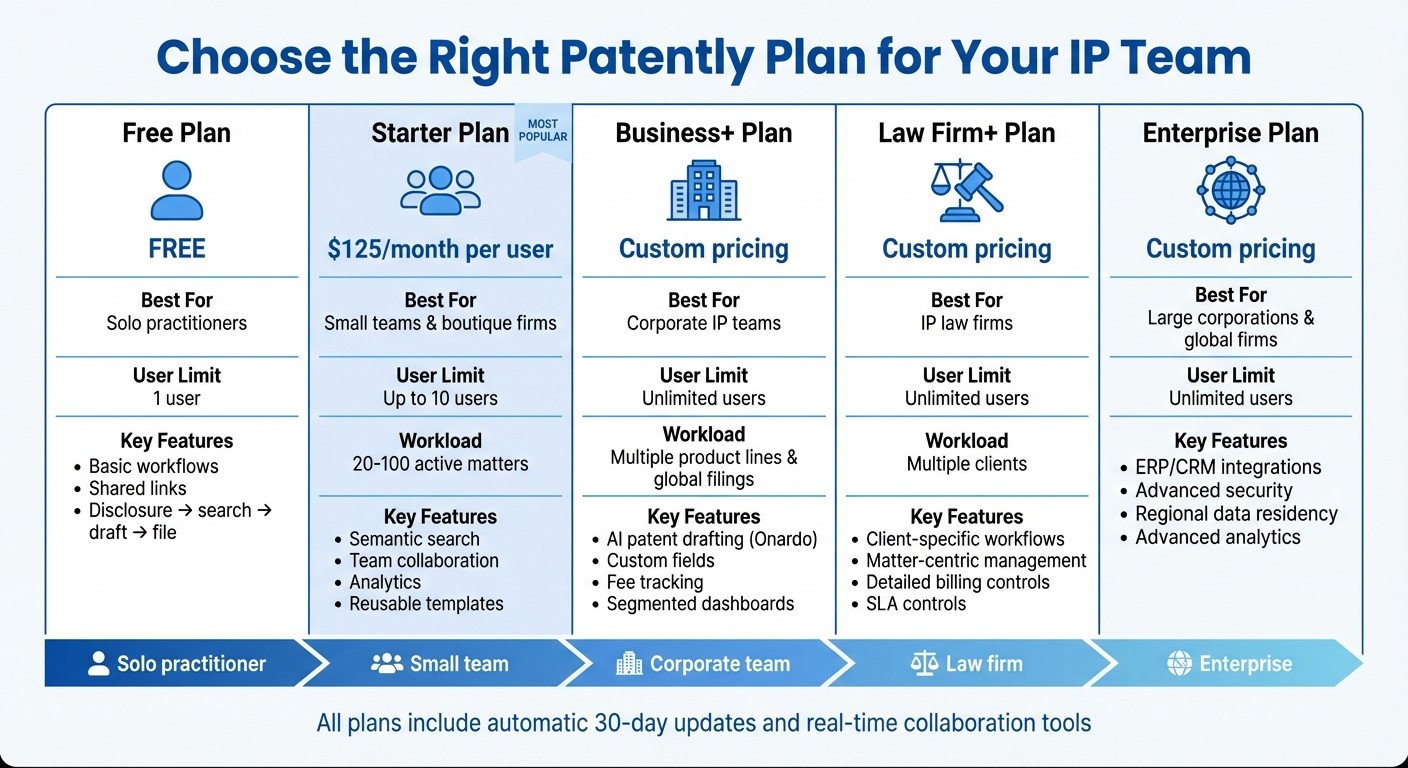
Patently’s tiered plans are designed to meet various workflow scaling needs. Here’s a quick breakdown:
Free Plan: Ideal for solo practitioners managing straightforward workflows like disclosure → search → draft → file.
Starter Plan: At $125/month per user (up to 10 users), this plan is great for small in-house teams or boutique firms handling 20–100 active matters. It offers reusable templates and basic collaboration tools for tasks like office-action responses.
Business+ Plan: With custom pricing and unlimited users, this plan is suited for corporate IP teams managing multiple product lines and global filings. It includes AI patent drafting with Onardo, custom fields, fee tracking, and segmented dashboards for better collaboration.
Law Firm+ Plan: Also custom-priced, this plan is tailored for IP law firms managing multiple clients. It focuses on client-specific workflows, matter-centric management, and detailed billing controls.
Enterprise Plan: Designed for large corporations or global firms, this custom-priced option supports tight integration with ERP, document management, and CRM systems. It also includes advanced security features and regional data residency.
Plan | Best For | Key Features | User Limit |
|---|---|---|---|
Free | Solo practitioners | Basic workflows, shared links | 1 user |
Starter | Small teams, boutiques | Semantic search, team collaboration, analytics | Up to 10 users |
Business+ | Corporate IP teams | AI drafting, fee tracking, advanced dashboards | Unlimited |
Law Firm+ | IP law firms | Client-specific workflows, SLA controls | Unlimited |
Enterprise | Large corporations/firms | Custom integrations, advanced analytics | Unlimited |
Once you’ve chosen the right plan, keep an eye on performance metrics to identify and address bottlenecks.
Using Analytics to Optimize Workflows
Patently’s smart reports and automatic 30-day updates are essential for tracking portfolio health and spotting inefficiencies. Pay close attention to cycle times for each stage - prior-art search, drafting, internal review, client review, and filing. If one stage consistently takes too long, it’s a clear sign of a bottleneck.
Monitor workload distribution across team members to prevent missed deadlines by reassigning tasks proactively. Use deadline-risk dashboards to highlight tasks nearing critical deadlines, such as USPTO office-action responses, PCT national phase entries, or maintenance fees. These tasks can then be prioritized in task queues automatically.
For deeper insights, segment analytics by client, technology domain, or jurisdiction. This can help pinpoint where delays or poor outcomes are concentrated. Compare processing times to results - like allowance rates or claim scope - to determine where extra review adds value and where streamlined handling works just fine. Key metrics to track include:
Average time from invention disclosure to filing (in days)
On-time response rates for office actions, aiming for 98–100%
Percentage of matters exceeding service-level agreements at each stage
By focusing on these metrics, you can refine your processes and improve overall efficiency.
Integrating External Data Sources
Patently’s AI patent search simplifies review by combining external and internal search results into a unified list. Using Vector AI for semantic filtering, you can sort by owners, dates, and status offices, giving you a comprehensive view of relevant patents. For specialized workflows, external data integrations, like Questel’s essentiality analysis for 4G and 5G standards, can enhance decision-making in licensing and enforcement projects.
Automating updates from patent office feeds eliminates the need for manual docketing, while linking litigation or enforcement databases aligns prosecution strategies with risk assessments. Connecting R&D or inventor portals makes disclosure workflows smoother, and integrating billing or ERP systems ties workflow stages to cost and budget analytics. This gives finance teams better visibility into IP spending by matter type or client.
Conclusion
AI-powered hierarchical workflows are transforming how U.S. patent operations are managed. Tools like Patently take over time-consuming tasks such as docketing, pre-filling forms, and providing status updates. This frees up attorneys and paralegals to focus on more strategic responsibilities like shaping claims, planning portfolios, and advising clients. Studies suggest that incorporating AI into intellectual property workflows can boost efficiency by at least 20% in drafting and prosecution. As automation extends to areas like maintenance, analytics, and team collaboration, even greater productivity gains are achievable.
These workflows don't just improve speed - they also enhance accuracy and reduce risks. Automated deadline tracking helps avoid missed dates, while standardized data entry minimizes filing errors. With centralized dashboards, teams gain a clear overview of priorities, workload distribution, and the overall health of their portfolios, enabling smarter and more proactive decision-making.
Collaboration also sees a boost. When inventors, R&D teams, in-house counsel, and external firms work from a unified platform, communication becomes seamless. Features like real-time task routing, shared workspaces, and role-based access make reviews and approvals faster and more secure, ensuring confidentiality is maintained.
For U.S. patent organizations, adopting AI-powered workflows through tools like Patently means handling larger volumes of filings, cutting down on outside counsel costs, and creating a scalable operations framework that aligns with business goals. This approach leads to more efficient portfolio management, ensuring intellectual property remains strategically impactful and well-prepared for future challenges.
FAQs
How can AI-powered workflows enhance IP project management?
AI-powered workflows bring clarity and efficiency to IP project management by structuring tasks into organized, customizable hierarchies - whether by client, department, or project phase. This approach not only enhances collaboration but also simplifies access control, ensuring all team members have a clear view of project progress.
By automating repetitive tasks and streamlining workflows, these tools help save time, minimize mistakes, and increase overall productivity. This allows patent professionals to dedicate more energy to tasks that require expertise and strategic thinking.
What are the main features of Patently's AI tools, such as Onardo and Vector AI?
Patently offers AI tools like Onardo and Vector AI to simplify patent workflows with advanced features. These include AI-assisted patent drafting, accurate claim writing, and easy-to-use figure labeling.
Vector AI stands out with its advanced semantic search capabilities, providing highly precise and context-aware results. This not only boosts efficiency but also helps minimize errors, enabling patent professionals to tackle complex intellectual property projects with greater speed and ease.
How can IP teams choose the right Patently plan for their needs?
When deciding on the ideal Patently plan, it's important for IP teams to evaluate factors like the complexity of their workflows, the size of their projects, and their collaboration needs. Patently provides a range of tools, including AI-assisted patent drafting, advanced semantic search, and SEP analytics, designed to address a variety of requirements.
For smaller teams or those handling simpler projects, a basic plan might be sufficient. On the other hand, larger teams managing the entire IP lifecycle could benefit from a more feature-rich option. Focus on the tools and features that align with your team's goals and scale to find the plan that fits your needs best.