AI Patent Scoring for SEP Analysis
Intellectual Property Management
Dec 15, 2025
AI dramatically speeds SEP analysis—semantic scoring, knowledge graphs, and citation networks let teams prioritize truly essential patents without replacing experts.

AI is transforming how businesses analyze Standard-Essential Patents (SEPs). These patents protect technologies required to implement industry standards like 5G or Wi-Fi. Traditionally, reviewing SEPs is time-consuming and expensive, involving experts manually comparing patent claims with technical standards. AI tools now simplify this process using advanced Natural Language Processing (NLP) and machine learning models to assign essentiality scores, helping teams prioritize patents for licensing, litigation, or valuation.
Key Takeaways:
What SEPs Are: Patents critical for compliance with technical standards (e.g., 5G, Wi-Fi).
Challenges: Manual SEP analysis is slow, inconsistent, and resource-intensive.
AI Solutions: Tools use NLP, semantic models, and knowledge graphs to compare patent claims with standards, speeding up reviews and improving accuracy.
Applications: AI supports licensing, portfolio valuation, and claim charting by identifying high-priority patents.
AI doesn’t replace experts but enhances their work, making SEP analysis faster and more reliable.
Agentic AI – Patent Expert Co-Pilot Framework for (SEP) Licensing & Litigation Intelligence
AI Techniques for SEP Analysis
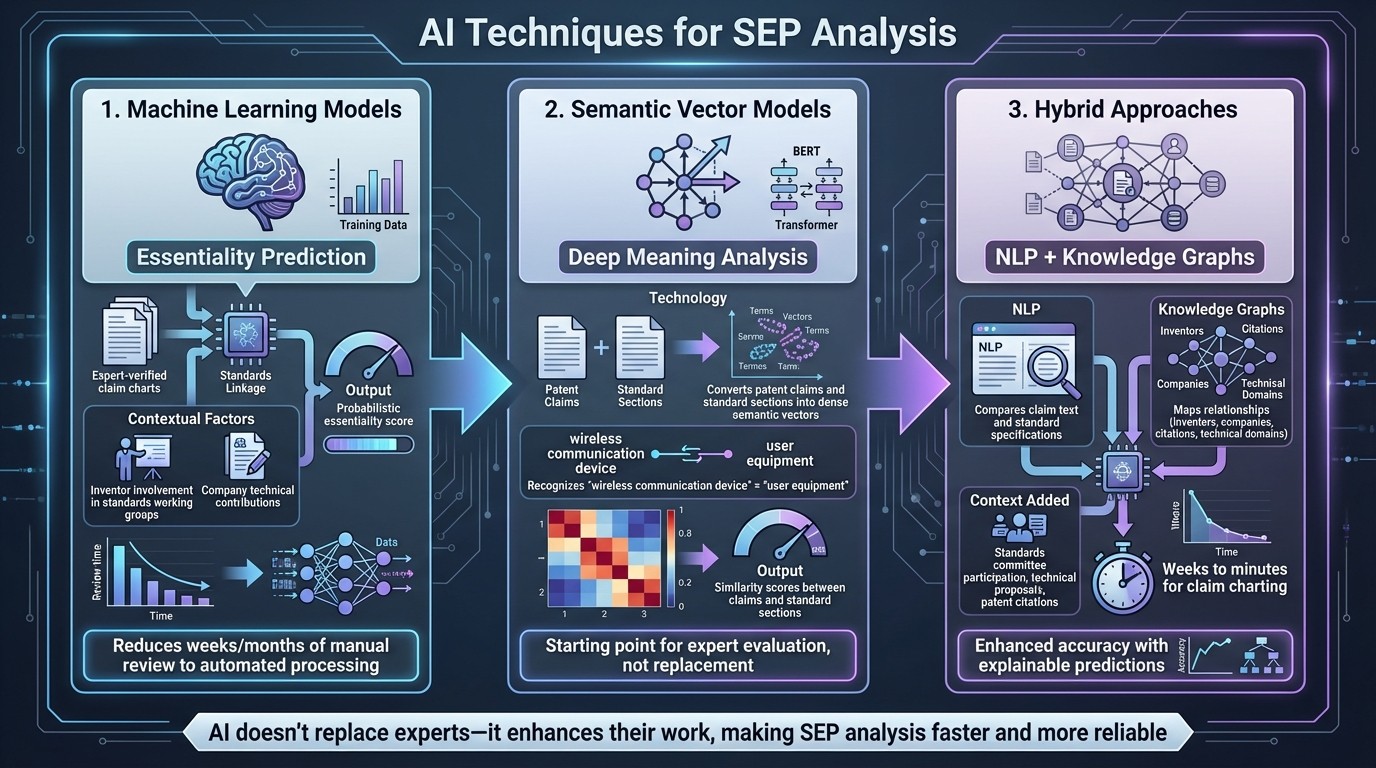
AI Techniques for Standard-Essential Patent Analysis Workflow
Machine Learning Models for Essentiality Prediction
Machine learning (ML) has stepped in to ease the burden of manual essentiality reviews. These models analyze Standard Essential Patents (SEPs) by learning from expert-verified claim charts that link patent claims to specific standards. By examining thousands of labeled patent-standard pairs, the models identify patterns and apply that knowledge to evaluate new patents. The training data goes beyond claim and standard text, incorporating contextual factors like whether inventors were involved in standards working groups or if their companies made accepted technical contributions to a standard. Such participation often signals a patent's relevance to the standard.
The output of these models is a probabilistic essentiality score, which helps intellectual property (IP) teams prioritize their efforts. With this scoring system, teams can rank thousands of patents and focus their expert resources on the most promising candidates. As highlighted by IPWatchdog, these semantic algorithms significantly reduce the time and cost associated with manual reviews by comparing patent claims and standard sections at scale - tasks that traditionally took weeks or months.
Semantic Scoring with Vector-Based Models
Semantic vector models take ML-based analysis to the next level by focusing on the deeper meaning of text. Models like BERT and other transformer architectures have made AI-driven SEP analysis more effective by converting patent claims and standard sections into dense semantic vectors that go beyond simple keywords. This approach is particularly valuable when legal language in claims doesn’t align perfectly with the technical descriptions used by engineers. For instance, these models can understand that terms like "wireless communication device" and "user equipment" refer to the same concept, even if the wording differs.
These vector models calculate similarity scores between claims and standard sections, flagging potential matches for expert review. They process thousands of claims against extensive standards documents simultaneously, uncovering conceptual overlaps that would take human reviewers months to identify. As noted by Atkinson & Bollegala, while semantic similarity doesn’t equate to legal essentiality, these AI-generated scores are most effective when used as a starting point for expert evaluations rather than as a replacement for human judgment.
Hybrid Approaches Combining NLP and Knowledge Graphs
The most advanced SEP analysis systems combine natural language processing (NLP) with knowledge graphs to provide a more comprehensive understanding of the patent and standards landscape. While NLP focuses on comparing the semantics of claim text and standard specifications, knowledge graphs add critical context. They map relationships such as which inventors worked on specific standards committees, which companies contributed accepted technical proposals, how patents cite one another, and the technical domains they address. By integrating these insights, hybrid systems enhance the accuracy of essentiality predictions and explain why certain patents receive higher or lower scores.
For example, a patent linked to an inventor who actively participated in 5G working groups and whose company contributed multiple accepted proposals to the 5G NR standard is more likely to be essential than one from an organization with no standards involvement. In 2025, Patently adopted these hybrid techniques, enabling rapid and detailed mapping of patents to technical documentation. This automation transformed SEP claim charting, reducing the time required for high-quality analysis from weeks to mere minutes, while providing the depth needed to support essentiality predictions effectively. These integrated methods are paving the way for even more advanced SEP analytics.
Applications of AI in SEP Analytics
Mapping Standards to Patent Portfolios
AI tools have revolutionized the way intellectual property professionals link patent portfolios to technical standards like 4G and 5G. By leveraging semantic algorithms, these systems analyze and compare patent claims with standard specifications, processing thousands of claims efficiently. This technology bridges a crucial gap: while attorneys often draft broad claims, engineers rely on precise technical language. Vector-based models, trained on expert-created claim charts, can identify when patent language aligns with standard terminology, ensuring accurate mapping between portfolios and standards.
For instance, an SEP Check module showcases this functionality. Users can input a patent number, select specific claims, and target standards such as 5G technical specifications. The system then parses the claims, identifies the latest versions of the standards, and generates claim charts with essentiality ratings like "Normative" or "Implied." These ratings are linked to specific excerpts from the standards. What once required weeks of manual expert review can now be achieved in minutes, all while maintaining the necessary level of detail. This precise alignment not only connects patent portfolios to technical standards but also supports more sophisticated licensing and valuation strategies.
Licensing and Valuation Insights
AI-driven SEP analysis provides objective scoring, which plays a critical role in licensing and valuation decisions. A common challenge in this space is that many declared patents are not truly essential, while some essential patents remain undeclared, complicating royalty negotiations. AI tools address this by evaluating essentiality likelihood at the claim level, refining self-declared patent data to uncover true value. For example, a Semantic Essentiality Score (SES) helps stakeholders estimate essentiality rates, aiding in the assessment of royalty bases during negotiations. These scores adapt dynamically as standards evolve - such as the progression from 5G Release 16 to Release 18 - allowing companies to benchmark their portfolios without the expense of exhaustive manual reviews. These insights enable advanced portfolio scoring, directing attention to genuinely essential patents and enhancing strategic licensing efforts.
Portfolio Scoring and SEP Prioritization
AI models enhance portfolio analysis by ranking patents based on their likelihood of essentiality. By combining semantic scores with contextual factors - such as inventor involvement in standards working groups - IP teams can focus their efforts on the most promising patents for licensing, R&D alignment, or acquisition. A 2020 European Commission pilot study confirmed the effectiveness of AI tools in SEP scoring.
Patently's SEP analytics simplifies these processes by offering detailed insights into ownership, geographical coverage, and technology scope for 4G and 5G standards-essential patents. Using Vector AI, Patently ranks patents, enabling quick identification of high-value SEPs. This empowers IP professionals with actionable data, reducing the time spent on manual reviews and enhancing strategic decisions. By streamlining scoring, AI tools sharpen SEP analysis and support more focused decision-making.
Patently: AI-Powered SEP Analytics
Overview of Patently's SEP Analytics
Patently offers SEP analytics tailored for 4G and 5G technologies, combining reliable ownership data with insights into geographical and technological coverage. At the heart of this system is Vector AI, an advanced semantic search tool that helps patent professionals identify relevant SEPs more quickly and accurately than traditional keyword-based methods. As Patently explains:
Our advanced search feature, powered by Vector AI, makes finding relevant patents faster, more intuitive, and precise.
Patently's system uses accurate SEP families as the foundation for essentiality assessments, ensuring that users can trust the platform's analytics. This strong base allows for more efficient workflows in SEP analysis.
How Patently Improves SEP Analysis Workflows
Patently's AI-driven tools simplify and speed up SEP analysis in multiple ways. For example, the platform automates claim chart creation, mapping patents to technical documentation in just minutes. Vector AI enhances this process by aligning broad legal claims with specific technical standards, cutting down the time and effort required for manual reviews.
Teams can manage large and complex SEP projects with features like hierarchical categorization and customizable workflows. Monthly updates keep portfolios current, reflecting any changes in patent status. By automating much of the heavy lifting, Patently allows experts to focus on strategic oversight, maintaining accuracy while significantly reducing timelines.
Benefits for IP Professionals
These improvements offer clear advantages for intellectual property professionals. Patent attorneys gain practical insights for FRAND negotiations through fast claim-to-standard mapping and objective essentiality scoring. The platform also supports team collaboration with shared comments, ratings, and insights at both the family and asset levels. Visual tools for exploring patent families help teams align on portfolio valuation and prepare evidence for licensing discussions or litigation.
For researchers, the ability to map standards to portfolios streamlines R&D alignment, while licensing professionals can use geographical and technological coverage data to support rate negotiations. Together, these features enhance speed, precision, and teamwork, transforming SEP analysis from initial screening to final valuation.
Future Trends in AI for SEP Analysis
As AI tools continue to evolve, new developments are set to enhance the precision and efficiency of Standard Essential Patent (SEP) analysis.
Advancements in Cross-Lingual Models
One of the most promising areas of progress lies in cross-lingual AI models. These tools aim to overcome language barriers that complicate global SEP evaluations. By creating language-agnostic vector representations of patent texts and standard specifications, these models can analyze documents across languages like Chinese, Japanese, Korean, and European languages without needing separate models for each. This eliminates much of the dependency on machine translation, ensuring the nuanced claims within patents remain intact for direct semantic comparisons.
For U.S.-based intellectual property teams, this means more accurate assessments of non-U.S. patent portfolios during licensing negotiations, all while working in U.S. dollars. Additionally, it enables quicker identification of non-U.S. patents that might require further review by local counsel. When combined with language-independent analysis, graph-based methods take this precision even further by refining how claims are assessed.
Knowledge Graphs for Better Claim Analysis
Knowledge graphs are revolutionizing SEP analysis by uncovering connections that standard text-based methods might miss. These graphs map out relationships between entities such as patents, claims, sections of standards, technical features, inventors, assignees, standards contributions, and even litigation events. These entities are linked by specific relationships, such as "claims feature", "implements section", or "authored contribution".
By modeling these relationships, knowledge graphs can infer essentiality even when there’s minimal textual similarity. For example, if the same inventor is linked to both a standards submission and a related patent claim, the graph highlights this connection. This added context helps distinguish between superficial similarities and genuine essentiality, offering a deeper understanding of the patent's relevance.
Integration with Citation Networks
Citation networks add yet another layer of depth to SEP analysis. These networks represent patents as interconnected nodes based on their backward and forward citations. Metrics like forward citation counts (indicating technological impact), citation velocity, and measures like betweenness and PageRank provide valuable insights.
When combined with semantic analysis and knowledge graphs, citation networks help identify patents that are not only essential but also influential. For U.S. practitioners, this approach allows SEPs to be ranked by both their essentiality and their broader impact on innovation. This ensures that licensing discussions and enforcement efforts focus on patents that are critical to standard features and have a significant influence on subsequent developments. In negotiations, such data-backed insights make it easier to differentiate between "core" SEPs and those that are more peripheral, helping justify royalty rates in U.S. dollar terms effectively.
Conclusion
AI-powered patent scoring has reshaped how patent professionals handle Standard-Essential Patent (SEP) analysis. Tasks that once demanded time-consuming manual reviews can now be completed in a fraction of the time using AI techniques like semantic modeling, vector search, and hybrid approaches that blend natural language processing with knowledge graphs and citation networks. This shift allows U.S. intellectual property teams to allocate their expertise to high-priority cases, cutting costs and speeding up licensing negotiations, due diligence, and litigation preparation.
AI models trained on expert-verified claim charts deliver consistent and probabilistic essentiality scores, offering greater reproducibility compared to manual assessments. These tools incorporate contextual factors - such as an inventor's involvement in standards bodies, technical contributions, and citation impact - to refine predictions. This enables data-driven strategies for licensing, FRAND analysis, and portfolio valuation, all measured in U.S. dollars.
Platforms like Patently streamline these AI capabilities into a single workflow, enhancing both efficiency and traceability. By integrating various functions, users can pinpoint potential SEPs, assess how claims align with standards, and produce defensible work products to support licensing, prosecution, and litigation. This comprehensive approach is essential for modernizing SEP analysis, helping U.S. teams effectively present their positions to counterparties, courts, and regulators.
The efficiencies achieved so far pave the way for future advancements. Emerging technologies, such as cross-lingual models, enhanced knowledge graphs, and citation-aware algorithms, promise to expand AI's role in global SEP management. That said, AI should remain a tool for filtering and prioritizing, not a replacement for human judgment. Experts will continue to provide the technical insights, legal expertise, and business context that go beyond simple text analysis. By embracing AI platforms that balance automation with transparency, U.S. patent professionals can transition from reactive essentiality checks to proactive, data-driven strategies, gaining a stronger edge in negotiations and dispute resolution.
FAQs
How does AI enhance the efficiency and precision of SEP analysis?
AI has reshaped the way SEP analysis is conducted, utilizing advanced algorithms to uncover patent relationships, evaluate ownership, and assess technical relevance with a high degree of accuracy. It simplifies the process by automating tasks like drafting claims, spotting errors, and examining patent families, cutting down on time-intensive manual work.
With AI in the mix, professionals can make quicker, well-informed decisions and work together more efficiently, ensuring a thorough and precise approach to evaluating SEPs.
How do semantic vector models help determine if a patent is essential to a standard?
Semantic vector models delve into the meaning and context within patent content, making it easier to draw accurate comparisons between patents. By pinpointing similarities in technology and claims, these models assist in determining whether a patent is tied to a specific standard. This method enhances accuracy and minimizes uncertainty in evaluating essentiality.
How do knowledge graphs help analyze the relevance of patents to standards?
Knowledge graphs simplify the process of analyzing how patents align with standards by visually mapping the relationships between patents, their owners, and the technologies they address. This approach makes it much easier to see how particular patents connect to standard-essential technologies and understand their overall influence.
By breaking down complex relationships into a clear and structured format, knowledge graphs help pinpoint important patents, highlight their relevance to specific standards, and reveal any overlaps or missing areas in coverage.