How AI Models Forecast Patent Trends
Intellectual Property Management
Dec 16, 2025
AI models forecast patent activity—identifying emerging tech, tracking competitors, and guiding portfolio decisions using ARIMA, LSTM, Transformers and GANs.

AI is reshaping how we analyze patent trends, turning complex datasets into actionable insights. Here's the core takeaway: AI-powered tools can predict emerging technologies, track competitor strategies, and optimize patent portfolios. By leveraging models like ARIMA, LSTM, and Transformers, businesses can make smarter decisions about innovation and intellectual property.
Key Points:
ARIMA: Best for short-term patent filing forecasts based on historical data trends.
LSTM: Ideal for identifying long-term patterns and disruptions in technology.
Transformers: Analyze large datasets to detect emerging tech clusters with high precision.
GANs: Simulate future patent scenarios, reducing prediction errors.
AI tools also streamline patent data preparation - cleaning, structuring, and engineering features like citation velocity, inventor mobility, and filing trends. Platforms like Patently provide advanced analytics, helping teams visualize trends, monitor competitors, and manage portfolios efficiently.
AI’s future in patent forecasting includes integrating multimodal data, real-time innovation tracking, and predictive litigation insights. While AI enhances decision-making, expert validation remains critical to address legal complexities and ensure accurate interpretations.
AI Models Used for Patent Trend Forecasting
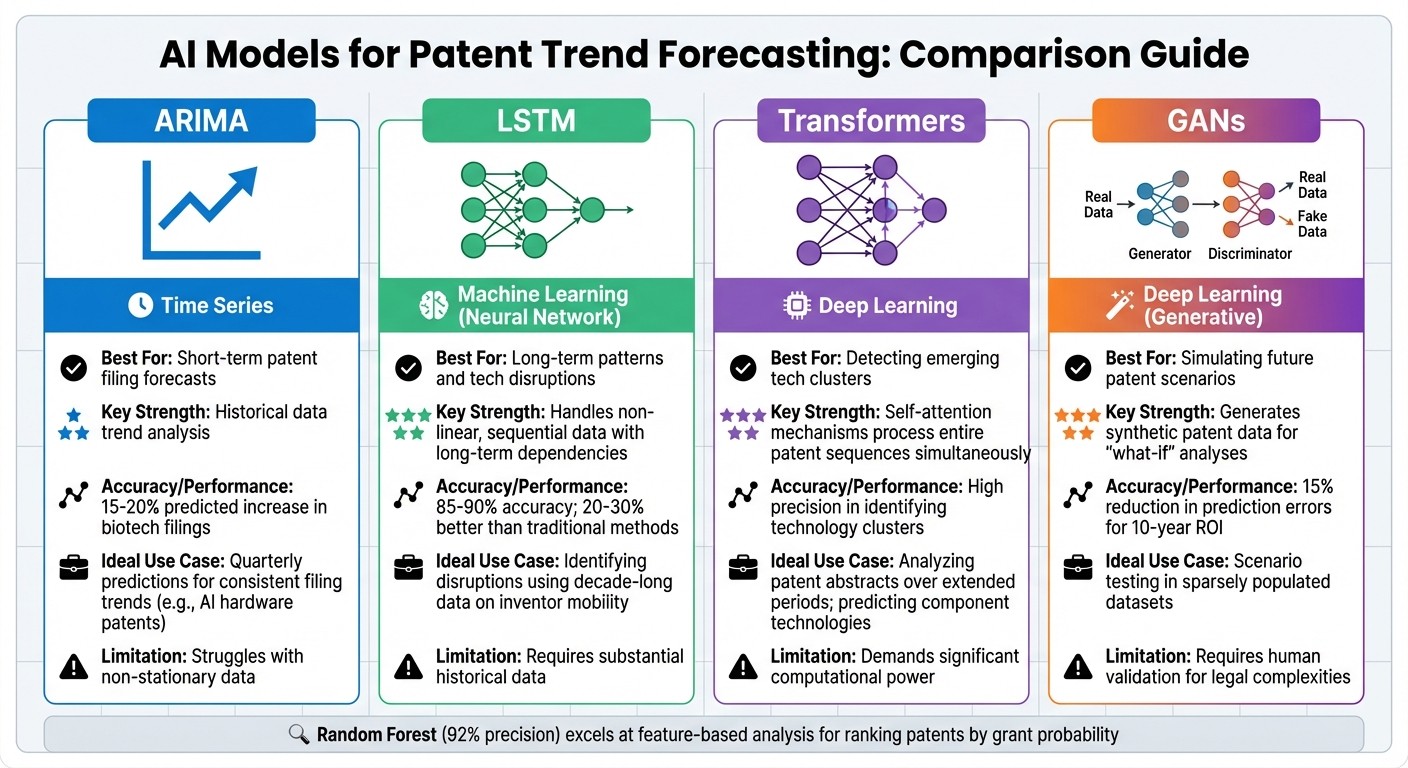
AI Models for Patent Forecasting: Capabilities and Use Cases Comparison
Different AI models bring unique strengths to patent trend forecasting, creating a versatile toolkit for intellectual property (IP) analysis. Time series models like ARIMA focus on historical trends and seasonality, while machine learning approaches such as LSTM and Random Forest excel at analyzing sequential patterns and feature-based predictions. Deep learning models push the boundaries further by processing large datasets simultaneously and simulating future scenarios.
Time Series Models: ARIMA
ARIMA (AutoRegressive Integrated Moving Average) is a reliable tool for forecasting patent activity by breaking historical filing data into three components: autoregressive, differencing, and moving average. For example, using USPTO data from 2015 to 2025, an ARIMA(1,1,1) model could predict a 15–20% increase in biotechnology patent filings over the next 12 months.
This model is particularly effective for short-term forecasts where filing trends are relatively consistent, such as quarterly predictions for AI hardware patents. However, ARIMA struggles with non-stationary data. To maintain accuracy, experts suggest validating models with AIC scores and retraining them quarterly to keep up with changing IP landscapes.
Machine Learning Models: LSTM and Random Forest
LSTM (Long Short-Term Memory) networks are designed to handle non-linear, sequential data. By maintaining long-term dependencies through specialized gates, LSTM models can identify tech disruptions using a decade's worth of data on inventor mobility and emerging terms. These networks have achieved an impressive 85–90% accuracy in such tasks. For instance, Google's surge in AI patents demonstrated that LSTM models deliver 20–30% better long-term accuracy compared to traditional forecasting methods.
On the other hand, Random Forest, an ensemble learning technique, excels in analyzing feature-based data. It builds multiple decision trees using patent attributes like citations, claim counts, and technology classifications. This approach is particularly effective for ranking patents by grant probability or identifying high-value pharmaceutical assets, achieving a 92% precision rate by minimizing overfitting through bagging. While LSTM is ideal for time-based trends, Random Forest shines in static feature analysis, offering clear insights through feature importance rankings. Some platforms even combine these methods into hybrid tools for comprehensive risk assessment.
These machine learning techniques lay the groundwork for more sophisticated deep learning models.
Deep Learning Models: Transformers and GANs
Deep learning takes patent forecasting to the next level. Transformers, for instance, use self-attention mechanisms to process entire patent sequences simultaneously, sidestepping the sequential limitations of earlier models. By analyzing patent abstracts over extended periods, Transformers can identify emerging technology clusters with remarkable precision. This ability to process data in parallel makes them especially useful for predicting the development of component technologies.
GANs (Generative Adversarial Networks) bring another layer of innovation by generating synthetic patent data for scenario testing. A generator creates potential future patent landscapes, while a discriminator evaluates their realism. This method is particularly effective for "what-if" analyses in sparsely populated datasets, reducing prediction errors for 10-year ROI by 15% compared to baseline models. However, both Transformers and GANs demand significant computational power. To ensure accuracy, AI-generated outputs should be paired with human validation to address legal complexities.
Preparing Data for AI-Based Patent Forecasting
Data preparation is the backbone of AI model success. In fact, about 80% of the effort in AI projects goes into preparing data, which directly affects how accurate the model's predictions are. Even advanced models like Transformers or LSTM networks can produce misleading results if the input data isn’t clean and structured, leading to flawed patent strategies.
Where to Get Patent Data
Global patent databases are essential for AI forecasting models. Key sources include the United States Patent and Trademark Office (USPTO), European Patent Office (EPO), and World Intellectual Property Organization (WIPO), which provide structured data on patent filings, grants, and citations across different regions. Public platforms like Google Patents and Espacenet offer free access to patent families, while commercial services often provide APIs for bulk data downloads.
Patently stands out for delivering high-quality patent data with advanced search features powered by Vector AI. This platform ensures comprehensive results with reliable identification and error-checking. It offers trusted data on ownership, geographic scope, and technology coverage - particularly useful for analyzing 4G and 5G Standards Essential Patents (SEPs). Users can combine searches, including external datasets, into one unified result, filtering by owners, filing dates, or patent office status. Once collected, this data needs to be thoroughly cleaned and processed.
Cleaning and Preprocessing Patent Data
After gathering the data, thorough cleaning is critical to ensure its reliability for forecasting. Raw patent data often contains inconsistencies that can distort predictions. This includes standardizing formats (like inventor names and classification codes such as CPC/IPC), addressing missing values, removing duplicates, and filtering out irrelevant records. For example, date inconsistencies across databases can skew time-series analyses, so converting all dates to ISO 8601 (YYYY-MM-DD) ensures models like ARIMA and LSTM can process the data accurately.
Natural Language Processing (NLP) pipelines transform unstructured text into usable features. By parsing patent abstracts and claims, you can extract metadata, tokenize and lemmatize descriptions, and remove stop words. A practical example is the USPTO’s use of machine learning models trained on historical patents to predict AI-related filings, showing how proper preprocessing enables large-scale analysis. Techniques like TF-IDF or embeddings help reduce dimensionality, while balancing datasets addresses class imbalances between emerging and mature technologies.
Creating Features from Patent Metrics
Once the data is clean and structured, feature engineering becomes the next step to enhance predictive accuracy. Extracting key features from patent metrics can significantly boost model performance. Metrics like patent family size and forward citation counts are strong indicators of a patent's strategic importance and its potential technological influence. Other useful signals include filing-to-grant lag time, innovation rates (e.g., patents filed per year), geographic reach, and citation velocity.
Feature engineering transforms raw data into actionable insights. For instance, patents with high citation velocity in pharmaceutical research often signal upcoming market disruptors, while those with 10 or more family equivalents suggest broad international protection strategies. Patently’s AI tools allow users to explore patent families and uncover connections that aid in creating features for forecasting models. These features can then be used in models like Random Forest to rank patents by grant probability or LSTM networks to detect technological disruptions.
How to Apply AI Forecasting in IP Strategy
AI forecasting is reshaping how organizations approach intellectual property (IP) strategy. By leveraging advanced forecasting models and meticulously cleaned patent data, businesses can transform raw information into actionable strategies. This shift allows companies to move away from reactive, retrospective reviews toward forward-thinking forecasts that guide strategic filings and positioning. Let’s dive into how AI can uncover emerging trends, monitor competitors, and enhance collaboration.
Spotting Emerging Technology Trends
AI tools excel at identifying early-stage technology trends by analyzing filing patterns, citation velocity, and the appearance of new technical terms. These insights help pinpoint growing technology clusters and assess their potential, using risk scores to distinguish between promising growth areas and oversaturated fields. White-space analysis further highlights underdeveloped areas with rising activity, giving companies the chance to file strategically before competitors catch on. For industries like pharmaceuticals and tech, AI forecasting not only reveals opportunities for partnerships or competitive actions but also tracks the movement of inventors between organizations, offering a deeper layer of strategic insight.
Analyzing Competitors and Managing Portfolios
Once trends are identified, AI deepens its utility by refining competitor analysis. By examining patent datasets, AI tools can map out competitive landscapes and predict potential market disruptors. Real-time dashboards and watchlists alert teams to significant changes, such as filing surges, shifts in claim scope, or cross-licensing activity.
AI also optimizes portfolio management by evaluating patents based on citation patterns, market relevance, and geographical data. This allows teams to identify high-value patents worth maintaining while flagging low-impact ones for pruning. For example, patents with high citation velocity may indicate potential market disruptors, while those with waning relevance could signal an opportunity to cut maintenance costs. This targeted approach helps organizations prioritize investments and maintain a streamlined, effective portfolio.
Using Patently for AI-Driven Collaboration

Patently offers a comprehensive platform for integrating AI insights into team workflows, from patent drafting to portfolio analysis. Its tools, such as Vector AI semantic search and the AI assistant Onardo, enhance collaboration by consolidating insights and enabling unified decision-making. Teams can easily share comments, ratings, and evaluations at both the patent family and individual asset levels, tailoring these features to assess novelty, validity, and overall IP strategy. Project management tools ensure that AI-driven insights are seamlessly incorporated into strategic decisions across the entire IP team.
Patently also keeps teams informed with automated updates and smart reports, delivered on a set schedule (e.g., every 30 days). These reports provide real-time updates on competitor activity and portfolio status, enabling proactive adjustments based on the latest trends. Additionally, Patently’s SEP analytics offer detailed insights into 4G and 5G essential patents, including ownership, geographical coverage, and technical scope - crucial for navigating competitive landscapes and licensing strategies. By centralizing tools for search, drafting, analytics, and collaboration, Patently ensures that legal, engineering, and business teams operate from the same AI-enhanced playbook, streamlining everything from research to reporting.
Visualizing and Interpreting Patent Trends
Visualizing and interpreting patent trends accurately is a key step in using AI forecasts to guide strategic intellectual property (IP) management.
Best Practices for Visualizing Patent Trends
Different visualization techniques can help make sense of patent data. For instance, time-series line charts are ideal for tracking filing volumes, citations, or technological activity over time. By overlaying historical data with AI-generated forecast bands, you can easily spot patterns like seasonal trends or pivotal changes. Stacked area charts are another option, useful for comparing activity across different technology categories or assignees, which can inform decisions about portfolio management and R&D investments.
If you’re looking to identify hot spots or gaps, heatmaps work well by showing patent intensity across regions, technology fields, or assignees. For example, you might explore trends like technology versus geography or year versus CPC subclass. Meanwhile, clustering plots can reveal emerging subfields or areas where technologies are converging. Most IP teams combine two or three of these visualization methods in dashboards, providing both a broad overview and detailed insights into AI-driven data.
When presenting data, use standard formats like MM/DD/YYYY for specific dates, YYYY for annual trends, and include thousands separators (e.g., 12,500 patents). Add annotations to highlight key events that explain major shifts in trends. Forecasts should include confidence bands, such as 80–95% prediction intervals, to indicate variability and help decision-makers understand the range of likely outcomes rather than just a single projection. Interactive dashboards with filters for assignees, jurisdictions, or technology codes are great for in-depth exploration, but also ensure static, presentation-ready versions are available for executive-level discussions.
These visualization strategies lay the groundwork for meaningful interpretation of forecast results.
How to Interpret Forecast Results
Once the data is visualized, interpreting the forecast metrics can uncover actionable insights. For example, understanding the compound annual growth rate (CAGR) in a specific technology area - like an 18% CAGR in U.S. filings over five years - can help prioritize R&D efforts and allocate filing budgets effectively. Prediction intervals around forecast lines provide a sense of uncertainty: narrow bands suggest stable areas like mature technologies, while wider bands indicate more volatile or fast-changing fields, where staged or flexible IP strategies might be necessary.
To assess the reliability of the AI model, include forecast error metrics such as MAPE (Mean Absolute Percentage Error) or RMSE (Root Mean Square Error) from backtesting. Use visual cues like color-coded risk levels - red for high uncertainty or areas of model disagreement - and icons to flag zones with limited data. These features can help attorneys avoid over-relying on AI outputs for critical decisions like filings or enforcement actions. Be aware of anomalies, such as one-off spikes in filings caused by events like mass portfolio transfers or bulk continuation filings, which models might mistakenly interpret as long-term trends. Annotating these events helps prevent misinterpretation.
Validation is an essential step. Start by backtesting - hide a few years of historical data, run the model on earlier years, and then compare its predictions to actual outcomes using error metrics and visual overlays. Collaborate with subject-matter experts, such as R&D leaders or senior patent counsel, to review key visuals and outliers. They can provide insights into whether forecasted trends align with what’s happening in labs or the market.
Tools like Patently offer collaborative features that allow teams to explore patent families visually, add comments, and rate individual patents. These tools also make it easy to export analyses into customized reports for stakeholders. Automated updates - say, every 30 days - ensure that patent trend visualizations stay current and relevant, supporting ongoing adjustments to IP strategies.
The Future of AI in Patent Forecasting
Key Takeaways
AI is revolutionizing patent forecasting, shifting it from a reactive process to a proactive, data-driven strategy. By quickly identifying emerging technologies, tracking competitor activity, and assessing portfolio risks, AI tools are transforming how businesses approach intellectual property management. For example, semantic clustering can pinpoint fast-growing niches, while competitive intelligence tools track filing trends and inventor movements, enabling earlier freedom-to-operate checks. Predictive models also help identify low-value patents for abandonment, saving companies thousands of dollars in maintenance fees, while highlighting high-value "crown jewel" patents. When integrated into processes like quarterly portfolio reviews, R&D meetings, and annual budget planning, AI tools - especially when paired with dashboards showing cost projections in USD - can significantly boost ROI and improve competitive positioning.
However, these tools work best when combined with expert review. While AI excels at detecting patterns, it doesn’t fully account for evolving legal doctrines in areas like subject-matter eligibility, obviousness, or claim construction. IP professionals should interpret AI-generated results as ranges rather than absolutes and document how these insights inform their recommendations to ensure alignment with U.S. legal standards.
What's Next for AI in Patent Forecasting
Today's AI tools already enhance strategic decision-making, but emerging advancements promise to push the boundaries even further. Future systems will integrate multimodal data - including claims, drawings, prosecution histories, litigation records, and market data - with additional sources like scientific publications, standards documents, and product details. This integration will refine forecasts and better connect patent filing trends to commercialization timelines. For example, graph neural networks will analyze citation and co-inventor networks, sharpening predictions about key technologies and potential litigation risks.
Next-generation tools will also simulate shifts in patent trends under varying regulatory and funding scenarios, offering deeper insights for IP planning. Real-time innovation trackers will alert users to micro-trends and early inflection points, while predictive signals from litigation and licensing histories will help estimate assertion risks and identify potential surges in licensing demand. As quantum computing and advanced cloud infrastructures develop, these systems will be able to process massive global datasets and run multiple forecasting scenarios simultaneously, allowing for dynamic re-clustering under different assumptions.
Collaboration features will also see significant improvements, making it easier for legal, R&D, and business teams to align on IP strategies. For U.S. practitioners, this evolution marks a shift from managing portfolios reactively to creating proactive "IP roadmaps" that align closely with product development and standards strategies. Advanced AI tools will empower professionals to focus on strategic leadership, integrating AI outputs into broader business and legal contexts. Platforms like Patently are already paving the way by offering AI-powered SEP analytics, semantic search, and collaborative project management - all within a unified workspace designed to support forecasting, drafting, and strategic analysis.
FAQs
How do AI models like LSTM and Transformers help predict patent trends?
AI models like LSTM (Long Short-Term Memory) and Transformers have transformed how we forecast patent trends by diving deep into complex patterns within patent data. They shine in uncovering temporal trends (how patent activity shifts over time) and semantic relationships (connections between different technologies and innovations).
These tools make predictions more accurate, giving professionals the edge to spot emerging technologies, keep tabs on the innovation landscape, and fine-tune intellectual property strategies. By tapping into these capabilities, organizations can maintain a competitive edge in the fast-paced world of patents.
Why is data preparation crucial for improving AI's patent trend forecasts?
Data preparation plays a key role in ensuring accurate AI-powered patent trend forecasting. Why? Because clean, consistent, and relevant data is the foundation for reducing errors, improving model training, and delivering reliable predictions.
When the data is well-prepared, AI models can more effectively pinpoint patterns and trends. This leads to sharper insights, helping drive smarter strategic decisions in the realm of intellectual property management.
How do AI tools help manage and optimize patent portfolios?
AI tools like Patently are transforming the way patent portfolios are managed. By automating essential tasks such as searching, analyzing, and categorizing patents, these tools streamline the process significantly. They also provide valuable insights into aspects like ownership, lifecycle status, and geographic coverage, making it easier to pinpoint critical assets and address potential risks.
Beyond simplifying management, these tools aid in strategic decision-making. With data-driven analytics, they offer insights into licensing opportunities, standard-essential patents (SEPs), and the relationships between patents. On top of that, AI boosts efficiency in tasks like drafting, claim charting, and collaborative reviews. This not only reduces manual labor but also enhances accuracy throughout the entire patent lifecycle.