AI in SEP Analytics: Monitoring Standards Compliance
Intellectual Property Management
May 24, 2026
AI maps and monitors SEPs against evolving standards like 3GPP and ETSI to enable continuous compliance and risk detection.

AI is transforming how Standard Essential Patents (SEPs) are analyzed and monitored for compliance with technical standards like 5G and Wi-Fi. Here's what you need to know:
SEPs Defined: These are patents necessary to implement recognized technical standards. Verifying if a patent is truly essential or falsely claimed is critical to avoid licensing disputes caused by the "essentiality gap."
AI's Role: AI tools use Natural Language Processing (NLP) and semantic search to compare patent claims with extensive standards documents (often over 2,000 pages). This automation reduces manual effort and improves accuracy.
New Methods: AI introduces spectrum-based ratings (Normative, Implied, Informative, Contextual) instead of binary classifications, offering more precise evaluations.
Data Sources: Key datasets include technical specs from standards-setting organizations (e.g., ETSI, 3GPP), patent registries (USPTO, EPO), and litigation records.
Challenges: Over-declaration of patents, inconsistent data, and jurisdictional complexities require AI systems to normalize and validate information for reliable results.
Monitoring Standards: AI enables continuous updates by tracking changes in standards and aligning them with SEP portfolios, flagging risks in real-time.
Tools: Semantic search, knowledge graphs, and drift detection ensure accurate mapping of patents to standards and quick adaptation to updates.
AI-powered SEP analytics streamline compliance processes, reduce review times by up to 70%, and support better licensing and litigation strategies.
AI Approaches to SEP and Standards Mapping
AI Methods Used in SEP Mapping
Modern AI systems for SEP (Standard Essential Patent) mapping use a combination of techniques to analyze and compare patent language with standards. At the most basic level, text matching lays the groundwork. However, more advanced methods like vector embeddings and semantic search dig deeper, capturing nuanced meanings and regional variations. This becomes essential when different regions or standards organizations describe the same concept in varying terms.
In addition, cutting-edge systems approach standards documents with a hierarchical structure. By recognizing the relationships between sections, figures, tables, and equations, these systems can construct knowledge graphs. These graphs help trace cross-references (e.g., "as defined in §X") and assemble complete evidence packages for claim charting. This approach ensures that context is preserved, rather than isolating snippets of information.
A dual-index system further enhances this process. It combines a structured database for metadata with vector-based Retrieval-Augmented Generation (RAG) for high-recall searches across massive datasets. Machine learning models, trained on manually reviewed SEPs, can then assess the essentiality of new patents. This streamlined process has the potential to reduce review times by as much as 70%.
Of course, the effectiveness of these techniques depends heavily on access to comprehensive and reliable datasets.
Key Datasets for AI-Based SEP Analysis
The success of AI-driven SEP mapping hinges on the quality and diversity of the data feeding these systems. Standards-setting organizations (SSOs) like ETSI, 3GPP, IEEE, and ITU provide the technical specifications that AI uses for semantic comparisons. Meanwhile, patent registries such as USPTO, EPO, CNIPA, JPO, and KIPO supply critical legal data, including grant statuses, priority dates, and ownership histories. Litigation records from courts like the Unified Patent Court (UPC) and U.S. District Courts offer insights into SEP enforcement and interpretations of FRAND (Fair, Reasonable, and Non-Discriminatory) obligations.
Specialized datasets also play a pivotal role. For example, TeleSpec-Data is a telecom-focused dataset that includes 38,302 documents, such as 15,054 3GPP specifications covering Releases 8–19 and 23,248 ETSI documents spanning 15 working groups from 2000 to 2024. The EPO's prior art collection adds another layer, with over 5.5 million documents from standards development organizations. In rapidly advancing fields like wireless communications, nearly 70% of EPO search reports now reference documents from these organizations.
"Technology standards are the backbone of our digital economy, driving innovation and growth, and ensuring seamless connectivity across devices and platforms." - António Campinos, President, European Patent Office
Data Source | Key Examples | Primary Use |
|---|---|---|
SSO/SDO | ETSI, 3GPP, IEEE, ITU | Technical specs for semantic matching |
Patent Registries | USPTO, EPO, CNIPA, JPO | Legal status and family mapping |
Litigation Records | UPC, U.S. District Courts | Identifying enforced SEPs |
AI Training Sets | TeleSpec-Data | Pretraining models on telecom domain |
Patent Pools | Benchmarking royalty rates and ownership |
Limitations of Automated SEP Classification
Despite these advancements, automated SEP classification faces several challenges. One of the biggest issues is over-declaration. Organizations like ETSI and 3GPP don’t verify the essentiality of patents before accepting declarations. As a result, companies often declare patents broadly or defensively. This creates a need for rigorous data validation and filtering to ensure AI systems can distinguish genuinely essential patents from noise.
Another challenge is data inconsistency. For instance, assignee names often vary across registries (e.g., "Nokia Corp" vs. "Nokia Oyj"). Metadata formats differ between patent offices, and SSO databases frequently lag in updating records to reflect mergers or patent assignments. Jurisdictional complexities add further layers: a patent active in the U.S. might be expired in Europe, and varying definitions of patent families can distort portfolio size estimates and royalty calculations.
To address these gaps, AI systems must integrate normalization processes. This includes grouping patents by shared priority dates, reconciling SSO declarations with live patent office records, and using corporate hierarchy data to identify accurate "ultimate owners." These steps are critical to building reliable and actionable SEP analytics.
GSLC Tim Pohlmann Welcome Remarks - SEP determination using AI
AI Methods for Global Standards Compliance Monitoring
AI-driven mapping has made SEP classification more efficient, but keeping up with evolving standards requires advanced monitoring techniques to ensure compliance.
Continuous and Risk-Based Monitoring Frameworks
Traditionally, SEP compliance reviews have been periodic - often conducted once or twice a year. These manual processes involve checking updates from standards bodies, reviewing meeting reports, and reassessing portfolios at major release milestones. The problem? A lot can change between these reviews, and delays in addressing critical updates can lead to serious business and legal risks.
AI transforms this approach. Modern monitoring systems work continuously, pulling in documents from organizations like 3GPP, ETSI, IEEE, and ITU. Automated tools - such as crawlers, APIs, and event-driven feeds - capture new drafts, change requests, and finalized releases as they happen. Natural language processing (NLP) enhances this process by parsing and categorizing incoming content, flagging updates relevant to specific technologies or patent claims. According to a 2021 EU RegTech report, automated regulatory tools can cut the time needed to evaluate a new document by up to 80% compared to manual reviews.
Another game-changer is risk-based prioritization. Not every update carries the same level of importance. AI models evaluate updates based on factors like technical criticality (e.g., mandatory vs. optional clauses), market exposure in the U.S., SEP density in the affected area, and whether the feature is tied to ongoing litigation. Updates flagged as high-risk are sent directly to human reviewers, while lower-risk changes are logged for periodic review. Borrowing techniques from industries like finance and pharmacovigilance, this approach ensures IP teams focus their efforts where it counts most.
Tracking Standards Updates and SEP Portfolios
AI doesn’t just monitor standards - it also tracks changes and aligns them with SEP portfolios.
Take a new 3GPP release, for example. Release 17 alone includes hundreds of Technical Specifications and thousands of change requests. Manually identifying which updates impact your SEP portfolio is nearly impossible at this scale. AI steps in by creating a structured digital model of each standard, mapping updates clause-by-clause to previous versions using semantic similarity models. This process highlights where changes have occurred.
For each updated clause, semantic search tools compare the language of related SEPs, pulling in claim text and prosecution history. From there, an essentiality likelihood classifier estimates whether a candidate patent remains relevant to the updated standard. The result? A continuously updated, time-stamped SEP-standards mapping that reveals which patents may have gained or lost essentiality - giving IP teams a solid foundation for revisiting licensing strategies and disclosure requirements.
Core Tools and Technologies
The backbone of any compliance monitoring system relies on three key technologies working in tandem.
Semantic search bridges the gap between clauses and patent claims, even when terminology changes.
Knowledge graphs link standards clauses, SEP declarations, patent families, and products, enabling quick impact analysis when standards evolve.
Drift detection ensures the system stays accurate over time by spotting changes in the meaning of technical terms like "network slicing" or "beamforming." When semantic drift is detected, related classifiers are flagged for retraining.
Tool | Function | Why It Matters |
|---|---|---|
Semantic search + vector embeddings | Maps standards clauses to patent claims by meaning | Adapts to terminology changes and paraphrasing |
Knowledge graph | Connects clauses, SEPs, owners, and products | Speeds up analysis when standards are updated |
Drift detection | Tracks shifts in technical term meanings | Ensures AI models remain accurate over time |
NLP-based change detection | Highlights added, removed, or altered requirements | Identifies material updates across large document sets |
Risk scoring models | Ranks updates by business and legal impact | Directs human attention to the most critical changes |
Governance and Risk Management in AI-Powered SEP Analytics
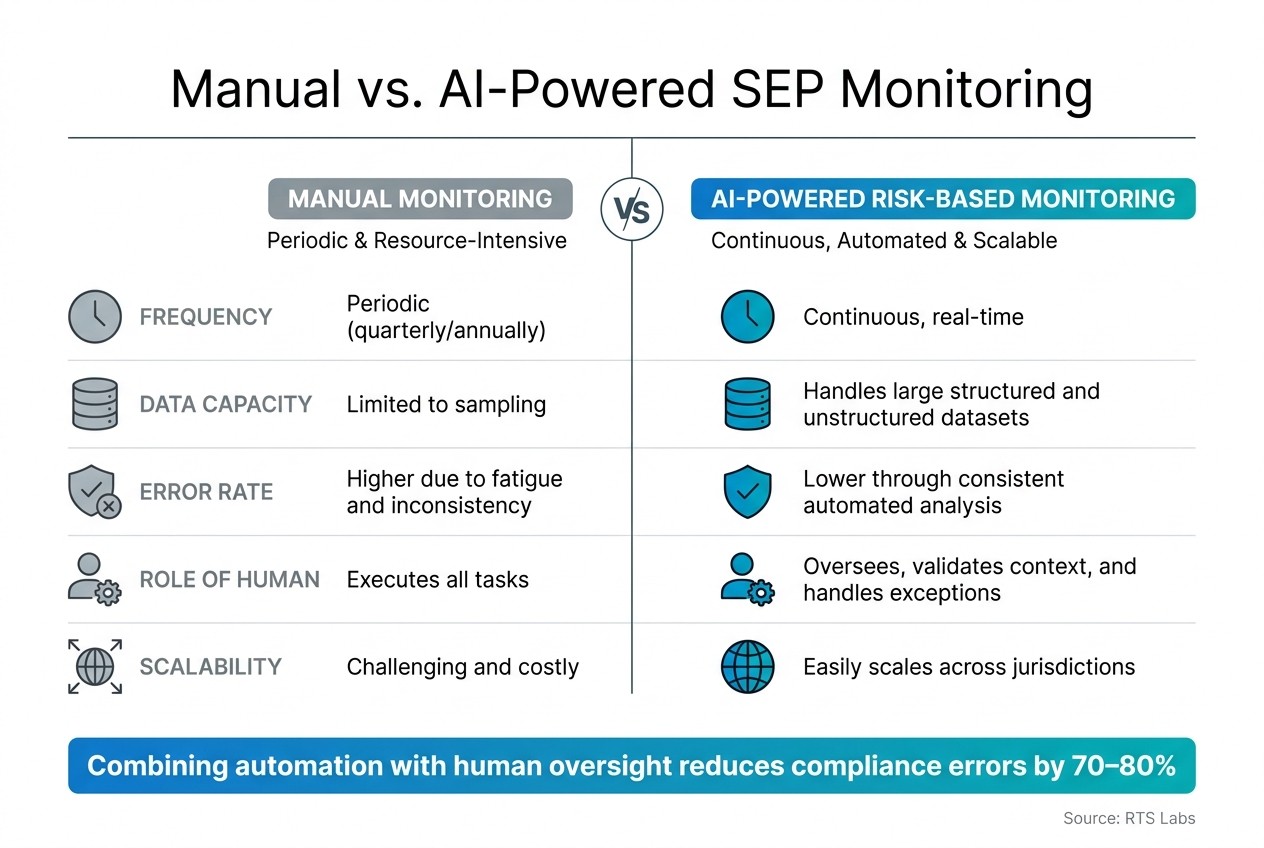
Manual vs. AI-Powered SEP Monitoring: Key Differences
Strong governance frameworks play a crucial role in ensuring the integrity of AI-driven SEP analytics. Even the most advanced AI systems need oversight to address potential risks effectively.
Identifying and Addressing Compliance Risks
One major challenge in SEP analytics is misclassification - when the essentiality of a patent is assessed incorrectly. This can compromise the reliability of SEP data. To tackle this issue, organizations are increasingly turning to independent third-party verification. Instead of relying solely on self-declarations, these external evaluators help confirm essentiality, which improves the reliability of classifications.
Another noteworthy shift is the move from simple "yes/no" classifications to a probabilistic approach. This method better reflects the uncertainties inherent in SEP classification. Additionally, integrating verified data into centralized platforms like WIPO's PATENTSCOPE enhances governance by making the data more accessible and easier to audit.
Human Oversight and AI Explainability
AI tools in SEP analytics are designed to support expert judgment - not replace it.
"AI provides a continuous stream of data-driven recommendations, while experienced teams assess context, validate findings, and take corrective action where needed." - RTS Labs
For effective governance, clear decision-making roles are essential. Legal, technical, and IP teams must collaborate to review AI-generated alerts, escalate issues, and make final decisions. Combining automation with human oversight has proven to reduce compliance errors by 70–80%.
Explainability has also become a critical requirement:
"Explainability is no longer optional. Many regulations require organizations to articulate how AI systems arrive at decisions, especially in high-impact areas." - Tanium
In SEP analytics, this translates to maintaining tamper-resistant audit trails. These include system logs, version histories, and decision records, all designed to withstand scrutiny from regulators and stakeholders. This approach shifts human involvement toward strategic decision-making rather than routine monitoring, as highlighted in the comparison below.
Risk-Based vs. Manual Monitoring: A Comparison
Continuous, risk-based monitoring becomes even more dependable with robust governance measures. The table below outlines the differences between traditional manual monitoring and AI-powered risk-based approaches:
Feature | Manual Monitoring | AI-Powered Risk-Based Monitoring |
|---|---|---|
Frequency | Periodic (quarterly/annually) | Continuous, real-time |
Data Capacity | Limited to sampling | Handles large structured and unstructured datasets |
Error Rate | Higher due to fatigue and inconsistency | Lower through consistent automated analysis |
Role of Human | Executes all tasks | Oversees, validates context, and handles exceptions |
Scalability | Challenging and costly | Easily scales across jurisdictions |
This doesn’t mean manual review is irrelevant. Instead, its role has evolved. Human expertise is still critical for reviewing high-risk flags, validating edge cases, and ensuring AI outputs align with legal and business objectives.
Practical Uses of AI-Powered SEP Analytics
AI-Driven Features in Patently
Patently brings AI-powered tools to SEP workflows, making processes faster and more precise. Its Vector AI semantic search goes beyond simple keyword matching by understanding concepts, helping users find relevant patents even when the language differs. One standout feature is Patently Mine, which automates claim charting - a task that usually takes days - delivering results in just minutes. Impressively, it identifies 94% of patents verified as essential to standards, saving significant time and effort for teams.
Improving Workflow Efficiency
Patently doesn’t stop at advanced search and automation; it also boosts collaboration and data management. Patently Rate allows teams to work together more effectively by sharing ratings, comments, and organizing projects into hierarchical categories. It also includes safeguards like ethical walls and access controls to maintain data security. To keep everything up to date, the platform automatically refreshes data every 30 days, ensuring that ratings and landscape projects stay current and reducing delays for teams working across different locations.
Challenges in Deployment
Despite its benefits, deploying AI in SEP analytics isn’t without obstacles. Standards documents are often dense and complex, packed with equations, tables, and diagrams. Successfully integrating AI requires advanced techniques like section-aware extraction and structured knowledge graphs to maintain the document’s hierarchy and cross-references. Overcoming these challenges is essential for ensuring accurate and ongoing compliance monitoring.
Conclusion and Future Directions
Key Takeaways
AI has transformed how IP teams approach Standard Essential Patent (SEP) analytics. Tasks that once required weeks of manual effort can now be completed in days. The main benefits? Scale and consistency. AI can evaluate millions of patent families against thousands of standards clauses, using uniform criteria across different jurisdictions. It also flags risks that might slip through traditional manual reviews.
The most effective workflows combine AI-driven insights with attorney oversight, ensuring that results remain legally sound and ready for audits. Keeping detailed records of model versions, thresholds, and expert adjustments is just as critical as the analysis itself.
These advancements lay the groundwork for further progress in SEP compliance strategies.
Emerging Trends in AI and SEP Compliance
Looking ahead, the next few years promise exciting developments in how AI tackles SEP challenges. Domain-specific large language models (LLMs), fine-tuned for patent claims and standards documents, are expected to significantly enhance the precision of SEP-to-standard mapping. Additionally, multimodal analysis will enable systems to interpret not only text but also diagrams and technical figures - key elements often found in standards specifications.
Another major shift is the move toward real-time, event-driven monitoring. Instead of periodic reviews, AI systems will automatically generate alerts when new SEPs are declared, standards are updated, or competitor portfolios expand in critical technology areas. For companies managing risks across regions like the U.S., EU, and Asia, this means geo-targeted dashboards tailored to each jurisdiction's enforcement trends. With 6G expected to be fully AI-driven by 2028–2030, the growing complexity of SEP activity will make continuous monitoring essential rather than optional.
Final Thoughts
IP teams that integrate AI into their SEP workflows today will be better equipped to navigate the increasingly intricate standards environment. This evolution highlights the need to adopt AI-powered tools within established IP practices. A practical first step is deploying AI tools on high-risk, high-density standards like 3GPP 5G or Wi‑Fi, where SEP activity is most concentrated and the benefits are most evident. From there, teams can broaden their focus.
Patently simplifies this process with features like semantic search, automated claim charting, and robust SEP analytics, enabling seamless transitions from analysis to actionable insights. As AI models advance and real-time data systems improve, the gap between organizations embracing these tools and those lagging behind will likely grow rapidly.
FAQs
How can AI determine if a declared SEP is truly essential?
AI determines whether a declared Standard Essential Patent (SEP) is truly essential by examining its technical details and textual content in relation to relevant standards. With the help of natural language processing (NLP), it evaluates the similarity between patent claims, descriptions, and standards documents by analyzing their semantic alignment. Additionally, AI models trained on prior SEP evaluations enhance this process by predicting essentiality more effectively, reducing human bias. This method provides a more objective foundation for fair licensing agreements and helps lower potential legal disputes.
What data do AI tools need to accurately map patents to standards?
AI tools thrive on consistent and unified data to accurately link patents to standards. Key details include patent ownership, geographic scope, technical applicability, and declarations made by standards organizations. Additionally, these tools use semantic and textual similarity techniques to analyze and match patents with standards documents, ensuring accurate connections.
How do teams validate AI results for SEP compliance monitoring?
Teams ensure the accuracy of AI results in SEP compliance monitoring by conducting independent essentiality checks with technical experts. They also cross-reference declarations with trusted data sources, creating a robust verification process to maintain reliability.