How AI Enhances Permissions Management
Intellectual Property Management
May 25, 2026
Explains how AI enables dynamic, context-aware, and granular access controls for patent workflows while highlighting risks and governance.

AI is reshaping how permissions are managed, especially in patent workflows where data sensitivity is critical. Traditional methods like folder permissions and static role-based access are no longer sufficient. AI introduces dynamic, context-aware systems that adjust access in real-time based on user roles, device security, and project involvement.
Key Highlights:
Granular Access Control: AI enforces permissions at document, section, or even data-row levels, ensuring tighter security.
Automated Audit Trails: Tracks every action, aiding compliance and legal due diligence.
Dynamic Authorization: Factors like location, credentials, and risk scores determine access in real-time.
Placeholder Anonymization: Protects sensitive data by substituting variables during processing.
Reduced Permission Fatigue: Predicts access needs with high accuracy, streamlining workflows.
Benefits:
Faster patent drafting tools and collaboration.
Stronger compliance with legal and security standards.
Minimized risks of data leaks or improper access.
However, risks like data leakage through consumer AI tools and challenges around patentability rules require organizations to use enterprise-grade platforms and maintain strict governance. AI-driven permissions systems are becoming essential for balancing security with efficiency in modern workflows.
How AI-Powered Permissions Management Works
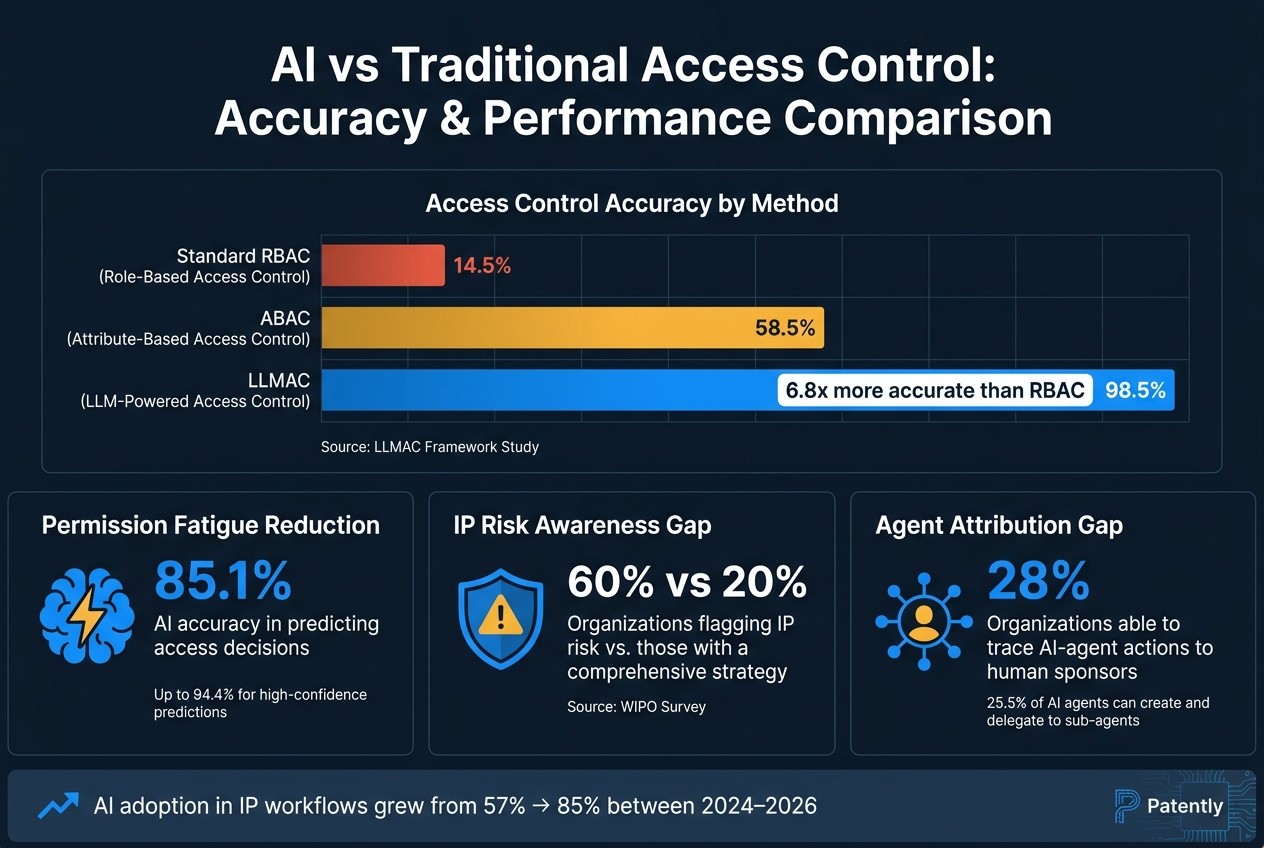
AI vs Traditional Access Control: Accuracy & Performance Stats
Automated Entitlement Discovery and Normalization
Handling access permissions using top patent tools can simplify complex workflows. AI steps in to simplify this by scanning access control lists (ACLs) and role assignments, identifying overlaps, gaps, or conflicts that manual reviews might miss.
One clever method it uses is placeholder anonymization, also known as parameter substitution. Here’s how it works: when AI processes sensitive patent data - like unpublished claims or confidential client details - it substitutes placeholder variables for the actual data. The real information is only reinserted within a secure customer environment, ensuring data remains protected. This automated normalization creates a solid base for more adaptable, context-sensitive authorization.
Dynamic, Context-Aware Authorization
AI systems take things further by addressing the shortcomings of static role-based access. These systems evaluate real-time factors such as user credentials, device security, location, and risk scores to determine access permissions dynamically.
The results speak for themselves. For example, the LLMAC framework, which integrates large language models with traditional access models, achieved an impressive 98.5% accuracy in handling complex workflows. Compare that to 14.5% for standard role-based access control (RBAC) and 58.5% for attribute-based access control (ABAC). This highlights how incorporating real-time context can drastically improve access control.
"LLMs can learn from examples and apply that knowledge to new cases while following company policies. Their ability to process and combine information from multiple sources allows them to handle the complex decision making which is needed in modern access control." - Sharif Noor Zisad and Ragib Hasan, Researchers
Another bonus? AI reduces "permission fatigue." Automated permission assistants analyze user history and communication patterns, predicting access decisions with up to 85.1% accuracy - and up to 94.4% for high-confidence predictions. This means fewer interruptions for patent professionals, allowing them to focus on their core tasks.
Metadata-Driven Document and Chunk-Level Controls
AI doesn’t just stop at document-level permissions; it digs deeper into the document’s structure. Using section-aware parsing, it creates a hierarchical graph to assign permissions at a more granular level, such as sections, figures, tables, or even specific chunks of data.
This level of detail is especially useful in patent drafting. Professionals can draft patent applications with AI to ensure these granular controls are integrated from the start. Imagine a collaborator needing access to the background section of a specification but not the unpublished claims. AI systems can enforce such nuanced permissions. Even when synthesizing responses from multiple data chunks, the system assigns permissions based on the most restrictive source chunk.
"The system can derive permissions for cached results based on the chunks used to create the result... allowing each output to be treated as one or more new data chunks with a synthesized permission set." - John Manton and Spencer Reagan, Inventors
AI also assigns confidence scores to metadata tags. For instance, if a document’s sensitivity classification falls below a set threshold - say, 90% confidence - it gets flagged for human review before being shared more broadly. This ensures automated classifications don’t lead to accidental data leaks. By enabling granular controls, AI gives patent professionals the tools to manage sensitive information with precision and confidence.
Benefits and Risks of AI Permissions Management in Legal and Patent Settings
Key Benefits: Efficiency, Auditability, and Risk Reduction
AI-powered permissions management is reshaping how legal and patent professionals approach their work, offering notable improvements in efficiency, auditability, and risk management. Take the example of Bob Hansen from The Marbury Law Group - he cut the drafting time for a 28-hour patent application down to 19.6 hours in February 2026. That’s a 3–4x improvement, making fixed-fee projects feasible at partner rates and eliminating "write-off" losses altogether [AI Insights for Patent Teams - Patently, 2026]. These time savings directly enhance productivity in patent drafting and team collaboration.
Auditability is another standout feature of AI. Automated systems create detailed logs of every access, edit, and update, which are indispensable for tracking invention timelines and ensuring due diligence. For instance, in the 2026 Warner v. Gilbarco, Inc. case, the court confirmed that AI-assisted materials could qualify for protection under the work product doctrine, provided they were created in anticipation of litigation and not disclosed to adversaries via the platform's terms of service.
Risk reduction rounds out the benefits. Enterprise-grade AI platforms often include Zero Data Retention (ZDR) agreements, ensuring that client data isn’t stored or used to train public models. This closes many of the security gaps that manual workflows often leave exposed. However, while these advantages are compelling, AI-powered permissions management also presents several risks that deserve attention.
Risks and Challenges to Watch
Despite its advantages, AI in patent and legal settings comes with risks that can have serious consequences, especially in environments where data sensitivity is non-negotiable.
One of the most immediate concerns is data leakage through consumer-grade AI tools. Many general-purpose AI assistants retain user prompts for model training. This means that entering sensitive information - like an unpublished invention disclosure - into the wrong tool could inadvertently influence another user’s results. A survey by the World Intellectual Property Organization (WIPO) revealed that while 60% of respondents flagged intellectual property risks as a major concern in AI development, only 20% of organizations had comprehensive IP risk management strategies in place.
Another challenge lies in how AI use may intersect with patentability rules. For instance, under 35 U.S.C. §102(a), entering invention details into an AI platform could be interpreted as a "public disclosure", potentially barring patent eligibility. This risk is even higher in jurisdictions like Europe, which adhere to absolute novelty rules and offer no grace periods. Additionally, when AI generates content that inventors didn’t actually conceive, questions about inventorship can become a legal minefield.
"The incorporation of AI-generated material complicates the analysis regarding which aspects of the claimed invention were actually conceived by those individuals." - Baker Botts
Avoiding AI altogether isn’t the answer. Instead, organizations should adopt a thoughtful approach: use enterprise-grade platforms with strong confidentiality agreements, maintain detailed and secure usage logs, and ensure that human experts carefully review AI-generated content before filing. This balanced strategy allows teams to leverage AI’s benefits while keeping its risks in check.
Applying AI Permissions Research to Patent Drafting and Collaboration Platforms
Permissions-Aware AI Patent Drafting Assistants
The challenges of data leakage and unauthorized disclosures emphasize the importance of embedding permissions logic directly into the drafting process. AI drafting assistants handle access rights at the point of content generation. For instance, when a draft incorporates input from multiple sources - such as prior art references, internal memos, or earlier claim sets - the resulting output automatically inherits the strictest permissions from all contributing sources. This approach, known as the least permissive intersection model, ensures that only users with the appropriate clearance for all source materials can access the generated content.
For teams managing highly sensitive disclosures, deploying AI tools at the edge adds another layer of security. Lightweight Small Language Models (SLMs) operating on local infrastructure prevent invention data from being processed on cloud servers, minimizing the risks associated with remote data handling.
Secure AI-Powered Semantic Search
AI’s capabilities extend beyond drafting to enable secure semantic search with robust permissions enforcement. Before retrieving any information, the system verifies the user’s credentials - such as clearance level, project role, and department - against document metadata. A k-Nearest Neighbors (k-NN) pre-filtering step ensures that only authorized documents are processed by the model. This proactive method is more secure than post-filtering, where sensitive data might already have been accessed before restrictions are applied.
Patently’s semantic search, powered by Vector AI, exemplifies this approach. Jerome Spaargaren, Founder and Director of Patently, highlighted its impact:
"This powerful addition has positioned Patently as one of the most innovative platforms for semantic patent search and is core to our technology stack."
When search responses are cached for future use, the same least-permissive logic is applied. If another user submits a similar query, they’ll only receive the cached result if their permissions align with every source element used in generating the response.
Granular Permissions for Collaboration and SEP Analytics
In collaborative environments, granular permissions provide essential safeguards. Patent work often involves teams of attorneys, engineers, clients, and analysts working together, yet not everyone should have access to the same data. By implementing permissions at the project, document, or even row level, rather than just at a folder or role level, granular controls ensure data security.
Platforms like Patently use Row-Level Security (RLS) policies combined with JWT-based authentication to isolate data at the database layer, preventing cross-project data breaches. Additionally, real-time collaboration tools, such as Y.js, support simultaneous multi-user editing while enforcing role-based permissions and maintaining a detailed audit trail.
For SEP (Standard Essential Patent) analytics, the need for strict permissions is even greater. Access to sensitive information, such as 4G/5G declaration data, claim mappings, or licensing positions, often depends on the client, partner firm, or stage of negotiations. To address this, dynamic permissions are applied consistently across all AI-driven patent workflows. Compound object modeling ensures that access to related data - like comments, SEP declarations, or attached tags - is independently evaluated. Just because a user can view a primary patent document doesn’t mean they automatically gain access to its associated materials. This layered approach keeps sensitive data compartmentalized and secure.
Governance and Future Directions in Permissions-Aware AI
Best Practices for Governance and Monitoring
As AI continues to redefine permissions management, ensuring robust governance and proactive monitoring is critical - especially in patent workflows where sensitive data is at stake.
AI agents should be treated as privileged users with clearly defined roles, limited access scopes, and routine audits to prevent "privilege creep." A particularly effective framework is the Three-Layer Permission Boundary Pattern, which includes:
Establishing scoped permission boundaries to limit maximum access.
Using Attribute-Based Access Control (ABAC) for real-time decision-making.
Moving authorization logic out of application code and into versioned, testable definitions, leveraging tools like Open Policy Agent or Cedar. This approach improves auditability and reduces risks like injection attacks.
Brooks Kushman highlights the evolving nature of AI security:
"AI security is no longer just about protecting models. It is about controlling data, defining access, preserving evidence, and ensuring accountability across complex, evolving systems."
To maintain alignment with permissions and regulatory standards, continuous monitoring is essential. This can be achieved through short-lived, task-specific tokens (expiring within 10 minutes) and real-time dashboards. Such tools outperform static spreadsheets, which struggle to keep up with the fast-paced, dynamic demands of modern AI operations.
For patent teams, detailed audit logs are non-negotiable. These logs should capture every permission decision - including who accessed what, when, and through which AI model. Legal hold processes further underscore the importance of this data. For instance, the 2026 ruling in United States v. Heppner (Southern District of New York) clarified that interactions with public generative AI tools lack attorney-client privilege. Platforms like Patently integrate these governance measures to safeguard sensitive patent data while ensuring compliance with legal standards.
While these practices address current risks, the rapid evolution of AI demands continuous research and innovation to tackle emerging challenges.
Research Gaps and Future Opportunities
Despite advancements, there are still critical gaps in permissions-aware AI that need attention. Traditional permission systems typically manage around 15 predefined data types at a coarse level of granularity, but LLM-based agents often deal with far more diverse and unpredictable datasets, which can overwhelm existing models.
Another pressing issue is the lack of standardized metrics for evaluating enforcement effectiveness. Proposed frameworks like the Domain Distinguishability Index (DDI) and Utility Gap Index (UGI) aim to measure whether unauthorized information can be retrieved from data silos. However, these tools are still in their early stages and have yet to gain widespread adoption.
Attribution is another area that requires improvement. Currently, only 28% of organizations can trace AI-agent actions back to their human sponsors. This is especially concerning since approximately 25.5% of AI agents are capable of creating and delegating tasks to other agents. In patent workflows, where accountability is paramount, this gap must be addressed.
The regulatory environment is also evolving rapidly. For example, the EU AI Act's high-risk provisions will come into effect on August 2, 2026. Meanwhile, AI adoption in intellectual property workflows has surged from 57% to 85% between 2024 and 2026. This acceleration underscores the need for governance frameworks to adapt quickly.
Research Area | Current Limitation | Future Opportunity |
|---|---|---|
Data Type Coverage | Limited to ~15 known types | Expanding to cover the full range of data types encountered in LLM-based workflows |
Enforcement Metrics | No standardized benchmarks | Establishing DDI and UGI as industry-standard tools for auditing permissions |
Agent Attribution | Only 28% of organizations can trace actions | Developing automated systems to trace agent actions to their human sponsors |
Output Permissions | No automated derivation for synthesized content | Implementing automated least-permissive rules for AI-generated documents |
Conclusion: What AI Means for Permissions Management in Patent Workflows
AI is transforming permissions management from a rigid, manual task into a flexible and deeply embedded part of patent workflows. By integrating access controls directly into AI tools, user permissions seamlessly govern interactions across platforms like Jira, Slack, and Confluence.
This shift brings real benefits to collaboration and data security. When permissions are built into the AI layer instead of being added later, patent teams gain continuous, context-aware protection without disrupting their daily routines. For instance, semantic search stays confined to authorized data, drafting assistants only reveal what users are allowed to access, and SEP analytics collaboration ensures sensitive information doesn’t reach the wrong hands.
It’s critical that AI never oversteps existing access boundaries. As Glean Technologies emphasizes:
"It is important to select an AI tool that understands and respects the user's access permissions for any connected data source, and that does not grant broader access than a user's existing permission set."
For patent teams, embedding native access controls into AI tools isn’t optional - it’s essential. Platforms like Patently are designed with this in mind, offering AI-assisted drafting, semantic search, and project collaboration with integrated access controls. This evolution from static to AI-driven permissions ensures sensitive data stays secure without slowing down workflows.
Looking ahead, permissions-aware AI won’t just be a nice-to-have - it’ll be the standard. Teams that adapt by labeling AI outputs, coordinating SaaS permissions with IT, and maintaining detailed audit logs will be better prepared for future regulatory demands. The path forward is clear: integrating smart, context-aware permissions is the key to balancing security and efficiency in patent work.
FAQs
How does AI decide access in real time?
AI manages access in real time by examining contextual data, user behavior, and the characteristics of resources. By leveraging machine learning or large language models, it predicts access permissions based on established patterns and predefined policies. These systems are designed to continuously learn and enforce policies dynamically, adjusting to evolving conditions to maintain accurate and reliable decision-making.
Will AI ever expose confidential patent data?
AI systems can inadvertently expose confidential patent information if sensitive data is entered into publicly accessible or consumer-grade AI platforms. These platforms typically process data on external servers, which might store prompts or outputs, posing a risk to confidentiality. To protect sensitive information, it’s crucial to rely on AI tools specifically built with robust privacy measures for professional environments.
How can teams audit AI permission decisions?
To ensure accountability in AI permission decisions, teams should maintain detailed, unchangeable audit trails. These logs should capture essential details such as:
Who authorized the action
What resource was accessed
When the action occurred
Why the action was taken
The outcome of the decision
For added clarity, include non-deterministic data like model versions, prompts, and confidence scores. This level of detail supports transparency and helps teams understand the reasoning behind AI decisions.
Organizing audit data - whether by specific interactions or detected anomalies - makes it easier to trace and review decisions. Additionally, recording human oversight actions ensures a comprehensive history that supports compliance and accountability efforts.