AI-Powered FTO Search: Benefits for Startups
Intellectual Property Management
May 26, 2026
AI FTO tools help startups cut search time and cost, detect patent risks early, and pair with legal review for high-stakes decisions.

Top patent tools powered by AI are transforming how startups approach Freedom to Operate (FTO) searches. Here's why they matter:
Faster Results: AI tools complete FTO analyses in under 30 minutes, compared to weeks or months for manual methods.
Lower Costs: Startups save $20,000–$30,000 per claim chart by automating most of the process.
Broader Coverage: AI scans patents across global jurisdictions (US, Europe, China, etc.) and even academic databases.
Early Risk Detection: Automated claim mapping and real-time monitoring help identify potential patent issues during R&D.
While AI tools are efficient and cost-effective, manual FTO searches remain essential for high-stakes legal opinions. Combining both methods - using AI for initial analysis and legal experts for critical cases - strikes the right balance between speed, cost, and thoroughness.
1. AI-Powered FTO Search Tools
AI tools are changing the game for startups by making freedom-to-operate (FTO) searches faster, broader, and more cost-effective.
Speed
With AI, FTO analyses can be completed in less than 30 minutes. These tools use multiple agents working simultaneously to scan databases like USPTO, WIPO, and Google Patents. What used to take days of manual effort is now handled in a fraction of the time through parallel processing.
Cost
The cost savings are hard to ignore. AI tools automate the bulk of the process, reviewing hundreds of patents without requiring external legal teams for every step. Startups only need to involve outside counsel for the riskiest findings, cutting expenses dramatically. Some organizations report saving between $20,000 and $30,000 per claim chart.
"The FTO analysis tool has transformed our product clearance process. We can now run comprehensive freedom-to-operate checks before product launches... accelerating time-to-market significantly." - Michael, IP Portfolio Manager (Semiconductor)
Coverage
These tools don’t just work faster - they cast a wider net. A single AI platform can assess patent risks across major jurisdictions like the U.S., Europe, China, Japan, Korea, and WIPO - all in one go. For startups operating globally, this broad reach is essential. Some systems even tap into academic databases like arXiv and IEEE, capturing non-patent literature that traditional keyword searches might miss.
Risk Mitigation
AI goes beyond simply identifying patents. It provides actionable insights, such as automated claim mapping that compares product features to patent claims. Risk indicators - color-coded as green (disclosed), orange (suggested), and gray (none) - help teams focus on patents that need deeper legal review. Continuous monitoring features also alert teams to new competitor filings in real-time, ensuring no surprises during product development. By combining speed, depth, and proactive tracking, AI tools offer a strong alternative to traditional FTO search methods.
2. Manual FTO Search Methods
Manual freedom-to-operate (FTO) searches involve defining a clear scope, reviewing patent databases, analyzing claims, and assessing risks. This process demands significant time and expertise, often making it both expensive and slow. These challenges highlight why many are turning to AI-driven alternatives.
Speed
Unlike automated AI searches, manual methods take considerable time and effort. On average, manual searches require around 100 labor hours and can stretch over weeks or even months. Every step - whether it's analyzing claims or cross-referencing patents across jurisdictions - needs to be done by hand. This slower pace can delay product launches, which is especially frustrating for startups working on tight timelines.
Cost
The costs of manual FTO searches can be steep. Basic analyses typically start at $10,000–$15,000, while more in-depth investigations range from $20,000–$50,000. If the search spans multiple jurisdictions, costs can climb past $100,000. Adding to the challenge, these expenses are often unpredictable, with outside counsel fees rising as the search scope grows.
Coverage
Manual searches rely on keyword and classification strategies, which come with risks. Differences in terminology or language can lead to overlooked patents. Additionally, the 18-month delay in patent publication creates gaps in the information available for review.
Risk Mitigation
"The stakes are high: launching a product that infringes existing patents can result in injunctions, damages exceeding millions of dollars, and significant reputational harm." - PatSnap Team
While manual searches can provide defensible legal opinions, they are static. This means they don't adapt to changes, like new patents being published or product designs evolving over time. As a result, they may leave companies exposed to unforeseen risks.
Pros and Cons
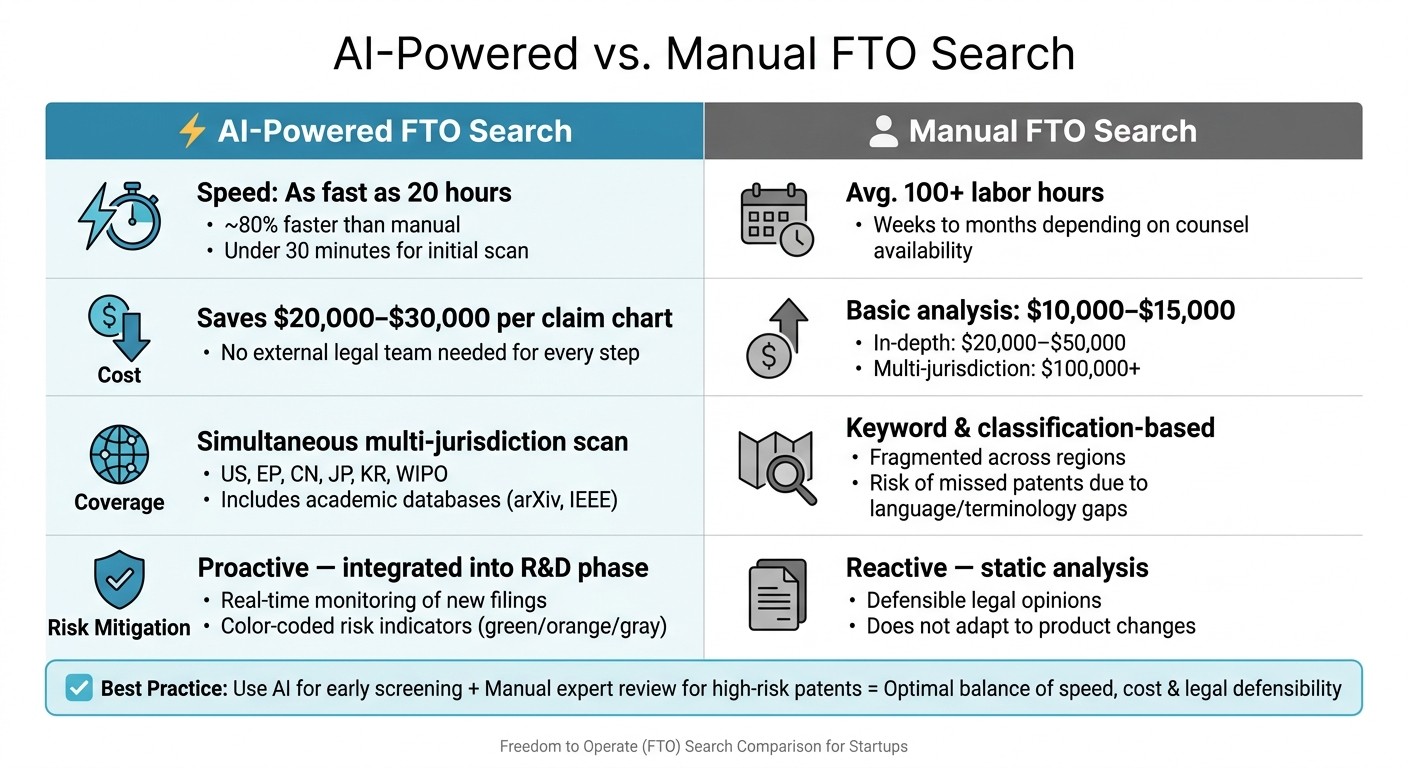
AI-Powered vs Manual FTO Search: Speed, Cost & Coverage Compared
When it comes to AI-powered and manual FTO (Freedom to Operate) searches, each has its strengths and weaknesses. Here's a breakdown of the main differences:
Factor | AI-Powered FTO Search | Manual FTO Search |
|---|---|---|
Speed | Cuts project timelines by about 80%; a 100-hour project can be done in roughly 20 hours | Often spans weeks or months, depending on the availability of legal counsel |
Cost | Automation saves $20,000–$30,000 per claim chart | Comprehensive investigations typically cost $20,000–$50,000 per engagement |
Coverage | Screens multiple jurisdictions simultaneously, including the US, EP, CN, JP, KR, and WIPO | Coverage can be fragmented, as scaling to multiple regions requires significant manual effort |
Risk Mitigation | Proactive approach, integrated into R&D and drafting phases for early risk detection | Reactive, with static analyses that are harder to adapt as products evolve |
Startups, in particular, can gain a lot by blending these methods. AI tools are perfect for startups working with limited funds and tight deadlines, as they provide quick and affordable insights. On the other hand, manual searches offer the legal depth and defensibility needed for high-stakes decisions.
AI-powered tools shine in identifying risks early and narrowing the focus, but they don't replace the nuanced judgment of legal experts. For situations where the stakes are higher, manual analysis and formal legal opinions are indispensable.
Using a hybrid strategy - leveraging AI for initial screenings and involving legal experts for deeper dives into high-risk patents - strikes a balance between efficiency and thoroughness.
Conclusion
For startups, navigating the choice between AI-powered and manual FTO searches doesn’t have to be an either-or decision. The smartest approach? Combine the strengths of both methods.
Use AI tools early in development. AI-powered FTO screening is a game-changer during the R&D phase. These tools can quickly scan hundreds of patents across global markets, helping you identify potential roadblocks early on. Plus, they can reduce project timelines by about 80% and significantly cut costs compared to traditional methods.
Bring in manual expertise for critical cases. When AI flags a high-risk patent, that’s your cue to involve a patent attorney. Their formal legal opinion will provide the Freedom to Operate (FTO) Reviews you need. This targeted use of expert input helps you manage legal expenses while ensuring thoroughness where it counts.
FAQs
When should a startup still hire a patent attorney for an FTO?
Startups should bring in a patent attorney for a Freedom to Operate (FTO) analysis when the situation demands detailed legal expertise, claim mapping, or navigating complex patent landscapes. This becomes especially important in high-risk or highly specialized technical areas, where relying solely on AI tools might fall short of providing the necessary depth and precision.
How reliable are AI FTO results for avoiding infringement risk?
AI-driven Freedom to Operate (FTO) results offer a dependable way to minimize infringement risks. By delivering quick and precise analysis of patent claims, they enable teams to spot potential blocking patents and assess the likelihood of infringement with ease. This streamlined process not only enhances decision-making but also lowers the chances of missing critical details compared to traditional manual approaches.
What product details should I prepare before running an AI FTO search?
When preparing materials for an AI Freedom to Operate (FTO) search, it's crucial to provide comprehensive and clear documentation that thoroughly describes your product. This ensures the search can effectively assess potential risks and overlaps with existing intellectual property. Here's what to include:
Features: Outline the key functionalities and unique attributes of your product. Be specific about what sets it apart from similar offerings in the market.
Components: Break down the product into its individual parts or modules. Include details about materials, design, and how each component contributes to the overall functionality.
Functional Specifications: Provide detailed technical specifications, such as performance metrics, system requirements, and operational capabilities. This should give a clear picture of how the product works.
Drawings and Diagrams: Include technical drawings, schematics, and flowcharts that visually represent the product's design and operation. These help clarify complex systems or processes.
Claim Language: Draft precise claim language that defines the scope of your product's innovation. This is especially important for identifying areas of potential overlap with existing patents.
Supporting Documents
To ensure clarity and completeness, attach relevant documentation in various formats:
PDFs: Use for finalized documents like technical specifications, schematics, or user manuals.
PowerPoint Slides: Include presentations that summarize key aspects of the product for quick reference.
Word Files: Provide editable documents for detailed descriptions or claim language drafts.
Invention Transcripts: Add transcripts or notes from brainstorming sessions or invention disclosures to capture the development process.
By organizing and presenting this information thoroughly, you can help the AI FTO search deliver precise and actionable results.