AI Patent Reporting for Competitive Insights
Intellectual Property Management
Apr 25, 2026
AI turns patent text into competitive intelligence using NLP, semantic clustering, and citation analysis to reveal trends and white spaces.
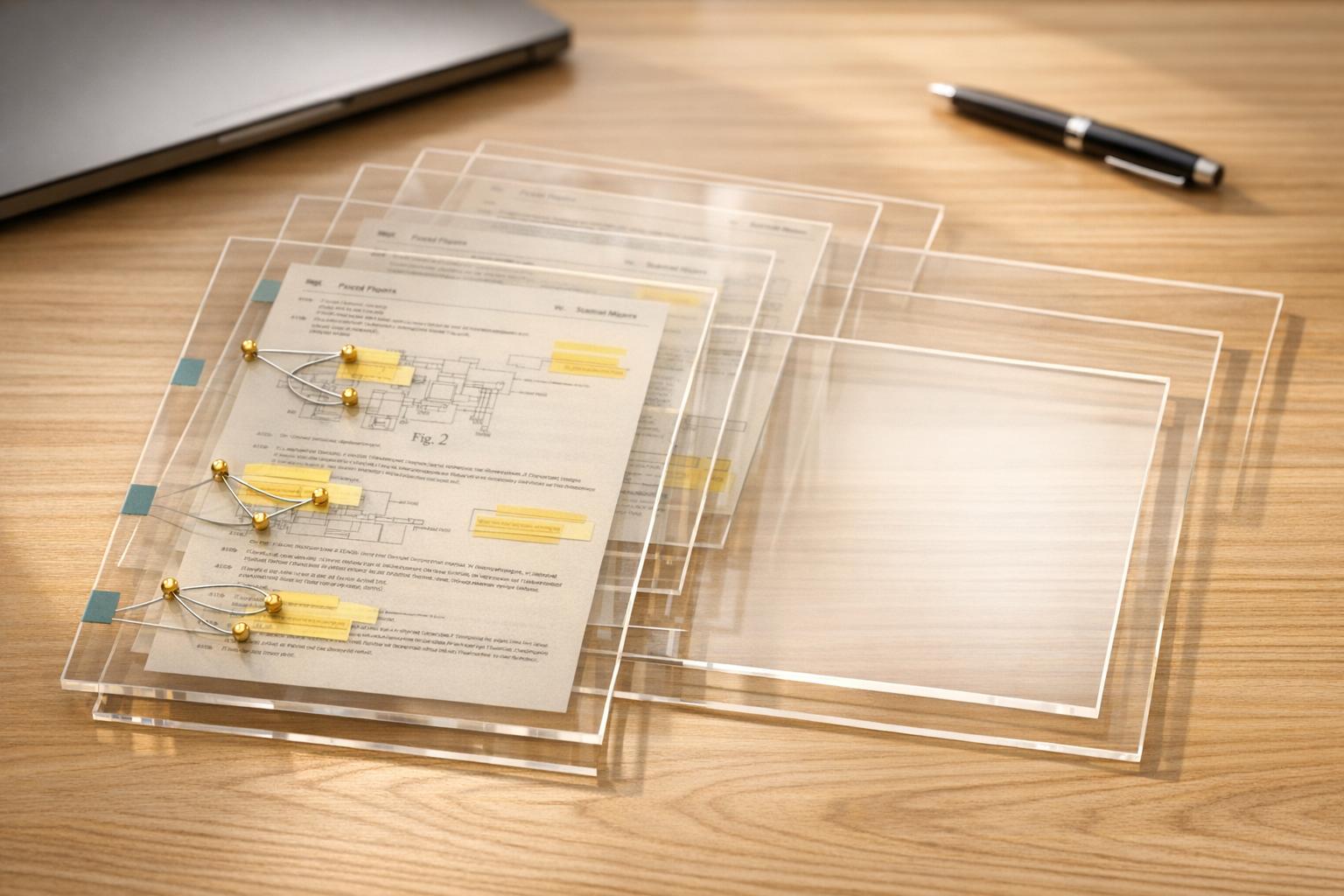
AI patent reporting takes the overwhelming task of analyzing global patent data and transforms it into actionable insights for businesses. By using advanced AI techniques like Natural Language Processing (NLP), semantic clustering, and citation analysis, these tools help companies understand innovation trends, monitor competitors, and identify new opportunities. Unlike traditional keyword-based searches, AI systems interpret the technical meaning of patents, uncovering patterns and connections that manual methods often miss.
Key Takeaways:
What It Does: AI patent reporting automates patent data analysis, offering insights into R&D trends, competitor strategies, and market opportunities.
Why It Matters: Patent filings often signal future market moves. Understanding this data helps businesses avoid risks, refine strategies, and focus on areas with high potential.
How It Works: Using NLP and semantic clustering, AI groups related patents, tracks citations, and identifies gaps or bottlenecks in the patent landscape.
AI-powered tools like Patently simplify this process with features like semantic search, citation mapping, and exportable analytics, enabling faster and more precise decision-making. With patent filings expected to exceed 4 million by 2027, integrating AI into patent analysis is no longer optional - it’s a must for staying competitive.
AI Techniques for Patent Analysis
Advanced AI techniques are reshaping how raw patent data is transformed into actionable insights. By employing sophisticated algorithms, these methods decode the technical meaning and connections within vast collections of patent documents. Below, we break down the key techniques driving these capabilities.
Natural Language Processing for Patent Claims
Natural Language Processing (NLP) is a game-changer for extracting critical information from unstructured patent text. Using tools like Part-of-Speech (POS) tagging, NLP can interpret context to differentiate meanings - like distinguishing a "battery" for energy storage from a "battery" of tests.
One standout application is claim similarity analysis, where NLP identifies patents covering the same invention, even if they use entirely different terminology. This is invaluable for uncovering prior art or spotting potential scope issues that conventional searches might overlook. Key NLP techniques include:
POS tagging for understanding technical context.
Named Entity Recognition (NER) to categorize inventors, companies, and technologies.
Topic modeling to uncover themes and trends across patent collections.
These tools make it easier to detect technological shifts and stay ahead in competitive markets.
Semantic Clustering and Vector Analysis
Semantic clustering takes text analysis to the next level by grouping patents based on their conceptual similarity, rather than relying on shared keywords. AI converts patent text into vectors, enabling it to cluster similar inventions together. This approach helps identify emerging trends, track competitor R&D efforts, and spot converging technologies before they gain widespread attention.
For fast-evolving fields like Generative AI, experts suggest organizing clusters by technical subsystems - such as model architecture, deployment, or data - rather than lumping everything into one broad category. This ensures the clusters remain actionable and insightful. Monitoring shifts in filing activity and assignee concentration within clusters can also reveal competitors' market strategies. Unlike traditional keyword searches, which often miss up to 40% of relevant patents, semantic searches uncover conceptually related patents across different languages.
Citation Network Analysis
Patent citations provide a wealth of information about influence and innovation. Forward citations show "market pull", indicating that an invention has solved a significant problem and is being built upon by others. Backward citations, on the other hand, reveal the technical foundation of an invention. Frequent reliance on recent backward citations suggests a rapidly evolving field, while older citations point to a more stable domain.
Modern citation analysis emphasizes citation velocity - how quickly a patent accumulates citations. This metric is crucial for spotting "breakout" patents that are shaping industry standards at a rapid pace. The source of citations also matters: those from major players carry more weight than citations from smaller entities. Additionally, high self-citation rates often signal a deliberate strategy to protect core technologies. By tracking citations across regions, companies can identify technologies gaining traction as global standards. A sudden spike in a competitor's citation velocity might indicate a new trend worth immediate attention.
Types of Competitive Intelligence from AI Patent Reports
AI-enabled patent analysis provides a wealth of information, from spotting emerging trends to uncovering jurisdictional patterns. These insights help businesses make informed decisions about research investments, market opportunities, and potential legal challenges.
Technology Trends and Convergences
AI uses advanced clustering to group related patents, uncovering patterns that manual analysis might miss. For example, it can link terms like "thermal", "heat", and "dissipation" into a single "Cooling" category, revealing niche areas of innovation. This approach also highlights filing bursts - sudden increases in patent activity that suggest a competitor's strategic move or a startup's focus on a new sector.
Another area AI excels in is identifying market convergence, where two distinct fields combine into a dominant innovation. A notable example is the intersection of AI algorithms with drug discovery. AI also detects "structural holes", or gaps between disconnected technology clusters, which often signal untapped opportunities for cross-industry development. Beyond identifying these gaps, AI can analyze why they exist, providing deeper strategic insight.
Jurisdictional Filing Patterns
Patent filings in a new region often signal a competitor's plan to enter that market - long before any product launch. By analyzing geographic patent data, businesses can see where competitors are focusing their R&D and which markets they prioritize for intellectual property protection. A spike in filings in a specific region by major players might prompt companies to adjust their strategies, whether through local partnerships or tailored marketing efforts.
AI tools also map patent families, showing how a single invention is protected across multiple countries. This mapping reveals the perceived value of a technology and highlights where competitors aim to gain a commercial edge. Considering that patent litigation costs range from $2.3 million to $4 million per case, these insights are critical for managing legal risks. Additionally, jurisdictional mapping can identify gaps in patent activity, pointing to unexplored markets or technologies ripe for innovation.
White Spaces and Bottleneck Patents
White spaces in the patent landscape are areas with little or no patenting activity, despite clear commercial demand. These gaps represent opportunities for innovation where solutions have yet to be protected. AI excels at identifying these areas, uncovering hidden opportunities that manual searches might miss. As PowerPatent explains:
"White space in the patent landscape isn't just a legal term or a nice-to-have. It's one of the most powerful strategic tools a business can use".
On the flip side, bottleneck patents create intellectual property roadblocks, often delaying product launches or market entry due to broad claims by competitors. AI helps businesses navigate these obstacles by breaking down inventions into their components - systems, methods, and dependencies - to determine if they represent genuine advancements or minor tweaks to existing technologies. By identifying white spaces, companies can focus R&D on areas with fewer legal challenges, while spotting bottlenecks helps avoid costly delays. Optimizing patent portfolios with these insights can also cut maintenance costs by up to 30%.
Patently's AI Patent Reporting Features
Patently integrates several AI-driven tools to simplify and speed up patent analysis. These tools transform extensive patent data into actionable insights, cutting down the time and effort needed for manual research.
Vector AI Semantic Search
Patently's Vector AI uses advanced natural language processing (NLP) models to convert patent text into vectors, enabling searches based on concepts and context rather than just matching words. This means you can describe an invention in plain language - like "In-ear headphones with noise isolating tips" - without worrying about complex Boolean operators. The system intuitively connects related ideas, so a search for "brake system" might also bring up patents using terms like "Bremssystem", bridging language barriers without requiring direct translations.
Results are ranked by conceptual similarity, and the platform even provides relevance scores at the claim limitation level. This feature highlights specific parts of a document that align with an invention, uncovering connections between seemingly unrelated industries. For example, it might link aerospace mechanisms to innovations in medical devices. The tool captures both broad functionalities and detailed technical aspects of an invention, offering a comprehensive view.
Forward and Backward Citation Browser
Patently's citation browser turns static patent lists into interactive maps, offering a visual representation of how technologies evolve through citations. It helps users trace the development of a technology, identifying influential "hub" patents that act as key nodes in a field. By exploring these citation networks, users can quickly spot patents driving future advancements or serving as foundational prior art.
This tool works seamlessly with Vector AI, identifying related patents even when they use different terminology - like "fastening mechanism" versus "clip assembly." It also tracks citation velocity, showing how often a patent is cited compared to industry norms. This helps gauge a patent's influence and its role in shaping future innovations. Together with semantic search and citation mapping, the platform simplifies the process of gathering and sharing insights.
Exportable Analytics Reports
Patently makes it easy to share findings with stakeholders through exportable, company-branded Word documents. These reports include standard patent data - like bibliographic details, legal status, and citations - alongside custom fields and notes added during reviews. The platform supports various common formats for flexibility.
Automated monthly reports keep competitive intelligence up to date, saving time on manual updates. A "search journal" feature creates a defensible record of the search process, which can be useful for investors or partners. Additionally, interactive visuals like 3D technology landscapes and heatmaps group patents into clusters, making it easier to identify innovation trends and hotspots.
Benefits of AI in Patent Reporting
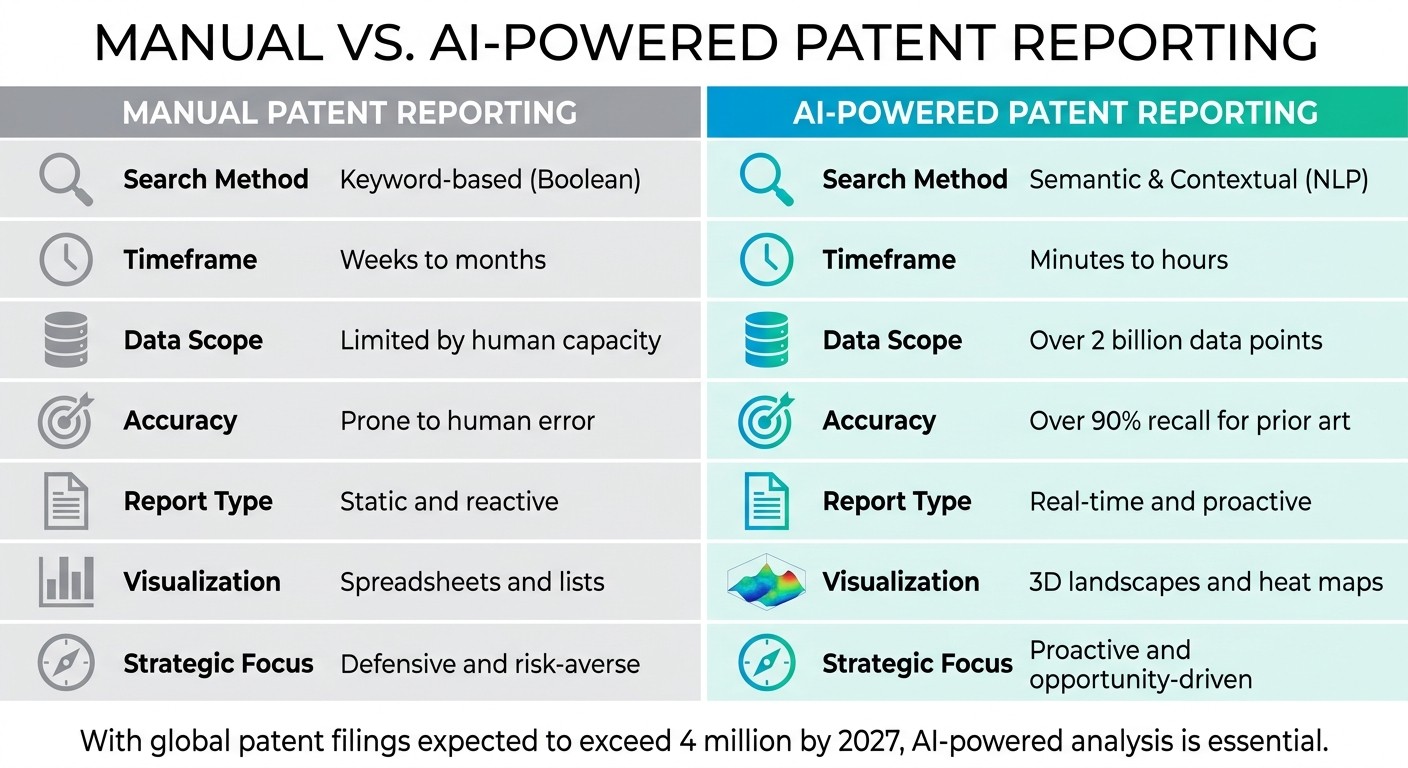
Manual vs AI-Powered Patent Reporting: Key Differences
AI-powered patent reporting transforms how organizations approach patent analysis, making it faster, more precise, and more strategic. By automating what was once a slow, labor-intensive process, AI tools allow companies to gain deeper insights and stay ahead in competitive markets.
Time Savings and Efficiency
AI drastically reduces the time required for patent research. Tasks that used to take weeks of manual effort can now be completed in just minutes or hours. For example, companies using AI-driven patent tools report innovating 75% faster while cutting costs by 25%. These tools process over 2 billion structured data points, including 204 million patents from 174 jurisdictions, saving an average of 10–15 hours per freedom-to-operate (FTO) or novelty searching.
Features like semantic search allow users to describe inventions in plain language, quickly retrieving related patents without needing complex keyword searches. Real-time monitoring ensures competitive intelligence is always up to date, while advanced visualizations, such as 3D landscape mapping, reduce analysis time by 25% compared to traditional document reviews. This efficiency supports more agile and responsive innovation strategies.
Accuracy and Predictive Analysis
AI doesn't just work faster - it works smarter. By using Natural Language Processing (NLP) and semantic analysis, AI tools understand the context of an invention, uncovering prior art that manual keyword searches might overlook. These tools achieve over 90% recall for relevant prior art in standardized test scenarios.
AI systems also excel at processing raw data from diverse global sources, standardizing formats and languages into a cohesive dataset. This continuous monitoring flags new patent filings and competitor activities in real time, unlike manual reports, which can quickly become outdated. Additionally, AI enables predictive analytics, identifying trends by analyzing filing velocities and citation patterns. This helps forecast emerging technology areas and market opportunities before they become mainstream.
Manual vs. AI-Powered Reporting Comparison
Feature | Manual Patent Reporting | AI-Powered Patent Reporting |
|---|---|---|
Search Method | Keyword-based (Boolean) | Semantic & Contextual (NLP) |
Timeframe | Weeks to months | Minutes to hours |
Data Scope | Limited by human capacity | Over 2 billion data points |
Accuracy | Prone to human error | Over 90% recall for prior art |
Report Type | Static and reactive | Real-time and proactive |
Visualization | Spreadsheets and lists | 3D landscapes and heat maps |
Strategic Focus | Defensive and risk-averse | Proactive and opportunity-driven |
With global patent filings expected to exceed 4 million by 2027, manual analysis is no longer practical. AI doesn't just improve existing workflows - it opens the door to entirely new ways of conducting competitive analysis and strategic planning.
Conclusion
AI-powered patent reporting is changing the game by turning static patent data into dynamic insights that fuel smarter decisions. Using techniques like NLP and semantic clustering, this technology bridges the gap between precise analysis and actionable strategies. It shifts teams away from just collecting data to actively positioning themselves in the market - whether that’s spotting untapped opportunities, monitoring competitors’ moves, or weaving IP insights directly into product planning. This shift not only sharpens decision-making but also expands access to advanced IP insights across entire organizations.
The beauty of this technology lies in its accessibility. It’s no longer just patent attorneys who can make sense of complex legal and technical data. Now, product managers, engineers, and executives can harness these insights too. By automating time-consuming tasks like Freedom-to-Operate analyses and prior art searches, AI frees up professionals to tackle bigger strategic questions - like where to invest in R&D or how to identify new licensing opportunities.
Patently offers a great example of this transformation. Its top patent tools, such as Vector AI semantic search and a citation browser, uncover important patent relationships. On top of that, its exportable analytics reports turn raw data into actionable insights that can be easily shared across teams, ensuring that IP strategies are tightly aligned with broader business goals.
As global patent filings continue to rise and competition heats up, AI-powered reporting has become essential. Companies that integrate ongoing patent intelligence into their innovation processes gain the clarity needed to foresee risks, secure strong positions, and transform their IP portfolios into real competitive strengths.
FAQs
How does AI semantic search find patents beyond keywords?
AI semantic search takes patent searching to the next level by moving beyond simple keyword matching. Instead, it transforms patent text into mathematical vectors, enabling the system to analyze both the meaning and context of the content. This means it can uncover conceptually similar prior art, even when different terms or languages are used, leading to results that are far more thorough and precise.
What signals do patent citations reveal about competitors?
Patent citations play a key role in showcasing the impact of innovations. They pinpoint prior art, helping to establish the groundwork for new developments and shaping competitive strategies. Beyond that, they serve as indicators of market trends, shedding light on areas where technological efforts and market influence are heavily concentrated.
How can AI identify white spaces and bottleneck patents?
AI can sift through extensive patent datasets to pinpoint gaps in innovation and areas with limited patent activity - often referred to as white spaces and bottleneck patents. By leveraging advanced semantic search and visualization tools, it identifies unexplored opportunities and regions of potential patent congestion. This insight helps businesses make smarter, more strategic decisions about where to focus their efforts.