Vector Search vs. Traditional Patent Search: Key Differences
Intellectual Property Management
Apr 24, 2026
Vector search finds conceptually similar prior art; Boolean search gives claim-level precision—use both for faster, thorough patent research.

Patent searching tools are evolving. Here's what you need to know:
Traditional search uses exact keywords and Boolean logic (AND, OR, NOT), but it often misses relevant patents due to vocabulary mismatches (e.g., "wireless device" vs. "mobile apparatus"). It works best for precise queries but struggles with conceptual relationships and synonyms.
Vector search leverages AI to understand ideas and concepts, not just keywords. It identifies related patents even if different terms or languages are used. This approach reduces missed results by 30–60%, speeds up searches, and handles large datasets efficiently.
Quick takeaway: Vector search is great for broad, early-stage exploration, while traditional search excels at precise, detailed queries. Combining both methods ensures thorough and efficient patent research. Many firms use AI-enabled patent analysis to further streamline these workflows.
Quick Comparison
Feature | Traditional Search | Vector Search |
|---|---|---|
Basis | Exact word matching | Conceptual understanding |
Query Type | Boolean operators | Natural language input |
Handling Synonyms | Manual input required | Automatic recognition |
Speed | Slower | Faster |
Accuracy | Misses 20–40% of results | Reduces false negatives by 30–60% |
Cross-Language | Limited | Strong |
Both methods serve unique purposes. Use traditional search for precision and vector search for broader discovery.
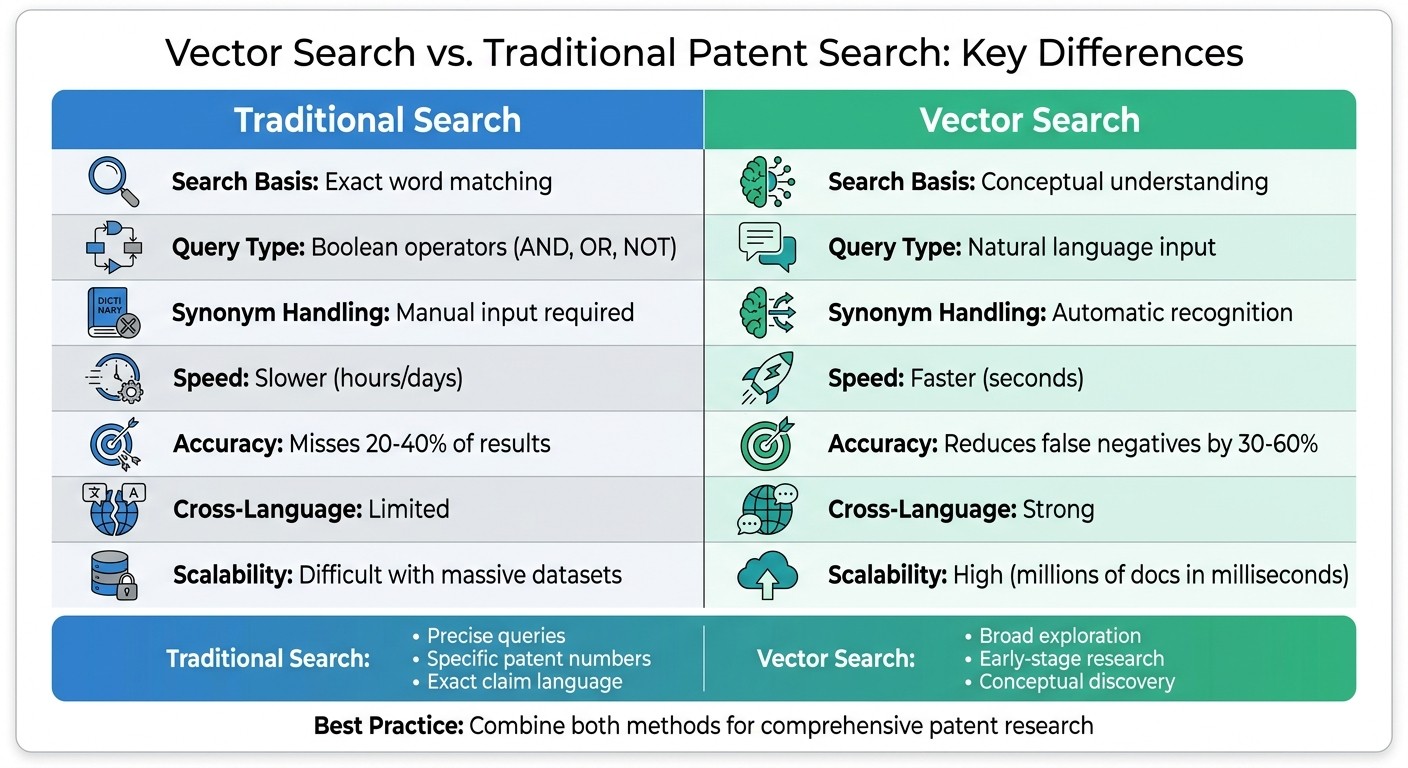
Traditional vs Vector Patent Search: Feature Comparison Chart
Patently: How to guides... Vector search

How Traditional Patent Search Works
Traditional patent searches operate by breaking down patent text into individual words or stems, which are then stored in an index. When you perform a search, the system scans this index for exact matches to your query. If a document contains the precise terms you entered, it's retrieved; if not, it's excluded. This method is rooted in Boolean logic, which underpins the entire search process.
Search queries rely on operators like AND, OR, and NOT, creating a binary framework: a patent either meets the criteria or it doesn’t. For instance, a query for "wireless AND communication" will only return patents that include both terms. To refine results, many systems use relevancy ranking algorithms such as TF-IDF or BM25, which prioritize documents based on how frequently the search terms appear in the database. However, the system focuses strictly on literal matches, lacking the ability to grasp broader concepts.
The method faces challenges as the scale of patent databases has exploded, growing from about 2 million documents in 1998 to over 100 million today. Traditional searches struggle with context, failing to recognize that "automobile brake system" and "vehicular deceleration apparatus" might describe the same concept.
Strengths of Traditional Methods
Traditional keyword searches shine when you're working with specific terms. If you know the exact technical phrase, inventor name, or patent number, Boolean searches deliver precise and reliable results quickly. Intellectual property professionals often prefer this method because they are familiar with Boolean syntax and classification codes like CPC and IPC. This transparency makes it easier to explain search strategies in contexts like patent prosecution or litigation.
Limitations of Traditional Methods
While effective for exact matches, traditional searches fall short when dealing with semantic subtleties. They can't differentiate between multiple meanings of the same word or identify similar concepts expressed in different terms. For example, a search for "biodegradable packaging" might miss patents describing the same idea using the phrase "compostable container".
"The second generation's computer-assisted approach to patent search is basically the same as manual search – first search to define the set of patents to review, then retrieve the patent documents, and finally read each one to find the ones that are most relevant." - Clarivate
Another drawback is the need to manually account for every possible synonym or variation, such as "wireless", "contactless", or "inductive." This process is not only tedious but also prone to errors. According to research from WIPO, keyword-based methods can result in 30% to 60% more false negatives compared to semantic approaches. Additionally, some inventors intentionally use obscure language to make their patents harder to find through keyword searches. Errors in patent databases further complicate the process; for example, IBM's name appears with over 100 different misspellings in patent records. These challenges highlight why traditional methods are excellent for precise, known queries but struggle to interpret broader, conceptual relationships.
What is Vector Search?
Vector search tackles the vocabulary mismatches that often occur with traditional Boolean searches. Instead of relying solely on exact word matches, it transforms text into semantic embeddings - mathematical representations that capture deeper meanings. For instance, if you search for "biodegradable packaging", the system can also identify related concepts like "compostable containers" or "environmentally friendly wrapping materials", even though these phrases don’t share any common words.
This is possible thanks to machine learning models trained on extensive datasets. These models learn how different concepts relate to one another, even if expressed in varied ways. A modern embedding model, such as OpenAI's text-embedding-3-small, generates vectors with 1,536 dimensions for each text input. These embeddings create a rich, multi-dimensional map where similar ideas are grouped closely together, enabling searches that are far more context-aware.
How Vector Search Works
To understand vector search, picture embeddings as multi-dimensional coordinates that represent different aspects of meaning. When you input a query, the system converts both the query and the documents in its database into numerical vectors. It then identifies the vectors closest to the query in this mathematical space.
This approach captures contextual relationships, analyzing how terms interact within descriptions and claims to grasp the broader intent. For example, searching for "automobile brake system" might return results for "vehicular deceleration apparatus", as both concepts are semantically similar and occupy nearby positions in the embedding space. This process relies on the distance between vectors rather than word-for-word matching.
Vector Search in Patent Databases
Vector search is particularly effective in patent databases, where it can uncover conceptually similar inventions that traditional search methods might miss. This helps address challenges like synonyms and varying terminology. Research from the World Intellectual Property Organization (WIPO) highlights that semantic search technologies can reduce false negatives in prior art searches by 30% to 60%.
Take the example of IP professional Laurence Brown, who in October 2024 used Patently's Vector AI to search for "In-ear headphones with noise isolating tips." By applying targeted filters and relevance sorting, he quickly pinpointed the relevant Sony patents from a pool of 300 results. The system’s ability to recognize semantic connections across different technical descriptions eliminated the need for complex Boolean queries with endless synonyms.
Modern vector search platforms also excel at cross-linguistic concept matching, enabling users to find relevant patents in multiple languages. This feature is increasingly important as patent portfolios grow globally. For example, AI-related patent applications have surged by 28% year-over-year, according to the European Patent Office's 2025 Patent Index.
Traditional vs. Vector Search: Key Differences
Traditional Boolean searches and vector searches take fundamentally different approaches to understanding and processing queries. Traditional search focuses on retrieving documents that contain the exact terms in your query, like "autonomous vehicle." In contrast, vector search transforms the input into mathematical representations that grasp broader concepts, such as "self-driving cars" or "unmanned transportation systems." These differences significantly impact how each method performs, especially in the context of patent searches.
The way queries are formulated highlights this divide. Traditional searches rely on Boolean strings, requiring operators like AND, OR, and NOT to cover every possible variation of terminology. This means you need to manually include all potential synonyms. On the other hand, vector search eliminates this hassle by using natural language input. For example, you can input a full invention description, and the system will identify patents that are conceptually related, focusing on the technical essence rather than just matching isolated keywords. This shift makes workflows more efficient and complements the underlying retrieval mechanisms.
Speed and scalability are also key differentiators. Traditional searches can take hours or even days as you repeatedly refine queries and sift through results. In contrast, vector search platforms process queries in seconds, even across massive datasets. For instance, an Am Law 100 firm reported cutting patent search time from 100 billable hours to just 20 after adopting AI-powered tools.
Another important distinction lies in how results are ranked. Traditional systems prioritize keyword frequency, while vector search uses advanced algorithms like Cosine Similarity and K-Nearest Neighbors (KNN) to measure conceptual relevance, offering a more nuanced ranking system.
Side-by-Side Comparison
Feature | Traditional Keyword Search | Vector Search (Semantic AI) |
|---|---|---|
Search Basis | Exact word/string matching | Conceptual and contextual meaning |
Query Type | Boolean operators and rigid syntax | Natural language descriptions |
Synonym Handling | Manual (must list all variations) | Automatic (understands related concepts) |
Recall | Lower (misses 20–40% of relevant art) | Higher (finds conceptually similar art) |
Speed | Slow (hours/days for manual refinement) | Instant (seconds for initial landscape) |
Cross-Language | Limited by translation accuracy | Cross-linguistic concept matching |
Result Ranking | Keyword frequency/Boolean logic | Mathematical proximity (relevance scoring) |
Scalability | Difficult with massive datasets | High (sifts millions of docs in milliseconds) |
Benefits of Vector Search for Patent Professionals
Vector search offers a game-changing way to save time and cut costs. Traditional early-stage patent searches often take between 3 to 8 hours and cost anywhere from $15,000 to $50,000 for moderately complex technologies. By contrast, AI-powered vector search can slash Freedom-to-Operate (FTO) or Novelty analysis time by up to 70%. For example, one Am Law 100 firm managed to reduce the time spent on complex patent counseling from 100 billable hours to just 20 - a massive 80% decrease.
It’s not just about speed - vector search also improves accuracy. Semantic search technologies address the common "vocabulary mismatch" problem, where inventors use different terms for the same concept. These tools reduce false negatives in prior art searches by 30% to 60% compared to keyword-only methods.
Another huge advantage is its global reach. Vector search's cross-language capabilities allow it to identify concepts across different languages without needing manual translations or exact keyword matches. For instance, it can recognize that the German term "Bremssystem" and the English "brake system" refer to the same idea. This feature is particularly critical given the rapid growth of AI-related patent applications, which increased by 28% year-over-year according to the European Patent Office's 2025 Patent Index.
"With the implementation of Elastic Cloud, we've been able to significantly expand our product offerings by introducing Vector AI. This powerful addition has positioned Patently as one of the most innovative platforms for semantic patent search" - Jerome Spaargaren, Founder and Director of Patently.
These quick and precise searches allow patent professionals to make well-informed, agile decisions. Instead of relying on a single exhaustive search, they can now perform multiple searches as a product evolves. Results arrive in seconds, and ranking algorithms like Cosine Similarity highlight the most relevant prior art, enabling attorneys to focus on strategic, high-value legal work instead of getting bogged down in time-consuming manual searches.
When to Use Each Search Method
Choosing the right search method depends on your project's stage and specific needs. Instead of sticking to just one approach, the best results often come from using both vector and traditional search strategically.
Vector search shines during the early stages of exploration, especially when technical details are still evolving or when you're looking for similar inventions across various industries. It's particularly useful for cross-language searches and broad conceptual discovery. For example, vector search allows patent professionals to quickly explore the conceptual landscape, identifying relevant prior art across millions of patent families during early evaluations.
On the other hand, traditional search is indispensable when precision is the priority. This method is ideal for tasks like verifying specific patent numbers, researching known inventors or assignees, or conducting classification-based searches. It’s especially effective for analyzing exact claim language or addressing legal risks in cases where a reference might not be an exact match but still poses potential issues. Traditional search remains critical for finalizing patentability opinions, freedom-to-operate analyses, and litigation where claim-level precision is essential.
For the most efficient workflow, combining both methods is key. Start with a 2–3 hour semantic discovery phase using vector search to explore terminology variations and map the conceptual landscape. Then, follow up with 1–2 hours of targeted keyword refinement to validate findings and focus on specific claim limitations. This "semantic-first" approach allows for multiple iterations as your project evolves - something that's quick and cost-effective with vector search but less practical with traditional methods. By blending semantic insights with precise keyword matching, you can adapt to the changing demands of patent search.
With global patent filings expected to surpass 4 million by 2027, the ability to swiftly narrow down relevant prior art before diving into detailed analysis is more critical than ever for staying competitive.
Conclusion
Choosing between traditional and vector search isn’t about picking one over the other - it’s about knowing when to use each for the best results. Traditional keyword searches are still crucial for tasks like verifying specific patent numbers, analyzing exact claim language, or researching known inventors and assignees. On the other hand, vector search takes discovery to a new level by focusing on concepts instead of keywords. For example, it automatically connects terms like "autonomous vehicle" and "self-driving car" without needing manual synonym lists. Studies reveal that Boolean queries can miss 40–60% of relevant patents due to synonym mismatches and translation issues. Meanwhile, semantic search technologies significantly reduce these false negatives by 30% to 60%. Recent examples highlight how vector search quickly identifies relevant patents, showcasing its efficiency.
The best approach combines both methods. Vector search helps map out conceptual connections and identify terminology variations, while traditional keyword searches refine and validate specific claims. This hybrid method transforms patent searching into an iterative process that evolves alongside product development - a process that’s more practical with vector search and less feasible with traditional methods alone.
Platforms like Patently now offer cutting-edge semantic search tools powered by Vector AI. These tools provide access to 82 million patent families and 250 million non-patent literature publications. As Jerome Spaargaren, Founder and Director of Patently, explains:
"This powerful addition has positioned Patently as one of the most innovative platforms for semantic patent search and is core to our technology stack".
With global patent filings projected to exceed 4 million by 2027, efficient search strategies are more important than ever. The ability to quickly filter relevant prior art before diving into detailed analysis is essential for staying ahead in a competitive field.
The future of patent research isn’t about replacing human expertise with AI. Instead, vector search streamlines data collection, freeing professionals to concentrate on interpretation and strategic decision-making - areas where human insight remains indispensable.
FAQs
How do I combine vector search and Boolean search in one workflow?
To get the best of both worlds, you can combine vector and Boolean searches with a hybrid approach. Start by using Boolean filters to narrow down your results - think keywords, categories, or metadata. Once you've refined the dataset, apply a vector search to identify semantically similar results. This way, you achieve precise keyword matching while also uncovering conceptually related items, giving you a broader and more meaningful set of results.
What should I enter as a vector search query for the best results?
When using a vector search, it's better to go beyond simple keywords. Instead, type out a natural language description of your invention or prior art concept. Why? Because this approach lets the system dig deeper into the meaning and context of your input, helping it find patents that are conceptually similar - not just those with matching words.
To improve your results, focus on crafting a detailed, concept-rich description of your invention's core idea or technical features. This helps bridge any vocabulary gaps, ensuring the system delivers results that are more accurate and relevant to what you're looking for.
Can vector search miss important prior art, and how do I double-check?
Vector search excels at identifying conceptually similar prior art, making it a powerful tool. However, it can sometimes overlook references due to challenges like outdated terminology, niche industry jargon, or subtle differences in context. To cover all bases, it's smart to pair vector-based searches with traditional keyword searches and expert reviews. Combining approaches - such as keyword searches, classification tools, and manual reviews - ensures you catch those nuanced details and achieve more thorough search results.