AI Patent Tools for Collaborative IP Management
Intellectual Property Management
Jun 27, 2026
Centralize invention intake, claim-level search, SEP review and portfolio pruning in an AI-driven shared workspace with governance.

If your patent team still works across PDFs, email threads, and spreadsheets, the main problem is usually coordination. I’d sum up the article this way: AI patent tools help U.S. teams keep invention intake, prior-art review, claim analysis, portfolio review, and SEP work in one shared record so people can make calls earlier and with fewer handoff issues.
Here’s the short version:
I see these tools as team workflow systems, not just search tools
They help attorneys, engineers, IP ops, licensing teams, and business leads work from the same file and same status
The biggest use cases are:
invention intake
prior-art review
portfolio classification
pruning decisions
reporting cycles
The key functions are:
semantic search
claim-level analysis
shared comments and task tracking
live portfolio dashboards
AI supports review, but it does not replace legal judgment
Good rollout depends on role-based access, decision logs, review gates, MFA, and clean data
A few numbers stand out. The article notes that manual claim charting can take days or weeks, while AI-supported review can cut that to minutes. It also cites reports that AI SEP analysis can reduce checking time by 70%.
What matters most is simple: one workspace, one decision record, and clear review rules. That’s what helps a patent group move from scattered admin work to shared portfolio decisions.
What AI patent tools are in collaborative portfolio management
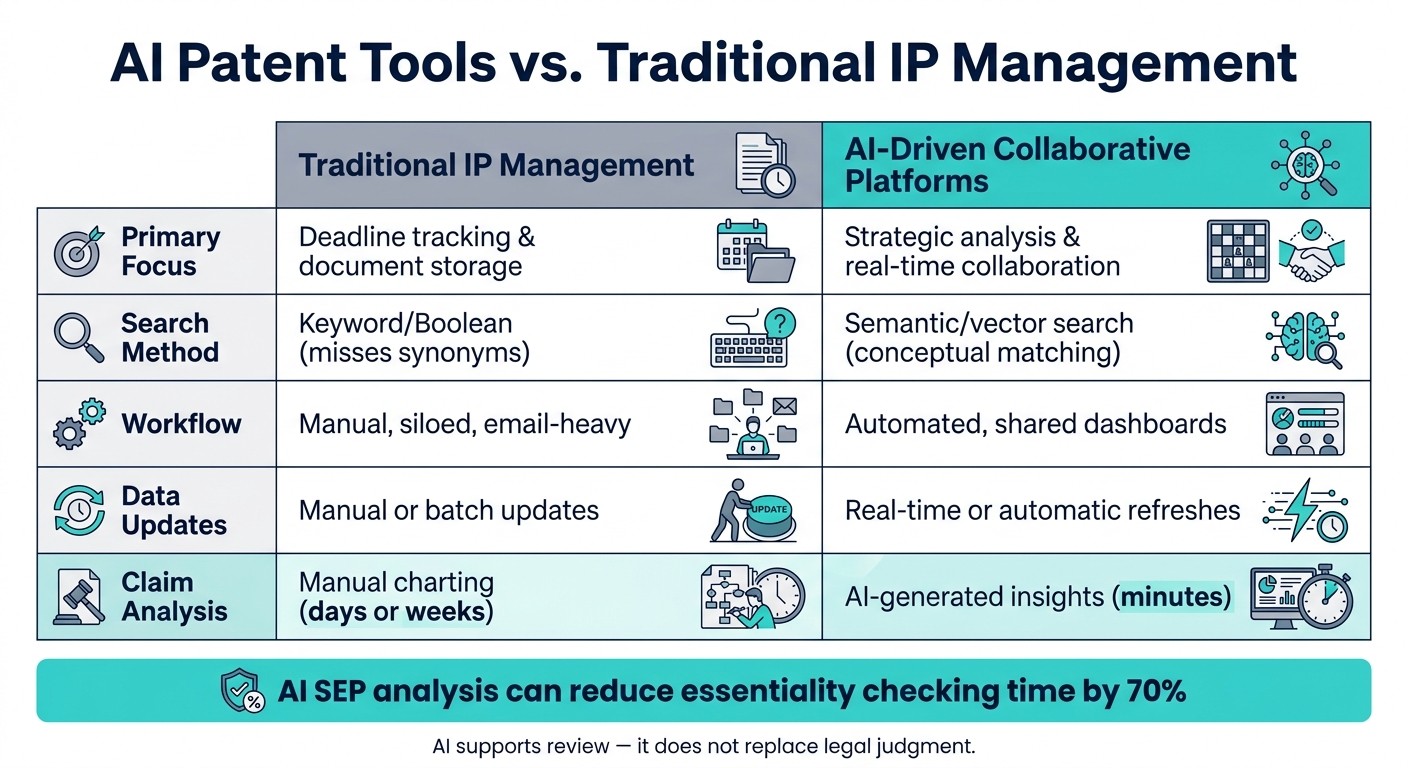
AI Patent Tools vs. Traditional IP Management: Key Differences
AI patent portfolio management tools bring claim-level analysis, semantic search, and shared workspaces into one place, so teams can review patents, prior art, and decisions in a single record. They do more than store files or track due dates. These platforms look at claims and patent relationships, surface prior art that matters, help spot possible SEP candidates, and tie those findings to team workflows.
Platforms like Patently combine collaborative drafting, semantic search, project management, and SEP analysis in one workspace. That setup supports the workflows discussed below.
How AI-driven platforms differ from traditional IP management systems
Traditional systems mostly track deadlines and hold documents. AI platforms add claim analysis, semantic search, and shared review.
The difference becomes clear when a team has to make a call. A traditional system stores a patent as a file. An AI platform breaks down independent and dependent claims, compares them semantically with prior art and competitor filings, and shows that analysis in a shared workspace where people can annotate, comment, and log decisions.
So instead of passing around a static PDF before a committee meeting, stakeholders can review an AI-generated shortlist of pruning candidates based on low citation counts and high maintenance costs, then leave feedback on the spot. That’s a big shift. The work moves from document storage to active decision support.
Feature | Traditional IP Management | AI-Driven Collaborative Platforms |
|---|---|---|
Primary Focus | Deadline tracking & document storage | Strategic analysis & real-time collaboration |
Search Method | Keyword/Boolean (misses synonyms) | Semantic/vector (conceptual matching) |
Workflow | Manual, siloed, email-heavy | Automated, shared dashboards |
Data Updates | Often manual or batch updates | Real-time or automatic refreshes |
Claim Analysis | Manual charting (days/weeks) | AI-generated insights (minutes) |
In day-to-day use, these capabilities help different people in different ways.
Who collaborates in a modern IP workflow
A modern U.S. IP workflow brings together people who need very different things from the same platform. The same portfolio can serve each role through permissions and task-based views.
Patent attorneys need drafting support and deep prior-art access. Engineers need a simple way to submit disclosures. Licensing teams need SEP analytics and claim-to-standard mappings. Portfolio managers need cost and coverage dashboards. That role-based setup is the heart of the collaboration value.
User Role | Primary Collaboration Needs | Visibility Level | Key AI Features Used |
|---|---|---|---|
Patent Attorney / Agent | Drafting support, prior-art review, prosecution tracking | Full access to claims and prosecution data | AI drafting assistant, semantic search, claim-level analysis |
In-House Counsel | Portfolio analytics, budget oversight, risk visibility | Portfolio-level risk and budget visibility | Analytics dashboards, cost tracking, governance workflows |
Inventor / Engineer | Easy disclosure submission, invention status updates | Technical summaries and disclosure status only | AI-guided intake forms, semantic prior-art summaries |
Portfolio Manager / IP Ops | Asset classification, pruning decisions, reporting | Coverage by technology, jurisdiction, and cost | Automated classification, citation analytics, pruning flags |
Licensing / Standards Team | SEP essentiality data, patent-to-product mapping | SEP analytics and deal-support views | SEP scoring, claim charting, standards contribution data |
A centralized, searchable decision record makes reviews, recommendations, and outcomes easier to audit. It also gives teams one shared source of truth, which matters when legal, technical, and business groups are all weighing the same asset from different angles.
Those role-based needs shape invention intake, review, and portfolio decisions. These capabilities matter most in invention intake, portfolio review, and SEP strategy.
Core IP portfolio workflows that AI improves
Invention intake and prior-art review in shared workspaces
AI-guided intake forms can turn messy invention disclosures into records that attorneys can use right away. Just as important, they send each submission to the right reviewers and keep everything in one shared workspace from day one.
These forms can change based on the invention area, whether that's software, hardware, or biotech. They also shape the output around the details that matter most: invention title, problem/solution summary, key claims, and supporting data. Natural language processing can suggest tech tags like "5G NR" or "edge AI", flag possible export-control concerns, and route submissions on its own.
In that same shared workspace, prior-art review stops being a one-person task. Attorneys and technical reviewers can see the same search histories, which makes it easy to check what's already been done, annotate claim elements, and tag references as blocking, relevant, or background. Instead of ideas getting buried in email threads, the team gets a clear record of how decisions were made.
Portfolio classification, pruning, and reporting cycles
Once prior-art review is done, that shared record can move straight into classification and portfolio planning. AI can group patents by technical theme and map them to taxonomies and product lines, such as AI/ML, IoT, cloud infrastructure, and 4G/5G RAN. It can also connect those clusters to product lines or revenue streams.
That gives teams a current picture of where patent coverage is strong, where product roadmaps have gaps, and which families may be good candidates for continuation or abandonment.
Pruning gets easier when cost data and impact signals sit in the same place. AI tools can forecast upcoming U.S. maintenance fees in USD, score assets using forward citations and product overlap, and flag low-value candidates with plain-language reasons like no product mapping, few citations, or no SEP signals. That kind of clarity helps legal teams talk with finance and product leaders without having to defend old calls on instinct alone.
Workflow | Key AI Capabilities | Practical Outcome for U.S. Teams |
|---|---|---|
Invention intake | NLP structuring, auto-tagging, smart routing | Faster, consistent disclosures and triage |
Prior-art review | Semantic search, shared histories, reference ratings | Deeper novelty checks, fewer blind spots |
Portfolio pruning | Clustering, cost analytics, risk scoring | Data-driven abandon/continue decisions |
SEP strategy (4G/5G) | Essentiality scoring, standard mapping, dashboards | Stronger negotiation and licensing positions |
These workflow gains depend on semantic search, claim analysis, and live dashboards.
SEP analytics and cross-functional strategy review
The same shared record can also support standards work. For U.S. companies with 4G/5G portfolios, the hard part isn't only figuring out which patents are declared essential. It's making sure legal, licensing, and business teams are all working from the same set of facts.
AI-driven SEP analytics help by estimating essentiality through claim-to-standard comparisons, ranking patents by relevance to specific parts of a standard, and showing that work in shared dashboards. Those dashboards can break down holdings by standard, such as LTE or 5G NR, by jurisdiction, and by licensing status.
AI-powered SEP analytics have been reported to reduce essentiality checking time by 70% while improving accuracy. Licensing teams can use side-by-side views of internal and third-party SEPs to judge cross-licensing balance and royalty exposure. Business teams can connect SEP strength to product strategy, so choices about entering new markets rest on actual portfolio data instead of rough estimates. Regular essentiality audits using AI analytics help keep negotiation positions current.
These workflows rely on the search, analysis, and project-management functions covered next.
AI capabilities that make collaboration work
Semantic search and claim-level analysis
Old-school keyword search tends to split teams apart. Semantic search does the opposite. It keeps people on the same prior-art set by matching technical meaning, not just exact wording. So even when two patents describe the same idea with different terms, the system can still connect them. That helps the team line up around the same high-quality results from the start.
This matters most in prior-art review and freedom-to-operate analysis. In those settings, attorneys, R&D engineers, and product managers all need to study the same patent landscape, but each group looks at it through a different lens. Semantic search gives them a shared starting point without forcing everyone to agree on one set of search terms first.
Claim-level analysis takes that common result set and turns it into something people can use. AI tools break each claim into parts, such as:
the preamble
the transition phrase
the individual limitations
They then compare those parts across related applications, competitor patents, or product specs. Teams can review a claim chart that maps each limitation to a product feature or a standards clause. And when limitations tied to a product roadmap are color-coded, scope discussions get a lot more concrete.
This also helps with portfolio pruning. Claim-level analytics can spot clusters of near-duplicate coverage, which makes it easier for teams to agree on abandonments or consolidations without dragging the decision out.
Some AI tools go a step further. They compare claim limitations directly against prior-art specs, then highlight and rank the most relevant results for each limitation. That lines up closely with how attorneys build invalidity or patentability arguments in practice.
Dense claim language can slow everyone down. Turning it into structured, comparable data gives litigators, licensing teams, and R&D a shared frame of reference. Fewer misunderstandings. Shorter back-and-forth over scope and risk.
Once the team agrees on the evidence, the next job is simple: assign the work and track the calls that get made.
Project management, portfolio analytics, and real-time updates
Search gets teams on the same page. Project management turns that agreement into motion.
When project management is built into the same system, search results link straight to tasks, deadlines, and owners. A prior-art finding doesn't just sit in someone's inbox waiting to be forwarded. Task assignment, status tracking, and shared notes help prosecution, licensing, and business teams stay lined up without a pile of side emails.
Portfolio analytics dashboards bring patent metadata, legal status, citation networks, and classification data into one view that updates on its own. For repeat reviews, like quarterly portfolio councils, maintenance-fee cycles, or SEP audits, that changes the feel of the meeting. People walk in with current data, not a spreadsheet someone patched together last week.
Real-time legal-status and citation updates are where the day-to-day payoff shows up most clearly. If a competitor files a continuation or a maintenance deadline is coming up, the platform flags it right away instead of waiting for a manual docket check. That kind of visibility cuts down on missed actions and helps keep governance steady.
Patently combines these capabilities in one workspace.
Using Patently and implementing AI tools effectively
How Patently supports collaborative drafting, search, and portfolio review
Patently brings drafting, search, and portfolio review into one controlled workspace. That matters because patent teams rarely work in a straight line. Attorneys, inventors, paralegals, licensing teams, and business stakeholders all touch the same matter, often at different stages and for different reasons.
Onardo, Patently's AI drafting assistant, lets attorneys, inventors, and paralegals co-draft applications in the same environment. A simple split of responsibilities helps avoid messes: the lead attorney owns the claims and abstract, inventors add the technical narrative and embodiments, and paralegals manage reference numerals, cross-references, and citation checks. Teams can lock drafts at review and pre-filing checkpoints so people aren't editing over each other at the worst possible moment.
Vector AI semantic search supports shared prior-art and FTO sessions by letting users search in natural language. For example:
"implantable cardiac device with wireless telemetry and adaptive signal filtering."
That makes group search sessions easier to run because people can describe the concept in plain English instead of forcing everything into rigid keyword strings. Teams can then tag results with standard labels such as "Key prior art", "Background reference," or "Potential licensing candidate," and connect those results to follow-up work like IDS prep or claim revision. The Forward and Backward citation browser adds another layer by helping teams spot blocking patents and prosecution history patterns that matter in U.S. practice.
For SEP work, the same shared setup helps licensing, standards, and business teams review 4G and 5G coverage, mark priorities, and keep decision-making in one record instead of scattering it across email threads and side documents.
None of that works for long without clear permissions, checkpoints, and audit trails. If access is loose or review steps are fuzzy, even a good system starts to drift.
Patently offers tiers for small teams, firms, and enterprise rollout.
Implementation practices for governance, security, and adoption
These tools do their best work when teams set rules early: who can access what, which reviews must happen, and where decisions get recorded. The table below shows the main rollout areas to watch.
Governance Area | Purpose | Responsible Role | Collaboration Impact |
|---|---|---|---|
Role Design | Secure access via role-based controls | IP Operations / IT | Lets clients and outside counsel see what they need without exposing sensitive matters |
Workflow Standardization | Consistent quality across drafts and decisions | Senior Patent Attorney | Helps junior associates meet firm standards faster with reusable prompt templates and disclosure forms |
Data Quality | Accurate portfolio reporting | Portfolio Manager / Paralegal | Reduces errors in assignee data, filing dates, and status fields |
Training & Adoption | Reduce training friction | AI Champion / Practice Lead | Builds team confidence and long-term buy-in |
Security Protocols | Protects unpublished and controlled material | Chief Security Officer | Maintains confidentiality through encryption, MFA, and access logging |
A few day-to-day habits make a big difference.
Standardized invention disclosure templates give Onardo structured input, which helps AI-generated drafts start from accurate technical detail.
Decision logs that record what was decided, why, and by whom create an audit trail that supports attorney supervision requirements and malpractice risk management in U.S. practice.
Gated workflow steps, such as requiring a completed prior-art review before a matter can be marked "ready to file," help stop key steps from being skipped when deadlines get tight.
AI adoption is rising, which makes governance and defensibility harder to ignore. Teams that build those controls in from day one are in a much better position than teams that bolt them on after something goes wrong.
Conclusion: What matters most for collaborative IP management
Patently works best when collaboration is structured, searchable, and fully auditable. The payoff is most clear when the platform lines up with the choices teams already have to make: which claims to file, which assets to prune, and which SEPs to put first in a licensing position.
The governance layer does the heavy lifting here. Clear roles, standard templates, and review checkpoints keep decisions traceable over time, while making sure every stakeholder works from the same governed record.
FAQs
How do AI patent tools improve team collaboration?
AI-powered platforms like Patently make teamwork easier by replacing messy email threads and static documents with one central, live workspace.
That means inventors, attorneys, and R&D teams can draft, edit, and annotate in the same place. Audit trails show what changed and when, while in-line comments and @mentions keep conversations clear. Instead of hunting through inboxes and scattered files, everyone works from one shared source of truth.
What tasks still require attorney review?
Patent attorneys should always do the final review of AI-generated drafts. That last pass helps make sure the work meets legal standards and stays in line with business goals.
AI can take care of first drafts, semantic searches, and routine docketing. That saves time on the busywork. But attorneys still matter where judgment counts most: strategic calls, hard claim interpretation, and making sure the final filing is accurate and legally sound.
What do we need before rolling out an AI patent platform?
Before rollout, set up one central source of truth. That means connecting your IP management systems, docketing databases, cloud storage, and R&D trackers so teams aren’t stuck working from scattered data in different places.
You’ll also want to check security early, not later. Make sure the platform meets SOC 2 Type 2, ISO 27001, TLS 1.3, and AES-256 standards. At the same time, put a clear plan in place for data cleaning and normalization so the system isn’t fed messy, inconsistent records.