How AI Improves IP Sustainability Reporting
Intellectual Property Management
Jun 28, 2026
Semantic AI classifies patents, maps them to ESG/SDG claims, and creates traceable, audit-ready IP sustainability reports.

AI helps IP reporting teams sort patents, map them to ESG and SDG claims, and cut review risk. If your patent data sits in different patent tools, manual reporting can break down fast. This article shows how AI helps you classify patents by meaning, link each claim to source records, and keep a clear audit trail.
Here’s the short version:
Manual review does not scale well across large patent portfolios
AI can reduce manual data work by 40% to 70%
Semantic AI finds patents by meaning instead of exact keywords
Human review still matters for edge cases and final sign-off
Traceability is the key to audit-ready reporting
75% of the top 100 corporate patent portfolio owners say the UN SDGs are part of business planning
If I had to sum it up in one line, it would be this: AI helps you move from messy patent records to report-ready IP data with less guesswork.
Navigating the Storm: A Blueprint for AI-Powered Sustainability Reporting
How AI Improves Data Accuracy and Patent Classification
AI improves reporting by pulling patent data from many sources, cleaning it up, and getting it ready for classification.
Automate Data Collection and Normalization
AI-powered ingestion tools pull patent records from multiple public databases and standardize the fields that matter most for reporting. That includes assignee names, priority dates, jurisdictions, technology classifications, and patent families. Automated tools can also normalize assignee names and multilingual terms at scale, so teams end up with one clean reporting dataset instead of a mess of mismatched records.
Once that data is standardized, AI can sort out which patents belong in sustainability reporting.
Classify Sustainability-Related Patents with Semantic AI
Keyword-based classification has a big weakness: it can miss patents that clearly relate to sustainability if they don't use the exact words in the search. Semantic AI fixes that by using natural language processing and embeddings to classify patents by meaning, not just keyword matches.
That output then moves into tagging and traceability.
Use Patently for Portfolio Tagging and Traceability
After classification, teams still need a clear way to tag and track what made the cut. Patently's Vector AI semantic search helps teams find sustainability-related patents based on concept, not just phrasing. From there, teams can tag those patents and use citation trails to show why each asset belongs in scope.
How AI Supports Compliance and Reduces Reporting Risk
Once patents are classified and tagged, the next job is making sure the data can stand up to review. Compliance needs two things: accurate numbers and a clear audit trail behind each one.
Map IP Data to Disclosure Requirements
AI maps each classified patent to the disclosure metric it supports, whether that metric is tied to an SDG or an internal ESG priority. That process creates validation tables that connect every reported figure back to its source data.
If a reviewer asks why a certain patent is included in a sustainability metric, the support is already there. You’re not scrambling to piece it together later.
Before sending any data through AI systems, sort it by sensitivity tier: Public, Internal, Confidential, and Restricted. This helps protect privileged information and keeps the workflow in line with export controls from the start.
Once that mapping is set, AI can scan for gaps, mismatches, and claims that don’t have support before anything is disclosed.
Flag Anomalies and Unsupported Sustainability Claims
One of the biggest compliance risks is a claim that sounds solid but isn’t backed by evidence. AI can make weak data look stronger than it is, so anomaly detection and human review need to work side by side.
AI can flag:
Inconsistent classifications
Missing source records
Methodology changes across reporting periods
Sustainability claims with no traceable patent support
Legal and sustainability experts should review flagged items before disclosure.
AI helps teams move faster, cut classification errors, and produce documentation that can be audited.
The last piece is simple but important: assign review, approval, and export tasks so the full process stays traceable.
Use Patently to Manage Reporting Tasks and Exports
Patently's project tools assign reporting tasks, control access to sensitive records, and export auditable outputs for legal review or disclosure. Teams can set custom fields for sustainability tags and use access control to manage sensitive records.
That keeps review, approval, and disclosure in one audit-ready workflow.
How to Build an AI-Enabled IP Sustainability Reporting Workflow
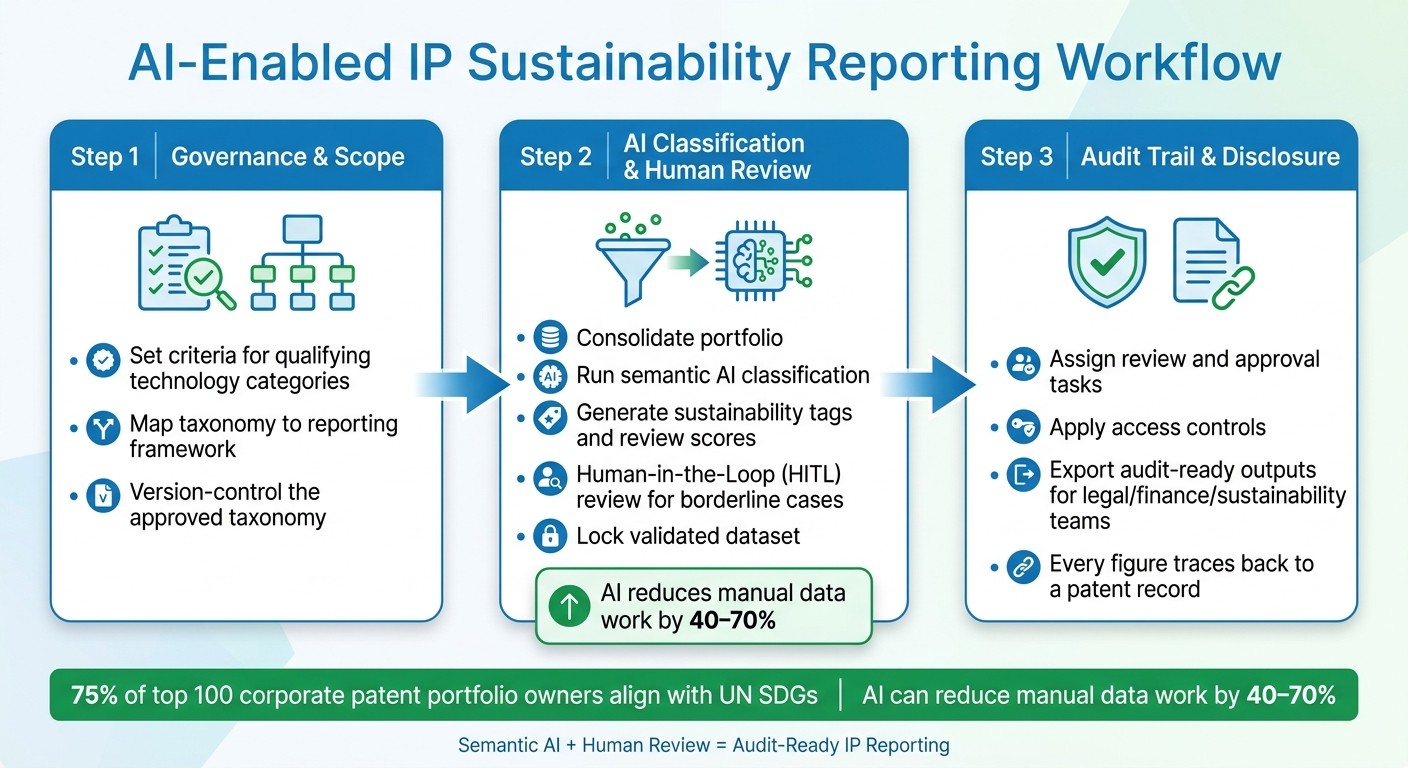
AI-Enabled IP Sustainability Reporting Workflow: 3 Steps to Audit-Ready Disclosure
Use this three-step workflow to turn classified patents into audit-ready disclosure outputs. It takes you from classification to disclosure with a clear audit trail.
Step 1: Define the Sustainability Taxonomy and Reporting Scope
Before any AI runs, the team needs to agree on what counts as sustainability-related IP. That means setting clear criteria for which technology categories qualify and which metrics will be reported in the cycle.
Start with clear data governance. Track the technology type, the sustainability outcome, and the calculation method. Then map the taxonomy to the reporting framework before classification starts. Once the taxonomy is approved, version-control it so later changes are traceable.
After that, move straight into portfolio ingestion and review.
Step 2: Ingest, Classify, and Review Portfolio Data
With the taxonomy locked, patent operations can consolidate the portfolio and run AI-based classification. Use semantic classification across the portfolio to produce sustainability tags and review scores.
The key control here is human-in-the-loop (HITL) review. AI should handle the first pass, but a cross-functional committee needs to validate borderline cases, material patents, and any claims that will appear in the final report.
Once validation is done, lock the dataset and prepare the disclosure package.
Step 3: Document Controls and Publish Audit-Ready Outputs
The final step turns validated data into outputs that legal, finance, and sustainability teams can use. Every figure in the report needs a clear chain of custody. In plain terms, each number should trace back to a patent record, a classification decision, or a calculation.
Patently's project management tools support this step directly. Teams can assign review and approval tasks, apply access controls to sensitive records, and export audit-ready outputs for disclosure or legal review.
How to Measure Results and Improve the Process Over Time
Track the Reporting KPIs That Matter
After each reporting cycle goes live, check the numbers that show whether the workflow is getting better or just moving work around. Focus on these five metrics:
Coverage: share of the portfolio classified against the sustainability taxonomy
Accuracy: classification error rate flagged during human review
Cycle time: hours spent per reporting cycle
Correction rate: number of manual corrections made during review
Provenance coverage: share of disclosure data points with a traceable source record
Each metric tells you something different. Coverage shows how well ingestion and classification are working. Correction rate shows how much cleanup the human review step still needs. Provenance coverage shows how ready you are for audit checks.
That last one matters more than it may seem at first glance. When provenance coverage is high, reviewers can trace data back to the source without digging through emails, spreadsheets, or side notes. That usually makes reviews faster and cuts down on follow-up questions.
Use these metrics to see whether automation is improving speed, accuracy, and audit readiness from one cycle to the next.
Refine Taxonomies and AI Rules as Standards Change
Once the workflow settles into a steady rhythm, use each reporting cycle to tighten the taxonomy rules and keep classifications lined up with current standards.
Review taxonomy and tagging rules on a regular schedule. Then update them when reporting standards shift. If those updates change which assets fall into scope, revise the tagging criteria and version-control the taxonomy so every change stays traceable.
FAQs
How does semantic AI classify patents?
Semantic AI classifies patents with large language models that pull out three core parts of a technology: its function, solution, and application. From there, it turns patent abstracts and classification definitions into vectors in a shared space. Then it uses cosine similarity to spot concept-level matches.
Patently applies this Vector AI method to map technical context across frameworks like WIPO and OECD standards. That makes automated, hierarchical categorization possible for sustainability reporting.
Why is human review still necessary?
Human review still matters. A lot.
AI can scale mistakes just as fast as it scales output. It can miss context, lean on thin data, or reach the wrong takeaway when the input is incomplete. And when its reasoning isn't clear, things can go sideways fast, especially in areas where nuance and materiality matter.
That's where human experts step in. They check sources, confirm what the content is actually saying, and make sure the final output is useful in practice, not just polished on the surface. They also help prevent greenwashing, which is a big deal when claims need to stand up to scrutiny.
On top of that, people are still the ones best suited to handle materiality assessments and forward-looking statements. Those calls need judgment. They have to line up with ethical, legal, and stakeholder expectations, and that kind of judgment can't be left on autopilot.
What makes IP reporting audit-ready?
Audit-ready IP reporting replaces manual, scattered work with an AI-driven process that improves traceability and accuracy. It links patent portfolios to recognized ESG metrics and sustainability frameworks, so reporting is based on measurable evidence instead of guesswork.
It also depends on strong data governance. That means clear roles, documented assumptions, human review of AI outputs, secure handling of sensitive data, and transparent logs of inputs and validation for auditors, regulators, and stakeholders.