How AI Analyzes SEP Licensing Market Trends
Intellectual Property Management
Jun 29, 2026
AI should rank and flag SEP assets—humans must retain judgment on essentiality and FRAND decisions.

AI helps me turn messy SEP data into a usable view of licensing risk, portfolio rank, and likely royalty pressure.
If I had to boil this down, here’s the answer:
I start with declared SEP data, patent family records, standards text, litigation records, and market signals
I use AI to clean names, merge families, map claims to standards, and sort patents by topic
I track filing dates, transfers, declarations, and assertion activity to spot where pressure may build
I use those outputs for portfolio ranking, rate planning, and FRAND range checks
I still rely on engineers and legal teams for the final call
A few facts stand out right away:
Over-declaration and under-declaration both distort SEP datasets
In one 5G view, RAN drew 97% of Release 15 declarations
In early Release 18 activity, SA accounted for 72% and CT for 28%
Manual review still costs about $4,000 to $8,000 per patent and takes 1–2 days each
What matters most is simple: AI is best used to sort, rank, and flag. It does not decide FRAND, and it does not replace claim review.
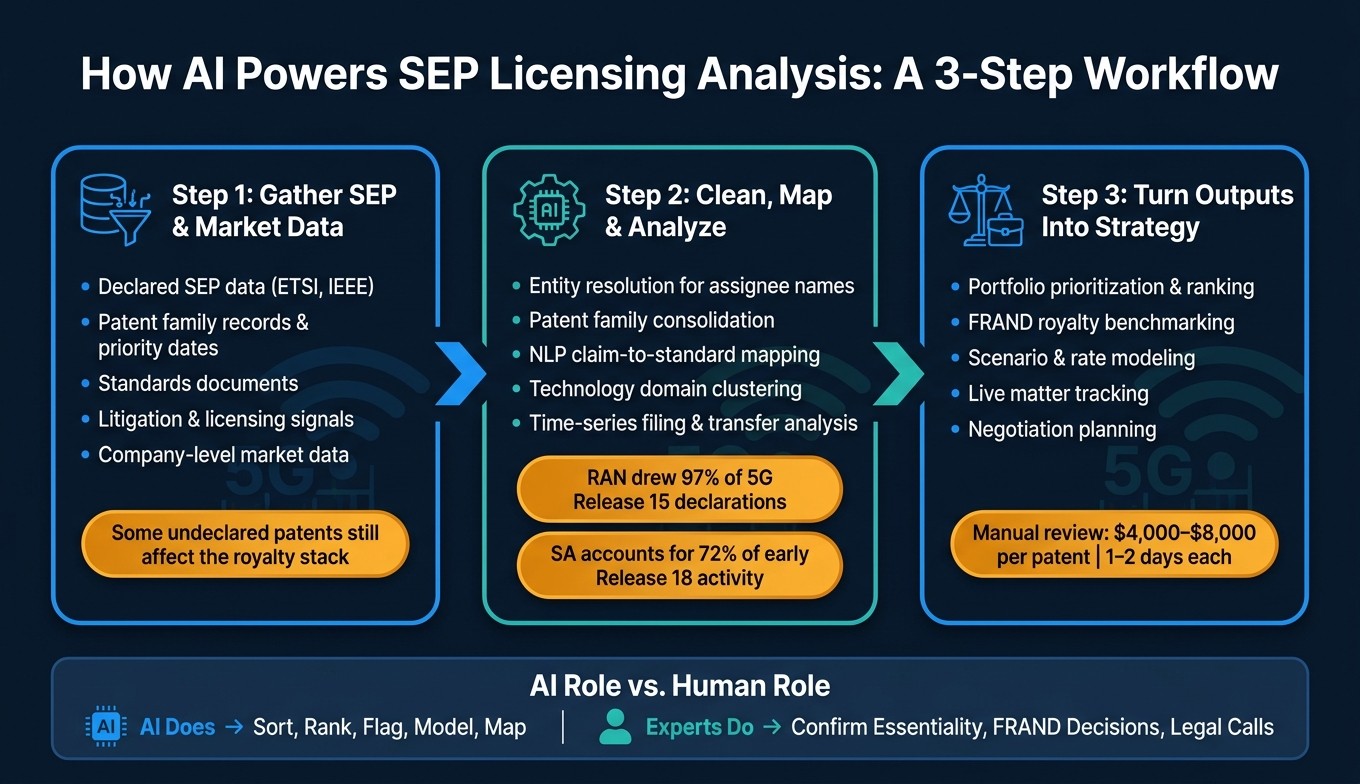
How AI Powers SEP Licensing Analysis: A 3-Step Workflow
Agentic AI – Patent Expert Co-Pilot Framework for (SEP) Licensing & Litigation Intelligence
Quick comparison
Stage | What I look at | What AI does | What people still do |
|---|---|---|---|
Data collection | SEP lists, patent tools and records, standards, cases, market data | Pulls records together and links them | Check data gaps and source quality |
Data processing | Assignees, families, claims, standards sections | Cleans, groups, maps, and scores | Review matches and technical fit |
Market trend review | Filing, transfer, declaration, assertion timing | Finds patterns over time | Judge licensing impact |
Licensing use | Portfolio rank, royalty ranges, FRAND checks | Builds models and comparison inputs | Make legal and business calls |
So when I read SEP market trends with AI, I’m not asking for a final answer. I’m using it to get to the right patents, the right patterns, and the right questions much earlier.
Step 1: Gather the SEP, Standards, and Market Data AI Needs
Good AI analysis starts with data, not algorithms. If the records are missing or patchy, the output can point you in the wrong direction.
SEP and standards data sources
The base layer is declared SEP data from standards bodies like ETSI and IEEE, matched with full patent family records. That means pulling in bibliographic data, priority dates, legal status, and family groupings, not just patent numbers.
Standards documents add the technical context AI needs to connect patents to the right standard and domain. Without that context, essentiality analysis gets much weaker. And there’s another catch: declared SEP data is incomplete. Some undeclared patents may still be technically essential and can still affect the royalty stack.
Licensing and market signals
Patent data by itself won’t tell you what a license is worth. You also need licensing and litigation signals to add the business side of the story, including licensing disclosures, court decisions, and dispute outcomes. That helps AI tell the difference between technical strength and commercial leverage.
Company-level market data adds another layer of business context. But these signals only start to help once the data is cleaned up, normalized, and linked together.
Why centralized tools such as Patently matter
This is where centralized tools like Patently come in. Patently pulls together standards-body and patent-office data in one workflow. It combines semantic search, citation analysis, and SEP analytics across 4G, 5G, and Wi-Fi.
Its Vector AI search helps surface conceptually related patents across fragmented datasets. Automatic 30-day updates keep the results current. And the search output stays connected to project management and collaboration tools, with comments and ratings tied to the relevant patent family and asset.
With the data in place, Step 2 can clean, normalize, and map it to spot market patterns.
Step 2: Process the Data So AI Can Detect Market Patterns
Once the data is collected, AI cleans it up and connects the records so market patterns start to show. That structure helps teams move from raw patent data to signals they can actually use.
Clean, normalize, and link patent records
The first problem is messy data. Assignee names often shift over time, so AI uses entity resolution to tie assignees back to their ultimate parent entities, including subsidiaries and affiliates. That matters because a negotiation counterparty may control far more of the SEP landscape than the filing name suggests.
Patent family consolidation matters just as much. If you count individual assets instead of families, portfolio sizes can look bigger than they are, and the competitive picture gets skewed. Working at the family level gives a cleaner view of geographic coverage and portfolio strength.
Map patents to standards and technical domains
Once the records are clean, AI can map patents to their declared standards. NLP and semantic search scan independent claims and specifications, then match them to specific sections of technical standards. Clustering sorts patents into technology topics, which helps teams see where a portfolio fits inside the standard's architecture.
Inventor participation in the relevant working group can strengthen the essentiality signal and add weight to a semantic match. Even then, these methods support the analysis; they don't replace legal or technical review. AI surfaces likely candidates, and qualified engineers confirm essentiality.
That gives teams a clearer sense of where licensing pressure is most likely to build.
Detect filing, ownership, and assertion trends over time
Time-series analysis is where AI starts to show market movement. By lining up filing, grant, declaration, and release-freeze dates, AI shows which segments draw attention first.
When SEP portfolios move to PAEs or unidentified licensors, AI can flag the transfer and the related royalty-stacking risk.
3GPP Technical Specification Group | Focus Area | Trend Note |
|---|---|---|
RAN (Radio Access Network) | Radio interface, massive MIMO | Dominated 5G Release 15 (97% of declarations) |
SA (Service and System Aspects) | Architecture, network slicing | Dominating 5G-Advanced Release 18 (72% of declarations) |
CT (Core Network and Terminals) | Protocols, ultra-reliable communication | Accounts for 28% of early Release 18 declarations |
These patterns feed portfolio prioritization and FRAND benchmarking in Step 3.
Step 3: Turn AI Outputs Into Licensing Strategy and FRAND Decisions
AI patterns only matter if they change what you do next. Once AI spots filing, ownership, and assertion patterns, the next step is to turn those signals into portfolio choices, royalty positions, and day-to-day matter handling.
Prioritize portfolios and target markets
Not every SEP deserves the same level of effort. AI helps teams rank assets by essentiality and standards alignment, so they can spend time on the patents most likely to matter in licensing talks.
It can also surface undeclared standard-related patents.
Support negotiation planning and FRAND benchmarking
AI can pull together public licensing signals, including patent pools and PAEs, to estimate a royalty range and benchmark comparable rates. That gives teams a practical starting point for royalty bands and comparable-rate checks.
This is where scenario analysis earns its keep. A team can test what happens if essentiality scores change, or if the other side’s portfolio turns out to be weaker than first thought. That kind of modeling helps before the first serious rate discussion starts.
Use these outputs as inputs for negotiation planning and FRAND benchmarking, not final legal conclusions.
That only works when the analysis stays tied to active matters.
Track live matters with Patently workflows
A live workflow helps keep ranking, benchmarking, and review decisions in one place. Patently connects SEP analysis to active matters with hierarchical projects, Patently Know/Rate, 30-day data refreshes, ethical walls, and branded exports.
Teams can group active matters by standard, domain, or campaign through hierarchical projects. The "Patently Know" and "Rate" features let team members record essentiality views and rated assets, which creates an internal audit trail that supports FRAND benchmarking and litigation strategy over time.
Ownership and declaration data refresh every 30 days, so teams aren’t working from stale information while the market shifts. And when negotiations get sensitive, ethical walls and access controls help protect confidential matters. For stakeholder reviews and negotiation planning, branded exports make it easier to share clean summaries.
Patently Feature | Workflow Benefit |
|---|---|
Hierarchical Projects | Organizes live matters by standard, technology, or target |
Patently Know / Rate | Documents internal expert opinions and rated assets |
30-Day Auto-Updates | Refreshes ownership and declaration data automatically |
Ethical Walls | Protects confidentiality during multi-party negotiations |
Branded Exports | Streamlines reporting for stakeholders and negotiation planning |
Benefits, Limits, and Conclusion: Using AI Responsibly in SEP Market Analysis
After AI spots market patterns, the last step is turning those signals into licensing decisions you can stand behind. AI doesn't replace licensing judgment. It cuts through the clutter, sorts the data, and helps teams focus. Final essentiality and FRAND decisions still sit with experts.
What AI improves for SEP licensing teams
Benefit | How AI Delivers It |
|---|---|
Faster Review | Automates claim-to-standard mapping and filters irrelevant declarations for reviewing a large competitor portfolio before talks. |
Broader Coverage | Vector search identifies related patents across languages and terminology, finding relevant SEPs written in different terminology. |
Consistent Benchmarking | Applies uniform scoring to all patents in a technology stack, ranking a portfolio's relative strength for FRAND benchmarking. |
Undeclared SEP Detection | Identifies patents likely essential but not yet listed in SSO databases, surfacing undeclared SEPs for review. |
That said, these gains only matter if teams use AI as a ranking tool, not as a legal answer. It can point you to the patents worth a closer look. It can't make the call for you.
Where AI still needs expert oversight
AI output is directional, not final. Experts still need to confirm essentiality, weigh confidential license evidence, and account for jurisdiction-specific FRAND rules.
The time and cost of manual review haven't disappeared either. Essentiality review still runs about $4,000–$8,000 per patent and takes 1–2 days for each one. AI doesn't erase that burden. What it does is help teams decide which patents are worth spending that time and money on.
Key takeaways for building an AI-assisted SEP analysis workflow
The best setup is simple: keep AI at the analysis layer, and keep people at the decision layer.
Start with clean SEP and market data. Then use AI to normalize, map, and rank the records. After that, let experts make the final calls on essentiality, FRAND, and jurisdiction.
That's the balance that makes AI useful here. It helps teams move faster without handing over judgment where it matters most.
FAQs
How does AI identify likely SEPs?
AI can spot likely standard-essential patents by looking past self-declared SEP lists, which are often messy or just plain wrong.
Instead of taking those lists at face value, it compares patent claims to the technical parts of standards like 5G or Wi-Fi. It does this with semantic mapping and vector search, which helps match the language and meaning of a patent claim to the right section of a standard. The point is simple: filter out patents that probably aren't essential.
It can also look at signals around the patent, such as:
citation data
whether the inventors took part in standard-setting groups
litigation patterns
From there, AI can assign predictive essentiality scores to show how likely a patent is to be essential to a given standard.
Patently adds a True Essentiality filter that blends AI analysis with expert technical review.
Can AI estimate FRAND royalty ranges?
Yes. AI can help estimate FRAND royalty ranges by looking at market data, similar license deals, and patent claims to find rates that line up with FRAND principles.
Patently uses analytics to review licensing programs, pool structures, and rate benchmarks. That helps professionals spot pricing anomalies and back up complex licensing negotiations with data.
Why is expert review still necessary?
Expert review still matters. AI-enabled analytics can miss bad data, make things up, and struggle with highly technical details.
There’s another issue too: standards groups don’t verify essentiality. That means patent holders may over-declare patents, which can make their market share look bigger than it is.
On its own, AI can produce false positives. Human experts help check the output, spot weak matches, and support accurate, reliable, and legally sound assessments.