AI Patent Search vs. Traditional Methods: Key Differences
Intellectual Property Management
Jun 30, 2026
AI finds prior art faster and broader; manual searches give claim-level legal judgment—use AI first, expert review second.
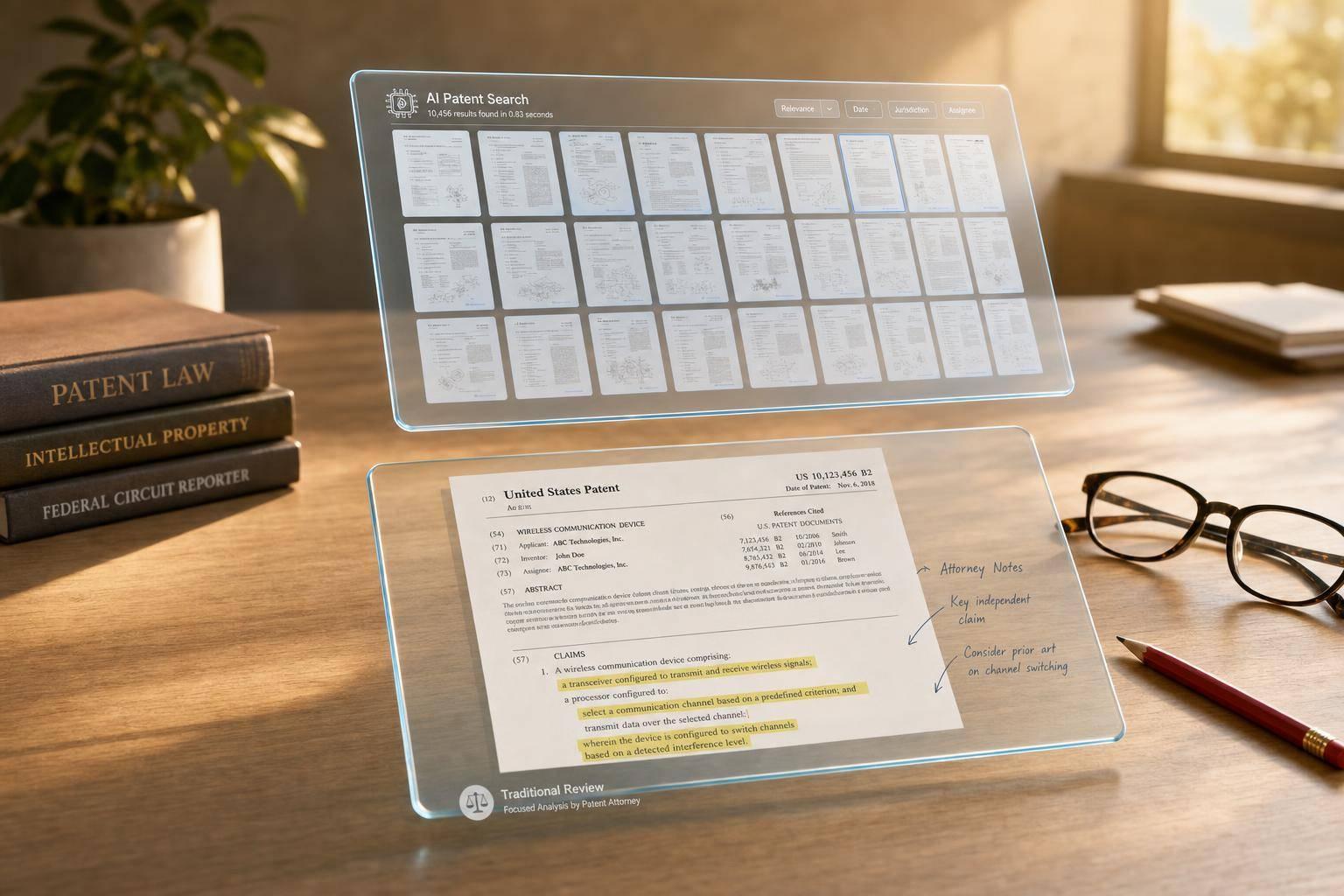
If you need the short answer: AI search is faster and casts a broader net (often using top patent tools), while manual search is better for claim-level legal calls. For most U.S. startups and IP teams, the best setup is AI first, human review second.
Here’s what matters most:
Manual search depends on keywords, Boolean logic, CPC codes, and citation review.
AI search looks at meaning, not just exact words.
Manual work often takes 7 to 13 hours, and hard searches can go past 20 hours.
A manual search often costs $800 to $2,500 per search.
AI-based semantic search can improve recall by 25% to 40%.
Manual keyword search can miss 20% to 40% of relevant documents when the wording changes.
For FTO, human legal review still makes the final call.
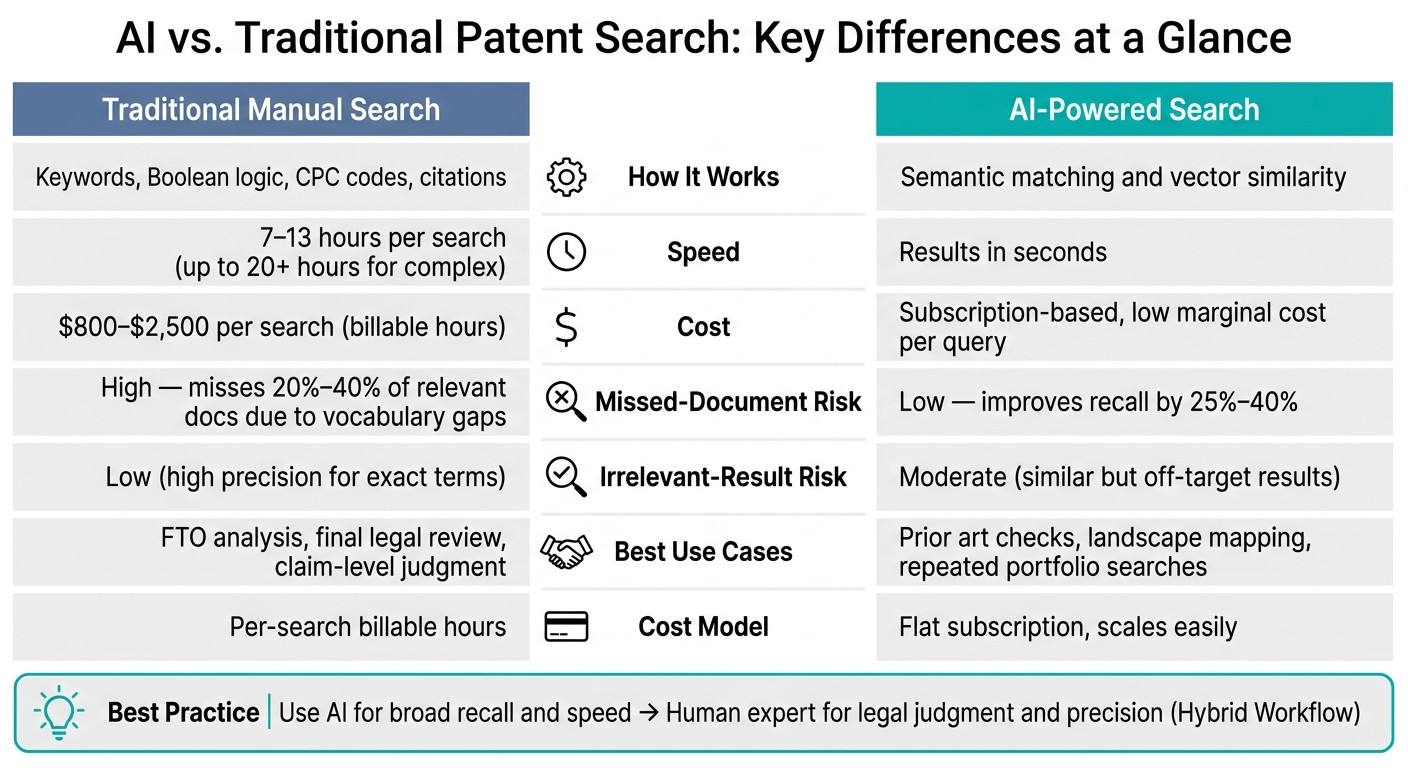
AI vs. Traditional Patent Search: Key Differences at a Glance
AI-Powered Patent Search: Find Prior Art Faster & Smarter with IP Author
Quick Comparison
Area | Manual Search | AI Search |
|---|---|---|
How it works | Keywords, Boolean terms, CPC codes, citations | Semantic matching and vector similarity |
Speed | Hours per search | Results in seconds |
Best at | Precision and legal judgment | Breadth and concept matching |
Main risk | Missed prior art from wording gaps | More similar-but-off-target results |
Cost model | Billable hours per round | Usually subscription-based |
Best use cases | FTO and final legal review | Prior art checks, landscape review, repeat searches |
In plain terms: AI helps you find more, faster. People decide what matters legally. If I were running startup IP work, I’d use AI to surface related art, then have a patent pro review the top results and tighten the search with Boolean terms where needed.
How Traditional Patent Search Works
Traditional patent search follows a structured, human-led process. A professional starts by defining the invention, then builds keyword and synonym lists, adds Boolean logic and CPC codes, and searches patent databases. After that, they review claims and citations, pull out new terms, and run the search again. It works best when the searcher knows which terms, classifications, and citations matter most.
Manual Keyword, Boolean, and Classification-Based Workflows
The big strength here is expert judgment. Professionals read claim language closely, weigh legal relevance, and decide whether a reference discloses each claim limitation. They also catch differences in wording that can change legal meaning, like "comprising" versus "consisting of."
"Human intuition, legal experience, and an understanding of nuanced technical details are irreplaceable." - Patlytics
The weak spot is the vocabulary gap. If an inventor describes an idea with different terms than the ones used in prior art, the search can miss key references. That issue gets worse with non-English filings, where term translation often has to be done by hand.
Time, Expertise, and Typical U.S. Cost Ranges
A professional search usually takes 7 to 13 hours, and more complex searches can go past 20 hours, with costs ranging from $800 to $2,500 per search. For startups that run searches again and again, those hours and dollars stack up fast.
That baseline sets up the next contrast: AI changes both the speed of the search and the range of related prior art it can surface.
How AI Patent Search Works
AI changes patent search in a pretty direct way: it matches meaning, not just words. Instead of forcing someone to guess the exact phrase used in a patent, the searcher can describe an invention in plain English. The system then looks for prior art based on the idea behind that description, not only exact wording.
Under the hood, it turns patent text into vectors and compares how close those vectors are. That’s what lets it find patents that describe the same concept even when the language shifts, like "drone" versus "unmanned aerial rotorcraft."
Semantic Search and Vector-Based Similarity Analysis
The main engine here is similarity scoring. When you submit a description, the AI converts it into a vector and compares that vector with patent documents. The closer two vectors are, the more closely related the ideas are, even if the wording looks different on the page.
Models like BERT-for-Patents and PatentSBERTa are tuned on patent datasets, which helps them handle specialized legal language and technical syntax with more accuracy.
This helps close the vocabulary gap that often limits old-school search. Semantic search methods have been shown to improve recall by 25% to 40% compared with Boolean-only methods. The USPTO now uses similarity-based search in examiner workflows, which shows these methods are moving into day-to-day use.
For startups, that can mean:
Fewer missed references
Less time rewriting search strings
A lighter review workload
That broader recall is what changes speed, coverage, and the amount of manual review needed.
How AI Supports Search, Drafting, and Portfolio Organization
Patently combines semantic search with drafting and portfolio tools, so teams can move from prior art review to prosecution work in one place. Its AI drafting tools, customizable project management features, and SEP analytics keep search, drafting, and portfolio tasks in the same workflow.
That matters most when speed, recall, and cost are on the line.
Key Differences in Efficiency, Accuracy, and Cost
The clearest gaps show up in speed, recall, and cost.
Efficiency: Search Speed, Iteration, and Scale
With manual search, every step takes time: building the query, running database searches, then refining the results. AI can return ranked results in seconds from a plain-language prompt.
Here’s the big shift: each extra AI query adds very little time. Each extra manual search can add hours. That gap becomes much more important when teams need to rerun searches across multiple inventions or during portfolio reviews.
Accuracy and Coverage: Expert Judgment vs. Semantic Recall
Manual search works best when the right terms are already known. It gets weaker when inventors describe the same idea in different language.
Manual keyword search can miss 20% to 40% of relevant documents when inventors and examiners use different terms. AI helps close that gap by matching concepts instead of exact strings. But there’s a tradeoff. AI also brings a moderate risk of pulling in results that are similar, yet not actually relevant. So human review still matters. This is why many firms are adopting AI-enabled patent platforms to streamline the drafting and review process.
In practice, the usual approach is simple: use AI-enabled patent analysis for broad recall, then have an expert validate the results.
Dimension | Traditional Manual Search | AI-Powered Search |
|---|---|---|
Concept Matching | Limited to exact word matches | High; understands technical intent |
Missed-Document Risk | High (20% to 40% due to vocabulary gap) | Low (high recall of related concepts) |
Irrelevant-Result Risk | Low (high precision for exact terms) | Moderate (irrelevant but similar results) |
Cost and Resource Use: Attorney Hours, Search Costs, and Repeatability
Manual search runs on billable hours. Every round of refinement adds to the invoice. AI-assisted search shifts more of the spend to a subscription model, with low marginal cost per query.
The sharpest contrast shows up in repeatability. Running ten AI searches usually costs little more than running one. Running ten manual searches tends to multiply time and spend in a near one-to-one way. That pattern matters most for startups that need repeatable searches as their portfolio grows.
Those differences lead straight to the next issue: when to use AI, when to use manual review, and when to combine both.
Choosing the Right Approach for Startup IP Management
Best-Fit Use Cases for AI, Manual Search, and Hybrid Review
Those tradeoffs lead to a simpler question: which method fits each IP task?
Use the method that matches the job: AI for breadth, manual review for legal judgment, and a hybrid setup for most startup searches.
AI-powered search works best when speed and range matter most. It’s a strong fit for early-stage idea vetting, landscape mapping, and repeated searches across a growing portfolio. That’s where AI tends to pay off most clearly. A smart way to start is with vector search to surface prior-art terminology, then tighten the search with Boolean queries.
Expert-led manual review still matters when legal judgment is on the line. For FTO, experts make the final claim-by-claim infringement-risk call. AI can rank references, but it can’t make that decision.
That point matters even more now because examiners rely on similarity search. The USPTO now uses Similarity Search in examination workflows, so a keyword-only search can miss part of the field.
In day-to-day use, a hybrid workflow usually makes the most sense: AI for broad recall and fast iteration, then manual review for precision and legal validation. The table below matches each search method to the task.
Scenario | Best Approach |
|---|---|
Prior art check and technology landscape review | AI semantic search |
Pre-filing patentability search | Hybrid (AI + expert review) |
Expert-led manual review | |
Repeated portfolio-wide searches | AI semantic search |
Conclusion: The Differences That Matter Most
AI wins on speed and breadth. Manual review wins on precision and legal judgment. Most startup teams need both.
FAQs
When should I use AI search instead of manual search?
Use AI search for broad patentability research, technical landscape mapping, competitor portfolio tracking, and large-scale dataset analysis. It helps when terminology doesn’t line up neatly and when you need to find conceptually related documents, even across languages.
For the best results, use a hybrid approach: AI search for fast semantic discovery, then manual review for final claim interpretation, strategy, and validity assessment.
Can AI patent search replace an attorney for FTO?
No. AI-powered tools can make freedom-to-operate (FTO) work faster by finding relevant documents up to 40% faster, but they do not replace an attorney.
Here’s the simple version: AI is good at broad, high-recall searching and sorting through results. That can save a lot of time on the front end.
But an attorney is still needed for claim interpretation, legal conclusions, and the professional judgment that an FTO analysis calls for.
How much can AI search reduce patent search costs?
AI-powered search can cut patent search costs in a big way because it trims the time spent on prior art discovery.
With old-school keyword searches, the cost can run more than $7,800 per search. Semantic AI can shrink search time by 40% to 80%.
That difference adds up fast. For firms handling 20 applications per month, the time saved can translate into $18,000 to $60,000 in monthly savings in billable hours.
AI integration may also reduce overall patent prosecution costs by up to 30%.