Top 7 Benefits of Contextual Patent Search
Intellectual Property Management
Jul 1, 2026
How contextual (semantic) patent search boosts prior-art recall, speeds searches, and reduces FTO, validity, and portfolio risk.

Keyword-only patent search can miss 30% to 40% of relevant prior art. That is the core issue. In this article, I show how contextual patent search helps me find conceptually related patents even when the wording does not match.
If I had to sum it up in one line: contextual search improves recall, cuts search time, and lowers risk in patentability, FTO, validity, and portfolio work. It does this by reading meaning instead of relying only on exact terms.
Here’s the short version:
Better prior art recall when patents use different wording
Broader concept coverage across synonyms, paraphrases, and shifting terms
Less time spent rebuilding Boolean strings and rerunning searches
More consistent results across different searchers and query wording
Stronger portfolio and landscape review through concept mapping
Better reach across languages and fields
Lower search cost by reducing manual search work
The article also makes one practical point clear: the best setup is usually hybrid. I’d start with semantic search for recall, then use Boolean filters like CPC codes, date ranges, and jurisdictions to narrow the result set.
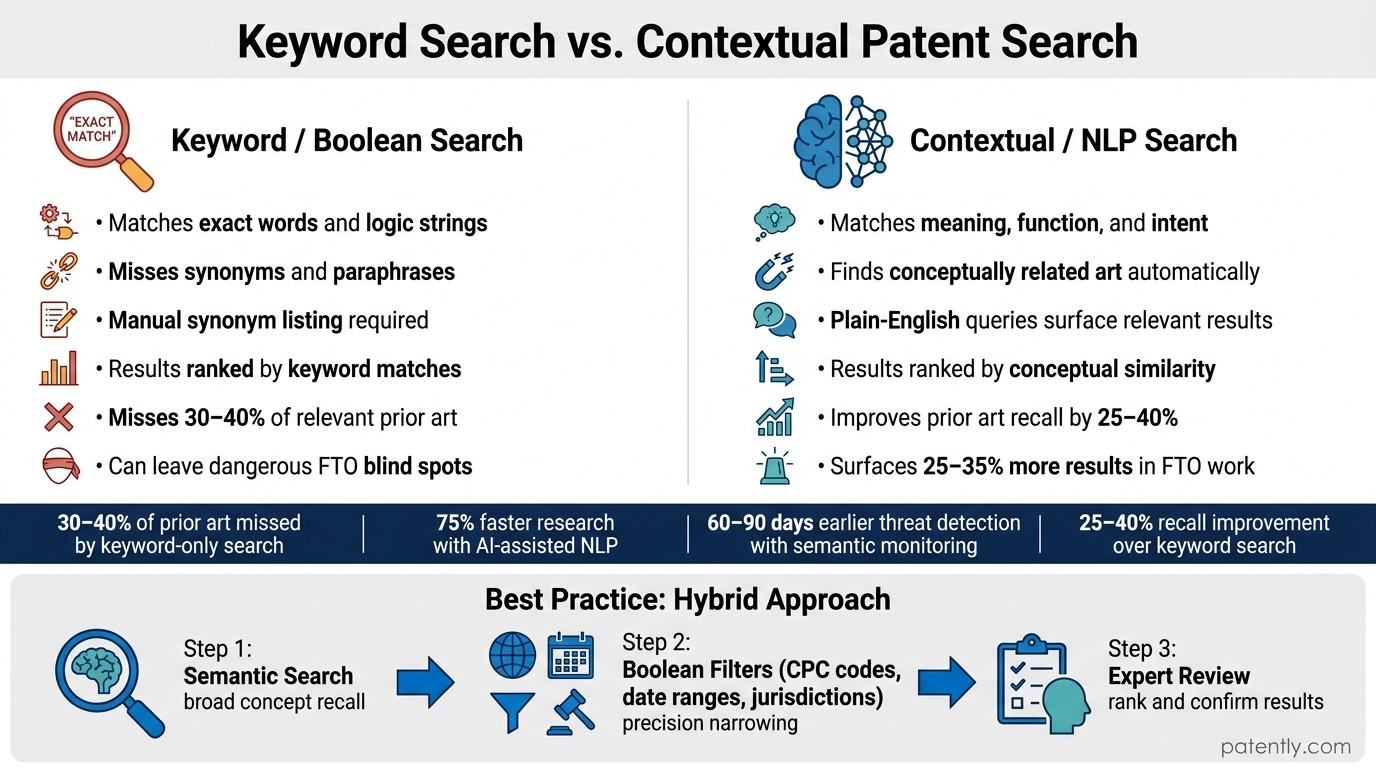
Keyword Search vs. Contextual Patent Search: Key Differences & Stats
Quick Comparison
Search approach | How it works | Main downside or upside |
|---|---|---|
Keyword / Boolean search | Matches exact words and logic strings | Can miss the same idea when it is written differently |
Contextual patent search | Matches meaning, function, and intent | Gives a stronger first-pass result set |
Hybrid approach | Uses semantic search first, then Boolean filters | Often the best fit for U.S. patent workflows |
If you want a simple takeaway, it’s this: when patent language changes but the idea stays the same, contextual search is more likely to surface the right art.
What Contextual Patent Search Means in Practice
Contextual patent search uses NLP to match the meaning of a query to patents, claims, and technical descriptions, not just exact words. In simple terms, the system turns documents into numeric representations of meaning, then compares those representations to your query.
That’s different from Boolean search, which depends on exact terms and hand-built logic. With Boolean search, much of the work falls on the searcher. You have to guess the right wording, add synonyms, and build the logic yourself. Contextual search does a lot of that work on its own by picking up related concepts and user intent. That makes it useful across both patent and non-patent sources.
In practice, a plain-language description of an invention can bring up relevant patents and applications even when those documents use different wording. That matters because patent language often says the same thing in very different ways. A search for function or purpose, for example, may still find documents that never use your exact terms.
Contextual search can also look across U.S. patents, published applications, global patent data, and non-patent literature in one interface. That saves time and gives you a broader view at the start. Non-patent literature can also surface early FTO risks before major R&D spend.
That helps explain why many patent professionals are moving beyond keyword search and adopting top patent tools that leverage AI.
Why Patent Professionals Are Moving Beyond Keyword Search
The core problem is vocabulary mismatch.
A keyword search can miss prior art when the same idea shows up under different wording. Two patents might cover the same invention, yet one says "flexible substrate" and the other says "bendable carrier layer." A plain keyword search may catch one and miss the other.
That gap creates real search risk:
Missed prior art
Weaker FTO analysis
Lower recall in patentability reviews —a critical concern for patents and startups looking to secure their IP.
Patent language is built for precision, not for easy discovery. Drafters often lean on broad functional terms like "marking device" instead of "pen" or "edge node" instead of "edge computing." If your search plan depends on the exact words a patent attorney happened to use, you're likely to miss relevant prior art.
This gets even harder in cross-disciplinary fields. When an invention spans multiple industries, the language used in each area may not line up at all. A keyword search built around one domain can struggle to connect those dots.
That’s why many teams now use a hybrid approach: semantic search for recall, then Boolean filters like CPC classes for precision. Semantic tools help cut down vocabulary mismatch and semantic drift. The benefits below build on that shift.
1. Improved Prior Art Relevance
The biggest payoff of contextual search is better prior art relevance. Instead of matching only exact words, it matches concepts and meaning. That means it can surface patents that matter even when they use different wording and have no direct terminology overlap.
That recall gap matters. Semantic search often improves prior art recall by a clear margin compared with keyword-only search. In plain English, that can mean the difference between a solid patentability analysis and one with blind spots.
And those blind spots aren’t small. If a patentability search misses a relevant reference, you might file an application that isn’t novel. That can burn prosecution spend and increase the risk of invalidation later on. Prior art quality shapes everything that follows, so finding the right art early gives attorneys a better shot at drafting stronger claims and lowering rejection risk.
2. Broader Semantic Coverage
Keyword search has a built-in limit: it finds only what you type in. Contextual search fills that gap by matching concepts, not just exact words. That matters when the same idea shows up under different technical names.
You don’t have to guess every wording twist to find related material. In practice, that means fewer manual search rounds and less reliance on exact phrasing just to get a complete set of results.
This matters most in fast-moving fields where language shifts fast, like AI, biotechnology, and advanced materials, where terminology is still evolving. It helps reduce missed prior art when terms haven’t settled yet, and it gives teams a better shot at spotting patents that could block a product before they sink major money into development.
The result is better patentability, invalidity, and FTO decisions because fewer prior art references slip through. It also cuts the time teams spend building and revising search strings.
3. Time Savings in Search Workflows
Contextual search doesn’t just broaden coverage. It also saves time right at the start of the workflow.
With keyword search, people often have to try one synonym after another, rerun the search, and then tweak it again. Contextual search cuts that query-building time by matching concepts on its own. The result is fewer search iterations and a faster first-pass set of results.
AI-assisted NLP can make patent research up to 75% faster than Boolean search by cutting down the number of reruns.
You can see that speed in actual search work. In one Patently Vector AI search for "in-ear headphones with noise isolating tips", Laurence Brown identified relevant Sony patent applications in under five minutes after reviewing 300 results. The point is faster access to a usable result set, not less diligence.
That time savings lets attorneys spend more of their effort on claim analysis and legal judgment in novelty, FTO, and litigation work.
4. Higher Accuracy and Consistency
One of the biggest upsides of contextual search is consistency. With NLP, query drift drops, which means small wording changes are less likely to send people down totally different paths. That matters a lot in patent search, where two people may mean the same thing but phrase it in different ways.
The same idea can lead to the same result set even when searchers use different terms. If one user searches for "flexible substrate" and another types "bendable carrier layer", the system can map both to the same underlying concept. That helps close the gap between everyday search terms and the language used in patents.
NLP also helps after the search itself. It can review claim language, flag independent and dependent claims, and point out key limitations. In plain English: teams get a more uniform way to read claims, which can lead to steadier decisions across the docket. It also makes portfolio analysis more consistent and easier to compare across matters.
5. Deeper Technical and Portfolio Insight
Contextual search does more than find relevant art. It helps teams see the shape of a technology landscape. Instead of matching terms alone, it maps concepts. That makes it easier to see where invention is clustered and where undercovered areas still exist.
One practical use is whitespace analysis: finding undercovered technology areas by mapping the full concept space of a field. In plain English, IP teams can spot actual invention openings, not just missing keywords.
It also makes competitive landscape mapping sharper. Contextual search can surface cross-domain patents that sit at the intersection of multiple technology fields. That's a big deal when you're trying to track how a space is changing, especially when new ideas don't fit neatly into one category.
That same semantic view helps with prosecution and portfolio calls. During prosecution, finding conceptually related disclosures early can help teams avoid costly rejections and reduce the chance they'll need to narrow claims later. During portfolio reviews, teams can compare related filings and find coverage gaps faster. And with real-time data feeds, IP teams can track competitor filings and legal events as they happen. That gives them earlier visibility into crowded areas and emerging threats.
6. Cross-Language and Cross-Domain Reach
Contextual search becomes even more useful when prior art shows up outside English-only sources or outside a single technical lane. Patent filings move across borders, and new ideas often pull from more than one field.
On the language side, the gap is large. Cross-language semantic search helps surface prior art in Chinese, Japanese, and Korean filings that keyword search often misses.
The same thing happens across fields. A method from one area can show up in another, but the wording may look completely different. Each field has its own jargon, so a keyword search built for one domain can miss art described in another. Semantic search looks at the underlying idea, not just the exact terms, which helps it find those cross-field links more often.
It also helps with older patents. A lot of older filings use terms that don't match how people write today, so plain keyword search can pass right by them. Semantic models help keep those earlier disclosures in view. Taken together, these capabilities can improve recall by 25% to 40% over keyword-only search.
That extra reach gives contextual search an edge over keyword search when prior art sits outside familiar terms.
7. Lower Search Costs and Better Resource Use
Those time savings also cut search costs.
Contextual search reduces manual query loops. Instead of building long Boolean strings and testing one synonym after another, teams can describe the invention in plain English and find conceptually related patents faster. With keyword search, you have to guess every wording variation for the same technology. Contextual search covers much of that work on its own.
That means IP teams spend less time on query building and result cleanup, and more time on FTO analysis, portfolio benchmarking, whitespace identification, and legal strategy. That’s where the payoff comes from: time moves away from mechanical search work and back to senior reviewer judgment.
A simple way to use it is this:
Start with semantic search to find the right concepts
Use Boolean filters like CPC classes or date ranges for the final pass
For high-volume teams, those gains add up fast: less manual query work, less advanced Boolean training, and faster prior art reporting.
Keyword Search vs. Contextual Search: A Side-by-Side Look
Keyword search matches exact wording. Contextual NLP search looks at meaning, so it can find related art even when people describe the same idea in different words.
That difference shows up fast in recall, how you build queries, and how results get ranked.
Feature | Keyword/Boolean Search | Contextual NLP Search |
|---|---|---|
Recall | Lower; misses synonyms and paraphrases | Higher; finds conceptually related art |
Synonym and phrasing coverage | Manual; requires listing variations and exact matches in the query | Automatic; plain-English queries can surface relevant results |
Result ranking | Based on keyword matches and Boolean logic | Based on conceptual similarity to the invention description |
Keyword search still has a place. But on its own, it can leave a material prior-art gap.
And that’s not a small issue. If relevant prior art gets missed, patentability, FTO, or validity analysis can get skewed. That gap is exactly why the next section turns to risk in U.S. patent work.
How These Benefits Reduce Risk in U.S. Patent Work
These benefits matter most when they lower legal risk.
At the core, the problem isn’t just a different way to search. It’s an operational risk issue. Traditional keyword-based searches miss 30% to 40% of relevant prior art, and that shortfall can affect patentability, invalidity, FTO, and litigation.
For patentability and invalidity work, missing prior art early can create expensive problems later. It can lead to costly USPTO rejections, push applicants into claim narrowing they didn’t need, and leave a party exposed when trying to challenge a competitor’s patent. Contextual search helps by surfacing relevant prior art from adjacent fields that keyword searches often miss. That can close gaps before they turn into legal trouble.
For FTO and clearance, exact-word matching can leave dangerous blind spots. And those gaps can put a product launch at risk of infringement claims. Semantic search typically surfaces 25% to 35% more relevant results than keyword search alone in FTO engagements. In plain English, that means teams can spot more issues before a product reaches the market.
Beyond filing and clearance, semantic search can also help teams see trouble coming sooner. For litigation preparedness, concept-based monitoring can surface competitive threats 60 to 90 days earlier, giving teams more time for design-arounds or licensing.
What IP Teams Should Know Before Getting Started
Those upsides only matter if the workflow is set up the right way. Contextual search is a workflow choice, not just a software choice. Before a team rolls it out, it helps to check a few practical points: source coverage, jurisdiction coverage, and update cadence.
Once coverage is clear, the next step is deciding how reviewers will screen results. A simple structure works well here:
Use keyword search to set the scope
Use semantic search to expand recall
Use expert review to rank and confirm results
This setup matters most in invalidity challenges and FTO clearances, where missing a relevant reference can change the whole picture.
Patently brings together semantic search, drafting support, citation browsing, project management, and SEP analytics in one platform.
The final piece is reviewer training. Teams need to read semantic results in a consistent way. That means training reviewers to interpret semantic rankings and assess claim-scope relevance. Contextual search can surface related prior art that looks unfamiliar at first. The key is knowing why a result ranked high and how to judge its claim-scope relevance. That’s what makes the tool produce steady, repeatable results.
Conclusion
Taken together, these benefits shift search from a simple keyword task to a meaning-based review process. Contextual search helps close the main gaps in keyword search by matching meaning, not just wording.
That matters because missed prior art can weaken patentability, FTO, and validity analysis.
For teams that want to use this workflow on a regular basis, the right platform matters. Patently supports this workflow with Vector AI semantic search, citation browsing, and project management tools.
FAQs
How does contextual patent search work?
Contextual patent search uses Natural Language Processing and Vector AI to go beyond rigid keyword matching and read the technical intent behind a patent.
Here’s how it works, in three stages:
Patent text is tokenized and converted into numerical vectors.
Similar concepts are grouped in a multi-dimensional space.
Algorithms such as cosine similarity and K-Nearest Neighbors rank results by conceptual similarity instead of exact wording.
That shift matters. Two patents can describe the same idea in very different language. A plain keyword search might miss that link. Contextual search is built to spot it.
When should I use semantic search versus Boolean filters?
Use semantic search first to cast a wide net. It helps close terminology gaps and surface prior art that's related in meaning, even when it uses different wording.
Then add Boolean filters - like date ranges or CPC classifications - to narrow the results and make the review more precise.
Can contextual search help with FTO and invalidity reviews?
Yes. Contextual or semantic search can improve Freedom-to-Operate (FTO) and invalidity reviews because it can surface conceptually related prior art that plain keyword searches often miss.
Here’s why that matters: patent language is often slippery. Two documents can describe the same idea using very different terms. A keyword search may skip one of them entirely. Semantic search looks past exact wording and pays more attention to technical meaning.
That can help teams:
reduce missed references
move through complex reviews with less manual searching
improve recall
support claim-level analysis with more relevant prior art
In practice, this means you’re not just hunting for matching words. You’re trying to find the same idea, even when it shows up in different language.