AI in SEP Licensing: Key Trends for 2026
Intellectual Property Management
Jul 2, 2026
AI now handles large-scale SEP triage, FRAND valuation, and contract review—people retain final legal and technical judgment.

AI now does the first pass in SEP licensing, and people check the output after. That shift is being driven by one simple fact: reviewing a 100-patent SEP portfolio can take 600 to 700 expert hours, while AI-assisted review can cut that work to about 14 days.
If I had to sum up 2026 in one line, it would be this: AI is most useful for sorting, matching, and benchmarking at scale - but people still make the final legal and technical calls. The data in this article points to three main uses:
Claim-to-standard review: AI helps sort likely patent-to-standard matches across very large portfolios.
FRAND pricing work: AI supports royalty-stack analysis, comparable-license review, and portfolio ranking.
License review and negotiation prep: AI pulls terms from agreements and helps teams compare offers against past deals.
A few numbers explain why this matters:
30% to 60% of declared patents in some major standards may be non-essential
Raw declaration data can carry about an 18% error rate
For large licensors, that can shift yearly valuation by $136 million to $272 million
So the main takeaway is simple: use AI for triage, scale, and data review; use human review for final judgment, claim support, and contract meaning. That is the working model many IP teams now follow in SEP review, FRAND analysis, and live negotiations.
Area | What AI does first | What people still do |
|---|---|---|
Patent review | Find likely claim-to-standard matches | Decide final essentiality |
FRAND analysis | Benchmark rates and model scenarios | Judge legal support and pricing position |
Contract review | Pull clauses and compare terms | Confirm meaning and legal effect |
If you work in SEP licensing, this article shows where AI is already part of the workflow - and where it still stops short.
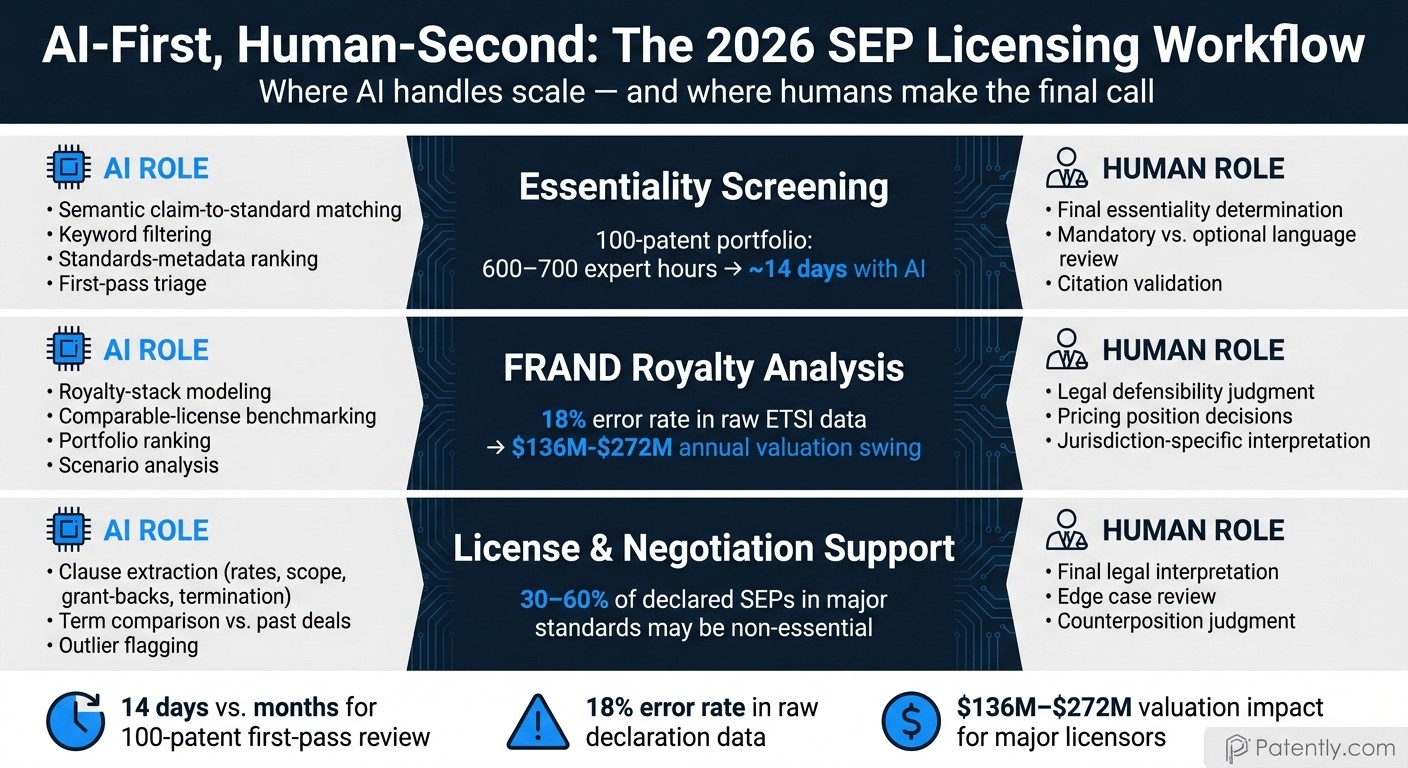
AI vs. Human Roles in SEP Licensing: 2026 Workflow Breakdown
GSLC Tim Pohlmann Welcome Remarks - SEP determination using AI
Trend 1: AI for SEP essentiality assessment at scale
You can see this workflow shift most clearly in essentiality screening. In SEP licensing, AI’s most direct use case is essentiality triage. As Solve Intelligence put it:
"At today's portfolio scales, AI is a precondition for SEP essentiality and validity assessment, not an enhancement of human review."
How claim-to-standard matching works
AI screens essentiality by matching claim language to standard text. It usually starts with semantic search to find likely overlaps, then uses keyword filters to cut false matches. Standards-participation metadata can also help rank results.
This work is also moving past cellular standards. It now covers video codecs like H.266, HEVC, and AV1, which pulls in content platforms and streaming companies that often have far less SEP licensing experience.
What the evidence says about accuracy and limits
A 2026 in-house audit found that AI can shrink first-pass claim charting from months to days, but expert validation still handles the last step.
That distinction matters. AI can flag likely matches, but it does not decide essentiality. Human review is still needed to sort mandatory language from optional language in a standard and to make sure citations can stand up to scrutiny.
So the best way to use it is simple: use AI for triage, not final essentiality conclusions.
Where Patently fits in SEP analytics
Patently’s License module brings together AI portfolio analysis and verified essentiality data to support faster, evidence-based SEP review. After essentiality is triaged, that same dataset can also support FRAND valuation and portfolio strategy.
Trend 2: Data-driven FRAND valuation and licensing strategy
Once essentiality is verified, the next step is price: what is the portfolio worth, and what terms can you defend? At that point, the focus moves away from simple essentiality counts and toward pricing that can stand up under scrutiny, plus a clear view of where the portfolio sits in the market.
AI-assisted FRAND royalty benchmarking
FRAND valuation rests on two inputs: the verified SEPs held by the licensor and the verified SEPs in the standard’s total stack. That sounds straightforward. In practice, it gets messy fast.
Raw ETSI declaration data has an approximate 18% aggregate error rate across major owners, and that can swing annual valuation by $136 million to $272 million for major licensors. That’s not a rounding error. It can change the entire shape of a licensing program.
AI helps on both sides of the valuation process. It supports top-down royalty-stack models and comparable-license analysis, while linking each valuation input back to verified patent evidence. That link matters. If the input data is shaky, the output won’t hold up for long.
U.S. courts, especially the Eastern District of Texas, are using data-based analytics more often in FRAND disputes. And rulings such as Wilus v. Samsung have reinforced that IEEE RAND commitments are governed by U.S. law even when the portfolio includes foreign patents. In plain terms, data quality is no longer just a back-office issue. It can become a legal issue.
Portfolio optimization for licensing outcomes
Valuation is only part of the job. Teams also need to decide which patents deserve attention first.
A manual review can go deep on a small set of assets. But it can’t efficiently map a portfolio of 10,000+ patents for licensing potential, jurisdictional gaps, or under-monetized clusters. That’s where AI starts to change the day-to-day work.
AI-driven portfolio analysis can flag the patent families with the strongest licensing value and show where jurisdictional coverage is thin. It can also help teams sort out whether pool participation or direct bilateral licensing is the better route for a given asset cluster. Instead of spending months on manual review, teams can cut that work down to weeks.
Those decisions shouldn’t sit in a slide deck. They need to feed straight into license drafting and negotiation prep, where the stakes are higher and the clock is usually ticking.
Connecting analysis to execution with integrated workflows
Analysis by itself doesn’t do much if it never reaches the people handling the deal.
A common pain point for IP teams is that portfolio data, licensing strategy, and matter tracking often live in separate tools. That split slows decisions and creates data drift. One team updates the portfolio view, another tracks negotiation status somewhere else, and before long no one is working from the same file.
Integrated workflows help teams move from portfolio analysis to licensing tasks without re-entering data. That matters most when negotiation timelines are short and everyone needs a single source of truth. From there, the same outputs can move straight into contract review and negotiation support.
Trend 3: AI for contract review and negotiation support
Portfolio analysis and FRAND valuation naturally feed into contract review and negotiation support. This is where AI pulls terms from signed and proposed licenses and compares them with past deals.
Automated review of SEP license terms
Reviewing large batches of SEP license agreements by hand is slow, and results can vary from one reviewer to the next. AI helps by pulling out key terms - royalty rates, geographic scope, grant-back clauses, release provisions, and termination provisions - from large sets of agreements and turning them into structured data.
That kind of output helps teams spot patterns and outliers much faster. IP teams are using "AI-first, human-second" workflows, where AI does the first pass on structure and people step in to check edge cases and make the final call. In practice, that means using AI to pull key clauses and flag terms that look off, while keeping human review for final legal interpretation.
Negotiation analytics and benchmark-driven counterpositions
Once contract terms are in structured form, teams can compare a proposed term sheet with past deal patterns and benchmark data. That gives licensing teams a clearer sense of whether an offer falls within a normal range or stands out.
This becomes especially helpful when the other side puts forward a royalty structure or territorial scope that's tough to judge on the spot. Scenario modeling can test different territory mixes or royalty-base structures against benchmark data, which helps teams prepare counterpositions and interim rate positions tied to deal history. Put simply, it gives them more support for the numbers and terms they put back on the table.
Benefits, risks, and the role of human judgment
AI is good at speeding up high-volume review work. But ambiguity, jurisdiction-specific interpretation, and final legal judgment still need a human eye.
Conclusion: What IP teams should watch next
In 2026, AI has become routine support for SEP analysis, valuation, and negotiation. At this point, the big question for IP teams isn't whether AI helps. It's where AI fits best.
The efficiency case is clear. AI can shrink a 100-patent audit from months to days. But speed alone isn't enough. Defensibility matters just as much. In practice, that means AI should take on triage and claim matching, while humans handle validation, edge cases, and final legal judgment.
That split sounds simple on paper. In day-to-day work, it's getting tougher. FRAND disputes now stretch across multiple jurisdictions, so teams need to keep their positions aligned across the UK, Germany, the UPC, and China. At the same time, new standards in AI inference, XR streaming, and edge computing are set to add more SEP work to the pile.
Patently offers SEP analytics and workflow tools to support that shift.
FAQs
How accurate is AI in SEP review?
AI can make SEP review faster and more accurate, especially when teams need to work through large declared patent portfolios. Instead of relying on manual review alone, it helps professionals sort through large volumes of patents, map claims to technical standards, and filter out data that likely isn't essential.
That said, AI isn't perfect. It can still produce noisy results or hallucinate connections that aren't there. That's why human expert oversight is still needed for final validation.
What still requires human review?
AI platforms like Patently help teams move faster by automating semantic mapping, relevance-based sorting, and essentiality scoring. That saves time on the heavy lifting.
But human review is still the last checkpoint.
Experts still need to verify claim-level proof, check the reasoning behind why a patent is mandatory rather than optional, and complete the final audit so the assessment is accurate, valid, and defensible.
How does AI improve FRAND pricing?
AI helps improve FRAND pricing by shifting talks away from subjective claims and toward evidence-based valuations.
One big reason this matters: studies often find that 30% to 60% of declared portfolios are not actually essential. That can muddy negotiations fast. Tools like Patently tackle this with automated, clause-level claim-to-standard mapping, which helps pinpoint the patents that are genuinely essential.
That gives both sides a cleaner starting point. They can filter out irrelevant data, audit portfolios for pricing anomalies, compare proposed terms against market benchmarks, and support more predictable, fair, and compliant rate-setting.