Vector AI in Scalable Prior Art Search
Intellectual Property Management
Jul 3, 2026
Scale prior art discovery with vector embeddings and hybrid search: boost recall, apply metadata filters, and require human claim review.

If I rely on keywords alone, I will miss prior art. In large patent sets, the same idea can appear in different words, different languages, and different filing styles. A vector-based search setup helps me find meaning-based matches first, then narrow results with CPC, dates, jurisdiction, and claim review.
Here’s the short version:
Prior art search is hard at scale because patent and NPL collections are huge, multilingual, and full of synonym gaps.
Vector AI uses embeddings to match text by meaning, not just exact terms.
Hybrid search works best: semantic retrieval first, then metadata filters, Boolean follow-up, and human claim review. This process is streamlined by AI-enabled patent analysis platforms that centralize novelty and validity projects.
Review still matters because semantic matches can drift into the wrong domain.
Quality should be measured with labeled sets and metrics like recall@k.
Governance matters: log queries, thresholds, filters, reviewers, and reasons for inclusion or exclusion.
A few facts stand out:
using top patent tools, search often spans millions of documents across USPTO, EPO, WIPO, and NPL sources.
ANN methods such as HNSW let teams search those vector indexes without checking every record one by one.
In patent review, 35 U.S.C. § 102 and 35 U.S.C. § 103 shape why missing one reference can affect claim scope and later enforcement.
What I take from this is simple: vector search is not a replacement for attorney judgment. It is a search layer that helps me build a larger first-pass candidate set, especially when wording differs across patents, papers, and languages.
What is AI Vector Search? | Search by Meaning, Not Keywords
Quick Comparison
Search approach | What it does well | Main weak spot | Best use |
|---|---|---|---|
Keyword / Boolean | Tight term control | Misses synonym and language variation | Narrow follow-up review |
Pure vector search | Finds semantic matches | Can pull wrong-domain results | Broad first-pass recall |
Hybrid search | Blends meaning search with filters | Needs setup and tuning | Patentability, FTO, and invalidity workflows |
I’d sum it up this way: start broad with semantic search, narrow with structure, and finish with claim-level human review.
How Vector AI Works in Patent Search
Embeddings, Similarity, and Semantic Retrieval
A transformer model like BERT, RoBERTa, or SciBERT converts a patent claim or abstract into a high-dimensional embedding. In plain English, it turns the text into a numeric representation that reflects meaning and technical context.
When a model is trained on patent data, it can learn that "autonomous vehicle" and "self-driving car" point to the same idea. It can also keep the legal meaning of claim language intact and map equivalent concepts across languages. That embedding then becomes the basis for similarity scoring in the next step.
Vector search puts semantic similarity ahead of exact wording. That helps with recall, but it also makes the process less transparent than keyword search. This matters when relevant prior art describes the same idea with different terms than the invention disclosure. As a result, patent search systems use dense retrieval to rank likely matches first.
Dense Retrieval and Hybrid Search
A Vector AI search uses dense retrieval. The system matches the query embedding against a vector index of patent documents, then ranks results by how close those vectors are in semantic space.
Hybrid search adds another layer. It combines semantic results with structured patent filters, so searchers can narrow broad result sets while still getting the upside of vector-based matching.
Text and Structure-Aware Search
This approach isn't limited to claim text. Vector AI can embed claims, abstracts, specifications, and scientific papers in a shared semantic space.
That means teams can search across more than one text source at the same time, without writing separate rules for each one.
Building a Scalable Vector AI Search Stack
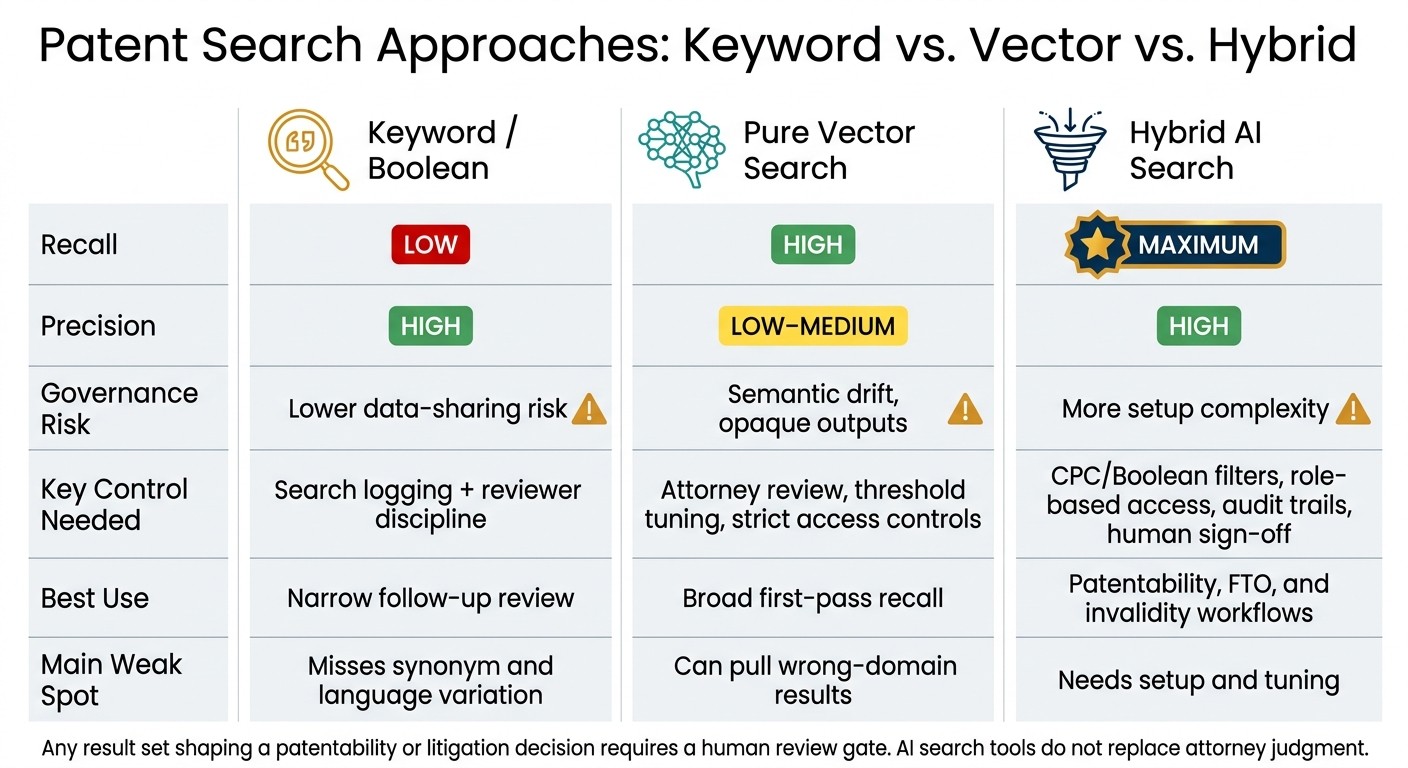
Keyword vs. Vector vs. Hybrid Patent Search: A Side-by-Side Comparison
Data Ingestion, Embedding Pipelines, and Vector Indexes
Once semantic search is working, the next job is making it work at patent-scale volume. That starts with the data itself: structured patent documents from the USPTO, WIPO, and EPO, along with non-patent literature (NPL) such as academic papers and technical standards.
Before anything gets embedded, the raw text has to be cleaned, normalized, and chunked. That step sounds mundane, but it sets the stage for everything that follows. If inputs vary too much, the model ends up comparing apples to oranges.
From there, a transformer model like SciBERT or MiniLM turns each document into an embedding. This is where domain tuning starts to matter a lot. Patent-tuned models can separate technical meanings that a general model may blur together. In patent search, that difference can change which documents show up and which ones get missed.
Those embeddings are then stored in a specialized vector database. At that layer, Approximate Nearest Neighbor (ANN) methods - especially HNSW (Hierarchical Navigable Small World) - make it possible to search millions of vectors fast without scanning every item one by one. Vector databases and search engines sit at the center of this part of the stack.
Latency, Recall, and Distributed Scaling Decisions
As the corpus gets larger, the stack has to deal with plain trade-offs. Most production systems use fast lexical retrieval first and then apply neural reranking. That pattern keeps search responsive while still giving the semantic layer room to improve result quality.
Deployment choices come with trade-offs too:
Self-hosted systems give teams more control.
Cloud-native systems cut ops work and scale faster, but they add recurring cost and put external data handling on the table.
Speed matters, of course. But speed alone doesn't win trust. Reviewers still need claim-level context, because a fast result that can't be checked against the claim language isn't much help.
Keeping Metadata and Full Text Connected
Fast retrieval still needs structured context for defensible review. Similarity scores alone don't carry enough weight for legal review. A result may look close in concept, but it still has to be checked against classifications, citation chains, patent family data, priority dates, and the actual claim language.
If that metadata isn't tightly connected to each vector, the review process slows down fast. Reviewers can't easily confirm relevance, and they can't narrow results to the right jurisdiction or time window without jumping between disconnected layers of the system.
That's why the metadata layer matters just as much as the embedding pipeline. Patently, for example, keeps rich field mappings for each patent so teams can apply granular filtering. In practice, a hybrid workflow uses metadata pre-filtering to shrink the dataset before vector similarity search. That lets reviewers move from a broad semantic result set to a defensible candidate list - grounded in jurisdiction, priority, family, and claim scope - without losing the full document context.
Practical Applications in Prior Art Workflows
From Invention Disclosure to High-Recall Candidate Sets
Once the search stack is set up, the next job is turning an invention disclosure into a candidate set that someone can actually review. Because the embeddings are already linked to metadata, teams can move from search to review in a single flow. Instead of squeezing a disclosure into rigid Boolean strings, Vector AI lets practitioners enter a natural language summary of the technical problem and solution. The system turns that input into a high-dimensional vector and pulls patents with similar meaning across large patent corpora.
The first pass should aim for high recall. From there, teams can filter by priority date, jurisdiction, and CPC or IPC class, then pull alternate terms for a Boolean follow-up. One useful refinement step is a vocabulary harvest: scan the top results for synonyms and alternate technical terms. For example, you might search for "Wireless Charging" and find prior art using "Inductive Power Transfer" instead. Those terms can then go back into a follow-on Boolean query to close the vocabulary gap. The last filtered set then moves to claim-level human review.
Use Cases Across Prosecution, Litigation, and Specialized Domains
This same flow works across the main patent tasks. It supports patentability, FTO, and invalidity work. In FTO review, the search should run against the full patent document, not just the title or abstract. For invalidity work, teams use the same semantic search to surface prior art fast, then narrow it with filters and human review.
There is a common pitfall here: false domain matches. Vector AI can blur functional similarity with the same function in a different domain. So a medical device search might pull in automotive sensor patents. The usual fix is to apply CPC class limits, such as A61B for medical instruments. Using Vector AI in pre-filing workflows also lines up with examiner-style search behavior.
Using Patently for Semantic Search and Team Workflows
In team settings, the same semantic search and filtering process can stay organized in one shared workspace. Patently's semantic search uses Vector AI, which means teams can run natural language queries and get ranked results without building Boolean strings by hand. Citation browsing lets users trace chains from a candidate reference. Patently brings together semantic search, citation tracing, tagging, commenting, and shared result organization in one workspace.
For teams juggling multiple matters at once, that setup helps keep each investigation's candidate sets and annotations in order.
Implementation Best Practices, Risks, and Conclusion
How to Evaluate Quality and Maintain Trust
Once your search stack is fast, quality control becomes the main choke point.
The smart move is to test Vector AI against a labeled set of known relevant prior art. Build a small gold-standard dataset of labeled references for each technology area. Then measure recall@k, which is the share of known relevant documents that appear in the top k results. Benchmarks often show higher recall for semantic search than for keyword-only search. That’s why vector search should be checked against known relevant art, not trusted on gut feel alone.
Threshold tuning also matters a lot. Start with a permissive cosine threshold in the first pass. Then tighten it after CPC and Boolean filters narrow the set. It also helps to tune thresholds by technology area instead of forcing one cutoff across every domain. A biotech search and a software search rarely behave the same way.
You’ll also want feedback loops with the attorneys and searchers doing the review. That back-and-forth helps improve query framing and domain-level validation over time.
Governance, Confidentiality, and Human Review
After quality, the next issue is control. A system that expands recall still has to stay reviewable and secure.
One risk is semantic drift. That happens when the model finds documents that look functionally similar but are legally irrelevant. CPC or other classification filters can help contain that risk, but only when they’re applied with care.
Confidentiality is a separate issue. Before uploading invention disclosures to any AI-assisted platform, review the vendor’s privacy and security terms closely. Sanitize inputs. Limit access by role. Submit only the minimum problem statement needed for the search. If a disclosure is sensitive, treat it that way from the start.
Just as important, keep a clear log of:
query versions
thresholds
filters
reviewers
rationale
That record lets the team reconstruct why a reference was included or excluded. In patent work, that paper trail matters. It’s what makes a search defensible.
Use the search mode that fits the job: precision, recall, or balance.
Approach | Recall | Precision | Governance Risk | Key Control Needed |
|---|---|---|---|---|
Manual keyword search | Low | High | Lower data-sharing risk | Search logging and reviewer discipline |
Pure vector search | High | Low–Medium | Semantic drift, opaque outputs | Attorney review, threshold tuning, strict access controls |
Hybrid AI-driven search | Maximum | High | More setup complexity | CPC/Boolean filters, role-based access, audit trails, human sign-off |
Any result set that shapes a patentability decision, IDS strategy, claim amendment, or litigation analysis needs a human review gate. AI search tools speed up prior art discovery, but they do not replace attorney judgment at the claim analysis stage.
Key Takeaways for U.S. Patent Teams
Vector AI surfaces semantically related art that keyword and Boolean methods can miss. It also lines up with the USPTO's Similarity Search direction under MPEP § 904.02(b).
It works best as one part of a hybrid workflow:
broad semantic retrieval
structured CPC and Boolean filtering
attorney review at the claim level
Evaluation and governance can’t be a one-time setup. Teams need to test recall on a regular basis, tune thresholds by domain, log each search, protect privileged disclosures, and keep defensible search records for every matter.
FAQs
How is vector search different from keyword search?
Vector search looks at meaning and context, not just exact word matches. That matters in patents, where two documents can describe the same idea with very different language.
With keyword search alone, it's easy to miss relevant patents if the author used different terms for the same concept.
Vector AI solves that by turning patent text into mathematical vectors. Those vectors make it easier to find patents that are conceptually similar, even when the wording changes or the documents are written in different languages.
Patently uses this semantic approach to improve prior art search accuracy.
When should I use hybrid search for prior art?
The source material doesn't spell out a specific hybrid search method or say when to use one.
What it does explain is how Patently uses Vector AI. It turns natural-language descriptions into mathematical vectors, which helps surface patents that are conceptually similar, even when a standard keyword search might miss them.
For prior art research, you can start by typing a natural-language description of your invention into the Patently search field.
How can I tell if semantic search is missing key references?
Treat your first semantic search like a test drive. If the results feel thin or off-target, tweak the technical framing, rewrite the search description, and try different terms.
That small shift can make a big difference. A phrase that seems obvious to you may not match how similar ideas are described in patent documents.
Patently can help you spot holes in the result set by grouping documents by theme with Vector AI. You can also use citation browsers to follow citations forward and backward, which helps you find earlier patents and later technology developments you may have missed.