Emerging Green Standards: What Patent Teams Need to Know
Intellectual Property Management
Jul 4, 2026
Classify green assets, use WIPO/CPC/OECD tags, choose fast-track filings, and make patent records audit-ready for ESG.

Green reporting now affects patent work. If I manage patents in 2026, I need to classify climate-related assets, support ESG claims with file-ready records, and pick filing routes after the USPTO ended its climate pilot on April 18, 2025.
Here’s the short version:
I need a shared tagging system or top patent tools for green patents
I need to know when to use WIPO Green Inventory, CPC Y02/Y04S, and OECD ENV-TECH
In the U.S., green cases no longer get a special USPTO climate fast track, so I’m often looking at Track One or PPH
Other offices still offer lower-cost or free fast-track paths, but the rules differ by country
Patent records now support ESG, CSRD, EU Taxonomy, and due-diligence reviews
Audit trails, human review, and clean data matter if I want claims to hold up under investor or regulator review using AI-enabled patent analysis to ensure accuracy.
A few facts stand out right away:
Track One in the U.S. costs $4,515 for a large entity
Canada may issue a first action in about 3 months
The UK green route may lead to grant in about 12 months
China can issue a first office action in about 45 days
Japan may reach first action in about 2 months
Quick Comparison
Topic | What I need to know |
|---|---|
Green classification | WIPO is broad, CPC Y02/Y04S is more exact for climate work, OECD is mainly for statistics |
U.S. prosecution | No USPTO green pilot now; use Track One or PPH where it fits |
Foreign fast-track | Canada, UK, China, Japan, and Brazil each use different tests and process rules |
Drafting | I still need to tie any green claim to a clear technical effect in the spec and claims |
Compliance | Patent files now help support ESG statements and taxonomy-linked reporting |
Governance | Cross-team review, quarterly checks, and audit logs help cut claim risk |
If I want a patent portfolio that stands up to legal review, finance review, and ESG review, I need clean tags, clear proof, and a repeatable process from intake through reporting.
Green Patent Standards and Classification Systems
Before a patent team can tag assets or measure climate-tech exposure, everyone needs to work from the same definition of green. That sounds simple, but it isn't.
ESTs cover environmental technologies in a broad sense. CCMTs focus more narrowly on technologies that cut greenhouse-gas emissions or increase carbon sinks. WIPO built its Green Inventory around ESTs. The CPC Y02/Y04S scheme zeroes in on CCMTs. So the first job is to figure out which idea fits the invention in front of you. Only then does it make sense to assign a classification code.
Once those main code families are on the table, the next move is matching each invention to the right system. Classification standards act like a shared language between internal R&D labels and outside frameworks used for regulation, investor review, and competitor tracking. Without that shared language, a portfolio review starts to wobble. It can't answer basic questions with much confidence:
How much of our IP is climate-related?
Where are competitors filing?
Which assets support our CSRD disclosures?
WIPO IPC Green Inventory, CPC Y02/Y04S, and OECD ENV-TECH Explained
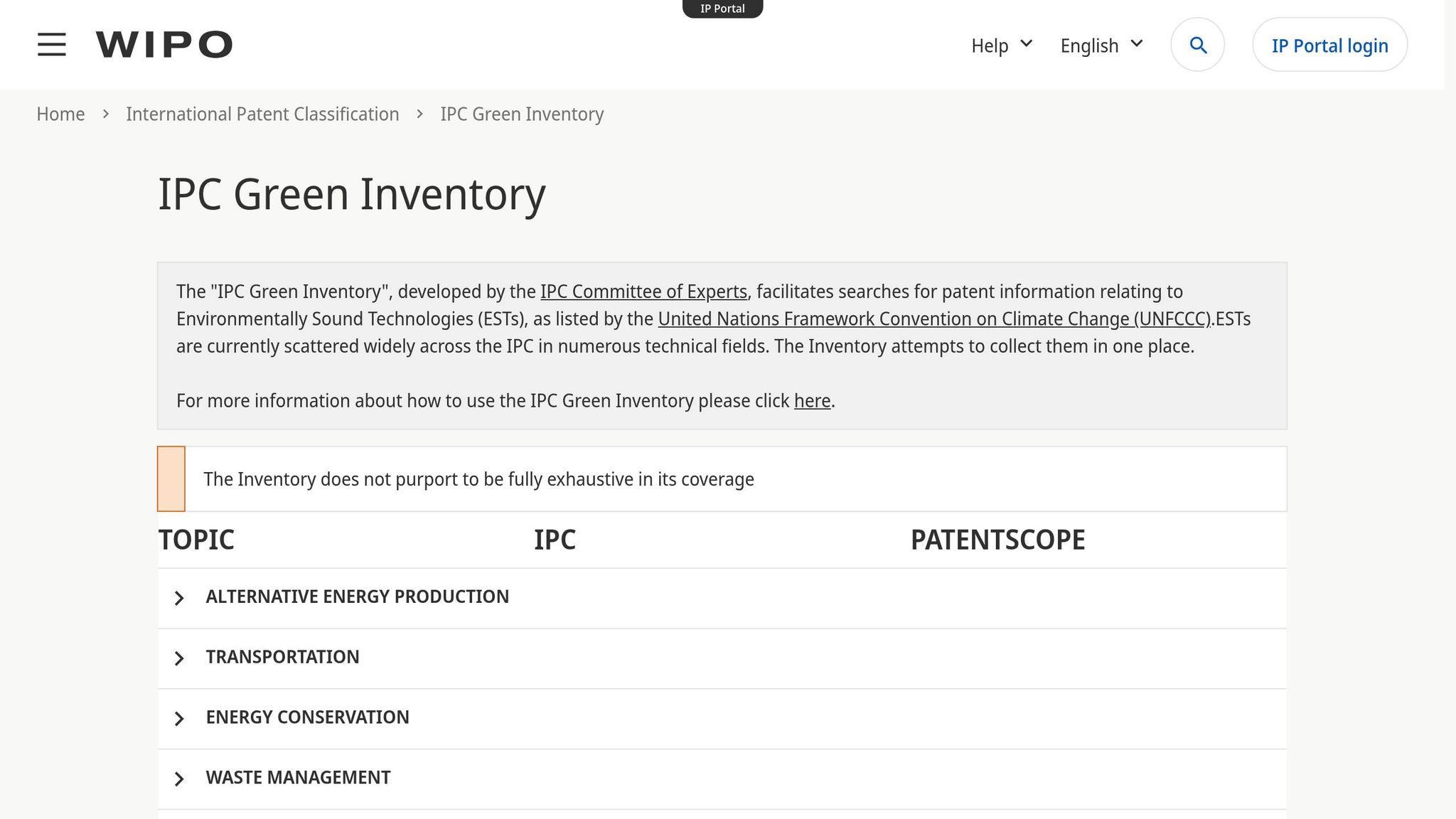
The WIPO IPC Green Inventory links green technology topics to IPC classes for search. Its main draw is breadth. It covers environmental technology beyond climate mitigation. But there’s a catch: it is not a formal standalone legal classification, so it gives you less detail for close analytics work.
The CPC Y02/Y04S scheme is a tighter tool for climate-related patent work. It was developed by expert examiners at the EPO and folded into the Cooperative Patent Classification used by both the EPO and USPTO. It tags patents across areas such as energy, greenhouse gas capture, buildings, industry, including agriculture, transport, waste, and wastewater management. Y04S is a separate branch for systems that supply or distribute electric power and store electric energy.
OECD ENV-TECH serves a different purpose. It is built for statistical identification and macro-level benchmarking, not for day-to-day prosecution or claim-level tagging.
Use the comparison below to pick the framework that fits the job.
Scheme | Scope | Primary Use Case | Strengths | Limitations |
|---|---|---|---|---|
WIPO IPC Green Inventory | Environmentally Sound Technologies (ESTs) | Green technology search and general categorization (Global/WIPO) | Broad international recognition; covers environmental tech beyond climate | Less granular than CPC tags; not a formal standalone legal classification |
CPC Y02/Y04S | Climate change mitigation (Y02) and smart grids (Y04S) | Detailed tagging, technical search, portfolio analytics (EPO and USPTO) | Fully integrated into CPC; high precision; user-friendly for non-experts | Primarily focused on mitigation, not all environmental tech |
OECD ENV-TECH | Environmentally related inventions | Statistical identification, benchmarking, policy analysis (International/OECD) | Excellent for aggregate reporting and macro-trend analysis | Designed for statistics, not daily prosecution or claim-level work |
Mapping Internal Portfolio Tags to External Green Codes
Most patent teams already have internal labels, but those labels usually reflect business priorities, not technical classification logic. The practical answer is a crosswalk. Map each internal tag to the outside code family that matches the technical effect described in the claims and specification. Then document the basis for that mapping and assign a confidence level when the case sits in a gray area.
One patent family can carry both a green and a non-green classification when the technical effects are mixed. For board reporting and due diligence, it helps to show the internal tag and the outside code side by side. That gives business teams the context they want, while legal and compliance reviewers get a standard reference they can check on their own.
Crosswalks also need regular updates. Claims shift, embodiments change, and commercialization priorities move with them.
These classifications start to pull their weight when they feed into prosecution and portfolio governance, where AI tools are increasingly used to align technical claims with these standards.
Prosecution Rules: Fast-Track Programs and Drafting Standards for Green Patents
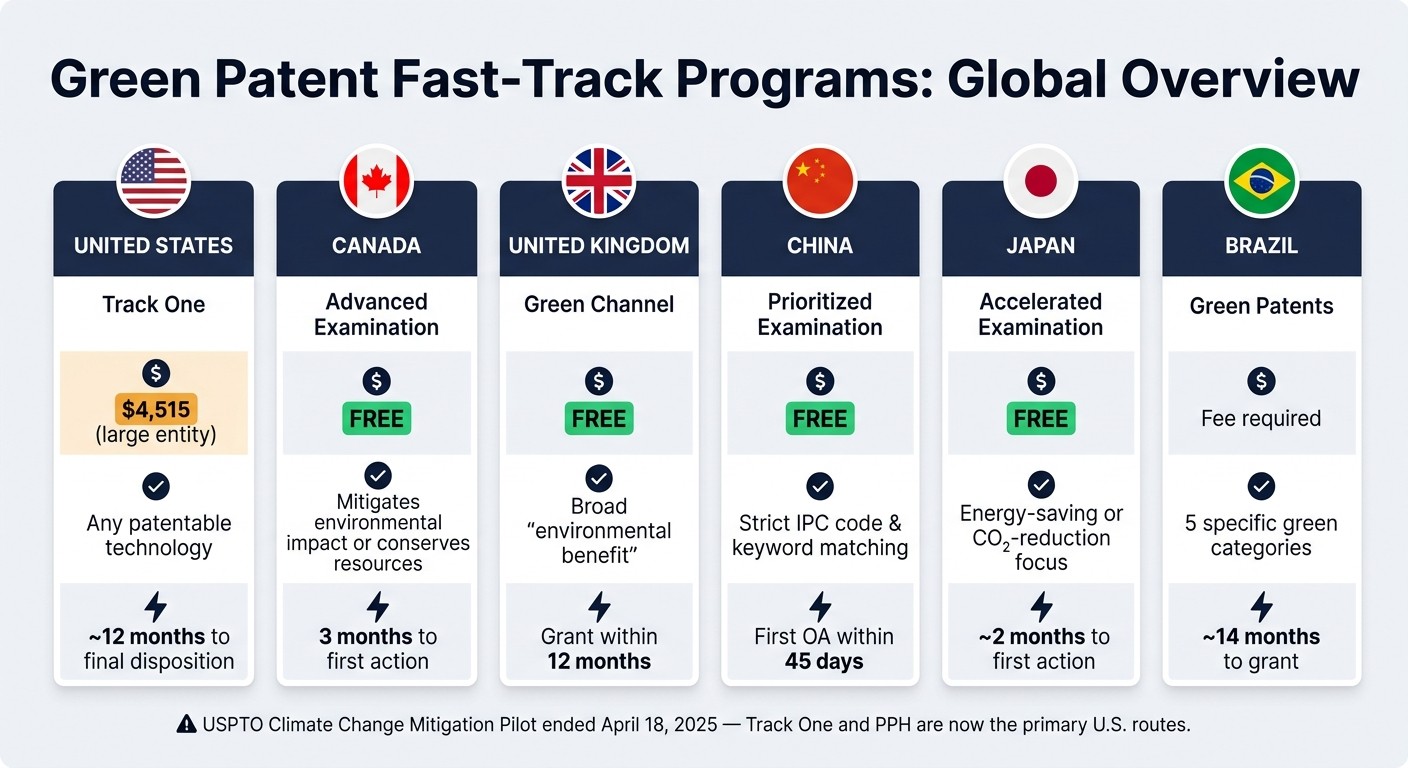
Green Patent Fast-Track Programs by Country: Cost, Speed & Eligibility
Once your portfolio is tagged and mapped, the next step is simple: how do you get green patent applications examined faster, and what rules shape that path in each country?
Eligibility Standards Across Major Patent Offices
The U.S. path changed in 2025. The USPTO ended the Climate Change Mitigation Pilot Program on April 18, 2025, and suspended environmental and energy accelerated examination on July 10, 2025. That leaves two main routes in the United States: Track One Prioritized Examination and PPH based on a qualifying foreign grant. So classification now matters even more. It helps determine which applications can move first and which foreign filings can support faster U.S. review.
Canada and the UK still offer free acceleration paths, and grants from either office may support a PPH request in the U.S. Canada’s Advanced Examination usually aims for a first office action within 3 months, while standard processing takes 14 to 24 months. The UKIPO Green Channel can lead to a granted patent within 12 months of filing, compared with a standard timeline of 3 to 6 years.
The rules are not the same everywhere. Canada and the UK use a broad test centered on lowering environmental harm or providing an environmental benefit. China’s CNIPA takes a tighter approach and requires alignment with named IPC codes under its Green Technology Patent Classification System. Japan centers its program on energy-saving or CO₂-reduction technologies. That difference matters. A filing that fits neatly in Canada may need much more careful classification work in China.
Jurisdiction | Program | Cost | Eligibility Standard | Speed |
|---|---|---|---|---|
United States | Track One | $4,515 (large entity) | Any patentable technology | ~12 months to final disposition |
Canada | Advanced Examination | Free | Mitigates environmental impact or conserves resources | 3 months to first action |
United Kingdom | Green Channel | Free | Broad "environmental benefit" | Grant within 12 months |
China | Prioritized Examination | Free | Strict IPC code and keyword matching | First OA within 45 days |
Japan | Accelerated Examination | Free | Energy-saving or CO₂-reduction focus | ~2 months to first action |
Brazil | Green Patents | Fee | 5 specific green categories | ~14 months to grant |
Process Requirements and Common Prosecution Pitfalls
Every fast-track program comes with its own fine print. In Canada, the request for Advanced Examination must use this exact language: "the commercialization of which would help to resolve or mitigate environmental impacts or conserve the natural environment and natural resources". CIPO will usually accept the request when that wording appears as required.
Small mistakes can knock an application out of the fast lane. In Canada, if you ask for an extension of time to respond to an office action, the application loses Advanced Examination status and goes back to the regular queue. In China, voluntary amendments filed after the initial request can push the case out of the expedited path, and some response periods are tight - as short as 15 days for utility models.
Speed does not lower the drafting bar. A green application still needs solid patent substance, and the environmental upside has to be framed as a technical effect. That is where many cases stumble. The environmental benefit may be easy to explain, but inventive step can still be hard to prove if the technical effect feels thin. Put plainly, saying an invention is "better for the planet" is not enough. The claims and specification need to connect that benefit to a specific technical improvement.
Early publication also plays a part in Canada and the UK. In Canada, a patent cannot be granted until the application has been open to public inspection for at least 3 months. In the UK, you need to request accelerated publication along with search and examination if you want the shorter path to grant. When drafting, the safest move is to show how the invention improves performance, efficiency, control, materials use, or emissions - not just that it supports a green goal.
ESG, Sustainability Regulation, and Portfolio-Level Compliance
Patent records now feed ESG compliance. So patent classification isn't just portfolio cleanup anymore. It has become part of compliance.
Disclosure Rules, ESG Reporting, and the EU Taxonomy Effect
For global companies, the EU Taxonomy, CSRD, and CSDDD turn patent portfolios into reporting evidence. Teams need to show which assets support aligned revenue and how owned or licensed technology is reviewed for environmental impact. CSDDD adds supply-chain due diligence duties. It applies to companies with more than 5,000 employees and more than €1.5 billion in revenue, and it covers environmental impacts tied to licensed or owned technology.
In plain terms, patents tied to sustainability claims can carry real reporting weight. If a business unit says revenue is taxonomy-aligned, the technology behind that claim needs to stand up to review. Patent teams are now being asked to map assets to EU Taxonomy criteria not only for internal planning, but also for third-party verifiers and regulators.
Those same records also shape how investors read the portfolio. Clear disclosure of green patents can improve investor valuation and stakeholder trust.
Greenwashing risk is climbing. EmpCo bans vague claims like "eco-friendly" and "climate-neutral" unless backed by recognized environmental performance. That puts pressure on patent teams too. If they're drafting claims or backing marketing language, the technical record needs to support the sustainability story the company is putting into the market.
ISO 14001 and Building a Compliance-Ready Patent Portfolio
ISO 14001 can extend environmental controls to the patent lifecycle, from invention disclosure to renewal. A practical step is to set up a cross-functional IP committee with people from R&D, legal, and sustainability. This group can review new disclosures against ESG commitments before filing decisions are made, flag patents tied to outdated or environmentally harmful technologies at renewal, and support pruning assets that bring reputational risk even if they remain legally valid.
The table below shows how each framework pulls on a different part of the patent lifecycle:
Framework / Standard | R&D/Filing | Retention | Reporting Duty |
|---|---|---|---|
EU Taxonomy | Shapes investment toward aligned technology areas | Supports retention of assets tied to sustainable activities | Map assets to EU Taxonomy criteria |
CSRD (ESRS) | Links patent activity to sustainability reporting | Flags assets that support long-term sustainability goals | Report how IP supports risk mitigation |
CSDDD | Requires due diligence on environmental impacts across the value chain | Identifies adverse impacts linked to licensed or owned technology | Document environmental impact of licensed assets |
ISO 14001 (EMS) | Integrates environmental criteria into invention review | Tracks portfolio performance against EMS targets | Records of invention reviews; R&D environmental impact |
Documentation is the control point. Lifecycle assessments, third-party validation, and clear notes on why assets were selected are what separate a green portfolio that can be defended from one that creates liability. Build that paper trail from the start, not after a regulator or investor comes knocking.
Those controls only work if the underlying patent data is clean, current, and searchable.
Analytics, Governance, and Tools for Green IP Management
Once teams pick their standards and set filing rules, the next job is control. That means tracking what was filed, checking that classifications hold up, and reporting the same way every time.
After classification, prosecution, and reporting rules are in place, teams need one system to monitor all of it.
Classification-Based Analytics and Green Compliance Dashboards
Once assets are classified, dashboards turn those tags into portfolio decisions.
A strong dashboard pulls together classification, status, geography, citation, and ESG data.
Dashboard dimension | What to track | Why it matters |
|---|---|---|
Classification tags | CPC Y02/Y04S, WIPO IPC Green Inventory, OECD ENV-TECH | Feeds reporting, review, and renewal decisions |
Citation metrics | Forward and backward citations, citation network position | Checks technical influence and surfaces high-value green assets |
Filing status | Active, pending, granted, lapsed, abandoned | Supports renewal, risk, and compliance decisions |
Geography | Jurisdictions filed, granted, family coverage | Shows where green assets are protected and where gaps exist |
ESG relevance | SDG mapping, carbon-reduction relevance, environmental theme | Connects patents to sustainability reporting and disclosure |
Review status | Human review, confidence score, audit trail | Cuts greenwashing risk and strengthens defensibility |
Business value | Licensing potential, unfiled opportunities, competitor overlap | Turns sustainability analytics into strategy insights |
It also helps to split direct green inventions from enabling technologies. They may sit in the same portfolio, but they don't serve the same reporting or review purpose.
If AI helps with tagging, people still need to check borderline cases. Those reviews should include sign-off and a clear audit trail.
That kind of workflow works best when drafting, search, and data management live in one place.
Using Patently to Manage Green Drafting, Search, Projects, and SEP Analysis
Patently supports the end-to-end green IP workflow that many teams are still trying to piece together across separate tools.
For drafting, Patently's AI assistant, Onardo, helps patent professionals build technically grounded claims from the start. That matters because green claims still need technical support.
For search, Patently's Vector AI semantic search helps teams find related patents and connect invention disclosures to green classifications. In plain English, it helps answer a simple but high-stakes question: Does this idea overlap with an existing technology family?
Patently also gives teams project management and fee tracking tools to organize green patent work with custom fields, access controls, and shared workflows across IP, R&D, and sustainability teams. If a team runs quarterly portfolio reviews or handles filings across many jurisdictions, that setup creates a traceable process instead of a patchwork of spreadsheets and emails.
Once that data layer is set up, the operating model becomes repeatable, allowing teams to capitalize on sustainable patent trends as they emerge.
Conclusion: A Working Model for Patent Teams Under Emerging Green Standards
A working model has five connected parts.
Invention intake starts with a standard disclosure form that captures the technical summary, environmental benefit, target markets, likely classifications, and disclosure risks.
Filing strategy uses recognized classification schemes - CPC Y02/Y04S, WIPO IPC Green Inventory, and OECD ENV-TECH - with claims backed by technical evidence from day one.
Portfolio review runs quarterly and scores assets for green relevance, technical support, FTO exposure, jurisdictional coverage, and business value.
Reporting relies on dashboard-driven, auditable data that separates regulatory views, ESG views, and business views.
Cross-functional ownership sets clear decision rights across IP, R&D, sustainability, and finance, with stage-gated signoff at each control point.
The governance table below shows who usually owns each part:
Governance area | Suggested owner(s) | Typical approval criteria |
|---|---|---|
Invention intake | R&D + IP | Technical description, novelty, supporting data, green relevance |
Green classification | IP + sustainability | CPC Y02/Y04S, IPC Green Inventory, OECD ENV-TECH alignment |
Patent filing decision | IP + R&D + finance | Patentability, evidence strength, budget, market/jurisdiction priority |
ESG/reporting review | Sustainability + IP | Climate/SDG linkage, disclosure relevance, audit trail |
Portfolio renewal/pruning | IP + finance + sustainability | Maintenance cost, strategic value, ESG value, use/licensing potential |
Licensing strategy | IP + business + sustainability + finance | Access goals, value capture, impact terms, risk allocation |
Document, tag, and validate before disclosure. Clean data, clear roles, and auditable workflows make green compliance easier to scale.
FAQs
How do I choose between WIPO, CPC Y02/Y04S, and OECD tags?
Choose the system that fits your research goal and the region you care about. Y02/Y04S is often the best fit when you need more detail on climate change mitigation and smart grid technologies. OECD tags work well for broad reviews of green tech and for looking at innovation across countries.
WIPO, including the Green Inventory, is often the go-to for international comparisons and for linking technologies to broader sustainability outcomes. In practice, many teams use more than one system to get better coverage.
What should I document to support green claims in audits?
Document patent evidence in a way that an auditor can trace from IP asset to measured outcome.
For each patent, link the invention to specific ESG metrics and relevant UN SDGs. Skip broad statements. Instead, show exactly what changed, how it was measured, and what proof supports the claim.
A simple record for each patent should cover:
Patent details: patent number, title, filing date, grant date, jurisdictions, and current status
Use case: the product, process, or system where the patent is deployed
ESG metrics: direct metrics such as Scope 1, 2, or 3 emissions avoided, energy use per unit, water use, waste diverted, recycled input rate, injury rate, or governance controls tied to the patented method
UN SDGs: map each patent to the SDGs it supports, such as SDG 7, SDG 9, SDG 12, or SDG 13
Impact evidence: lifecycle assessments, engineering studies, pilot data, customer deployment records, or third-party assurance
Methodology: system boundaries, baseline scenario, assumptions, emission factors, allocation method, and time period used for the calculation
Business data: deployment volume, active customers, units sold, licensed revenue, and market geography
Environmental claims need hard numbers. If a patented process cuts energy use by 18% per unit, show the baseline, the post-deployment result, the sample size, and who checked it. If a material patent lowers carbon output, include projected or measured tCO2e reduction, the LCA scope, and whether the study was reviewed by an outside party.
Keep the chain of proof clean: patent -> application -> measured change -> calculation method -> source document.
For environmental impact data, track items like:
Carbon: projected or measured emissions reduction in tCO2e
Energy: kWh saved per unit, per site, or per year
Water: gallons reduced per process cycle or annual use
Materials: pounds of virgin material avoided, recycled content used, scrap reduction, or yield gain
Waste: landfill diversion, hazardous waste avoided, or reuse rate
Make each figure audit-ready by attaching the source and method. That means noting whether the number came from an ISO-aligned LCA, a third-party lab test, a customer field trial, or an internal model. If the result is projected rather than measured, label it clearly.
A practical tracking table can look like this:
Patent | Deployed In | ESG Metric | UN SDG | Measured Outcome | Validation | Methodology | Revenue / Deployment |
|---|---|---|---|---|---|---|---|
US Patent [Number] | [Product or process] | Scope 3 emissions avoided | SDG 12, SDG 13 | [X] tCO2e avoided per year | Third-party LCA | Cradle-to-gate baseline vs. patented design; emission factors from [source] | $[X] revenue; [X] customer sites |
US Patent [Number] | [Manufacturing method] | Energy use per unit | SDG 7, SDG 9 | [X]% lower kWh per unit | Independent engineering review | Pre/post deployment meter data over [time period] | [X] plants deployed |
US Patent [Number] | [Material innovation] | Virgin material reduction | SDG 12 | [X] lbs avoided annually | Supplier certification + internal QA | Bill-of-material comparison across [X] units sold | $[X] licensed revenue |
This kind of structure does two jobs at once. It shows the patent has business value, and it shows the claim can stand up to review.
For transparency, store the backup files with each record: LCA reports, validation letters, metered data, sales records, licensing reports, and calculation worksheets. Also note version history, review date, document owner, and any limits in the data. That way, if someone asks how a number was produced six months later, the answer is already there on paper.
How do I choose between Track One, PPH, and foreign fast-track options?
Base the choice on your budget, timeline, and jurisdictional plan. Since the Climate Change Mitigation Pilot Program ended in 2025, the USPTO no longer has a green-tech-specific fast-track option.
Track One is now the main USPTO path for broad utility and plant applications. It aims for completion within 12 months, but the fee is steep: $4,515 for large entities and $1,806 for small entities.
PPH may also be an option if you’ve filed in another country and can rely on a foreign green-tech program for a matching U.S. application.