How AI Drafts Patents for Emerging Tech
Intellectual Property Management
Jul 5, 2026
AI speeds patent drafting but requires structured human disclosures, early semantic prior-art search, and strict human review before filing.

AI can help draft patent applications, but I would not let it run the process. The safest workflow is simple: start with a detailed human disclosure, run AI-based prior art search first, draft claims before the spec, and check every line before filing.
Here’s the short version:
AI helps with first drafts, claim options, support text, and consistency checks.
People still make the legal calls on inventorship, claim scope, §101, §112, novelty, and filing choices.
Search matters early: semantic search can improve prior-art recall by 30% to 40%, and for AI inventions, 80% to 90% of relevant art may sit in Chinese-language filings.
Bad input leads to bad drafts: vague disclosures often lead to weak support and filing risk.
Records matter: keep logs of prompts, outputs, edits, and human review because AI use may need to be disclosed to the USPTO.
If I were setting up an AI-assisted patent drafting workflow, I’d keep it human-led and task-based. I’d use AI to sort disclosures, suggest claim sets at different scope levels, and flag support or wording issues. Then I’d verify every citation, technical statement, and claim element against the source record.
A few domain risks stand out:
Software/AI: watch §101 and tie claims to a technical effect
Biotech/chemistry: watch enablement, especially after Amgen v. Sanofi
Hardware/semiconductors: focus on structure, ranges, and fabrication detail
Quantum: explain hard concepts in plain English and support them with figures
Area | Main thing AI can do | Main thing I would still review by hand |
|---|---|---|
Prior art | Semantic search and citation mapping | Relevance, novelty, and claim-positioning calls |
Claims | Draft broad, mid, and narrow versions | Scope, wording, and legal risk |
Specification | Turn disclosure into draft support text | Enablement, consistency, and support for each claim |
Final review | Flag missing basis, term mismatch, and weak spots | Filing readiness and disclosure duties |
The bottom line: AI can cut drafting time, but only if the disclosure is structured and the review process is strict.
AI-Powered Patent Claim Drafting. My New Workflow.
Prepare an AI-ready invention disclosure
AI output rises or falls based on the disclosure you feed it. If the disclosure is vague, the draft will usually be vague too, with thin support and weak claims. This part matters because it shapes everything that comes after.
Start with human conception and technical detail
Before any drafting starts, a human inventor or the attorney working with them should spell out the problem being solved, the core solution, how it works, and the specific advantages it delivers.
"Patent drafting is not a text-generation problem. It is an invention-understanding problem." - Tabrez Alam, Founder, eety.ai
Include the technical problem, the main components, how those components interact, and the key parameters. Thin disclosures invite generic assumptions and can create enablement risk.
Structure the disclosure for better AI outputs
AI tends to perform better when the disclosure follows a clear structure:
Disclosure Component | What to Include |
|---|---|
Technical Field | The specific field the invention belongs to |
Prior Art Problems | Specific deficiencies in existing methods, such as where Method X lacks Y |
Core Solution | Detailed enough to describe the components, interactions, and key parameters |
Technical Effects | Measurable improvements, ideally backed by data |
Embodiments | At least two distinct configurations that map to all independent claim features |
Use headings, bullet points, and consistent terminology throughout. That makes the disclosure easier for AI to parse without filling gaps on its own. Put simply, good structure gives the model enough context to review prior art and draft claims with less guesswork. This process is further streamlined by AI-enabled patent analysis tools that shorten cycle times for novelty and validity projects.
Document inventorship and AI involvement
The USPTO's November 2025 revised inventorship guidance says practitioners must disclose any AI-assisted drafting steps so the record matches the final application. Keep dated disclosure forms, inventor interview logs, and version histories that show human review. In plain English: keep a paper trail.
"AI serves as an enhancement rather than a replacement for human expertise. Attorneys must review every AI-generated element for clarity, precision, and legal sufficiency before submission." - GIP Research
With the disclosure in place, the next step is semantic prior art review and claim drafting.
Use AI in the patent drafting workflow step by step
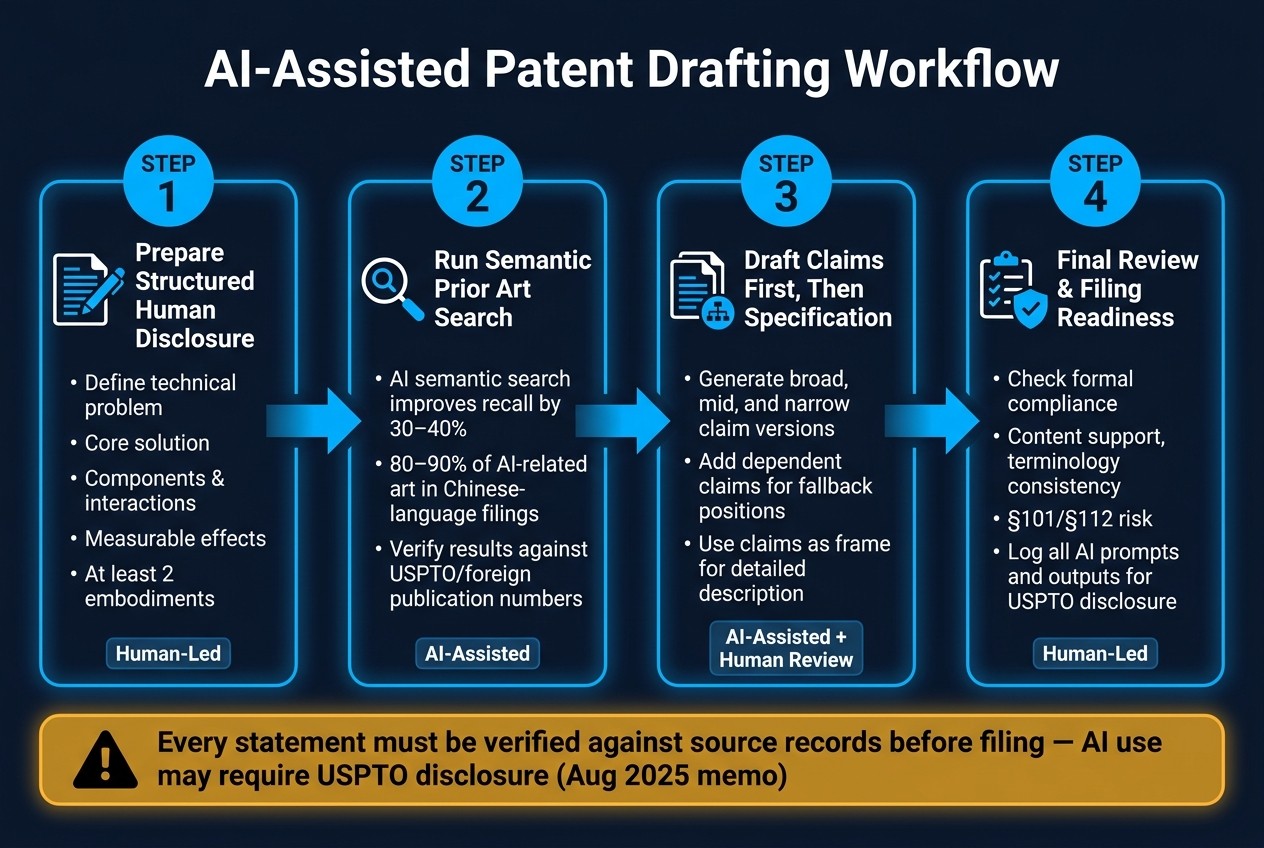
AI-Assisted Patent Drafting Workflow: Step-by-Step Guide
Use the structured disclosure as the engine for drafting. The trick is simple: break the job into small tasks instead of asking AI to write the full application in one go. Section-by-section prompting tends to give better output than a single big prompt.
Run semantic prior art review before drafting claims
Before you write a single claim, get a clear view of what already exists. AI-supported semantic search can help surface related patents before drafting starts.
That matters because those results shape your novelty and non-obviousness plan. If the prior art is crowded in one lane, you can shift claim scope early instead of dealing with that problem after a rejection. Semantic search and citation tracing tools can help teams map the prior art landscape with less manual effort. Then use those results to set claim scope before you expand the specification.
Verify search results against USPTO or foreign publication numbers.
Draft claims first, then build out the specification
Once the search map is clear, start with the independent claims. Ask AI for multiple versions at broad, medium, and narrow scope. Then add dependent claims for key variants and fallback positions.
After that, use the claims as the frame for the detailed description. AI can produce an initial claim set from the structured disclosure, and then an attorney can refine it.
Review for support, consistency, and filing readiness
After the claims and specification are drafted, run a final quality pass. Focus on four checks:
formal compliance
content support
terminology consistency
§101/§112 risk
These are the spots where weak support and inconsistent wording often lead to rejections. It also helps to run a second AI pass to flag weak scope, missing antecedent basis, and eligibility issues before human review.
Address domain-specific and governance issues
Adjust drafting approach by technology domain
Once the draft is structurally sound, shape it around the technology at issue and the filing risks that come with it. Different domains change claim scope, support, and exposure in very different ways.
Software and AI: Draft claims around a technical improvement, not just an abstract task. In independent claims, stay away from vague, high-level verbs. Tie the claim to a concrete technical effect to help cut §101 abstract-idea risk.
Biotech and chemistry: After Amgen v. Sanofi, genus claims face strict enablement review. Build in multiple concrete embodiments, along with step-by-step mechanisms, to show concrete support for the invention.
Hardware and semiconductors: Put the focus on structural novelty, exact parameter ranges, and fabrication details.
Quantum: Explain entanglement, quantum states, and related concepts in plain language, and pair that explanation with diagrams.
Manage hallucination, confidentiality, and legal risk
After the claim plan fits the domain, the next step is tightening the workflow so bad output doesn't slip into the record.
AI output can include made-up citations, unsupported technical points, or summaries that sound sure of themselves but don't trace back to the disclosure. That's the danger: the text can look polished while still being wrong. Every reference, technical statement, and cited figure needs to be checked against the source material before filing.
Confidentiality matters just as much. Set internal rules that bar unauthorized AI-enabled patent platforms from handling sensitive invention disclosures. For sensitive R&D data, use enterprise-grade environments with security standards such as ISO 27001 or SOC 2 certification.
You also need a paper trail. Track AI use in the file history, and keep prompt, output, and review logs. As Hayat Amin, CEO of Beyond Elevation, warned:
"Eighty percent of founders using AI to draft patents have no idea they owe the USPTO a disclosure obligation. The ones who find out during due diligence lose the patent and the deal."
Keep prompts and outputs in a secure log repository. Use version control to show which sections were AI-generated and which were human-authored. If inventorship or confidentiality comes under attack later, that record can make or break the response.
Domain-specific drafting risks: a comparison
The table below shows how AI shifts the drafting workflow by domain. This isn't a repeat of the earlier speed-and-cost comparison. It's about where things can go sideways and what reviewers need to watch.
Technology Domain | Primary Claim Risk | AI Drafting Focus | Key Review Burden |
|---|---|---|---|
Software and AI | Abstract-idea rejection (§101) | Tie claims to concrete technical effect | §101 eligibility check on every independent claim |
Biotech and chemistry | Enablement failure post-Amgen | Multiple concrete embodiments; stepwise mechanisms | Verify genus claim support against each embodiment |
Hardware and semiconductors | Structural vagueness | Precise parameter ranges; fabrication detail | Cross-check spec parameters against claim language |
Quantum | Examiner comprehension gaps | Plain-language descriptions plus diagrams | Confirm technical accuracy of analogies and figures |
Conclusion: Build a human-led AI drafting process
Even after disclosure, prior art review, and drafting, the model that works best is still human-led.
AI takes routine drafting off attorneys' plates. That frees them up to focus on the parts that matter most: claim scope, eligibility, and filing strategy. Put simply, AI can handle repetitive drafting and consistency checks, while attorneys handle claim scope, eligibility, and prior-art judgment.
In day-to-day use, the process comes down to four steps:
Start with a structured human disclosure
Run semantic prior art search first
Draft independent claims before the specification
Verify every statement against the source record
That last step is not optional. The USPTO's August 2025 memorandum requires disclosure of material AI contributions, and version control is one practical way to support that process.
Patently supports this workflow with AI-assisted drafting, semantic search, project management, and SEP analytics.
Keep the human in the lead, give the process structure, and the speed gains tend to follow.
FAQs
Can AI draft a patent without a lawyer?
No. AI can help draft patent claims, specifications, and drawings, but it can't replace a lawyer.
Patent applications are complex legal documents, and they need a professional eye. The smarter approach is a hybrid one: AI handles repetitive work and early drafts, while an experienced patent attorney sets the legal direction, checks technical accuracy, and does the final review.
What should be included in an AI-ready invention disclosure?
An AI-ready invention disclosure needs to be well structured, detailed, and technically precise. The goal is simple: give the AI enough depth and context to understand what the invention does, how it works, and how it differs from what already exists.
Start with a clear title. Then define the technical field so the subject area is obvious from the start. After that, explain the problem being addressed and point out the gaps in current methods or prior art. This part matters a lot. If you skip it, the invention can sound like just another idea in a crowded space.
From there, describe the solution in technical terms. That includes the main components, how those components interact, the key parameters that affect performance, and the different ways the invention can be put into practice. In plain English: don’t just say what it is - show how it works.
The disclosure should also include at least 500 words of technical detail. That level of depth gives enough material for analysis, drafting, and comparison. Short writeups usually miss the small but important parts that make an invention stand apart.
Visual material should be part of the package too, such as:
Flowcharts
Diagrams
Process flows
These help map the system or method in a way text alone often can’t. If a process has multiple stages, decision points, or feedback loops, a visual layout can make the logic much easier to follow.
It’s also important to compare the invention with the closest prior art. This comparison should spell out the technical differences, not just broad claims. For example, if an older system uses a static rules engine and the new invention uses a parameter-driven model that changes output based on live input conditions, say that clearly. That’s where the invention’s distinct edge becomes easier to see.
A strong disclosure, then, covers:
Title
Technical field
Problem addressed
Weak points in prior art or current methods
Technical description of the solution
Core parts and their interactions
Key parameters
Implementation scenarios
At least 500 words of technical detail
Flowcharts, diagrams, or process flows
Comparison against the closest prior art
That kind of writeup gives a patent team, reviewer, or drafting system something solid to work with. It turns a rough concept into a technical record that can actually support patent drafting and review.
How do I reduce AI patent drafting risks?
Maintain human oversight so the work stays legally sound and compliant. Give the system strong, well-structured inputs: detailed technical explanations, clear problem-solution statements, and any prior art that matters.
Use tools with consistency checks to review claim hierarchy, terminology, and antecedent basis. Keep sensitive information protected with secure, enterprise-grade platforms. And always compare AI-generated output with your original disclosure and patent requirements before moving ahead.