WIPO ADR for FRAND Disputes: Overview
Intellectual Property Management
Jul 6, 2026
Compare WIPO ADR options for FRAND disputes—mediation, arbitration, expedited arbitration, expert determination—and key submission and prep tips.

If SEP licensing talks fail, WIPO ADR can put a global FRAND fight into one private process instead of many court cases.
If I were sizing this up, I’d focus on four things right away (and perhaps use top patent tools to organize the data):
What WIPO offers: mediation, arbitration, expedited arbitration, and expert determination
What it can decide: royalty rates, portfolio scope, geography, and whether parties acted like willing licensors or licensees
Why teams use it: one forum, private process, more control over timing, and awards enforceable in 160+ countries under the New York Convention
What matters most at the start: a clear submission agreement, defined patent scope, chosen jurisdictions, seat, governing law, and case sequence
Here’s the short version:
Mediation fits settlement talks
Arbitration fits binding global FRAND rate disputes
Expedited arbitration fits time-sensitive disputes, often with a 6 to 9 month path
Expert determination fits one narrow issue, like a royalty input or whether a patent maps to a standard
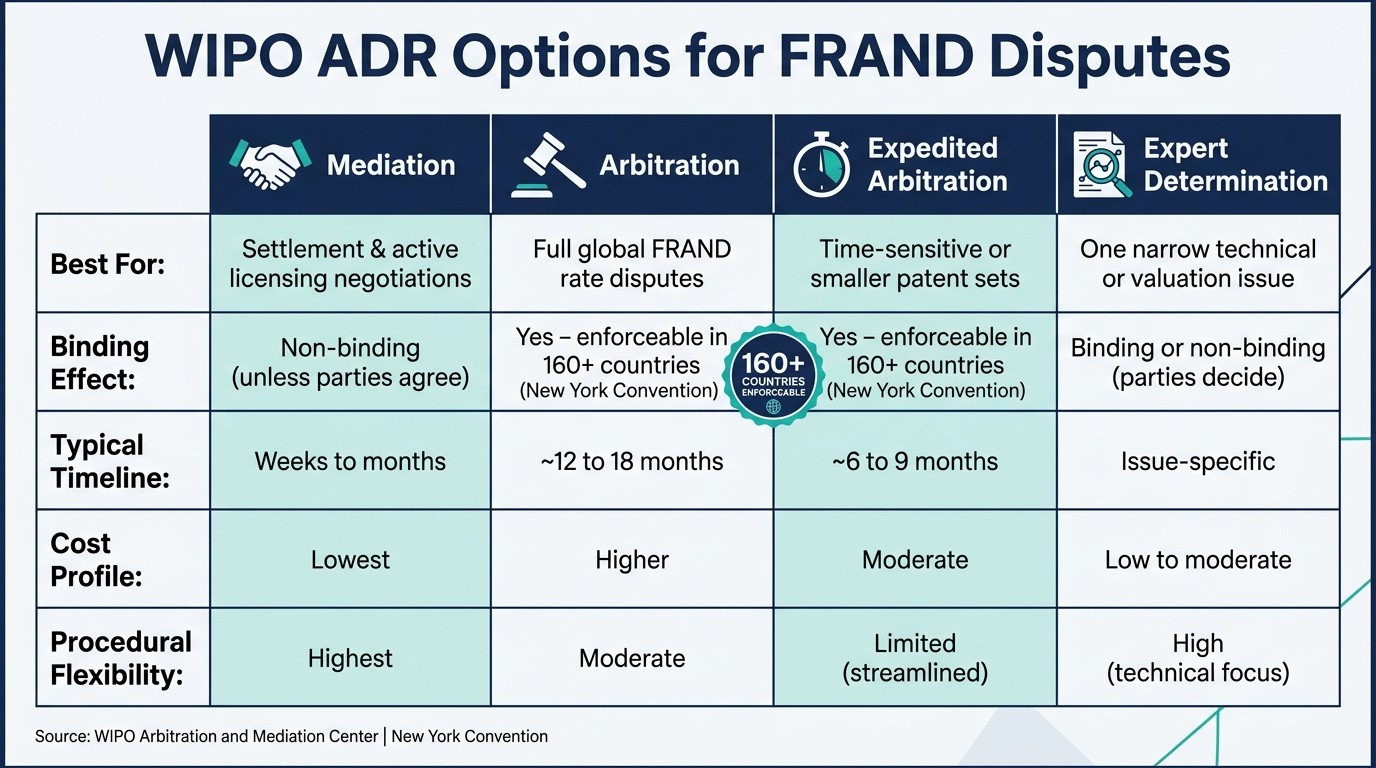
WIPO ADR Options for FRAND Disputes: Quick Comparison Guide
WIPO ADR for SEP and Patent Licensing Disputes
Quick Comparison
Option | Best for | Binding? | Typical timing |
|---|---|---|---|
Mediation | Settlement | No, unless parties agree | Weeks to months |
Arbitration | Full FRAND dispute | Yes | About 12 to 18 months |
Expedited Arbitration | Smaller or urgent disputes | Yes | About 6 to 9 months |
Expert Determination | One technical or valuation issue | Only if parties say so | Issue-specific |
For U.S. IP and licensing teams, the main takeaway is simple: WIPO ADR works best when I walk in with a tight record - claim charts, portfolio analysis, royalty support, and a clean process design from day one.
FRAND Licensing and SEP Disputes: Background
What FRAND Commitments Mean in Standards
A standard-essential patent (SEP) is a patent you have to use to implement a standard like 5G, Wi‑Fi, or video compression. If you want to build a product that follows that standard, you may need that patent.
When companies put their technology into a standard, the standard-setting organization (SSO) - such as ETSI - usually requires a promise: they must license those SEPs on FRAND terms: fair, reasonable, and non-discriminatory. The idea is pretty simple. Patent owners should get paid for their R&D work. At the same time, implementers should be able to access the technology needed to make interoperable products.
That balance sounds clean on paper. In practice, disputes keep coming up for the same reasons.
Common Issues in SEP and FRAND Conflicts
Most SEP and FRAND fights revolve around a small set of repeat issues.
Royalty valuation sits at the center of most disputes. What royalty rate counts as FRAND? That often means digging into comparable licenses and looking at aggregate royalty caps.
Essentiality is another common battleground. An asserted SEP may turn out not to be essential after all. When that happens, the whole licensing discussion can change shape.
Portfolio scope and geography add more friction. Parties may disagree on which patents are part of the deal, which product categories fall under the license, and whether the license should be global or limited to certain regions.
Then there's negotiation conduct. FRAND duties don't just cover the end result. They also touch how both sides act along the way. Courts and tribunals often look at whether the parties behaved like willing licensors and willing licensees. If one side stalls, makes unreasonable offers, or refuses to take part in good-faith talks, that conduct can become part of the dispute itself.
Why Court Litigation Falls Short for FRAND Disputes
FRAND disputes don't fit neatly into court litigation. They often stretch across several jurisdictions, and they usually call for people who understand rate-setting in the SEP context. There's also the confidentiality problem. Court cases are mostly public, so sensitive royalty data and licensing terms can end up exposed.
The comparison below shows the gap more clearly.
Feature | Court Litigation | WIPO ADR |
|---|---|---|
Time to Resolution | Often years; subject to parallel proceedings in multiple jurisdictions | Streamlined; parties can set specific timelines for a final award |
Cost Predictability | High and unpredictable due to multi-jurisdictional legal fees | More predictable; a single forum reduces redundant legal costs |
SEP/FRAND Expertise | Generalist judges; varies by jurisdiction | Parties can select specialized neutrals with technical and FRAND experience |
Confidentiality | Public proceedings; sensitive licensing terms may be exposed | Strictly confidential process and outcome |
Procedural Flexibility | Rigid; governed by local rules of civil procedure | Highly flexible; procedures can be tailored to the specific portfolio |
Geographic Scope | Usually limited to national borders | Can resolve global portfolio disputes in a single proceeding |
Those limits are a big reason WIPO ADR is often the more practical forum for global FRAND disputes.
WIPO Arbitration and Mediation Center: Role in FRAND Disputes
The WIPO Arbitration and Mediation Center gives parties a neutral, confidential place to handle cross-border FRAND disputes. Because WIPO is a UN agency, it can serve as one international venue for setting global FRAND terms. That matters when a dispute stretches across several countries. From there, the key choice is procedural: mediation, arbitration, expedited arbitration, or expert determination.
What the WIPO Center Does
The Center administers four types of proceedings:
Mediation, which supports voluntary settlement
Arbitration, which leads to a binding award
Expedited arbitration, which uses a shorter timetable
Expert determination, which decides narrow technical or valuation issues
Its roster of neutrals includes specialists in telecommunications, SEPs, and FRAND rate-setting.
WIPO's Track Record in SEP and FRAND Matters
WIPO's FRAND guidance, developed with ETSI and the Munich IPDR Forum, helped establish the Center as a practical forum for standards disputes. One big reason is confidentiality. It keeps royalty data, comparable licenses, and licensing strategy out of the public record.
WIPO's SEP Strategy and Relevance for U.S. Companies
WIPO's SEP strategy through 2026 reinforces its focus on ADR for hold-up and hold-out disputes. That sharpens WIPO's role in disputes over standardized technology. For U.S. companies, WIPO's work with the USPTO also provides practical guidance for global SEP licensing disputes.
Those institutional features matter because FRAND disputes often turn on picking the right procedure for the remedy sought, the timeline, and the technical record.
WIPO ADR Options for FRAND Disputes: Mediation, Arbitration, Expedited Arbitration, and Expert Determination
Once the parties choose WIPO, the next step is picking the right procedure. That choice should follow the result you want: a settlement, a binding decision, a faster path, or a ruling on one narrow technical point. In FRAND disputes, the procedure should line up with the main issue at stake - rate, scope, essentiality, or timing. Each option does a different job, and picking the wrong one can burn both time and money.
WIPO Mediation and Arbitration for FRAND
Mediation is the most flexible path. A neutral mediator helps both sides work toward common ground, but nothing is binding unless the parties agree to terms and sign a settlement. That makes mediation a good fit for early licensing talks, especially when the business relationship still matters and neither side wants to blow things up too soon.
There’s also a practical point here: a party can file a request for mediation on its own with the WIPO Center. The Center can then invite the other side to join and help start the conversation. In plain English, mediation can open the door even when talks have stalled.
Arbitration is the binding option. A tribunal issues a final award that can be enforced in more than 160 countries under the New York Convention. For FRAND disputes, that matters a lot. It means the parties can deal with global royalty rates and related license terms in a single proceeding instead of fighting piece by piece in different places.
If the fight is narrower, or the clock is ticking, standard arbitration may not be the best fit. In those cases, expedited arbitration or expert determination often makes more sense.
Expedited Arbitration and Expert Determination
Expedited arbitration keeps the binding nature of standard arbitration but cuts down the timeline. It usually relies on one arbitrator, limited evidence, and a final award within 6 to 9 months. That can be a strong option when a product launch is getting close or when the dispute covers a small, clearly defined patent set.
Expert determination is the most targeted tool of the four. It works best for one technical or valuation issue, not the whole dispute. The parties submit a specific question - such as whether a patent is essential to a standard or how a royalty percentage should be calculated - to one independent expert.
The result is binding only if the submission agreement says it is. That gives the parties room to shape the process. In practice, expert determination often works well as a carve-out from a bigger case. Instead of reopening the entire dispute, the parties can isolate one stubborn issue and get an answer on that point alone.
Model Submission Agreements and Choosing a Procedure
The submission agreement should pin down these choices before the case begins. WIPO offers model submission agreements built for FRAND disputes. These forms help the parties set the scope, geography, governing law, language, and confidentiality at the outset. Getting those points settled early can cut down later fights over procedure.
The table below compares the four options on the factors that usually matter most in FRAND disputes:
Feature | Mediation | Arbitration | Expedited Arbitration | Expert Determination |
|---|---|---|---|---|
Binding Effect | Non-binding | Binding (New York Convention) | Binding (New York Convention) | Binding or non-binding |
Speed | Fastest (weeks to months) | Moderate (12 to 18 months) | Fast (6 to 9 months) | Fast (issue-specific) |
Cost Profile | Lowest | Higher | Moderate | Low to moderate |
Procedural Flexibility | Highest | Moderate | Limited (streamlined) | High (technical focus) |
Best-Fit Use Case | Active licensing negotiations; relationship preservation | Global FRAND rate determination; complex portfolio disputes | Time-sensitive disputes; smaller patent sets | Essentiality checks; specific royalty calculations |
How to Structure a WIPO FRAND ADR Process
After choosing a WIPO procedure, the next step is setting the scope and the case-management rules. The big drafting calls are portfolio scope, procedure sequence, and the early case-management terms.
Defining Portfolio Scope and Covered Jurisdictions
Start by defining the dispute's scope. Parties can submit:
a full global SEP portfolio
a regional or technology-specific slice
a list of specific patents-in-suit
a representative sample used for valuation
For large portfolios, a representative sample can lower proof costs on essentiality and validity. But the sample needs to be spelled out with care. It should say exactly which patents or products the sample stands for.
Covered jurisdictions should also be set at the start. Clear scope language in the submission agreement helps avoid later fights over what, exactly, the tribunal has been asked to decide. Once that scope is fixed, the next step is deciding how to handle valuation, validity, and settlement.
Hybrid Process Design and Key Procedural Choices
With scope in place, parties can decide whether to split technical issues from FRAND valuation. They can sequence mediation, arbitration, or expert determination based on the dispute's scope and how fast they need an answer. There is also a narrower option: carve out one technical issue, such as whether a patent is essential to a standard, for expert determination first, then let arbitration address the overall FRAND rate.
WIPO model submission agreements can lock in the ADR path and the procedural rules early.
Other procedural choices have a direct effect on cost and timing. Bifurcating essentiality and validity from the FRAND rate calculation can make the case easier to run. A single arbitrator with telecom standards experience may cut down on expert evidence and move things along. It also helps to specify the seat and governing law at the outset. That can limit venue fights and support later enforcement under the New York Convention.
Pros and Cons of WIPO ADR for FRAND Disputes
WIPO ADR tends to work best when the submission agreement fixes scope, sequencing, and governing law upfront. The main drafting risk is an underspecified submission agreement, because that document sets the tribunal's authority and the route to a binding outcome. In plain English, if the drafting is loose, the process can get messy fast. These choices shape cost, speed, and enforceability.
Connecting WIPO ADR to SEP Portfolio Management and Licensing Strategy
WIPO ADR is often decided long before anyone files. The hard part starts earlier: mapping the SEP portfolio, putting a sound value on it, and documenting everything in a way that can hold up under scrutiny.
Once the scope and procedure are locked in, the next job is building the record behind them.
Using SEP Analytics to Prepare for WIPO ADR
Analytics help teams rank patents and choose a representative sample. The main task here is essentiality mapping - tying specific patent claims to the relevant parts of technical standards such as 3GPP or IEEE specifications. In WIPO proceedings, that work becomes a central part of the evidentiary record.
Forward citation analysis can support arguments about portfolio strength. If patents are cited often, that may help show technical importance.
Geographic coverage matters just as much. If a licensee earns major revenue in places where the patentee has weak patent protection, that gap should show up in the royalty weighting. In plain English: the proposed rate should reflect where protection actually exists.
For valuation, teams should keep their models current so they can back up royalty proposals. That record affects both settlement leverage and the case presented in WIPO ADR.
Analytics Type | Application in WIPO ADR | Strategic Benefit |
|---|---|---|
Essentiality Mapping | Linking patent claims to standard specifications | Proves the "E" in SEP; core evidentiary requirement |
Citation Analysis | Tracking forward citations by third parties | Demonstrates technical importance and portfolio strength |
Geographic Mapping | Visualizing patent grants across jurisdictions | Ensures the global FRAND rate accounts for actual protection |
Semantic Similarity | Finding patents with similar technical disclosures | Identifies comparable portfolios for royalty benchmarking |
Remaining Patent Life | Analyzing remaining life of the SEP portfolio | Adjusts valuation based on the duration of the license |
Those inputs should feed straight into claim charts and license comparisons.
How Patently Can Support FRAND Dispute Preparation
Patently's Vector AI semantic search helps teams find patents with similar technical disclosures across large datasets. That is useful when building comparable-license arguments and when running a preliminary essentiality review before formal proceedings begin. Instead of leaning on keyword searches alone, Vector AI surfaces patents based on conceptual similarity, which can make standards-mapping work faster.
The platform's AI-assisted drafting can produce preliminary claim charts. Keeping those charts ready before a dispute starts can cut the time and cost tied to the evidentiary phase in WIPO ADR.
Patently's collaborative project management with access controls lets U.S. in-house counsel, international outside counsel, and technical experts work from one centralized workspace. Claim charts, essentiality reviews, and licensing history can all sit in the same place, which makes the record easier to manage.
Key Takeaways for U.S. IP Teams
WIPO offers several ADR mechanisms - mediation, arbitration, expedited arbitration, and expert determination - and each fits different licensing scenarios and timelines. U.S. IP teams should enter WIPO ADR with current essentiality data, clean claim charts, and valuation models they can defend. The choices made at the start - from portfolio scope to procedural format - shape both efficiency and enforceability.
FAQs
When should I choose WIPO arbitration over mediation?
Choose WIPO arbitration when you need a final, binding decision. Mediation works differently. It aims for a voluntary settlement, and the mediator can't impose an outcome on either side.
Arbitration usually narrows what the parties can later fight over in court. Mediation leaves those options open. That’s why many parties start with mediation and move to arbitration if they can’t reach a settlement.
Can WIPO ADR resolve a global FRAND rate in one case?
Yes. WIPO ADR can let parties bring global FRAND disputes into one procedure.
If they choose arbitration, they can give the tribunal authority to decide the dispute on a global basis, instead of being boxed in by the national court limits that often apply. The parties can also set the scope themselves, including the geographic reach and the SEP portfolio at issue.
What should I define in a WIPO FRAND submission agreement?
Define the dispute clearly from the start. Spell out which SEPs are part of the case, whether that means the full portfolio or only a sample set. Identify the claims and defenses in plain terms, including issues like infringement, validity, enforceability, licensing terms, and any FRAND-related disputes. You should also state the geographic reach of the dispute, since a fight over rights in the United States may look very different from one that also covers Europe, China, or other markets.
The procedural ground rules matter just as much. Set out how mediators or arbitrators will be chosen, what language the proceedings will use, and where they will take place. Name the law that will govern the process and, if needed, the law that will apply to the merits of the dispute. It also helps to deal with interim measures up front, such as whether a party can seek emergency relief, asset preservation, or injunctive support before courts or through the tribunal.
Confidentiality should not be left fuzzy. Say what materials, testimony, and rulings must stay private, who may see them, and how sensitive licensing or technical information will be handled. And be explicit about the status of the outcome: whether any award will be final and binding, whether there is any route for appeal or review, and how enforcement will work across the places covered by the dispute.