AI in ESG Risk Assessment: Key Trends
Intellectual Property Management
Jul 7, 2026
AI classifies patent ESG signals, combines patent text and news, and guides filing, licensing, and portfolio risk choices.

AI is turning patent ESG review from a slow reading exercise into a scoring system. In the research covered here, models classified some patent-related ESG signals with 99.1% accuracy for E signals and 99.3% for G signals, while S signals stayed much harder at 63.6%. At the same time, outside-text systems pulled ESG insights from news with 89% accuracy, and explainable scoring setups improved score consistency by 12.4%.
If I boil the article down, the message is simple: patent portfolios are now being judged on more than legal strength. AI helps teams sort patents by climate-transition exposure, controversy risk, disclosure quality, litigation signals, and whether a company is actually using green tech or just mentioning it. Advanced AI patent drafting tools now help ensure that technical disclosures accurately reflect these green innovations.
Here’s the short version:
Patent codes alone are noisy. One study found only about 20% of patents tagged as green by standard patent codes were true green inventions.
Patent text is the first layer. Titles, abstracts, claims, and citations help models map patents to E, S, and G themes.
Outside data is the check. News, NGO reports, court records, and filings can show trouble before company reports do.
Prediction matters. Models such as gradient boosting and Legal-BERT + XGBoost turn text signals into portfolio risk scores.
Governance matters too.SHAP, LIME, human review, language checks, and data access rules help teams trust the scores.
Big gap: there is still no shared patent-ESG taxonomy, and green patenting does not always line up with firm ESG ratings.
A quick way to think about it: AI helps answer three questions - What does this patent do? What ESG risk is tied to it? Should that change filing, licensing, maintenance, or divestment decisions?
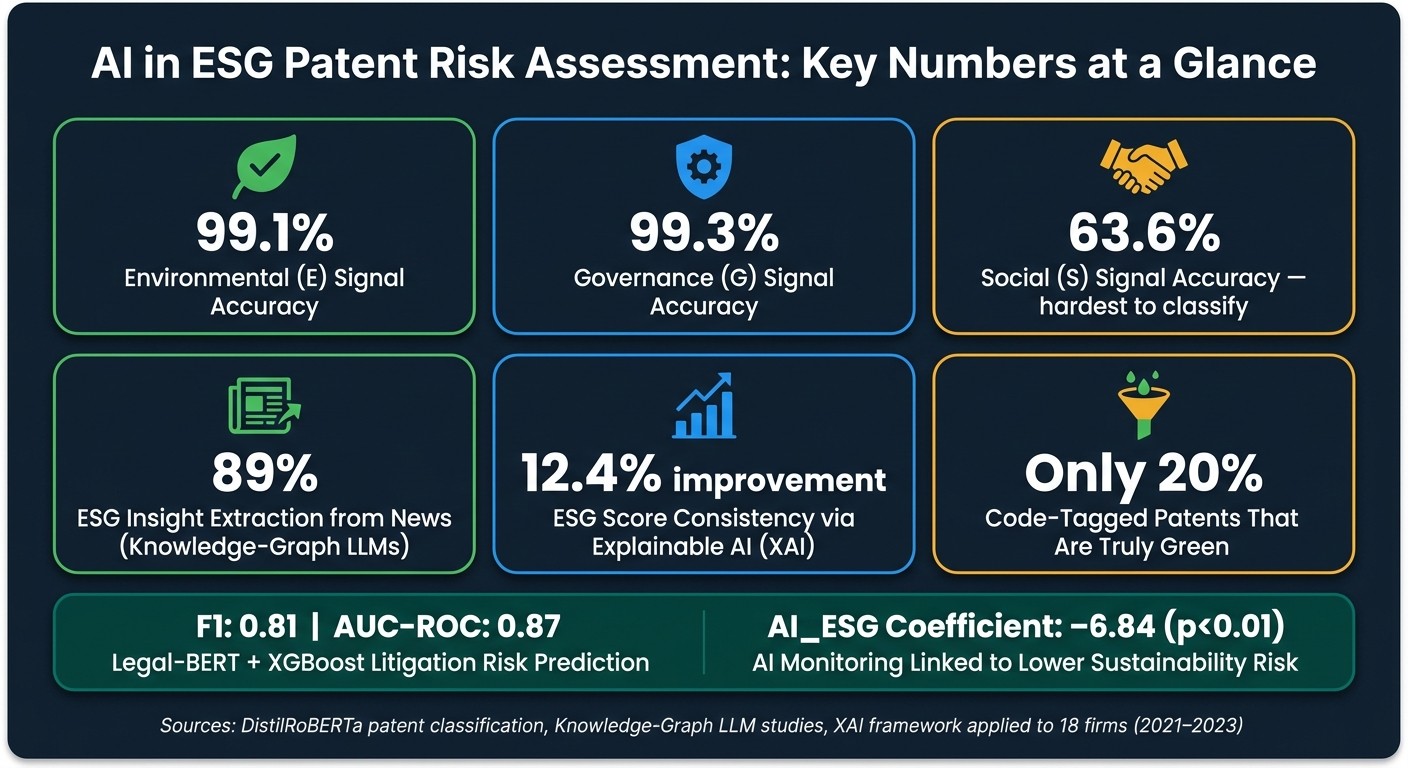
AI in ESG Patent Risk Assessment: Key Accuracy & Performance Metrics
AI-Powered ESG Intelligence | Machine Learning Project by Alyssa Assilbekova
Quick comparison
Area | What AI is doing | Key numbers |
|---|---|---|
Patent text scoring | Classifying E, S, and G themes from titles, abstracts, and other patent text | 99.1% E, 99.3% G, 63.6% S |
Green patent filtering | Sorting true green patents from broad code-based labels | Only 20% of code-tagged patents counted as true green in one study |
News and outside-text review | Reading news and NGO sources for controversy and greenwashing signals | 89% accuracy |
Firm risk monitoring | Linking AI-led ESG monitoring with lower sustainability risk | −6.84 AI_ESG coefficient (p < 0.01) |
Explainable scoring | Showing why a model gave a score | 12.4% better score consistency; 9% lower inter-sector variance |
Legal-risk prediction | Scoring court rulings and dispute-related ESG exposure | F1: 0.81, AUC-ROC: 0.87 |
So if you manage patents, license IP, or review deals, this is the shift to watch: AI is helping teams connect patent data, outside risk signals, and portfolio decisions in one workflow.
How AI Maps Patents to ESG Themes
Older systems like OECD ENV-TECH, EPO Y02, and WIPO Green Inventory still have a place. But they tend to cast the net too wide. NLP-based studies found that only about 20% of patents tagged as green under standard IPC/CPC codes actually count as true environmental inventions. That gap matters. If the label is noisy, the ESG signal is noisy too.
So the next step is simple in theory, harder in practice: figure out which patent text sources and which models give the cleanest read on ESG themes.
Patent-Based ESG Indicators and Green Innovation Signals
One approach uses Word2Vec CBOW to grow seed term lists, then screen out patents that only look green on the surface. That makes the output more useful for portfolio screening and due diligence, especially in licensing, M&A review, and ESG reporting.
Semantic Analysis of Claims, Abstracts, and Citations
Researchers often start with titles and abstracts. That makes sense. They give a fast read on what the patent is about before anyone digs into the full document.
Fine-tuned DistilRoBERTa models have posted accuracy rates of 99.1% for environmental indicators and 99.3% for governance indicators. Social indicators are a lot tougher. Accuracy drops to 63.6%, which lines up with the messier, more qualitative nature of social disclosures.
Large language models add another layer. They can pull out a patent's function, the problem it solves, and where it is used, then connect that to ESG outcomes. Models such as Qwen2.5-72B can tell the difference between technology that is actually used in a company's workflows and technology that shows up only as a general reference in a sustainability report. That's a big deal. It separates real deployment from ESG talk.
For teams that need score transparency, SHAP helps show which patent features are pushing a given ESG score up or down. In plain English, it creates a trail that regulators and investors can review.
Patent text gives the first signal. External data then sharpens it.
Using AI Tools in Patent Workflows
In day-to-day patent work, this kind of analysis fits right into search and review. Patently's Vector AI semantic search helps teams find ESG-relevant patents by meaning, not just by keyword.
NLP and Alternative Data for ESG Risk Signals
Patent text tells you what a company says it built. External text shows whether that work is tied to actual ESG exposure. That’s why researchers are looking past the usual review cycle and into sources that often surface trouble sooner: news, NGO publications, court records, and regulatory filings. In practice, this outside data works as a reality check. It helps test whether portfolio labels line up with how a company operates.
From Sustainability Reports to News and NGO Sources
There’s a basic problem with sustainability reports: companies write them themselves. So disclosure bias is hard to ignore. Recent research tries to deal with that by combining self-reported data with outside signals like news coverage, NGO reports, and media sentiment to flag greenwashing earlier.
This is where newer AI-enabled patent platforms start to matter. Knowledge-graph-enhanced LLMs can extract ESG insights from news sources with 89% accuracy. One study also found that AI-driven ESG monitoring was linked to lower corporate sustainability risk, with an AI_ESG coefficient of −6.84 (p<0.01).
For IP teams, that matters a lot. These signals help answer a simple but tough question: does the patent portfolio reflect what’s happening in the business? A portfolio may look clean on paper while the company behind it is already dealing with regulatory scrutiny or NGO pressure that hasn’t shown up in voluntary disclosures yet.
NLP Methods Relevant to IP Teams
For IP teams, the main issue isn’t lack of data. It’s figuring out which NLP methods can turn all that noise into signals you can act on.
ESG NLP now uses domain-specific transformers such as ClimateBERT, ESG-BERT, and Legal-BERT to classify sustainability topics and spot hidden risks in legal and regulatory text. Named entity recognition and sentiment analysis help connect ESG signals to companies and counterparties. Topic modeling adds another layer by flagging repeated boilerplate in disclosures - language that can hide weak performance.
Legal-BERT adds a more direct legal lens. It can score court rulings tied to assignees, which helps teams identify dispute-driven ESG risk. In one case, it reached an F1-score of 0.81 and an AUC-ROC of 0.87.
Manual Review vs. AI-Driven ESG Text Analysis
The core trade-off is simple: speed versus explainability.
Dimension | Traditional Manual Review | AI-Driven NLP Analysis |
|---|---|---|
Data volume | Limited to core disclosures and manual sampling | Processes large volumes of news, reports, and legal text |
Speed | Static; typically annual | Real-time or near real-time monitoring |
Detection | Reactive; relies on self-disclosure | Proactive; surfaces controversy signals before formal reports |
Labor | High; expert reading of long documents | Lower; automated classification and extraction |
IP fit | Difficult to link patents to ESG scores | Scales across patent claims, prosecution records, and court rulings |
The catch is explainability. Manual review is easier to read and defend, while AI models often need tools like SHAP or LIME to make their outputs clear. Even so, XAI-driven frameworks have shown promise. Applied to 18 firms across banking, aviation, and chemicals - including Lufthansa, BASF, and Deutsche Bank - they improved ESG-score consistency by 12.4% and cut inter-sector variance by 9% between 2021 and 2023.
A practical setup is to use AI for broad screening, then hand the outliers to human reviewers. That way, teams get scale without giving up judgment. These text signals then feed into the predictive ESG risk models that follow.
Predictive ESG Risk Models for Patent and Innovation Strategy
Once NLP picks up ESG signals, predictive models turn those signals into portfolio risk scores. In plain English, they help teams sort patents, assignees, and entire portfolios by risk level - whether that risk is financial, operational, or climate-related. From there, those scores can feed straight into portfolio choices.
Climate Risk, Controversy Prediction, and Firm-Level Exposure
Research tends to favor gradient boosting for ESG risk forecasting because it works well with explainability tools like SHAP. That matters because patent teams don’t just want a score; they want a signal they can review and trace back to the source.
For climate-focused risk, researchers use Y02 patent classifications to build the Climate Technology Contribution Index (CTCI) and Climate Specialisation Index (CSI). These metrics show how much of a portfolio is connected to climate mitigation. Among top innovators, the share of climate-related inventions ranges from 0.23% to 46.6%.
For controversy risk, hybrid Legal-BERT + XGBoost models can spot litigation-driven ESG risk that voluntary disclosures often miss.
How Predictive Signals Affect Patent Decisions
If a model flags high risk tied to litigation, carbon intensity, or a low CTCI, that signal can shape decisions around filing, maintenance, licensing, divestment, and R&D. So this isn’t just a reporting exercise. It has a direct role in revaluation, maintenance choices, and filing strategy.
ESG exposure also tends to push firms toward defensive patenting around core sustainable technologies. Predictive signals give IP teams a way to see when that move may make sense, especially when R&D budgets shift toward net-zero goals or broader sustainability targets.
Comparison of AI-Based ESG Modeling Approaches
Different model families answer different questions. Some focus on controversy risk. Others look at transition risk. Others try to tell the difference between firms that are actually building green technology and firms that are mostly talking about it.
Modeling Approach | Input Data | Model Output | Usefulness for Patent Decisions |
|---|---|---|---|
Controversy Prediction | Court rulings, regulatory sanctions, news | Litigation risk probability; SHAP-based risk features | Flag patents at legal risk; prune or monitor |
Climate Scenario Modeling | Emissions data, geospatial satellite data | Carbon efficiency & transition risk | Revalue carbon-intensive patents; align R&D budgets |
Applied Green Innovation Scoring | Patent filings, R&D narratives, LLM-classified adoption | Genuine technology adoption score | Prioritize green filings; distinguish real adoption from disclosure |
Each approach fills a different role. Controversy prediction points to places where legal risk is starting to build. Climate scenario modeling shows where a portfolio stands against transition pathways. Applied green innovation scoring helps separate firms that are genuinely innovating in sustainability from those that mainly describe it in disclosures. That’s one reason refined models like Qwen2.5-72B are being used more often for this work at scale.
Governance Risks, Responsible AI, and Research Gaps
Responsible AI Controls for ESG Analysis in IP
As ESG scores start shaping filing and maintenance decisions, model governance stops being a side issue. It becomes part of patent strategy itself. If an AI system helps guide filing, maintenance, licensing, or divestment decisions, IP teams need to check those outputs before acting on them.
The biggest governance risk is opacity. If a model flags a patent or portfolio as high risk, teams need a plain basis for that score before they move.
Tools like SHAP, LIME, and human review help make ESG scores easier to defend. In one XGBoost framework, these controls improved score consistency by 12.4% and reduced inter-sector variance by 9%.
But transparency isn't the whole story. Fair treatment across languages and sectors matters too. Bias is still a risk in multilingual patent data, which means teams should audit fairness and sort inputs before model use as:
public
internal
confidential
privileged
That step matters when legal risk is on the line, not just model performance.
Research Gaps in ESG Analytics for Patent Portfolios
Even with tighter controls, patent ESG analytics still doesn't have standard methods. The most stubborn gap is taxonomy inconsistency. Put simply, patent ESG scoring still lacks a common taxonomy across reporting frameworks and languages.
There's also the ESG-innovation disconnect. A company can show strong green patenting activity and still end up with weaker ESG ratings. Why? Because stakeholders often struggle to turn technical patent data into firm-level sustainability assessments. Green patenting, on its own, does not reliably lead to stronger ESG ratings.
Another issue is the lack of long-term proof. Even when extraction results look strong, there is still limited causal evidence showing that better ESG scoring leads to better patent decisions or stronger business value.
Conclusion: Key Trends IP Teams Should Watch
Taken together, the research points in one direction: AI can scale ESG analysis for IP teams, but governance has to keep up. Explainability, human review, fairness audits, and data classification are moving from nice-to-have controls to core parts of the process.
At the same time, the field still needs more standard taxonomies, better cross-lingual methods, and stronger evidence linking patent-level signals to actual ESG outcomes. Those gaps are likely to shape the next wave of work in patent ESG analytics.
FAQs
Why are social ESG signals harder for AI to classify?
Social ESG signals are harder for AI to sort because they’re qualitative and mixed in form. Companies describe them in different ways, use different terms, and report them with very little standardization. On top of that, meaning can shift across cultures.
These disclosures also deal with messy human outcomes, which don’t fit neatly into fixed labeling systems. So AI has to lean on advanced semantic analysis to read the nuance and make sense of what’s being said.
How can IP teams use ESG risk scores in patent decisions?
IP teams can use AI-driven ESG risk scores at each stage of the patent lifecycle, from filing and maintenance to enforcement. The goal is simple: sort patents based on factors like carbon reduction potential or social risk, then use that view to line up patent work with sustainability goals.
That can shape day-to-day portfolio decisions in a practical way. Teams may use these scores to retire underperforming assets, pursue licensing where it makes sense, and give more attention to high-value green technologies that deserve more R&D investment.
Why doesn’t green patenting always improve ESG ratings?
Green patenting doesn't always lift ESG ratings. The reason is pretty simple: patent systems like IPC and CPC sort inventions by technical field, not by social impact or whether the invention moves the needle on sustainability.
There's also a gap in how firms get judged. A company in the old-line energy sector might produce a lot of green patents and still end up with a lower ESG score. Why? Because ESG raters may see that firm as an incumbent making adjustments, not as a company that has fully shifted its business model.