Green Patents in ESG Reporting: Key Insights
Sustainable Innovation
Jul 8, 2026
Green patents signal R&D direction—not ESG proof; use share, quality-weighted metrics, tight screening, and audited impact links.

Green patents can support ESG reporting, but they do not prove ESG performance on their own. If I had to boil the article down to a few facts, it would be this: green patent grants in the U.S. grew about 300% from 2009 to 2019, a 1 percentage point increase in green patent share is tied to about a 0.717% drop in total carbon emissions, and patent share often says more than raw patent counts.
If you want to use green patents in reporting, I’d keep three points in mind:
Use patents as proof of R&D direction, not as proof of current ESG results
Focus on quality, share, and concentration, not just total filings
Back every claim with records, screening rules, and impact methods
Put another way: patents can show where a company is trying to go, while emissions data shows where it stands today. That gap is why green patents work best as one part of reporting, alongside emissions, revenue mix, and other business data.
A few numbers from the article make that clear:
U.S. green patents granted were up about 300% over 10 years
Among 104 top innovating organizations, climate-linked patents ranged from 0.23% to 46.6% of R&D
In one Italian firm sample, only about 1% had filed a green patent in the prior five years
One paper suggests open green patent disclosure is tied to about 15% higher valuation premiums and 22% higher stakeholder trust measures
Screening matters because only about 20% of patents labeled green in some research may be true green patents
Here’s the simple takeaway I’d give a reader: counting green patents is easy; using them well in ESG reporting is hard. You need a AI-enabled patent analysis method, a link to reporting standards, and plain-language support for every impact claim.
What to look at | What it tells you | What it misses |
|---|---|---|
Patent counts | R&D volume | Whether emissions fall |
Green patent share | Shift in R&D mix | Whether products succeed in market |
Citations/family data | Patent strength and reach | Near-term business results |
Emissions data | Current carbon footprint | Future R&D direction |
That’s the core of the article: green patents are best used as auditable signals, not as a stand-alone ESG scorecard.
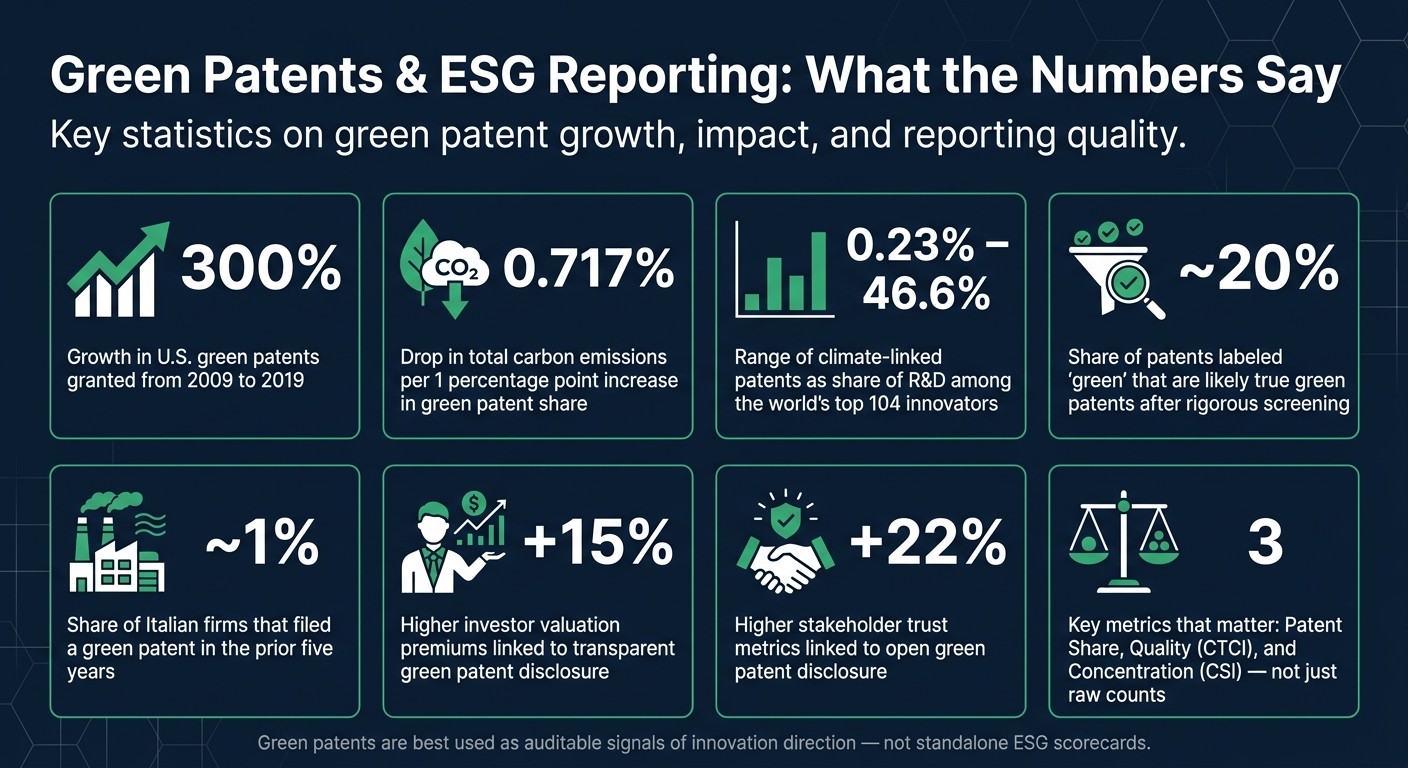
Green Patents & ESG Performance: Key Numbers at a Glance
Research on Green Patents and ESG Metrics
Researchers turn patent data into ESG metrics, but the design of those metrics matters a lot. The core issue is simple: which measures best show scale, quality, and concentration?
Patent-Based Sustainability Indicators
The most useful research measures answer three questions: how much, how strong, and how concentrated.
Framework / Indicator | Data Source | Technology Coverage | Typical ESG Use |
|---|---|---|---|
CPC Y02 Classification | Climate change mitigation technologies | Mapping R&D to decarbonization goals | |
WIPO IPC Green Inventory | WIPO | Broad environmental tech (waste, energy, etc.) | Identifying general eco-innovators |
CPPS (Portfolio Size) | Patent Databases | Absolute/relative counts of green patents | Quantifying the scale of green innovation efforts |
CTCI (Contribution Index) | Citation Data | Quality/impact of green patents | Assessing technological strength and environmental value |
Patent Family Counts (IPF) | Global Databases | International patent protections | Assessing global commercialization potential |
Reporting Application | Regulatory Reports | Activities meeting "Do No Significant Harm" | Proving technical eligibility for green finance |
Simple patent counts only tell part of the story. Using top patent tools can help analysts move beyond basic counts to more sophisticated metrics. Researchers use a few other metrics to get a better read on green innovation.
CPPS tracks green patent count, portfolio share, and change over time.
CTCI combines citations and growth to measure quality and impact.
CSI, based on the Herfindahl-Hirschman Index, shows whether green innovation is concentrated or spread across areas.
There are also measures for novelty and global reach. Patent radicalness looks at how far an invention extends beyond its core technology classes. International Patent Families (IPF) count inventions filed in more than one jurisdiction, which helps with cross-border comparison.
These indicators become more useful when they are mapped to climate and SDG taxonomies.
SDG and Climate Taxonomy Mapping Methods
CPC Y02 covers eight technology categories - from energy generation (Y02E) and transportation (Y02T) to carbon capture (Y02C) and waste management (Y02W) - which makes it practical for mapping a patent portfolio to specific decarbonization goals. WIPO's IPC Green Inventory takes a broader approach. It covers a wider set of environmental technologies and is widely used to identify green innovators across global databases.
Researchers also map patents to the UN Sustainable Development Goals (SDGs) to link innovation activity with broader social and environmental priorities. This method lets companies calculate the share of R&D tied to climate-tagged patents. Among the world's 104 most innovative organizations, that share ranges from just 0.23% to 46.6%. That's a huge spread, and it shows how uneven green innovation intensity can be even among top innovators.
Still, even strong patent metrics have blind spots. A patent-only view misses firms that report green activity in other ways, so ESG reporting should combine patents with trademarks or operational emissions data. In an Italian firm sample, only about 1% had filed a green patent in the five years before the study. That makes patent metrics useful as one input in ESG reporting, but not enough on their own to measure environmental performance.
Empirical Evidence Linking Green Patents to ESG Outcomes
Using the patent metrics above, researchers test whether green innovation lines up with ESG performance. The short version: the link is mixed. ESG pressure can push firms to file more green patents, but a strong patent portfolio does not always lead to better ESG scores.
Green Patenting and ESG Ratings
In Chinese A-share firms, higher ESG ratings lead to more green patenting, which suggests ESG ratings can act as indirect pressure on innovation activity. In other settings, the picture is less clear.
Cohen et al. find that firms in the old-line energy sector often produce strong green innovation and still end up with weaker ESG scores and lower capital inflows. Schlosser et al. find that a recent increase in green patent share is linked to lower emissions, even when total portfolio size is not. Andriosopoulos et al. show that market reactions shift based on the type of firm and on patent traits like radicalness and grant lag.
So the pattern doesn’t move in a straight line. ESG ratings may push firms toward more green patenting, but patent quality does not consistently turn into better ESG results.
Green Patents as Disclosure Signals
Patents also matter as disclosure signals in ESG reporting. They are visible, legally backed, and easier to verify than broad claims in a report. That helps investors tell the difference between a firm with a real environmental push and one that is mostly telling a good story.
They also do a different job than operating metrics. Emissions data shows a company’s current environmental footprint. Patents point to future-facing technical intent. Put simply, emissions tell you where the firm stands now; patents hint at where it may be heading.
Research also shows that mandatory greenhouse gas disclosure rules can increase green patenting, especially at firms with a high concentration of environmental investors.
Limits of Patent-Only ESG Measures
Patent data has clear limits. A larger stock of green patents does not predict lower emissions, but a rising green patent share does. That distinction matters. More patents alone may just mean more filings. A larger share of green patents suggests a stronger shift in the direction of the firm’s R&D mix.
There’s also a strategic issue. ESG engagement can push firms to patent using generative AI patent drafting tools to protect existing IP, instead of using patents for outward-facing innovation aimed at entirely new technologies.
Metric Type | Examples | Key Limitation |
|---|---|---|
Innovation signal | Green patent counts, patent radicalness, non-patent citations | Does not guarantee commercialization or immediate emission reductions |
Realized impact | Scope 1, 2, and 3 emissions; low-carbon product revenue | Lagging indicators and harder to connect directly to innovation |
These mixed findings make reporting standards and governance controls important.
Using Green Patents in ESG Reporting: Case-Based Insights
The next step is turning green patents into auditable ESG claims. That means using classification workflows, portfolio metrics, and impact estimates in a way that supports the claim without stretching the facts.
Mapping Patent Portfolios to ESG Priorities
A good reporting workflow starts by identifying every patent in the portfolio that falls under CPC Y02 or a similar green classification. Then connect each patent directly to a company ESG priority. Don’t leave that link implied.
That portfolio map gives the disclosure a paper trail. In 2023, Siemens AG and Merck KGaA used an IP analytics workflow to map their patent portfolios to specific UN Sustainable Development Goals. That mapping supported 2023 Sustainability Report disclosures tied to SDG 7 and SDG 13.
Here’s one simple way to structure that mapping for internal review and external reporting:
ESG Theme | Patent Category (CPC) | Related Indicator | Supporting Data |
|---|---|---|---|
Climate Change Mitigation | Y02E (Energy), Y02T (Transport) | Climate Patent Portfolio Size (CPPS) | Y02 family count |
Resource Efficiency | Y02W (Waste/Wastewater) | Patent Asset Index | Citations, family size, jurisdictions |
SDG Alignment | SDG 7 (Clean Energy), SDG 13 (Climate) | SDG Relevance Score | Text-to-SDG match score |
Innovation Quality | All Green Patents | Climate Technology Contribution Index (CTCI) | Forward citation growth rates and technological strength metrics |
Quantifying Impact and Building Evidence
Once the patents are mapped, the next job is to turn them into measurable outcomes. One study found that a 1 percentage point increase in the share of green patents is linked to a 0.717% drop in total carbon emissions. But that figure applies at the portfolio level. It is not a per-patent impact number.
For single-patent disclosures, tie each patent to measurable outcomes through lifecycle assessments. A company can make the disclosure stronger by stating the expected annual CO₂, water, or energy effect of each patented technology. Transparent green patent disclosure is linked to higher investor valuation and stronger stakeholder trust.
To make those claims hold up under review:
Document how patents were chosen
State assumptions in plain language
Keep audit-ready logs for every impact estimate
One more point matters here: classification by itself isn’t enough. Screening quality can make or break the whole exercise. Only about 20% of patents labeled green in the literature are likely to be true green patents. Standard systems like OECD ENV-TECH or EPO Y02 can pull in conventional technologies that happen to sit inside environmental classes, which creates a clear risk of overstating a portfolio’s environmental role.
That’s why novelty-based screening and NLP-assisted review are getting more attention. They help separate actual environmental advances from minor tweaks. Green patents can support ESG reporting well, but only if the classification process is tight and the impact evidence is backed up.
Standards, Governance, and AI-Enabled Patent Analytics
Alignment with Reporting Standards and Governance Controls
Patent counts on their own can make ESG impact look bigger than it is. That’s why reporting needs to connect to accepted standards and clear internal controls. A solid approach is to map green patents to IFRS S1/S2, TCFD, GRI, and SASB, then back up those claims with lifecycle assessments, third-party validation, and patent-office records.
Governance should center on three core controls:
Assign clear ownership for green IP reporting so IP, legal, sustainability, and finance teams use one shared method
Record the ESG reason for each filing and renewal in decision logs
Run periodic audits that compare public sustainability claims with actual patent activity
Once that reporting method is in place, AI can help teams apply it the same way across large patent portfolios.
AI Tools for Green Patent Identification and Tracking
After governance is set, the next step is execution. AI can speed up classification, tagging, and portfolio monitoring. NLP and semantic search can catch patents that were tagged the wrong way and help refine Y02 or ENV-TECH labeling. Tools built on algorithms such as Word2Vec can spot semantic connections that CPC codes miss, which helps improve the precision of green patent identification.
Patently's Vector AI semantic search, citation browser, and project tools help teams classify, track, and organize green patents by ESG theme.
The best setup is simple: use AI to flag likely candidates, then have people review them before final classification. AI doesn’t replace governance. It helps make green patent evidence more reliable and easier to audit.
Key Insights and Future Directions
Taken together, the evidence points to a simple idea: green patents work best as auditable signals of innovation, not as standalone proof of ESG performance. When companies disclose green patents in a clear, open way, investor assessments show about 15% higher valuation premiums and stakeholder trust metrics rise by 22%.
At the same time, patent counts on their own don't say much about emissions cuts. Research shows that a 1 percentage point increase in the share of green patents is linked to a 0.717% reduction in total carbon emissions. That's useful, but it also shows the limit of raw totals. Counts show volume; ratios show direction.
One issue still sits right in the middle of this debate: the ESG-Innovation Disconnect. A company can show strong green innovation while ESG scores and capital flows remain weak. In plain English, a firm may be doing serious patent work in climate-related areas and still not see that effort reflected in outside ratings or funding patterns.
The next step in reporting is moving past raw patent totals and toward quality-weighted indicators. The field is shifting from simple counts to impact metrics that weigh quality, and measures such as CPPS, CTCI, and CSI are gaining traction because they separate volume, quality, and concentration.
That shift opens up a few hard but necessary questions:
How should reporting standards recognize innovation with more accuracy?
Can cross-sector comparability improve when the share of climate inventions in company portfolios ranges from 0.23% to 46.6%?
How do firms connect patent portfolios to auditable climate and business outcomes?
The reporting challenge now is making these metrics consistent, comparable, and auditable.
FAQs
How do green patents fit into ESG reporting?
Green patents give a company something concrete to point to when it talks about its environmental work. Instead of leaning on broad claims or polished messaging, the business can show verifiable proof through its patent activity. That makes ESG reporting more grounded and easier to defend.
When green patents are built into ESG frameworks, they can send a stronger message to stakeholders, regulators, and investors. That can help with ESG ratings, public perception, and even market valuation. Patently can help organize this information so it’s audit-ready and lined up with recognized ESG metrics and sustainability goals.
Why is green patent share more useful than patent counts?
Green patent share tells you more than raw patent totals. Why? Because it shows how much of a company’s patent portfolio is tied to sustainability.
Simple patent counts can be misleading. A company might file lots of patents for small design tweaks without making much progress in the underlying tech.
By looking at the share of green patents across the full portfolio, stakeholders get a better way to tell the difference between meaningful, high-quality innovation and efforts that simply pad environmental claims.
How can companies verify that a patent is truly green?
Companies should look past broad official labels. Those labels often lump standard technologies together with work that has a clear environmental angle. A better approach is to verify patents with clear, data-driven criteria.
That usually means a few things:
Audit patent claims and abstracts with NLP and AI-driven semantic analysis
Cross-reference patents to measurable ESG metrics and UN Sustainable Development Goals
Support disclosures with lifecycle assessments or third-party validation
Clearly define the methodology used to label a patent as green
The main point is simple: if a company says a patent is green, it should be able to show why with a method others can follow and check.