5 Ways AI Predicts Patent Trends by Industry
Intellectual Property Management
Jun 11, 2026
Five AI methods—forecasting, semantic clustering, network analysis, predictive modeling, and data fusion—reveal patent trends across industries.

AI is transforming how we analyze patent trends, helping industries like healthcare, technology, and energy make better decisions. Here's a quick breakdown of five AI methods reshaping patent analysis:
Time Series Forecasting: Uses historical patent data to predict future trends, helping teams focus on emerging areas like AI diagnostics or chiplet designs.
Semantic Clustering: Groups patents by conceptual meaning, revealing innovation trends like biotech merging with digital health.
Citation & Co-Ownership Network Analysis: Tracks connections between patents, inventors, and companies to identify emerging technologies and collaborations.
Predictive Modeling: Estimates which patents will succeed and their economic value, guiding resource allocation.
Cross-Domain Fusion: Combines patent, scientific, and market data to predict trends earlier and more accurately.
These methods empower R&D and IP teams to stay ahead in fast-changing industries, ensuring smarter patent strategies and better innovation planning. Tools like Patently streamline this process, integrating advanced AI techniques into a single platform.
AI Is Now Predicting Patent Office Decisions
1. Time Series Forecasting of Patent Filings by Technology Sector
Time series forecasting leverages historical patent filing data to predict future trends in innovation. By analyzing decades of USPTO records, AI models can uncover recurring patterns in patent activity across diverse technology areas like medical imaging, solid-state batteries, or large language models.
These models also factor in economic indicators, such as shifts in funding, to spot early signals of changes in patent filing behavior.
Two main methods dominate this field: traditional models like ARIMA, which work well for stable sectors, and more advanced deep learning models like LSTM, which are better suited for industries with volatile trends. For instance, the EPO employs the N-BEATS model, which combines PATSTAT data with economic indicators to forecast filing activity effectively.
With these insights, R&D and IP teams can identify emerging opportunities early, using top patent tools to make strategic decisions to file patents in areas like chiplet architecture or AI-assisted diagnostics. This proactive approach helps avoid reactive measures and sets the stage for even more sophisticated AI-driven patent analysis techniques in the future.
2. Semantic Clustering and Topic Modeling of Industry Portfolios
Time series forecasting tells us when patent activity spikes, but semantic clustering dives deeper, uncovering what those spikes mean. Instead of relying on exact keyword matches, AI uses natural language processing (NLP) to interpret patent text. It transforms patent language into embeddings, grouping documents based on conceptual similarity. This allows patents describing related innovations to be linked, even if they use completely different words.
Here’s a quick comparison of traditional keyword search versus AI-driven semantic clustering:
Feature | Traditional Keyword Search | AI Semantic Clustering |
|---|---|---|
Basis of Grouping | Exact word matches | Conceptual meaning and intent |
Handling Jargon | Misses synonyms or vague terms | Recognizes technical links across disciplines |
Scalability | Requires manual review | Analyzes millions of patents in seconds |
Accuracy | Prone to false negatives | Achieves 91% accuracy in similarity tasks |
Updates | Static, outdated reports | Dynamic, real-time dashboards |
But AI doesn’t stop at clustering patents. It also tracks co-occurring IPC and CPC codes. When codes from previously unrelated fields start appearing together in patent filings - like biotechnology merging with digital health in wearable diagnostics or materials science intersecting with electronics in flexible devices - it signals a convergence of technologies.
These patterns often reveal shifts in industry focus before they’re visible in product launches or market reports. For example, in sectors like alternative proteins and sustainable materials, patents are moving away from focusing solely on new inventions. Instead, the spotlight is on scaling production - shifting from product patents to process optimization. Similarly, in fintech, AI detects clusters in areas like passive authentication and automated transactions, hinting at a growing trend toward "no-touch" payment systems. This convergence insight makes semantic clustering a powerful tool for identifying early signs of innovation.
3. Citation and Co-Ownership Network Analysis for Spotting Emerging Areas
Citation and co-ownership network analysis helps identify the key players driving innovation and reveals the direction of technological advancements. By visualizing patents, inventors, and companies as interconnected graphs, AI uncovers patterns that a standard patent search might miss. These insights, combined with co-ownership analysis, highlight the strategic collaborations fueling innovation.
One crucial signal is the citation bridge - when patents in one field start citing those in a completely different area. These cross-domain citations often hint at technology convergence long before filing surges become apparent. For instance, increasing citation links between biotechnology and digital health patents pointed to the rise of wearable diagnostics well before the market caught on.
Mapping co-ownership and inventor networks also identifies bridging actors - individuals or companies working across unrelated fields. These collaborations can signal upcoming filing surges, like when a materials scientist partners with a semiconductor engineer.
Here’s a quick look at how AI techniques in network analysis benefit IP planning:
AI Technique | What It Detects | Impact on IP Planning |
|---|---|---|
Citation Graph Analysis | Cross-domain citation bridges between patent clusters | Early detection of technology convergence and market shifts |
Inventor Network Mapping | Bridging actors filing across multiple disciplines | Helps predict areas where filing surges may occur |
Co-Ownership Analysis | Collaborative ties between companies and institutions | Highlights strategic alliances and emerging innovation hotspots |
For intellectual property teams, tracking inventor movements and collaboration networks offers a way to spot innovation trends early. Tools like Patently make it easier to perform this type of in-depth network analysis, giving patent professionals a head start on identifying convergence trends before they gain widespread attention.
4. Predictive Modeling of Patent Outcomes and Value by Industry
AI isn't just about identifying innovation trends - it also predicts patent outcomes (whether they'll be granted, maintained, or abandoned) and estimates their potential economic value. These predictions help intellectual property (IP) teams make smarter decisions about where to allocate resources and where to cut back.
To make these forecasts, AI models analyze a range of patent data signals. The importance of these inputs can vary depending on the industry, as each sector has its own regulatory and market dynamics.
Advanced modeling techniques have significantly improved prediction accuracy. For instance, a two-stage hybrid model achieves an impressive 90% accuracy in predicting patent renewals, compared to just 40% with a standard XGBoost model. This level of precision helps identify which patents are worth prioritizing. Similarly, generative AI enhances the accuracy of recognizing patent trends by 34% compared to traditional keyword-based methods. These insights play a critical role in shaping strategic IP decisions.
Model Type | Accuracy for Renewals |
|---|---|
Standard XGBoost | 40% |
Two-Stage Hybrid Model | 90% |
These predictions aren't just numbers - they drive actionable strategies. For example, if a pending application scores low on the likelihood of being granted, IP teams might revise the claims before the next office action. On the other hand, a high-value score for a granted patent could lead to a licensing campaign. Tools like Patently bring these models to life, combining semantic search with citation analysis to help patent professionals evaluate their portfolios in a meaningful way.
5. Cross-Domain Fusion of Patent, Scientific, and Market Data
No single data source can fully capture where an industry is heading. Patent filings reveal what companies are protecting, but scientific papers often highlight research directions 1 to 3 years earlier. Meanwhile, market signals - such as venture capital (VC) investments or product launches - indicate commercial momentum. When AI combines these sources, the resulting predictions are far more dependable than relying on any one source alone.
This fusion process integrates both structured and unstructured data to uncover connections. For instance, a surge in academic publications on solid-state battery chemistry, paired with increased VC funding for energy storage startups and a rise in related patent filings, provides a much clearer picture of an emerging trend. AI excels at identifying these convergence points across massive datasets - something manual methods simply can't match at scale.
Different industries prioritize specific data types, as shown below:
Data Source | Lead Time | Primary Industry Use |
|---|---|---|
Scientific Papers | 1–3 years ahead | Healthcare (drug discovery), Energy (materials research) |
Market Signals | Real-time to 12 months | Technology (VC trends), Automotive |
Regulatory Data | Varies | Healthcare (FDA approvals, patent cliffs) |
Standards Documents | Ongoing | Telecom (5G/6G licensing, SEPs) |
This table highlights how each data source plays a role in identifying trends early on.
A particularly effective technique is problem-solution signal analysis, where AI scans patent abstracts to detect shifts in R&D priorities. For example, AI can spot a transition in language from "can we build this?" to "can we scale this efficiently?". These subtle changes, often missed by manual review, become evident through large-scale analysis.
These insights are invaluable for shaping broader intellectual property (IP) strategies. By combining multiple data sources, companies can fine-tune their R&D investments and patent filing decisions. Tools like Patently make this process easier by offering features like semantic search and SEP analytics. This is particularly helpful in fast-evolving fields like 5G, where standards documents and patent filings are deeply interconnected.
Comparison Table
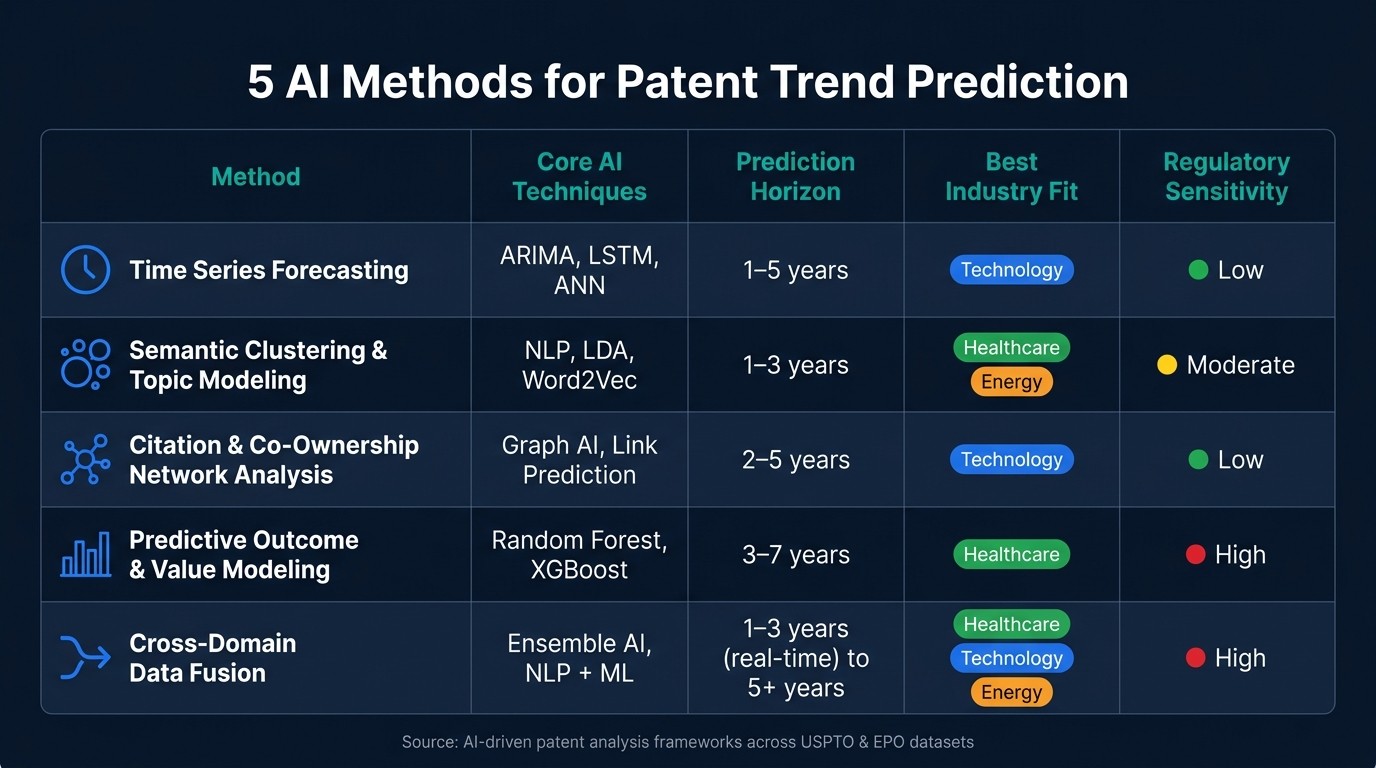
5 AI Methods for Patent Trend Prediction: A Visual Comparison
Each AI method has its own strengths, making it essential to choose one that aligns with your industry, data availability, and specific forecasting needs.
Below is a table summarizing the key differences between various methods of patent trend analysis. It highlights the core techniques, data requirements, prediction horizons, and industry applications to help you make an informed decision:
Method | Core AI Techniques | Data Richness | Prediction Horizon | Best Industry Fit | Regulatory Sensitivity |
|---|---|---|---|---|---|
Time Series Forecasting | ARIMA, LSTM, ANN | Moderate (filing records) | 1–5 years | Technology | Low |
Semantic Clustering & Topic Modeling | NLP, LDA, Word2Vec | High (patent text) | 1–3 years | Healthcare & Energy | Moderate |
Citation & Co-Ownership Network Analysis | Graph AI, Link Prediction | High (relational data) | 2–5 years | Technology | Low |
Predictive Outcome & Value Modeling | Random Forest, XGBoost | High (multi-variable) | 3–7 years | Healthcare | High (FDA, patent cliffs) |
Cross-Domain Data Fusion | Ensemble AI, NLP + ML | Very High (integrated sources) | 1–3 years (real-time signals) to 5+ years | Healthcare, Technology & Energy | High (varies by sector) |
This table serves as a quick reference to align your AI strategy with the specific challenges of your portfolio.
For instance, in healthcare, forecasting must accommodate complex FDA timelines and the risks associated with patent cliffs. Meanwhile, the technology sector can leverage network analysis to uncover emerging partnerships and licensing trends early on, thanks to insights from co-ownership and citation data.
If you're just starting out and working with smaller datasets, time series forecasting is a practical entry point. On the other hand, more advanced teams with access to richer, integrated data can achieve greater precision with cross-domain data fusion.
Conclusion
The five AI methods discussed - time series forecasting, semantic clustering, citation and co-ownership network analysis, predictive outcome modeling, and cross-domain data fusion - offer distinct ways to analyze patent trends across industries like healthcare, technology, and energy.
Each method aligns with specific needs. For instance, technology teams might favor time series forecasting, while healthcare professionals could benefit more from predictive outcomes and cross-domain fusion. Selecting the right approach depends on factors like the type of data you have, the industry you're working in, and the forecasting timeline you're targeting.
The next step is to bring these methods together seamlessly. This is where an integrated platform becomes essential. Tools like Patently simplify this process by combining various capabilities - such as Vector AI semantic search for clustering and white-space analysis, citation browsing, and specialized SEP analytics - into one cohesive system. This kind of integration brings out the best in each method.
FAQs
Which AI method is best for my industry?
When it comes to choosing the right AI method, it all boils down to your specific goals and the type of data you're working with:
For structured data, options like Multilayer Perceptrons or Wide and Deep Neural Networks are solid choices.
If you're analyzing trends over time, Recurrent Neural Networks (RNNs) are particularly effective.
To explore relationships, such as citation networks, Graph Neural Networks are highly useful.
For tasks like patent forecasting, LightGBM stands out as a top performer.
When it comes to semantic discovery, transformer-based NLP models are the go-to solution.
Patently offers tools tailored to meet these needs, including features like semantic search, SEP analytics, and project management, making complex processes more manageable.
What data do I need to forecast patent trends with AI?
To predict patent trends using AI, it's essential to merge internal patent data with external insights for a more comprehensive dataset. Start by gathering structured records from patent offices like the USPTO or EPO. These records typically include details such as titles, abstracts, application dates, and classification codes.
Next, layer in external signals to enrich your analysis. This could involve incorporating economic data, scientific research, competitor activity, or significant market events. For accurate results, make sure to clean and standardize the data to maintain consistency. Also, archive the raw data before any processing to ensure you have a reliable baseline for analysis.
How can I validate AI patent predictions before acting on them?
To ensure AI patent predictions are reliable, it's essential to blend AI-generated insights with expert analysis. This approach helps tackle potential data gaps and biases. Leveraging explainability tools can highlight the main factors influencing predictions, making the process more transparent. Setting confidence thresholds, like 80%, ensures that predictions below this level undergo mandatory manual review for accuracy.
Cross-validation is another key step - compare AI predictions against historical data to check for consistency and reliability. Additionally, using Retrieval-Augmented Generation (RAG) can anchor AI outputs to trustworthy sources, reducing errors and enhancing overall data reliability.