AI Patent Trends: Predicting Filing Hotspots
Intellectual Property Management
Jun 12, 2026
How AI predicts patent filing hotspots, revealing geographic and sector growth to guide filing, R&D, and policy decisions.

AI is reshaping how we analyze patent trends, helping identify emerging innovation hubs faster and more accurately. This article explores how AI tools predict "hotspots" - regions or tech clusters with rapid patent growth - and why understanding these trends is critical for businesses, researchers, and policymakers. Key takeaways:
Hotspots are defined by high growth in patent activity, either geographically or within specific technologies like generative AI or computer vision.
AI-driven analysis outperforms traditional methods by leveraging semantic search, clustering, and citation analysis to detect trends early.
Global leaders like China (49.1% of AI patents) and the U.S. (20%) dominate filings, but emerging players like Finland and secondary Chinese cities are gaining traction.
Sector trends show rapid growth in areas like natural language processing (35% annually) and AI-powered cybersecurity (50% growth from 2023–2026).
AI tools, such as Patently, streamline patent analysis with features like semantic search and citation tracking, enabling professionals to anticipate trends and refine filing strategies. Early action on these insights can provide a competitive edge in patents, R&D, and investments.
Data Sources and Analytical Methods
Key Data Sources for Patent Trend Analysis
Predicting innovation hotspots hinges on reliable patent data. Repositories like the USPTO (United States Patent and Trademark Office) and WIPO (World Intellectual Property Organization) provide structured, detailed records, including filing dates, applicant information, technology classifications, and citation histories. To gain a broader perspective, regional offices such as the EPO (European Patent Office), JPO (Japan Patent Office), and CNIPA (China National Intellectual Property Administration) contribute valuable regional insights.
In addition to these official databases, researchers are increasingly turning to non-patent literature - academic studies, technical standards, and R&D funding announcements - to identify innovation trends before they appear in formal patent filings. By cross-referencing this external information with patent data, analysts can detect which technologies are gaining traction in practical applications. This combination of data sources forms the foundation for the advanced AI techniques discussed below.
AI Techniques Used in Hotspot Prediction
Once the data is collected, advanced AI methods help uncover actionable insights. Techniques like time-series forecasting and semantic clustering are used to identify acceleration trends and group related patents, even when terminology varies. These methods are particularly valuable in rapidly evolving fields where language and concepts shift quickly.
Citation analysis plays a critical role in refining these insights. When a cluster of recent patents repeatedly cites the same foundational work, it often signals that a specific technology is maturing and drawing focused attention. Together, these techniques provide a clearer view of where innovation is gaining momentum.
The quality of the AI models used is equally important. For instance, fine-tuned transformer classifiers like the FGYZ (built on PatentSBERTa) achieve 97.0% precision and a 94.0% F1 score, outperforming USPTO’s LSTM model. This high level of accuracy is essential for distinguishing genuine innovation trends from statistical noise.
Platforms like Patently leverage these methods to make patent analysis more efficient and insightful.
Using Patently for Patent Data Analysis

Patently enhances patent analysis with its Vector AI semantic search, which identifies relevant patents even when terminology evolves - a key advantage in fast-changing areas like generative AI. This capability ensures users can track innovations effectively, even in fields with shifting vocabularies.
The platform also offers a Forward and Backward Citation Browser that simplifies citation-based trend analysis. This tool allows users to trace how ideas develop and spread without needing to cross-reference multiple databases manually. For professionals working on SEP (Standard Essential Patent) analytics - especially in areas like 4G/5G technologies - Patently provides targeted tools to pinpoint where standards-related filings are concentrated.
Research indicates that integrating generative AI into patent mining workflows can improve trend recognition accuracy by 34% compared to traditional keyword-based methods. This improvement is crucial for identifying emerging filing hotspots early, giving analysts and organizations a competitive edge in spotting innovation trends.
AI Just Turned Patent Research Into Visual Intelligence
Current AI Filing Hotspots and Trends
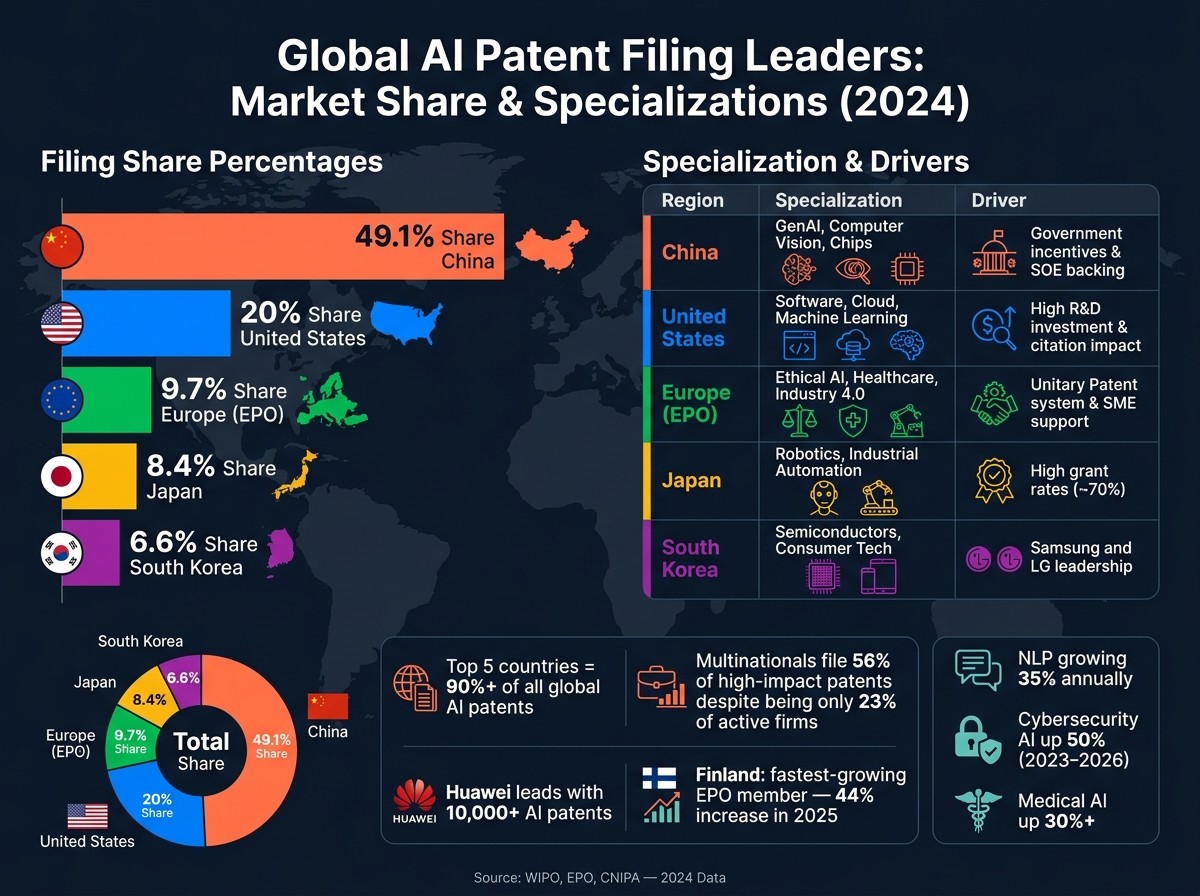
Global AI Patent Filing Leaders: Market Share & Specializations (2024)
The world of AI patent filings is buzzing with activity, with both established and emerging hubs shaping the landscape in unique ways.
Global Leaders in AI Patent Filings
A handful of countries dominate the global AI patent scene. Together, China, the U.S., Japan, South Korea, and Germany account for over 90% of all AI patents filed worldwide. China leads the charge, holding approximately 49.1% of global AI patent families as of 2024. The U.S. comes in second with around 20%, followed by Japan (8.4%) and South Korea (6.6%).
Region | Global Filing Share | Primary Specialization | Key Driver |
|---|---|---|---|
China | ~49.1% | GenAI, Computer Vision, Chips | Government incentives & SOE backing |
United States | ~20% | Software, Cloud, Machine Learning | High R&D investment & citation impact |
Japan | ~8.4% | Robotics, Industrial Automation | High grant rates (~70%) |
South Korea | ~6.6% | Semiconductors, Consumer Tech | |
Europe (EPO) | ~9.7% | Ethical AI, Healthcare, Industry 4.0 | Unitary Patent system & SME support |
While China leads in sheer numbers, the U.S. stands out in terms of influence, with its AI patents being cited more often - an indicator of their foundational role in the field. Multinational companies play a significant role, filing 56% of high-impact patents globally despite representing only 23% of active patenting firms. Huawei, for instance, tops the list of AI patent applicants, boasting over 10,000 AI-related patents focused on telecommunications and intelligent infrastructure.
"These organizations are building cognitive systems and integrated intelligence that will define the next industrial era." - Maroun S. Mourad, President, Intellectual Property, Clarivate
While these global leaders dominate in numbers and technological influence, new regional players are rapidly gaining momentum.
Emerging Regional Hotspots
Outside the established giants, several smaller regions are making waves. Finland, for example, recorded a 44% increase in AI patent applications in 2025 - the fastest growth among all European Patent Office (EPO) member states. Across Europe, AI-related filings at the EPO rose by 9.5% that year, thanks in part to the new Unitary Patent system, which simplifies protection across 18 EU states and saw a 28.7% uptake rate. Nokia exemplifies this growth, climbing from 12th to 5th place in EPO applicant rankings in just one year, achieving the fastest growth among the top 50 applicants.
In China, innovation is no longer confined to major hubs like Beijing and Shenzhen. Secondary cities are increasingly contributing, broadening the country's innovation ecosystem.
"The record volume of patent applications underlines Europe's innovative capacity and its appeal as a global technology market." - António Campinos, President, European Patent Office
These regional trends are mirrored by distinct sector-specific shifts that are shaping the future of AI innovation.
Sector-Specific Filing Trends
Different sectors are driving the geographic spread of AI filings. Natural Language Processing (NLP) is the fastest-growing AI category, with annual growth exceeding 35%. AI-powered cybersecurity patents have surged by 50% between 2023 and 2026, while medical AI patents are growing at over 30% annually, particularly in the U.S. and Europe, where regulatory environments reward documented technical advancements.
In Germany and across Europe, automotive AI and industrial algorithms take center stage, driven by Industry 4.0 initiatives and the push for predictive maintenance solutions. The UK, on the other hand, has focused on fintech, blockchain, and cybersecurity patents, aligning with the needs of highly regulated industries. Additionally, the EU AI Act's transparency requirements are prompting a shift from trade secrets to formal patent filings, further transforming the innovation landscape in Europe.
AI-Driven Predictions for Future Hotspots
Signals of Emerging Filing Hotspots
Filing hotspots don’t appear overnight - they develop over time, leaving behind clues that AI models can pick up before traditional analysis catches on. Some of these early signs include a rise in patent filings within niche technology categories, a more diverse range of applicants (like startups and universities joining established corporations), and increasing citation activity in areas that were previously under the radar. For instance, when patents in a specific category begin attracting forward citations across multiple jurisdictions, it’s a strong indicator that this technology is gaining traction on a global scale.
Another key signal comes from temporal data. A shorter time between a patent's priority filing and its publication often points to aggressive efforts to secure intellectual property early in the development cycle.
How AI Models Predict New Hotspots
AI forecasting models rely on a combination of rich data sources and advanced analytical techniques to identify emerging trends. Bibliographic information - like patent titles, abstracts, and classification codes - helps pinpoint which tech domains are gaining momentum. Temporal data tracks how quickly innovations move from research stages to market readiness. Relational data, such as forward and backward citations or patent family connections, highlights the influence and reach of specific patents.
Geospatial trends provide another layer of insight, showing where innovation is physically clustering. Meanwhile, semantic analysis digs into patent abstracts to detect subtle shifts in language that suggest new applications or evolving technologies. By blending these insights with regional data, geographic clustering can uncover emerging innovation hubs that might be overlooked if you only focus on raw filing numbers.
These AI-driven predictions give businesses and professionals a clearer picture of where to focus their attention and resources.
Putting Forecasts to Work for Patent Professionals
Spotting these signals is just the first step - knowing how to act on them is where the real value lies. Tools like Patently make this process more manageable. By combining semantic search powered by Vector AI with a Forward and Backward Citation Browser, these platforms allow users to track how specific technologies spread across regions and applicant types in real time. This simplifies the task of reviewing vast amounts of patent data.
For intellectual property strategists, these hotspot forecasts should be more than just reports - they’re planning tools. If AI flags a surge in filings within a particular area, it’s time to reassess your own filing strategy and R&D priorities to stay ahead in the competitive landscape.
Filing Strategy and Planning Recommendations
Adjusting Your Filing Strategy
Acting quickly when AI tools identify an emerging filing hotspot can give you a real edge. These early signs often show up 6 to 12 months before the market becomes crowded, offering a critical window to act. For U.S. companies and law firms, this might mean checking foreign filing strategies more often than the usual annual review. If AI analysis shows an uptick in patent activity in a particular jurisdiction or technology area, it’s smart to speed up PCT filings or national phase entries before the competition ramps up. Another useful indicator is patent velocity - the rate at which new patents cite earlier foundational work. This metric can help you decide when to move forward. Taking this proactive approach not only strengthens your filing strategy but also guides broader decisions around R&D and investments.
Using Hotspot Data for R&D and Investment Planning
Hotspot data isn’t just for filing strategies - it can also steer R&D and investment decisions. When patent activity starts clustering around certain regions or institutions, it’s a sign of emerging opportunities that deserve attention before allocating resources. For instance, if AI tools detect a rise in filings in a specific technology area, businesses should consider options like forming R&D partnerships, setting up satellite offices, or exploring licensing deals. This approach helps avoid pouring resources into crowded spaces while identifying open "white spaces" where innovation is still untapped.
Tracking scientific publications offers another layer of insight. Research papers often appear one to three years before related patents, so keeping an eye on publication trends alongside patent data can give organizations an early advantage in anticipating upcoming IP activity.
Policy and Ecosystem Considerations
Hotspot data doesn’t just benefit businesses - it’s also a valuable tool for policymakers aiming to nurture innovation ecosystems. The table below shows how different data sources can guide policy decisions at various stages:
Data Source | Forecasting Lead Time | Policy Use |
|---|---|---|
Scientific Publications | 1–3 years | Allocating early-stage R&D grants |
Geospatial/Mobility Data | Real-time | Planning regional tech hubs and infrastructure |
Patent Velocity | 6–12 months | Spotting market saturation or identifying gaps |
Citation Networks | Long-term | Highlighting foundational "hub" technologies |
For U.S. policymakers, AI-driven hotspot analysis can influence decisions around federal R&D funding, regional innovation infrastructure, and targeted incentives for specific tech sectors. Agencies like the National Science Foundation or the Department of Energy could use patent velocity data to identify areas where private-sector activity is gaining momentum. This allows public investments to amplify and support these emerging innovation clusters effectively.
Conclusion: Key Takeaways
The future of patent filings is being reshaped by AI, and understanding these shifts is crucial for staying ahead. Advanced AI tools are now enabling patent professionals to pinpoint emerging filing opportunities before they become saturated, offering a distinct edge in an increasingly competitive landscape.
The numbers tell a compelling story. In 2025, international PCT applications hit 275,900, with AI and computer technology accounting for 9.6% of filings. Semiconductor filings grew by 6.1% year-over-year, while Asian countries accounted for 56.3% of global PCT applications. This marks a significant global shift, highlighting the importance of adapting quickly. Generative AI has further enhanced trend recognition, boosting accuracy by 34% compared to traditional keyword-based methods. This widening gap between AI-driven and conventional approaches is impossible to ignore.
For patent professionals, sticking to reactive filing strategies is no longer enough. The leaders in this space are leveraging AI to uncover untapped opportunities, monitor convergence trends like AI-embedded hardware and IoT, and make decisions based on real-time data rather than outdated periodic reviews.
Patently exemplifies this shift with tools like semantic search powered by Vector AI, SEP analytics, and collaborative project management. These capabilities turn raw patent data into actionable strategies, allowing professionals to move from reactive to predictive filing approaches. Embracing AI is no longer optional - it's essential for staying competitive in the evolving patent landscape.
FAQs
What data do AI models use to predict patent filing hotspots?
AI systems examine a variety of data sources to forecast areas likely to see a surge in patent filings. These sources include patent databases, economic trends, scientific research papers, geospatial and mobility data, citation networks, and even multimodal details like patent claims, drawings, and legal statuses. By integrating all this information, AI can pinpoint patterns and geographic regions where future patent activity is expected to thrive.
How can I tell if a patent “hotspot” is real and not noise?
When identifying a patent "hotspot", it’s crucial to confirm its legitimacy by examining external data such as geospatial activity, mobility trends, or innovation signals. These indicators often show heightened activity in an area before patent filings increase. Relying solely on clustering or filing volume can be misleading, as these metrics may include irrelevant data. Cross-referencing with external signals helps ensure a more accurate assessment.
When should I change my filing strategy based on hotspot forecasts?
When predictive models and external data reveal new hotspots or shifts in innovation - often within a 12 to 24-month timeframe - it’s time to rethink your filing strategy. Early signs, such as an increase in patent filings, changes in geographic activity, or trends specific to certain sectors, can indicate where adjustments are needed. Leveraging real-time monitoring and predictive analytics allows you to focus on high-growth opportunities and steer clear of oversaturated markets before filing activity spikes.