AI Tools for Patent Overlap: Comparison
Intellectual Property Management
Feb 5, 2026
Compare AI patent-overlap tools using semantic search, citation mapping, and visualization to speed FTO, cut false negatives, and fit into IP workflows.

Patent overlap can lead to costly legal disputes, making it critical to detect and manage overlaps early. With over 3.4 million patents filed in 2023 alone, manual methods are no longer practical. AI tools simplify this process by using semantic search, citation mapping, and automated visualization to identify overlaps faster and more accurately. These tools reduce time spent on analysis by up to 80% and help companies save 30%–50% on patent maintenance costs.
Key Features to Look For:
Semantic Search: Goes beyond keyword matching to understand technical concepts, reducing false negatives.
Citation Mapping: Tracks patent relationships to identify clusters and trends.
Visualization Tools: Heatmaps and citation networks make data easier to analyze.
Workflow Integration: Syncs with IP management systems and supports team collaboration.
Example Tool: Patently
Access to 176 million assets across 166 jurisdictions.
Specialized features for Standard Essential Patents (SEPs) in 4G/5G technologies.
Project management tools for FTO analysis and competitor tracking.
Quick Comparison:
Feature | Traditional Methods | AI-Powered Tools |
|---|---|---|
Search Approach | Keyword-based | Semantic search with NLP |
Time Efficiency | Weeks | Hours |
Accuracy | High false negatives | Over 95% accuracy |
Data Coverage | Limited | 200M+ patents across 170+ jurisdictions |
Collaboration | Manual | Shared workspaces, real-time updates |
AI tools like Patently are transforming patent overlap analysis, allowing businesses to mitigate risks and optimize portfolios efficiently. When choosing a tool, focus on features that align with your team's workflow and jurisdictional needs.
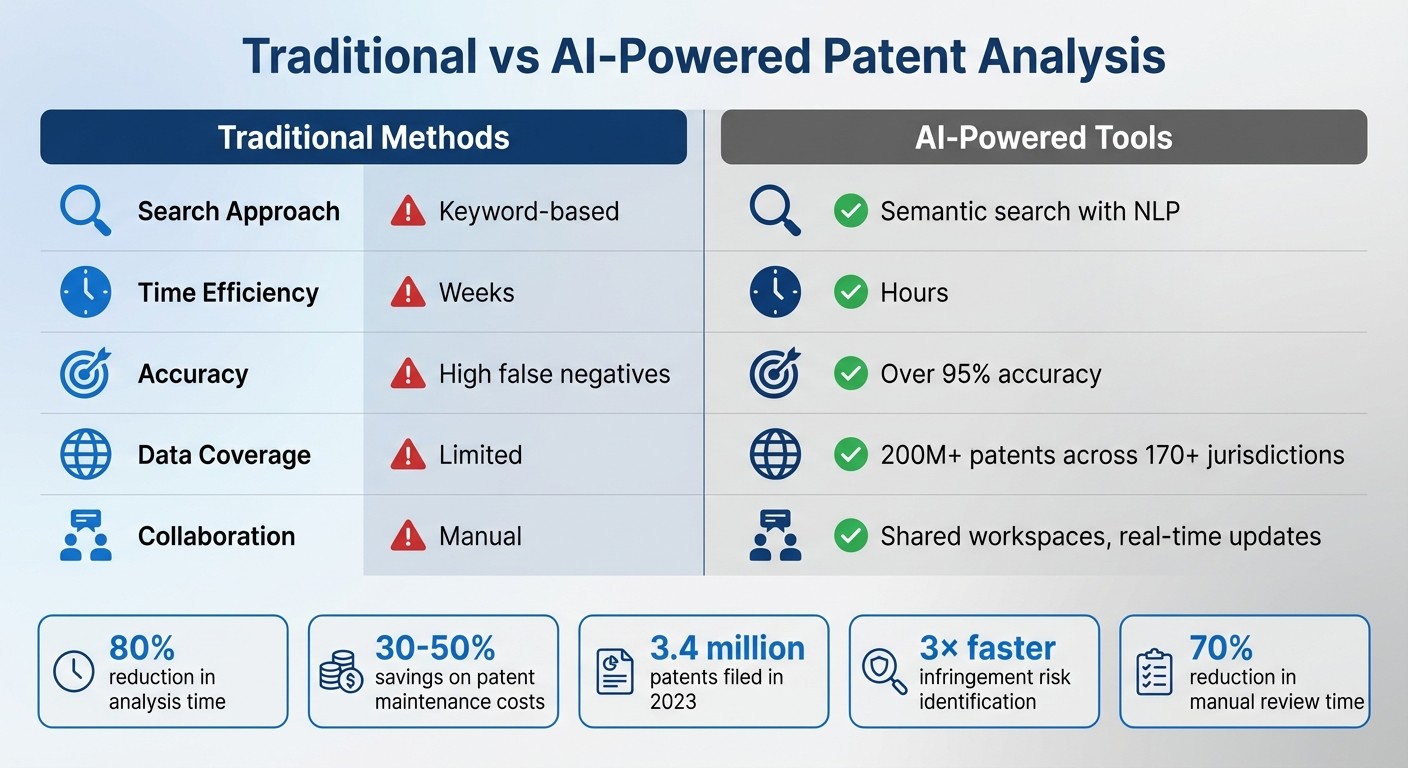
AI vs Traditional Patent Analysis Methods Comparison
Agentic AI – Patent Expert Co-Pilot Framework for (SEP) Licensing & Litigation Intelligence
How to Evaluate Patent Overlap Tools
Picking the right AI tool for patent overlap analysis means focusing on what genuinely improves your team’s efficiency and accuracy - not just flashy marketing claims. With over 3.4 million patents filed globally in 2021, relying on manual overlap detection is no longer practical. The right tool should enable your team to identify infringement risks three times faster and cut manual review time by up to 70%.
Key features to prioritize fall into three main areas: semantic search capabilities, citation and family mapping, and visualization with workflow integration. These features directly address the limitations of traditional keyword searches and can significantly speed up processes like product clearance or portfolio analysis. Let’s break down why these are essential.
Semantic Search and Contextual Analysis
Modern AI tools go beyond matching keywords - they understand the meaning behind technical language. This is crucial because patent language is often abstract and intentionally complex.
"Patent language is deliberately abstract... Keyword-based approaches struggle with synonymy, paraphrasing, and conceptual equivalence, leading to false negatives." - Thomas Chazot, Head of Growth Marketing, DeepIP
AI platforms with semantic search capabilities leverage natural language processing (NLP) to break down complex claims into technical components. For example, in a 2023 study by Yonsei University and the University of Auckland, a hybrid model combining semantic analysis with bibliographic data achieved a Pearson correlation of 0.6342 - far outperforming BERT’s 0.4612. This study, which analyzed 420 patent pairs from the USPTO Artificial Intelligence Patent Dataset, highlights how semantic tools can better identify conceptual equivalence and reduce false negatives.
When choosing a tool, look for one that can recognize technical similarities across industries and jurisdictions. This ability to surface "non-obvious" overlaps - even when terminology varies - sets top AI patent tools apart from basic keyword engines.
Citation and Patent Family Mapping
Understanding how patents connect through citations and family structures is critical for spotting patterns that single-document analysis might miss. The best tools automatically consolidate patent families across jurisdictions and normalize assignee names, offering a clearer view of competitors’ portfolios.
Citation analysis is particularly useful in identifying clusters of high-risk patents and spotting technology trends early. For industries like 4G/5G, where Standard Essential Patents (SEPs) are key, AI tools can align claim language with standards documentation.
Another standout feature is the ability to generate Evidence of Use (EoU) charts, which map patent claims to specific product features. Traditionally, creating these charts took days, but advanced tools can now automate this process in hours or even minutes. Once overlaps are identified, presenting the data in a clear, actionable format becomes the next challenge.
Visualization and Workflow Integration
Data visualization turns raw analysis into meaningful insights. Look for tools offering heatmaps, technology landscapes, and citation networks to visually represent clusters of related patents. These visual tools help R&D teams identify opportunities for new filings and draft patent applications with AI and flag potential infringement risks quickly.
Integration with existing systems is another must-have. Platforms with API access for syncing with IP management systems ensure that data like legal status, ownership, and deadlines remain up-to-date. This is especially important given that the average wait for a first office action is 19.9 months, and the USPTO had over 826,000 filings pending as of early 2026.
Shared workspaces are also increasingly valuable, enabling real-time collaboration between R&D, legal, and business teams. Make sure the tool supports exporting data and integrates smoothly with your existing workflows. For sensitive, unpublished inventions, verify that the platform complies with ISO 27001 or SOC 2 standards and offers private-cloud deployment options.
Patently: AI-Powered Patent Overlap Analysis
Patently is designed to streamline patent overlap analysis with precision and efficiency. The platform provides access to 176 million assets and 80 million patent families from 166 global patent offices, with data refreshed every 30 days.
Semantic Search with Vector AI
Patently’s semantic search capabilities stand out by leveraging large language models (LLMs) specifically tuned for patent law rather than relying on general-purpose AI. This specialized approach allows the platform to detect subtle overlaps and conceptual similarities that traditional keyword-based searches often miss.
The platform’s multimodal similarity models go beyond simple keyword matching, interpreting the full meaning of sentences to make searches more intuitive. For instance, the system can identify patents describing the same technical concept - even when inventors use industry-specific jargon or intentionally vague language to broaden claim scope. This is especially helpful in industries where precise terminology is often avoided to maximize patent coverage. These advanced search tools integrate seamlessly into collaborative and workflow-oriented environments.
Collaboration and Project Management
Patently complements its search features with a robust suite of project management tools. It supports customizable workflows for tasks like novelty searches and Freedom to Operate (FTO) analysis, and competitor tracking. Teams can organize projects by department, client, or case, with granular controls to ensure ethical boundaries are maintained.
Features like shared annotations, ratings (using numeric, star, or traffic light systems), and comments enable teams to stay aligned on both patent family and individual asset levels. The platform automatically updates projects every 30 days with the latest patent data, and users can easily export findings into company-branded Word or Excel reports. Additionally, the Forward & Backward (FAB) browser simplifies citation analysis by deduplicating citations at the family level, saving significant manual effort compared to tools that list citations for each family member.
"Patently has become an indispensable tool for us, playing a crucial role in various aspects of our Research and Innovation processes." - Stan Zurek, Head of Research and Innovation, Megger Instruments
SEP Analytics for 4G/5G Technologies
Patently also provides specialized analytics for Standard Essential Patents (SEPs) in 4G/5G technologies. Its project management tools support workflows for licensing and litigation vetting, which are critical in the telecommunications sector. The FAB browser, along with the "Genetic families" feature, helps users trace relationships across different generations of patent families. This makes it easier to identify overlaps between related technologies as standards evolve.
In SEP portfolios, where understanding citation patterns and cross-jurisdictional family relationships is key, these tools are invaluable for navigating licensing negotiations and assessing infringement risks.
How to Choose the Right Tool
Choosing the best AI tool for patent overlap analysis involves more than just evaluating features. It’s about finding a solution that fits your team’s workflow, accommodates your organization’s size, and supports the jurisdictions where you operate. The right tool should simplify your processes, not complicate them.
Integration with Existing Workflows
A good AI tool should work seamlessly within your current processes. Look for tools that align with your project milestones and support both Boolean and semantic searches. Features like secure, collaborative workspaces can make cross-departmental coordination smoother. Additionally, tools with strong security certifications and APIs for connecting to existing IP management systems are a must.
"ROI in IP software is not about how much data you get. It's about how much confusion you remove." - Golam Rabiul Alam, PhD
Don’t forget to check whether the tool’s dataset coverage meets your jurisdictional needs and is scalable for your portfolio.
Dataset Coverage and Scalability
After ensuring integration, focus on the tool’s coverage and ability to scale. It should include jurisdictions critical to your operations, like China (CNIPA) or Europe (EPO). Regular data updates are crucial, especially in fast-moving industries, to capture the latest filings. For larger portfolios, scalability is key - the tool should handle millions of patent documents in hours instead of weeks.
In addition, consider tools that incorporate non-patent literature (NPL), such as scientific journals and technical standards. This can help uncover overlaps with innovations that haven’t yet been patented. Running a trial with past project data is a practical way to test the tool’s ability to identify relevant prior art with minimal adjustments.
Cost-Benefit Analysis
Costs for AI tools can range widely depending on organizational needs. Smaller firms or individual practitioners might spend $800 to $3,000 per month, while large enterprises could see costs exceeding $8,000 monthly. When evaluating costs, don’t just focus on the price tag - factor in training, workflow integration, and overall ownership costs.
For smaller organizations, tools with straightforward pricing and user-friendly interfaces can save time and reduce onboarding challenges. Larger organizations, on the other hand, should prioritize comprehensive features, multi-jurisdictional coverage, and enterprise-level security. One way to measure value is by using a simple ROI formula:
(Labor Cost Savings + Quality Improvement Benefits – Tool Investment Cost) / Tool Investment Cost × 100%.
This approach can help you weigh the benefits against the investment, ensuring you choose a tool that delivers real efficiency and value.
Conclusion
Effective AI tools bring together speed, accuracy, and easy integration. But choosing the right AI tool for patent overlap analysis isn’t just about the technology - it’s about finding what fits your specific needs and organizational scale. With the market projected to grow by 300% in 2025 and advanced models like GPT-5 driving innovation, the potential for these tools has reached new heights, particularly with advanced semantic search capabilities.
It’s critical to match the tool to your workflow and organizational demands. For example, Patently stands out with features like Vector AI semantic search, collaborative project management, and specialized SEP analytics tailored for 4G/5G technologies. For businesses managing extensive patent portfolios, these tools can process millions of documents in hours, saving weeks of work. Users have reported cutting drafting times by 50–70% and achieving 3–5× better search efficiency.
"Investing in AI patent tools is not just a technology upgrade, but a strategic transformation." - The AI Gauge
When selecting a tool, ensure it meets SOC2 Type II certification and complies with GDPR/CCPA regulations. These standards are essential because patent searches often involve sensitive strategic data. Instead of relying solely on generic demos, test the tool with your own patent data to see how it performs. And with AI evolving so quickly - patent examination accuracy is already surpassing 99% as of 2026 - it’s wise to review and update your tool configuration quarterly to take advantage of the latest advancements.
The best tools simplify your workflow, not complicate it. Whether you’re a solo practitioner or part of a large enterprise, focus on solutions that integrate smoothly into your processes, cover the jurisdictions relevant to your business, and deliver measurable ROI within 6 to 18 months. The key is finding the tool that aligns perfectly with your needs.
FAQs
How do AI tools enhance the accuracy of detecting patent overlaps?
AI tools are changing the game when it comes to spotting patent overlaps. They use cutting-edge technologies like natural language processing (NLP), semantic search, and large language models (LLMs) to dig deeper than basic keyword matching. Instead of just looking for exact words, these tools interpret the meaning and context behind patent documents, making it possible to identify overlaps even when different terms are used.
By examining the broader context and technical details of patents, AI-powered platforms can find connections between related ideas that might be hidden by varied language. This deeper, semantic understanding uncovers prior art that traditional search methods often miss. The result? More accurate and reliable patent analysis, saving valuable time and boosting the overall quality of the process.
What key features should I consider when choosing an AI tool for patent analysis?
When choosing an AI tool for patent analysis, it's crucial to focus on features that boost both accuracy and efficiency. One key feature to look for is advanced semantic search, which allows the tool to grasp the context and meaning behind patent documents. This goes far beyond simple keyword searches, helping you identify relevant prior art that might otherwise be missed.
Another helpful capability is access to detailed patent insights. This includes tools for claim analysis, evaluating patent strength, and portfolio mapping - features that can simplify decision-making and refine your strategy.
Ease of use is also essential. A user-friendly interface and customizable reporting options can make it easier to integrate the tool into your existing workflow. On top of that, robust security features, such as data encryption, are a must to safeguard sensitive patent information.
Platforms like Patently bring these features together. They offer AI-assisted patent creation, semantic search powered by Vector AI, and in-depth SEP data analysis, making them a strong option for patent professionals.
How do AI tools integrate with existing IP management systems?
AI tools can make IP management systems more efficient by simplifying tasks like patent searches, classification, prosecution, and portfolio organization. Take Patently, for example - it offers features such as AI-driven patent drafting, advanced semantic search, and SEP analytics, all of which can seamlessly integrate into existing workflows. These tools usually connect to current databases and platforms via APIs or data-sharing protocols, ensuring real-time updates and higher precision.
By automating repetitive tasks like patent classification or analyzing legal statuses, AI reduces the need for manual work and lowers the risk of errors. It also brings advanced functions, such as autonomous prior art discovery, which improves patentability evaluations and supports better decision-making. This kind of integration not only saves time but also delivers more meaningful insights for managing patent portfolios strategically.