AI Patent Monitoring vs. Traditional Methods
Intellectual Property Management
Feb 4, 2026
Compare AI-driven patent monitoring and traditional methods—speed, semantic accuracy, real-time alerts, cost benefits, and when to use a hybrid approach.
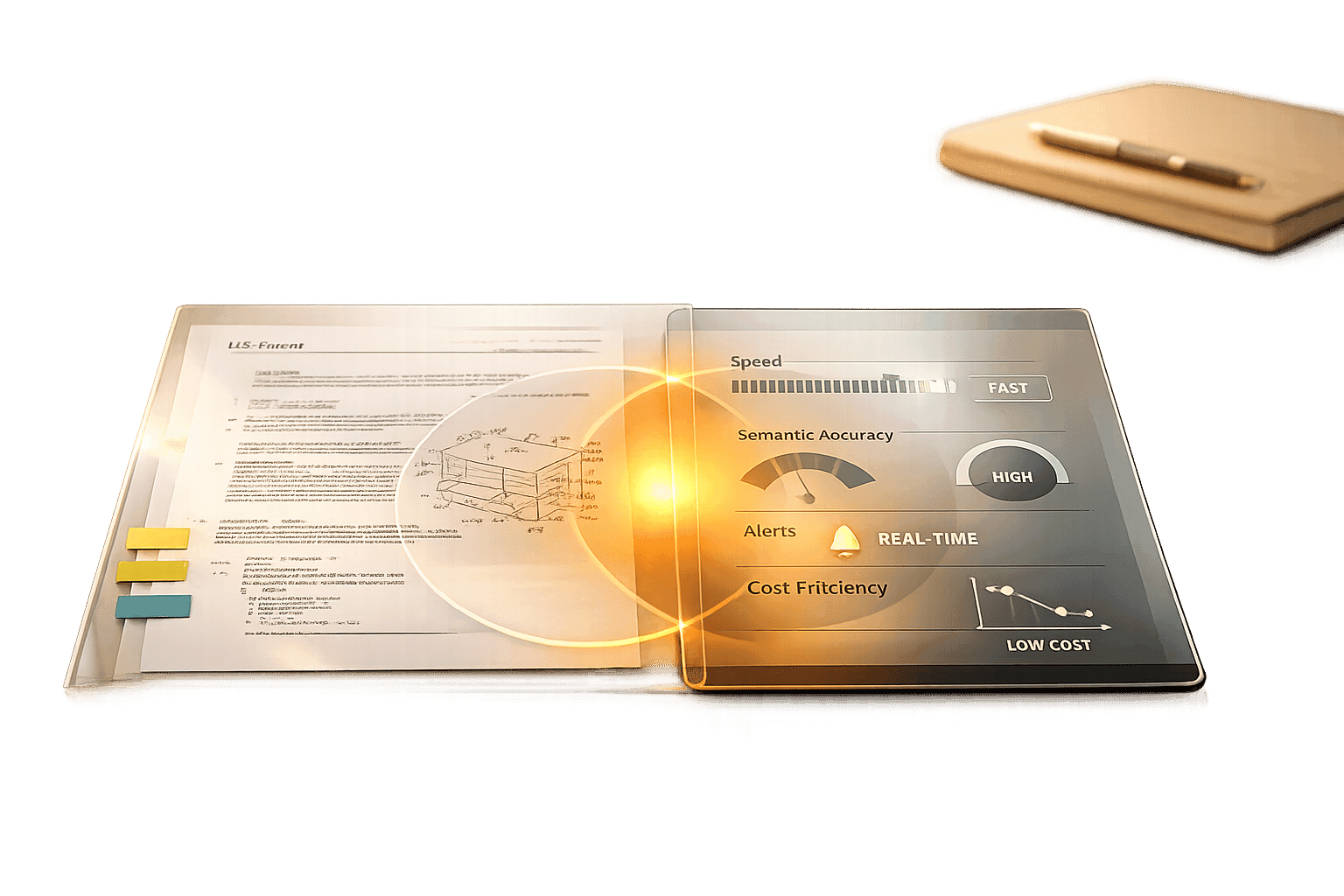
AI-driven patent monitoring is transforming how companies manage and analyze intellectual property. Here's why it stands out over top patent tools and manual approaches:
Speed: AI processes millions of patents in seconds, cutting search times by up to 70%. Traditional methods often take weeks.
Accuracy: Semantic searches understand concepts, reducing missed patents and irrelevant results. Manual keyword searches are prone to errors.
Cost: AI systems offer predictable subscription models, saving up to 90% in operational expenses over time.
Consistency: Unlike manual reviews affected by human fatigue, AI delivers reliable results every time.
Real-Time Updates: AI provides instant alerts on new filings and changes, while manual methods rely on periodic checks.
Quick Comparison
Feature | Manual Methods | AI-Driven Systems |
|---|---|---|
Speed | Weeks for searches | Seconds for millions of records |
Accuracy | Prone to missed patents | Semantic search reduces errors |
Cost | $800–$2,500 per search | $150–$600 per search (or subscription) |
Consistency | Varies with human factors | Always precise and reliable |
Updates | Periodic (monthly/quarterly) | Real-time alerts |
AI patent monitoring excels in speed, precision, and cost efficiency, making it ideal for large-scale monitoring and real-time insights. For nuanced cases, combining hybrid intelligence with human expertise ensures thorough and effective results.
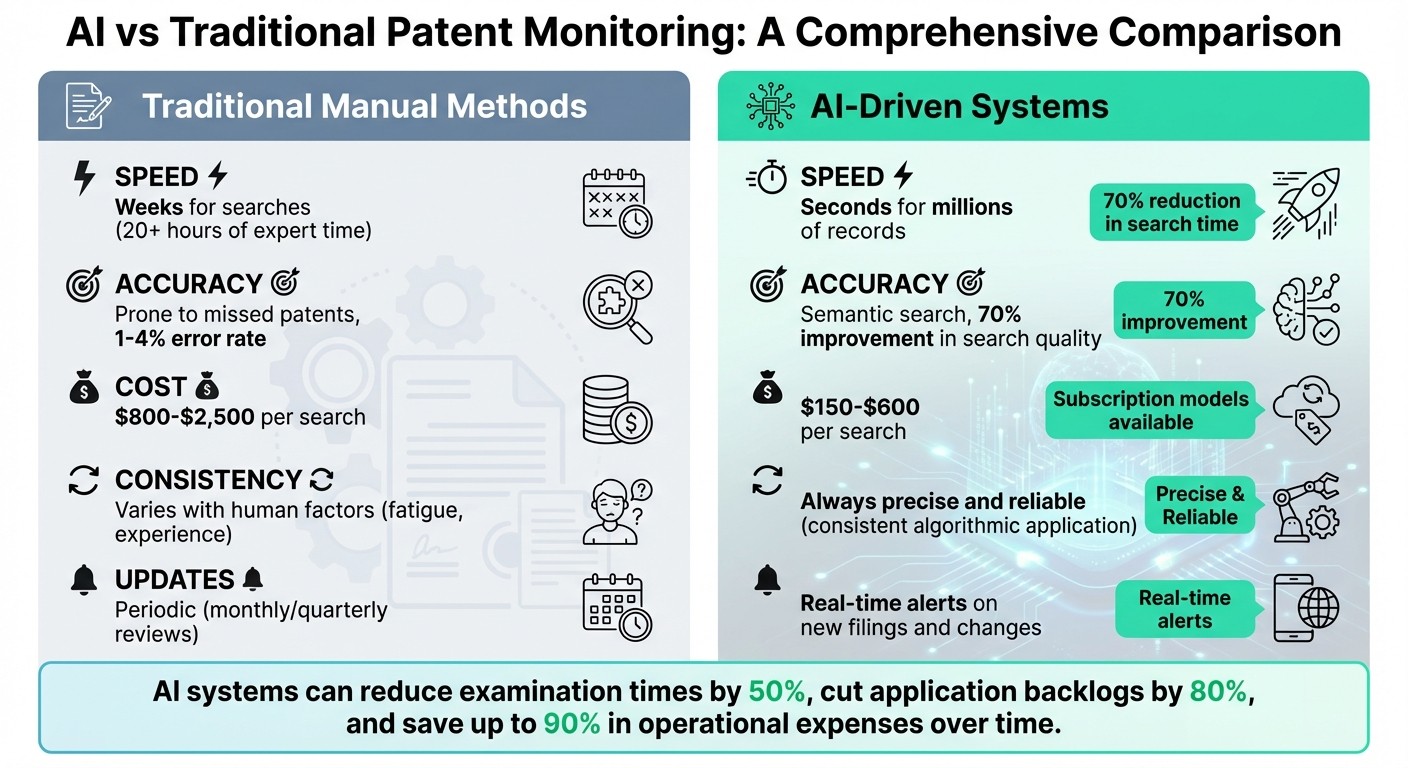
AI vs Traditional Patent Monitoring: Speed, Cost, and Accuracy Comparison
Speed and Time Efficiency
Automated Searches vs. Manual Processes
AI systems leave manual processes in the dust when it comes to efficiency. A manual patentability or invalidity search typically takes 20 hours or more of expert time. This involves sifting through 1.3 billion technical records spread across 179 databases.
In contrast, AI platforms can analyze millions of patent and non-patent literature records in seconds, slashing initial screening and search costs by as much as 70%. A great example is Brazil's National Institute of Industrial Property (INPI), which partnered with CAS in March 2022 to implement an AI-driven workflow. Using 10 custom algorithms and ensemble learning, the initiative achieved impressive results: a 50% reduction in examination times, an 80% drop in application backlog, and 77% of national applications requiring far less examiner search time.
Juliano Ryota Murakami, Partner at Gusmao & Labrunie, explained the stakes clearly:
"Excessive delays in patent examinations harm a country's innovation and economic development. They discourage companies from seeking legal protection for their inventions, since, when the patent is finally granted, the technology protected in it may be totally outdated and obsolete".
But the speed advantages of AI go beyond just faster searches - it also enables real-time monitoring.
Real-Time Updates
AI doesn’t just speed things up; it keeps you constantly informed. Traditional patent monitoring typically runs on a set schedule, like monthly or quarterly reviews. With 3.7 million patent applications filed globally each year, these periodic checks can easily miss critical filings.
AI changes the game by providing continuous surveillance and instant alerts for new filings, ownership changes, and legal events. For instance, starting October 20, 2025, the USPTO launched the Automated Search Pilot Program (ASAP!). This program uses an internal AI system to analyze application data and rank the top 10 most relevant prior art references before formal examinations even begin. Targeting at least 1,600 applications, the program aims to show how early AI insights can speed up prosecution.
This shift from periodic to real-time monitoring allows companies to react to competitive threats or licensing opportunities within hours instead of weeks, paving the way for a more agile and responsive patent strategy.
Accuracy and Coverage
AI advancements are doing more than just speeding up processes - they’re reshaping how we approach accuracy in patent monitoring.
Semantic Search Advantages
Traditional keyword searches often fall short because they can't bridge the semantic gap. This gap refers to the mismatch between the words you're searching for and the actual terms used in patents. For instance, if you're looking for "fitness trackers", a keyword search might miss patents that describe the same concept using terms like "activity bands" or "health monitoring wearables".
AI-driven semantic search tackles this issue by converting patent text into high-dimensional numerical vectors. These vectors map out concepts in a mathematical space, grouping similar ideas together regardless of the specific language used. For example, Patently's Vector AI allows users to describe inventions in plain language, uncovering conceptual matches that traditional keyword searches often miss.
Reports show that AI-powered semantic search can enhance search quality by up to 70% in some cases, with improvements of around 46% in others. This leap in quality is transforming the way patent monitoring is conducted.
"AI-powered semantic search does not just find keywords; it understands concepts, enabling searches of unprecedented accuracy, speed, and comprehensiveness." - DrugPatentWatch
Beyond refining accuracy, AI tools are also addressing coverage gaps in a way that manual methods simply can't.
Minimizing Coverage Gaps
The sheer volume of global patent filings - over 3.4 million in 2023 alone - and a corpus of more than 150 million documents make manual searches a daunting task. Human teams, no matter how skilled, struggle to maintain accuracy across such massive datasets. Traditional methods of data entry and review often result in error rates ranging from 1% to 4%, or 100 to 400 errors per 10,000 inputs.
AI-driven systems solve this problem by applying consistent criteria to every document, eliminating human fatigue and bias. These tools also excel in translating patents across more than 50 languages with over 95% accuracy, ensuring that no prior art is missed due to language barriers.
In one striking example, a Fortune 500 tech company avoided a $40 million patent infringement lawsuit in November 2025. Their AI-powered search tool uncovered prior art that had gone unnoticed for months using traditional keyword-based searches. That single discovery saved the company more than the cost of a decade’s worth of patent monitoring.
Comparison Table: Accuracy and Coverage
Feature | Traditional Keyword Method | AI-Driven Semantic Method |
|---|---|---|
Search Logic | Exact word/phrase matching (Boolean) | Conceptual and contextual meaning |
Synonym Handling | Manual entry of all possible variations | Automatic identification of related terms |
Language Support | Limited; requires separate searches | Cross-lingual (50+ languages) |
Error Risk | High (human oversight/fatigue) | Low (consistent algorithmic application) |
Discovery Scope | Limited to known terminology | Uncovers "hidden" or non-obvious art |
Search Quality | Baseline | Up to 70% improvement |
Detection Rate | Frequent false negatives | Minimizes gaps through conceptual matching |
Cost Considerations
AI doesn't just bring speed and accuracy to patent monitoring - it also reshapes the cost landscape. The financial benefits of AI-powered systems become increasingly evident compared to traditional manual methods, especially over time.
Initial Setup and Maintenance Costs
Traditional manual patent searches can cost anywhere from $800 to $2,500 per search, with comprehensive prior art searches for invalidity checks climbing to $5,000 to $10,000. Attorney fees add another layer, ranging from $5,000 to over $15,000 depending on the complexity.
AI-powered systems, on the other hand, operate on predictable subscription models. Basic novelty checks start at around $200 annually, while mid-tier options for research and development typically range between $3,000 and $7,000 per year. Enterprise-level systems cost between $15,000 and $30,000 annually, with advanced platforms exceeding $40,000 per year. While these upfront costs may appear steep, they pave the way for substantial long-term savings.
Long-Term Savings
Take the example of Amunet IP, which partnered with Lumitech in July 2025 to overhaul its patent screening process using AI. By integrating modular AI agents and natural language processing, they slashed the cost per query from over $200 to approximately $20. This shift saved $180,000 annually and reduced decision-making time from one month to just 10 minutes.
"The $180K didn't come from cutting corners. It came from cutting friction. From choosing the right tools, designing around the real pain points, and making sure every step, from search to decision, runs just a little bit smarter."
– Denis Salatin, Founder & CEO, Lumitech
AI also addresses hidden costs that traditional methods struggle to eliminate. For instance, manual office action reviews typically take 2 hours per case, while AI-assisted reviews reduce this to just 10–15 minutes, cutting processing time by about 87%. Similarly, in patent portfolio management, AI-driven renewals can save between $50,000 and $100,000 annually for portfolios of around 1,000 patents. Traditional multi-tier intermediary billing averages $150 per patent, but AI systems can bring that down to approximately $100 per patent.
The table below highlights these cost differences:
Cost Category | Traditional Manual Method | AI-Powered System |
|---|---|---|
Initial Search Cost | $800–$2,500 per search | $150–$600 per search |
Comprehensive Prior Art Search | $5,000–$10,000 | Included in subscription or ~$20/query |
Annual Platform Cost | N/A (pay-per-use) | $3,000–$40,000+ (subscription) |
Office Action Review | ~$850 per action | ~$500 per action |
Renewal Management | ~$150 per patent | ~$100 per patent |
Turnaround Time | 7–10 days | Under 48 hours |
Labor Cost Reduction | 0% (baseline) | Up to 60% |
These numbers make it clear: while AI systems may require higher initial investments, their efficiency and scalability result in dramatic cost reductions. In some cases, operational expenses can drop by as much as 90%. This transformative potential underscores the financial appeal of AI-powered solutions.
Consistency and Reliability
The quality of patent monitoring shouldn't depend on an examiner's mood or physical condition. Yet, traditional manual methods are prone to human inconsistency. Factors like an examiner's experience, time pressure, workload, or even fatigue can lead to fluctuating search results. Imagine one examiner meticulously identifying every relevant reference on a calm Tuesday morning, only to miss crucial prior art after a demanding Friday shift.
AI systems, on the other hand, sidestep these pitfalls entirely. They follow the same analytical steps with precision, no matter the workload or time of day. This tireless consistency ensures that best practices are always upheld, which becomes even more critical as patent portfolios grow larger and analysis demands increase.
Eliminating Human Oversight Risks
The sheer volume of modern patent data makes manual oversight a growing liability. With over 150 million patents globally and comprehensive searches spanning 1.3 billion technical records across 179 databases, the room for human error shrinks dramatically. AI, however, uses advanced semantic understanding to systematically identify key technical details, significantly reducing the risk of false negatives - errors that could lead to costly litigation down the line.
"Human search quality varies with experience, time, pressure, and fatigue. Agentic systems execute the same analytical steps consistently, ensuring that best practices... are always applied."
– Thomas Chazot, Head of Growth Marketing, DeepIP
Scalability and Reliability
As patent portfolios expand, traditional methods struggle to keep up. A prime example: the UK Intellectual Property Office had to double its workforce in a single year just to handle the surge in applications. AI systems, however, thrive under such conditions. Whether managing ten patents or ten thousand, their performance remains consistent. They also create traceable claim charts that clearly link invention features to prior art passages. This transparency allows human experts to quickly verify AI-generated results - something often missing in undocumented manual workflows. This steady reliability sets the stage for even more advanced capabilities that will be explored later.
Advanced Capabilities of AI Systems
AI patent monitoring offers more than just speed and consistency - it provides insights that manual methods simply can't achieve.
Multimodal Analysis
Traditional patent searches primarily focus on text, but patents often include technical drawings, flowcharts, and schematics that can't be fully understood through text alone.
Multimodal AI changes the game by analyzing both text and images simultaneously. By integrating various types of data into one analytical framework, these systems provide a deeper understanding of patents. For instance, when analyzing a mechanical patent, the AI doesn’t just read the claim language - it also studies the accompanying sketches to grasp spatial relationships, component interactions, and design elements that might not be explicitly described in words.
In July 2024, OpenAI secured USPTO Patent US12039431B1 for a multimodal system that lets users interact with images through point-and-click interfaces. This system provides contextually relevant AI responses, combining visual and textual inputs seamlessly.
The cost of training multimodal models has also dropped dramatically. A model that cost $100,000 to train in 2022 now requires less than $2,000, all while maintaining comprehensive analytical capabilities with minimal impact on speed. Although these models are about twice as expensive per token compared to text-only systems, they offer far more thorough analysis.
"Multimodal gen AI models... mirror the brain's ability to combine sensory inputs for a nuanced, holistic understanding of the world."
– McKinsey
These advanced methods aren’t just powerful - they’re also designed to fit seamlessly into existing workflows.
Integration and Customization
Modern AI platforms do more than analyze - they adapt to how teams work. Tools like Patently integrate with standard productivity software, embedding AI-enabled patent drafting tools and analyses directly into daily tasks.
Patently goes a step further by offering customizable project management features tailored to patent teams. These include hierarchical project categorization, granular access controls, and collaboration tools that ensure alignment across teams. Reports can be exported in various formats, and external data sources can be aggregated, creating a centralized hub rather than just another disconnected tool. This level of integration exemplifies how AI-driven platforms are reshaping patent monitoring.
Customization is where these systems truly shine. AI tools can be fine-tuned based on regular feedback, evolving alongside an organization’s needs. Some platforms even utilize "Technology-to-Application Mapping Tables" to connect technical functions with specific industries - such as healthcare, telecommunications, or automotive - helping teams quickly spot cross-sector opportunities or threats. Unlike static keyword-based searches, modern AI systems employ multi-step reasoning, reformulating queries, testing interpretations, and generating structured evidence chains. This ensures attorneys can verify results quickly, balancing professional oversight with improved efficiency.
Over time, these workflow advantages add up. Generative AI could automate 60% to 70% of tasks in knowledge-based professions. For patent professionals managing the 3.7 million applications filed globally each year, these capabilities are no longer optional - they’re becoming a must-have for staying competitive.
Conclusion: Choosing the Right Approach
Deciding between AI-powered and traditional patent monitoring isn't about picking one over the other - it’s about understanding what your organization truly needs. While manual searches excel in interpreting nuanced claims for critical cases, they fall short when faced with the sheer volume of millions of global patent applications.
AI platforms like Patently offer unparalleled speed, precision, and cost efficiency that manual methods struggle to match. Features like semantic search close terminology gaps, identifying patents that keyword-based searches might overlook. With round-the-clock automated monitoring, you’ll never miss an important filing or status update.
Consider this: automated searches can significantly cut initial screening costs, and patent examiners reportedly spend 40% of their time on prior art searches alone. These efficiency gains highlight how AI-powered systems can reshape the patent monitoring process.
For many organizations, a hybrid approach strikes the perfect balance. AI can handle rapid shortlisting and comprehensive technology mapping, while human experts provide the critical contextual validation and strategic insights. This combination ensures that the speed and breadth of AI complement the depth and precision of human review, creating a robust, layered strategy.
Think about your specific needs. If large-scale competitor monitoring, ongoing surveillance, or early-stage idea filtering are key priorities, AI automation isn’t just helpful - it’s essential. Platforms like Patently streamline everything from semantic searches to collaborative project management, offering a centralized system that grows with your team’s requirements. This approach not only enhances accuracy and scalability but also simplifies the day-to-day management of patents.
FAQs
How does AI improve the accuracy of patent monitoring compared to traditional methods?
AI-driven patent monitoring brings a new level of precision by leveraging semantic search and natural language processing (NLP). Instead of just matching keywords, these tools grasp the context and deeper meaning within patent documents. This approach cuts down on irrelevant results and ensures the output aligns better with what users are actually searching for.
On top of that, AI can handle massive datasets at incredible speed, scanning through millions of patents and technical records with remarkable accuracy. This capability significantly lowers the chance of overlooking critical prior art, making the entire patent monitoring process far more dependable and efficient compared to older manual or keyword-based techniques.
What are the cost advantages of using AI for patent monitoring?
AI-powered patent monitoring offers substantial savings in both time and money. These tools can handle tasks in hours that would typically take weeks, significantly cutting down on manual labor costs. Some organizations have even reported cost reductions of up to 90%, translating into savings worth hundreds of thousands of dollars each year.
Beyond cost savings, AI reduces the chances of overlooking critical prior art. This helps avoid costly rework and potential legal issues. By speeding up workflows and enhancing decision-making, AI tools make patent monitoring a far more efficient and economical option compared to traditional approaches.
Can AI manage complex patent cases without human involvement?
AI tools are transforming the patent process by automating tasks such as identifying prior art, assessing claim novelty, and offering predictive insights. These capabilities can save time and improve efficiency in handling complex patent-related tasks.
That said, human expertise is still irreplaceable. Interpreting detailed legal and technical nuances, ensuring precision, and managing unique case challenges require the judgment and experience that only people can provide.
AI shines when it's used as a partner to human decision-making, enhancing speed and accuracy while relying on human insight to navigate the complexities of the patent process.