Ultimate Guide to SEP Analytics for Patents
Intellectual Property Management
Feb 3, 2026
Learn how AI-driven SEP analytics verify essentiality, support FRAND licensing, and optimize patent portfolios for 4G/5G licensing and litigation.

SEPs are patents required to implement industry standards, like 5G or Wi-Fi, ensuring compatibility across devices. Unlike regular patents, SEP holders must license their patents under Fair, Reasonable, and Non-Discriminatory (FRAND) terms, balancing innovation with accessibility. However, not all declared SEPs are valid, making analytics crucial for verifying claims and managing portfolios.
Key Takeaways:
SEPs vs. Regular Patents: SEPs must be licensed under FRAND terms, unlike regular patents that can exclude usage.
Patent-to-Standard Mapping: Verifying essentiality involves aligning patent claims with standard specifications, often requiring tools like AI for efficiency.
FRAND Licensing: Licensing terms must be fair, reasonable, and non-discriminatory, with disputes often arising over royalty rates.
AI in SEP Analytics: AI streamlines the analysis of large SEP portfolios, helping identify patents that are actually relevant to standards.
Portfolio Management: Effective SEP management includes verifying essentiality, reducing over-declarations, and understanding global legal differences.
Why It Matters:
With over 300,000 declared SEPs globally and only 10-30% typically verified as valid, analytics tools are essential for navigating licensing, litigation, and portfolio valuation. AI-driven platforms like Patently simplify this process by offering verified data, semantic searches, and essentiality scoring.
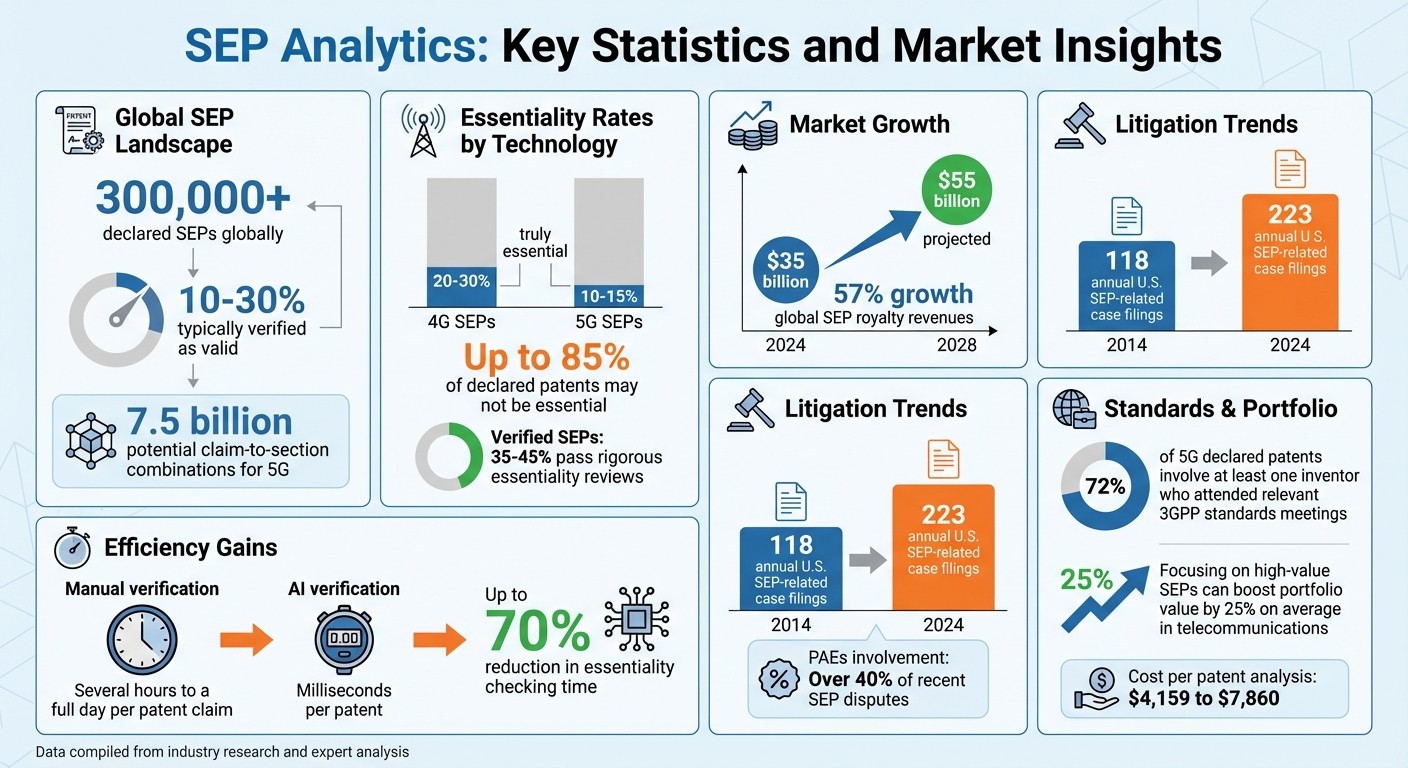
SEP Analytics Key Statistics: Essentiality Rates and Market Growth
GSLC Tim Pohlmann Welcome Remarks - SEP determination using AI
Core Concepts of SEP Analytics
SEP analytics revolves around two main ideas: patent-to-standard mapping and FRAND licensing. These concepts help determine which patents are genuinely essential, how they should be licensed, and their value in negotiations. Anyone working with SEP portfolios or handling licensing obligations needs to grasp these fundamentals.
Understanding Patent-to-Standard Mapping
Patent-to-standard mapping involves aligning patent claims with the technical specifications of a standard. A patent is considered essential only if every element of at least one claim matches a mandatory part of the standard. This process helps filter out truly essential patents from the many that are over-declared.
The mapping process typically includes these steps:
Identifying the relevant standards (e.g., 5G, Wi-Fi 6)
Gathering official specifications from Standard Setting Organizations (SSOs)
Analyzing claim language, definitions, and prosecution history to avoid scope issues
Documenting the findings in a claim chart
"Without a carefully-crafted claim chart, a patent has little value." - Kelce S. Wilson, Attorney, Grable Martin Fulton, PLLC
Research into 5G portfolios shows that the actual essentiality rates range between 6% and 30%. Verifying a single patent claim can take several hours or even a full day of expert analysis.
"The language and terminology used in patents is rather unique, and somewhat different from that used by technical engineers or product marketing personnel." - Kelce S. Wilson, Attorney, Grable Martin Fulton, PLLC
Given the complexity and volume of SEP declarations, many professionals now rely on AI-enabled patent analysis to compare patent claims with standard sections. These algorithms analyze terms as vectors in a conceptual space, moving beyond simple keyword searches. While these AI-driven tools improve efficiency, manual review is still the most reliable method for ensuring accuracy. Proper claim charts are critical not just for proving essentiality but also for strengthening licensing negotiations.
Once the mapping process is clear, the next step is to navigate the licensing framework under FRAND principles.
FRAND Commitments and Licensing Basics
FRAND commitments require licensing under Fair, Reasonable, and Non-Discriminatory terms. Most SSOs demand that members disclose any potentially essential patents and agree to FRAND licensing as a condition for including their technology in a standard. This system aims to balance patent owners' need to recover R&D costs with implementers' access to standardized technology - preventing "hold-up", or excessive royalty demands.
The three key elements of FRAND are:
FRAND Component | Description |
|---|---|
Fair | Licensing terms should be just and reflect the patent's actual value. |
Reasonable | Royalty rates must align with the standard and the patent's contribution. |
Non-Discriminatory | Terms should be consistent across similar licensees to maintain fairness. |
FRAND obligations require both parties to negotiate in good faith, with transparency and thorough documentation. Failing to show good faith can lead to consequences like losing injunctive relief for patent owners or facing higher litigation risks for implementers. The "Non-Discriminatory" aspect ensures that royalty rates stay consistent with those paid by similar companies, which requires careful analysis of factors like geographic scope, sales volume, and existing agreements.
"FRAND must be evaluated as a 'composite whole,' meaning that what might be fair and reasonable might also depend on what is non-discriminatory." - Fish & Richardson
Since FRAND royalties often depend on the number of essential patents, it's crucial to go beyond self-declarations and confirm essentiality through claim charting and technical mapping. FRAND interpretations vary across jurisdictions - UK courts might set global rates, while German courts focus on negotiation behavior - making it necessary for companies to adopt coordinated international strategies. To simplify licensing, many companies join patent pools, which offer consolidated licensing options for specific standards. However, these pools may not include all relevant SEPs.
Advanced SEP Analytics Techniques
Manually mapping patents to standards might work for small portfolios, but it quickly becomes unmanageable at scale. With over 300,000 declared patents worldwide and more than 7.5 billion potential claim-to-section combinations for 5G, relying solely on human review isn't practical or cost-effective. This is where advanced, AI-driven methods come into play, offering a way to streamline SEP analysis.
Using AI in SEP Analytics
AI platforms tackle the most labor-intensive parts of SEP analysis by employing semantic algorithms to map patent claims and standard sections. Instead of just matching keywords, these tools analyze the meaning and context behind technical language, bridging the gap between legal terminology and engineering specifications.
"A sophisticated AI algorithm can determine essentiality in milliseconds, whereas an expert will require days or sometimes weeks and months to come to the same decision." - Tim Pohlmann, Ph.D., Managing Director Americas, LexisNexis Intellectual Property Solutions
AI not only identifies irrelevant patents but also flags those with a high likelihood of essentiality for expert review. This approach combines the scalability of AI with the nuanced judgment of human experts.
These platforms also link patent data to standards participation. For instance, studies show that 72% of 5G declared patents involve at least one inventor who attended a 3GPP standards meeting where the related technical specification was discussed. Such links provide strong indicators of essentiality and help sift through over-declared patents.
Patently's SEP analytics tools include features like AI-powered essentiality scoring and a "True Essentiality" filter, enabling professionals to pinpoint genuinely essential patents within a portfolio. The platform also leverages Vector AI for semantic searches, making it easier to analyze patent families and map claims to specific standard sections.
Analyzing SEP Portfolios for 4G and 5G Technologies
AI's efficiency becomes even more critical when tackling the unique challenges of 4G and 5G technologies. Only about 20-30% of declared 4G patents are believed to be truly essential, and for 5G, that number drops to just 10-15%. This over-declaration problem underscores the need for systematic methods to identify valuable assets.
Start with claim segregation, which involves distinguishing between User Equipment claims (for devices) and infrastructure claims. Licensing and valuation often hinge on these differences.
"Not all declared patents are essential and not all essential patents are declared." - Tim Pohlmann, Ph.D., Managing Director Americas, LexisNexis Intellectual Property Solutions
For large portfolios, statistical sampling offers a practical way forward. Instead of analyzing every patent (a process that can cost between $4,159 and $7,860 per patent), professionals can focus on a representative sample - usually at least 100 families or 10% of the portfolio, with a cap of 1,000 families. AI tools can then extrapolate these findings to estimate essentiality rates across the entire portfolio.
Another key technique involves identifying undeclared SEPs. In areas like Wi-Fi 6 and video codecs, companies often submit blanket declarations without specifying patent numbers. AI classification tools can scan these portfolios to uncover technically essential patents that were never formally declared. This insight is vital for both companies building their portfolios and implementers assessing licensing risks.
Ultimately, the goal is to calculate royalty stack share - the proportion of total essential patents. This metric is crucial for determining FRAND royalty rates and assessing licensing opportunities and risks.
Best Practices for SEP Portfolio Management
Managing a Standard Essential Patent (SEP) portfolio effectively means balancing the creation of value with the need to minimize risks. With global SEP royalty revenues expected to grow from $35 billion in 2024 to $55 billion by 2028, and annual U.S. SEP-related case filings climbing from 118 in 2014 to 223 in 2024, strategic portfolio management has never been more important.
Increasing Portfolio Value Through SEP Analytics
Using analytics to evaluate your portfolio can help pinpoint high-value assets. For example, verifying essentiality is critical, as studies show that up to 85% of declared patents may not actually be essential. By identifying the patents that truly matter, you can strengthen your position in licensing negotiations.
An often-overlooked opportunity lies in undeclared SEPs - patents that are technically essential but have not been formally declared. A study of over 4,000 Wi-Fi 7 patents revealed that only 47% were essential, highlighting a significant number of undeclared SEPs. These "hidden gems" can open up new licensing opportunities without requiring additional R&D, making them a cost-effective way to expand your portfolio's value.
Pruning your portfolio is another key step. By shedding low-quality assets, you can reduce maintenance costs and improve your return on investment (ROI). In telecommunications, focusing on high-value SEPs can boost portfolio value by an average of 25%.
Benchmarking is also essential. By calculating your royalty stack share - the percentage of essential patents you hold in a standard - you can justify higher royalty demands. For example, Chinese companies now control 53.8% of foundational patents for the H.267 VVC standard, giving them a strong position in video codec licensing discussions.
When portfolio value is optimized, you're better prepared to manage risks in licensing and litigation.
Reducing Risks in SEP Licensing and Litigation
Risk management is as important as value creation. Start by conducting independent essentiality checks. Since only 35-45% of declared SEPs typically pass rigorous essentiality reviews, auditing both your own and competitors' portfolios can help you avoid weak licensing positions and manage royalty obligations effectively.
Understanding ultimate ownership is another critical step. Corporate structures can be complex, and identifying the true parent company behind patent holdings can provide leverage in negotiations. This is increasingly important as Patent Assertion Entities (PAEs) now account for more than 40% of SEP-related disputes in the U.S..
A global approach is essential for navigating regional legal differences. For instance, German courts are more inclined to grant injunctions, while the UK and China may set global FRAND (Fair, Reasonable, and Non-Discriminatory) rates. Keeping detailed records of all negotiations, including offers, counteroffers, and technical discussions, is crucial for demonstrating FRAND compliance if disputes arise.
Another key strategy is mapping product features to distinguish between mandatory and optional standard implementations. This can reveal design-around opportunities and reduce licensing costs. Before adopting standardized technology, check if your suppliers offer indemnity or litigation support for SEP-related claims.
Responding promptly to licensing requests is vital. Delays can lead to injunctions, especially in jurisdictions with stricter enforcement. Building a defensive SEP portfolio or publishing non-patented innovations can also help protect against competitors seeking patents on incremental improvements. Having accurate and transparent SEP data is fundamental for successful FRAND negotiations and effective risk management.
Using Patently for SEP Analytics
Patently's SEP analytics module, named Patently License, tackles the challenges patent professionals face when analyzing 4G and 5G portfolios. By leveraging advanced AI and comprehensive SEP data from Questel - covering over 20,000 5G and 15,000+ 4G patent families manually verified - Patently simplifies the process of evaluating SEPs.
Overview of Patently's SEP Analytics Features
Patently addresses the common issue of over-declaration in SEPs, where only 35-45% of declared SEPs typically pass expert essentiality reviews. The platform's True Essentiality filter ensures only patents verified as essential by technical experts are included. As Patently explains:
"See family-based counts of SEPs that experts have determined to be truly essential, not just those which have been declared as standard essential by the IPR holders".
The platform offers tools that make SEP analytics faster and more precise. For instance, the Vector AI semantic search eliminates the need for complex Boolean strings, making it easier to locate relevant patents. Meanwhile, the Forward and Backward (FAB) browser tracks citation networks across patent generations, providing a broader view of patent relationships. Patently also highlights its advanced AI tool, which significantly speeds up mapping patents to technical documentation:
"Our new breakthrough AI tool allows you to accurately map patents against technical documentation in minutes, unlocking high quality claim charting at unprecedented detail and scale".
Collaboration is made simpler with Patently Know, which lets teams add custom ratings and comments to patent families for tasks like novelty, validity, and freedom-to-operate reviews. To ensure accuracy, the platform refreshes global patent data every 30 days. For drafting new patents, the Onardo AI assistant can cut drafting time by 90% or more, whether working step-by-step or drafting complete specifications in one go.
The SEP analytics module also provides insights into ownership patterns, geographical reach, and technology coverage. It draws from a massive database of 176 million individual assets and 80 million patent families from 166 patent offices worldwide. This data is crucial for calculating royalty stack shares - your percentage of essential patents within a standard - helping justify licensing rates during FRAND negotiations.
Patently Pricing Plans
Patently offers a range of pricing plans to suit different professional needs:
Plan | Price | Users | Key SEP-Relevant Features |
|---|---|---|---|
Free | $0 | 1 | Basic search with filters, full patent details, family browsing |
Starter | $125/mo/user | Up to 10 | Semantic search (Vector AI), analytics, FAB citation browser, collaborative projects |
Business+ | Custom | Unlimited | AI patent drafting (Onardo), custom fields, fee tracking for families |
Law Firm+ | Custom | Unlimited | Matter-centric management, client access portals, all Business+ features |
Patently License | Contact for pricing | Custom | Advanced SEP analytics, True Essentiality filters, Questel data integration, ownership and technology coverage analysis |
The Starter plan at $125 per month per user is ideal for initial portfolio reviews and competitive analysis, offering tools like semantic search and analytics. For teams requiring AI-assisted drafting, Business+ adds the Onardo drafting assistant and allows unlimited users. The Patently License module, designed for managing large 4G and 5G portfolios, provides verified essentiality data, making it a critical tool for licensing or litigation. Pricing for this module is customized based on specific needs.
All paid plans, except the Free tier, include a 14-day free trial. Beyond telecom, Patently's data spans industries like smart homes, automotive systems, robotics, and medical applications, where 4G and 5G SEPs play an increasingly important role.
Conclusion
SEP analytics has become crucial for patent professionals navigating the intricate world of 4G, 5G, and the horizon of 6G technologies. With global SEP royalty revenues projected to hit $55 billion by 2028 and countless declared 5G patent families in play, identifying which patents are actually essential versus those merely declared remains a top priority for licensors and licensees alike. Research indicates that as much as 85% of declared patents may not truly align with the standards they claim to support.
The industry is increasingly moving toward data-driven portfolio management to tackle these challenges head-on. Tim Pohlmann, Managing Director Americas and Director SEP Analytics at LexisNexis Intellectual Property Solutions, emphasizes this shift:
"SEP litigation in the U.S. has entered a phase of sustained volume and complexity. With PAEs driving filings and AI reshaping portfolio analysis, IP professionals must transition from reactive defense to proactive, data-driven portfolio management".
Patent Assertion Entities (PAEs) now account for over 40% of recent SEP disputes - almost double their involvement from a decade ago. This surge highlights the growing complexity and stakes in SEP litigation.
AI-powered tools are stepping in to address these challenges. Platforms offering True Essentiality verification can cut essentiality checking time by up to 70%. For example, Patently's integration with Questel's expert-verified data tackles the issue of over-declaration, ensuring only patents deemed technically necessary are included in analyses. This leads to more accurate FRAND decisions and reduces the risk of inflated royalty payments.
Whether it's calculating royalty stack shares, countering PAE claims, or preparing for the next generation of wireless standards, the demand for precise, verified data is undeniable. The ability to differentiate between declared SEPs and truly essential ones often determines the line between fair payments and unnecessary costs. Rigorous analysis has never been more essential.
FAQs
How does AI streamline the process of verifying SEP essentiality?
AI is transforming the verification process for Standard Essential Patents (SEPs) by making it faster, more consistent, and scalable. Traditionally, verifying SEPs demanded extensive manual work by legal and technical experts, which took significant time and often carried the risk of human bias. Now, AI steps in to tackle these issues by using semantic analysis to compare patent language with standard specifications. This helps pinpoint patents that are likely essential to a given standard.
Even with these advancements, human oversight remains valuable. Interpreting patent claims and understanding their technological context can be complex, and AI works best when paired with expert judgment. That said, AI equips patent professionals with data-driven insights, enabling quicker and more reliable evaluations of SEPs - an increasingly crucial need in sectors like telecommunications and IoT.
How does FRAND licensing differ from standard patent licensing?
FRAND licensing involves agreements where patent holders are required to license their standard-essential patents (SEPs) under terms that are Fair, Reasonable, and Non-Discriminatory. This approach aims to strike a balance between the rights of patent holders and the needs of those implementing the technology, ensuring that the technology remains accessible without unfair restrictions.
On the other hand, standard patent licensing operates without these specific obligations. The terms in these agreements tend to be more flexible, often shaped by the negotiating power of the parties and the particular value of the patents being licensed. This allows for more tailored agreements, reflecting the unique circumstances of each negotiation.
Why is mapping patents to industry standards important for managing SEP portfolios?
Mapping patents to industry standards is a crucial step in managing Standard Essential Patent (SEP) portfolios. It pinpoints which patents are essential for implementing specific standards, ensuring that licensing strategies are grounded in reliable data. This process also supports adherence to FRAND (Fair, Reasonable, and Non-Discriminatory) commitments, which are key in the world of SEPs.
When done correctly, accurate mapping prevents the risk of overvaluing or undervaluing patents. It simplifies licensing negotiations, reducing the chances of disputes like infringement claims or challenges to a patent's validity. Beyond that, it helps identify critical patents for strategic development, fostering clarity and boosting the overall value of SEP portfolios. This is particularly important in complex fields like 4G, 5G, and IoT, where standards and technologies are constantly evolving.