AI in IP Task Management: Key Benefits
Intellectual Property Management
Feb 2, 2026
AI automates IP tasks—docketing, prior-art searches, and drafting—reducing errors, speeding workflows, and freeing teams for higher-value work.
AI is transforming intellectual property (IP) management by automating repetitive tasks, improving accuracy, and streamlining collaboration. Here's the bottom line:
Time Savings: Top patent tools reduce the time spent on tasks like prior art searches and document drafting, allowing professionals to focus on higher-value work.
Improved Accuracy: AI minimizes errors in documentation and enhances prior art analysis with advanced semantic search capabilities.
Enhanced Collaboration: Integrated platforms centralize workflows, simplify task assignments, and improve team coordination.
For example, Brazil’s INPI cut patent examination times by 50% and reduced its backlog by 80% using AI. With 45% of IP professionals already saving at least 25% of their time through AI, the shift toward automation is reshaping how IP tasks are handled.
Read on to learn how AI is addressing key pain points in IP management.
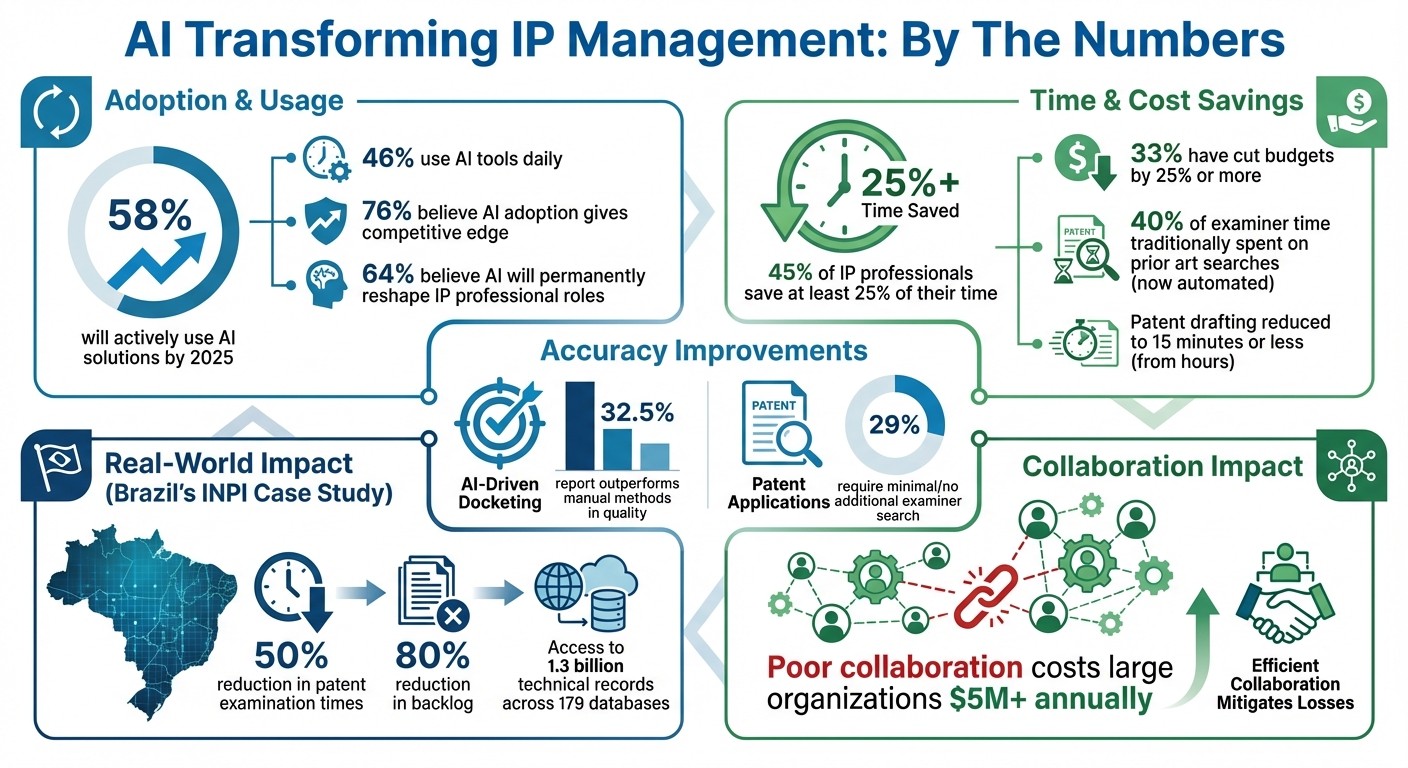
AI Impact on IP Management: Key Statistics and Time Savings
Integrated AI Workflows for Patent Prosecution IPWatchdog Webinar

Better Data Accuracy with AI
When it comes to IP management, accuracy is non-negotiable. A single missed deadline or a minor transcription error can derail a patent application, while inaccurate prior art searches risk producing patents that collapse under validity challenges. AI is stepping in to address these challenges with precision.
In fact, 32.5% of IP professionals report that AI-driven IP docketing and data verification outperform manual methods in quality. Why? AI eliminates the guesswork. Instead of manually entering details like applicant names, filing dates, or application numbers, AI automatically extracts this metadata - no typos, no skipped fields. Ralph Schroeder puts it best:
"AI can proactively identify inconsistencies or missing data by cross-referencing multiple sources and identifying anomalies that require attention".
Here’s how AI is making IP management more accurate by reducing documentation errors and refining prior art analysis.
Reducing Errors in Documentation
Patent drafts are prone to errors, whether it’s inconsistent claim numbering, mismatched terminology, or missing dependencies. These mistakes often lead to costly office rejections. The top generative AI patent drafting tools are changing the game by scanning drafts for these issues before submission. They validate claim structures, ensure consistent terminology throughout the document, and confirm that descriptions align with claims - acting as a built-in quality control system.
This same level of precision applies to prior art searches, where AI ensures a more comprehensive approach.
More Accurate Prior Art Analysis
Traditional keyword-based searches often miss patents that use different terminology for the same concept. AI revolutionizes this process with semantic search, powered by Natural Language Processing (NLP) and word embedding. Instead of focusing solely on exact keywords, AI understands the intent behind a query, uncovering conceptually related ideas.
The results speak for themselves. When Brazil's INPI adopted an AI system with 10 customized algorithms and ensemble learning in March 2022, the improvements were substantial. 29% of patent applications required minimal or no additional search by examiners. Examination times were cut by 50%, and the office’s backlog was reduced by a staggering 80%. By tapping into 1.3 billion technical records across 179 databases, the AI system delivered a level of thoroughness that manual methods simply can’t achieve.
AI isn’t just improving accuracy - it’s transforming the way IP professionals manage and analyze critical data.
Time Savings Through AI Automation
In the fast-paced world of IP management, time is everything. Missing a deadline can derail a patent application, while slow processing can create bottlenecks that hinder progress. AI is stepping in to tackle these issues. According to recent data, 45% of IP professionals report saving at least 25% of their time, and 46% use AI tools daily to manage their workloads.
Traditionally, examiners have spent up to 40% of their time on prior art searches. AI now automates these time-consuming tasks, scanning billions of documents, extracting metadata from patent office communications, and even generating first drafts of claims and descriptions. This automation allows professionals to shift their focus from tedious administrative work to making strategic decisions. It’s a game-changer for efficiency.
Faster Task Processing
AI slashes hours off repetitive tasks, transforming processes that once took entire workdays. Take docketing, for example - AI uses Natural Language Processing (NLP) to automatically extract metadata from PTO communications, ensuring accurate and instant data entry.
Drafting has also been revolutionized. Generative AI creates initial drafts of patent claims, descriptions, and trademark goods and services descriptions based on invention disclosures or prior registrations. What used to take hours can now be completed in minutes. Some AI-powered platforms even reduce the time needed to prepare complete invention disclosures to 15 minutes or less. Instead of starting from scratch, attorneys refine structured templates generated by AI, saving significant time and effort.
AI also handles other administrative tasks, such as formatting documents, renumbering patent figures, and running Optical Character Recognition (OCR) on search reports. These tools ensure that even the smallest details are managed efficiently.
Better Multitasking Capabilities
AI doesn’t just make individual tasks faster - it also improves the ability to juggle multiple projects at once. AI copilots integrate tools like legal databases, word processors, and IP management systems into a single, unified interface. This means professionals can check deadlines, draft responses, and review prior art all within one workspace - no more switching between multiple applications.
For global portfolios, this centralized approach is invaluable. AI systems automatically assign tasks to the right team members based on their workload and expertise. They can even reassign tasks when someone is out of the office. Workflow automation ensures that tasks are triggered by specific conditions, such as filing dates or examiner responses, so nothing is overlooked.
This capability allows IP teams to handle larger caseloads without adding more staff. They can monitor competitor filings, navigate jurisdictional requirements, and manage diverse portfolios seamlessly. As Toni Nijm, Chief Product Officer at Anaqua, explains:
"AI will handle the repetitive administrative tasks, freeing up IP professionals for more strategic work".
Ultimately, the true value of AI automation isn’t just in doing things faster - it’s in enabling teams to accomplish more while maintaining high-quality results. AI is helping IP professionals work smarter, not harder.
Better Collaboration Among IP Teams
Inefficient collaboration in large organizations can rack up costs exceeding $5 million annually. For IP teams managing intricate, multi-jurisdictional portfolios, these inefficiencies can delay projects and create expensive bottlenecks. AI is changing this dynamic by centralizing workflows and breaking down silos to unify team efforts.
AI-powered platforms go beyond task automation - they integrate document management, workflows, legal databases, and communication tools into a single workspace. Teams can collectively annotate documents using built-in communication features, ensuring everyone works from the latest version. When integrated with IP management software, AI assistants automatically sync updates across the system, keeping all collaborators aligned. This streamlined setup enhances team coordination and accelerates skill-building.
The results speak volumes. By 2025, 58% of IP professionals will actively use AI solutions for IP management, and 76% believe AI adoption gives them a competitive edge. These tools don’t just speed up processes - they reshape how teams collaborate, share knowledge, and grow together.
Easier Team Coordination
AI acts as the organization’s "eyes and ears", monitoring communications across email, chat, and video to provide context and ensure teams have access to necessary resources. By linking communication data with HR and CRM systems, AI helps identify internal experts and preserve institutional knowledge that might otherwise be lost when employees leave or change roles.
Workflow automation takes coordination even further. AI systems assign tasks based on factors like workload, expertise, and availability. If someone is unavailable, the system automatically reassigns tasks, avoiding delays. This intelligent task management allows teams to handle more cases without constant manual oversight.
Interactive dashboards and self-service portals provide stakeholders with real-time updates on portfolio status and custom reports, eliminating the need for manual data requests. Executives and internal clients can query the system using natural language and receive instant answers. This transparency lightens the communication load on IP teams and ensures everyone stays aligned.
Jasmine Cruz, Director of Product Solutions at Anaqua, highlights this streamlined approach:
"AQX is an end-to-end IP management platform... [it] really embodies our client's vision of IP management that is streamlined, efficient, and collaborative for all IP stakeholders".
As coordination improves, team members also gain valuable expertise through AI-supported workflows.
Faster Skill Development
AI doesn’t just streamline teamwork - it speeds up learning for junior team members. AI assistants can generate first drafts for patent claims, trademark reports, and office action responses. Instead of starting from scratch, junior professionals can refine these drafts, learning from structured templates in the process. This hands-on experience accelerates skill development compared to traditional methods.
Real-time feedback is another game-changer. AI flags potential issues in patent drafts that could lead to office action rejections, offering immediate guidance to help practitioners improve their work. Junior team members can also use AI to review their own drafts, catching potential problems before submission.
AI-driven summarization and classification tools simplify complex technical concepts and prior art by providing direct links to explanations and key findings. This on-demand support reduces reliance on senior staff, allowing experienced professionals to focus on strategy while juniors build independence.
The outcome? A more capable, self-reliant team. These skill gains complement the efficiency improvements AI brings, ensuring every team member contributes to smoother IP management. As Questel puts it:
"Qthena is designed to assist, not replace. Your expertise completes the workflow. The more context you can provide, the more tailored and helpful Qthena's draft becomes - always keeping you in control".
Patently's AI Tools for IP Task Management
Patently brings together the benefits of AI - accuracy, efficiency, and better teamwork - into one platform tailored for patent professionals. Its suite of tools tackles common challenges, such as drafting detailed patent specifications and performing comprehensive prior art analysis. Here’s how Patently’s tools make these tasks more manageable.
AI-Assisted Patent Creation
Onardo, Patently's drafting tool, simplifies the process of creating patent documents. By inputting claims and drawings, users can generate complete patent descriptions either step-by-step or all at once. It also auto-labels figure features with just two clicks. This tool cuts drafting time by over 90%, turning what used to be a lengthy process into a much faster one, while still leaving professionals in charge.
Semantic Search with Vector AI
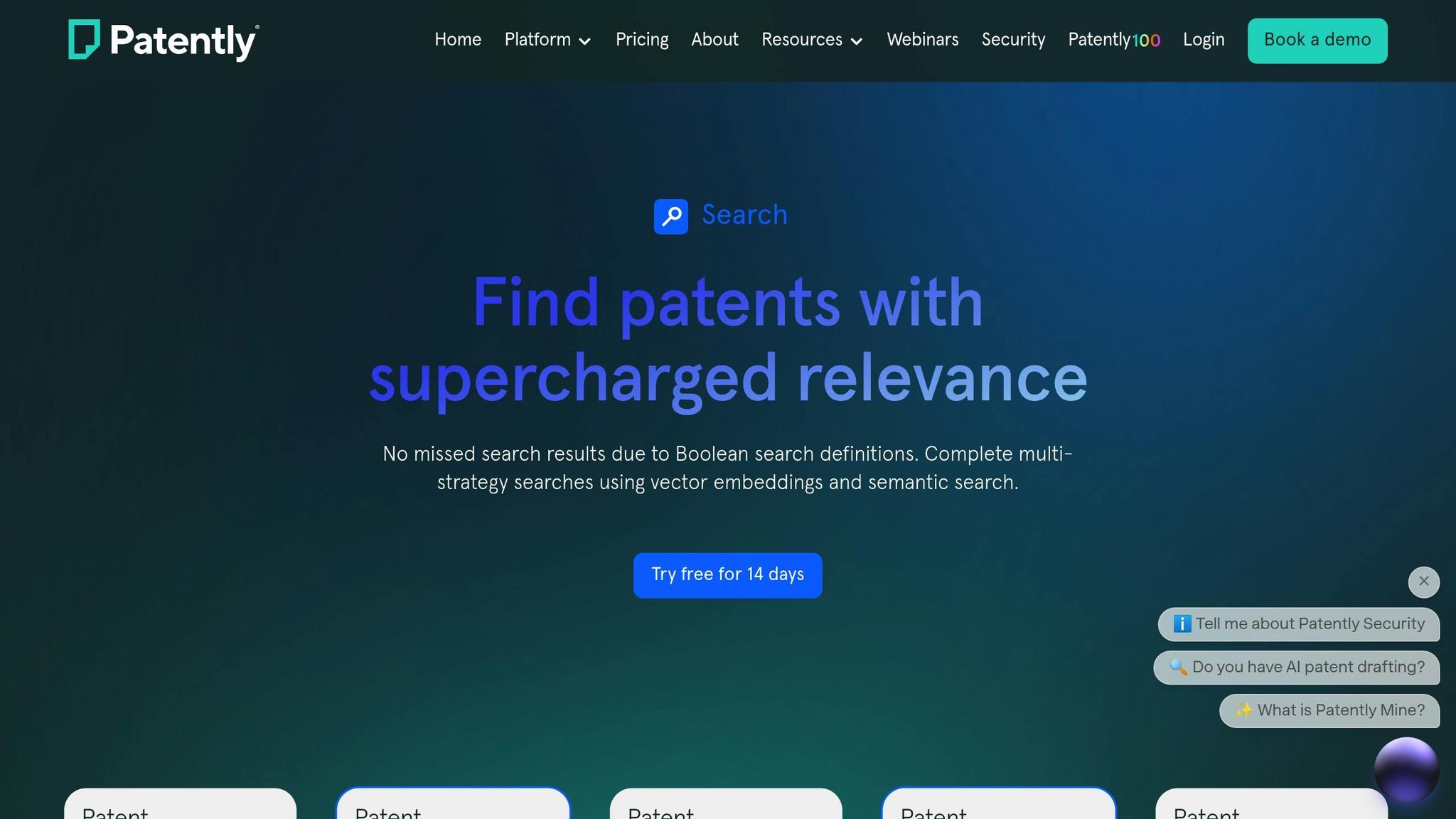
Patently’s Vector AI uses semantic search to grasp the context of queries and locate conceptually relevant prior art. The results are ranked automatically based on relevance, removing much of the guesswork. Traditional prior art searches can take 3 to 8 hours per case. Vector AI makes the process smoother and faster by helping professionals avoid sifting through irrelevant data.
Customizable Project Management Tools
Patently also offers project management features to simplify teamwork and task coordination. Projects can be organized by department, client, or specific matters, and granular access controls ensure confidentiality and compliance. Teams can collaborate effectively with shared comments, ratings, and insights at both the patent family and individual asset levels. The platform provides automatic updates every 30 days, generates smart reports, and includes one-click export options for Word or Excel, making it easier to share findings.
Conclusion
AI is transforming how intellectual property (IP) tasks are managed by automating repetitive processes like docketing and prior art searches. This not only reduces errors but also frees up professionals to focus on strategic, high-value work. According to data, 45% of IP professionals report saving at least 25% of their time, while 33% have managed to cut budgets by 25% or more through AI adoption.
The shift is clear: IP professionals are moving from being bogged down by administrative tasks to leveraging AI as a strategic advantage. In fact, 76% of practitioners believe AI adoption provides a competitive edge for their organizations, and 58% are already incorporating AI tools into their daily workflows. Rather than replacing human expertise, AI enhances it. As Toni Nijm, Chief Product Officer at Anaqua, explains:
"The future of IP management isn't about AI replacing human expertise. It's to augment IP professionals, freeing them from the time-consuming, transactional tasks."
This shift is exemplified by Patently's integrated AI solutions, which deliver practical tools for modern IP challenges. From AI-assisted patent creation to semantic search that grasps conceptual intent, and customizable project management features, Patently ensures secure collaboration and control over sensitive data. These tools directly address the critical challenges faced by IP professionals today. Evidence suggests this transformation is here to stay, with 64% of practitioners believing AI will permanently reshape the role of IP professionals.
FAQs
How does AI enhance accuracy in managing IP tasks?
AI improves precision in managing intellectual property (IP) tasks by automating labor-intensive processes like prior art searches and data analysis. It can process massive datasets, pinpoint essential details, and draw insights from unstructured information, cutting down the chances of human error.
With AI, patent professionals can achieve higher accuracy in areas like patent examinations, drafting, and portfolio management. This not only ensures more dependable results but also simplifies workflows, saving time and effort.
How does AI save time in intellectual property (IP) task management?
AI takes the hassle out of managing intellectual property tasks by handling repetitive chores like data entry, document review, and prior art searches. This frees up professionals to concentrate on more strategic and impactful work.
By streamlining workflows and reducing manual labor, AI dramatically shortens processing times. Tasks that used to drag on for weeks can now wrap up in just a few days, speeding up project timelines and boosting team efficiency.
How does AI improve collaboration within IP teams?
AI is transforming how IP teams work together by simplifying workflows and improving communication. It takes over repetitive tasks, delivers real-time data insights, and makes managing projects easier. This frees up team members to concentrate on more strategic, high-value activities instead of getting bogged down with administrative work.
Take patent drafting, prior art searches, or data analysis as examples. AI-powered tools streamline these processes, enabling teams to collaborate more effectively. They also ensure quick access to essential information, cutting down on delays and reducing the risk of miscommunication. By promoting smoother data sharing and smarter workflows, AI helps create a more cohesive and responsive environment for IP professionals.