AI Tools for SEP and Licensing Data Management
Intellectual Property Management
Feb 1, 2026
Compare AI platforms that speed SEP essentiality checks, streamline licensing data integration, and map patents to products for teams of all sizes.

Managing Standard Essential Patents (SEPs) and licensing data is complex. Key challenges include over-declaration, under-declaration, and fragmented datasets, which slow down essentiality reviews and complicate licensing negotiations. AI tools are now helping streamline these processes by improving accuracy, reducing research time, and connecting patents to technical standards.
Here’s a quick look at leading AI patent tools:
Patently: Offers SEP analytics, licensing data integration, and tools like "Patently Create" for patent drafting. Pricing starts at $125/month per user for smaller teams.
Tool B: Focuses on infringement workflows and claim chart generation. It uses AI to map patents to products but requires custom pricing.
IPlytics: Features a Semantic Essentiality Score to rank patents, tracks global ownership, and integrates market data. It’s designed for large-scale operations with custom pricing.
Each tool has strengths in specific areas like essentiality checks, licensing support, and scalability. Choosing the right one depends on your team’s needs and budget.
1. Patently
SEP Analytics Capabilities
Patently's License module leverages Questel's analytics to validate 4G and 5G SEP claims, mapping patent claims to technical documentation in just minutes. The platform keeps tabs on critical factors like ownership, geographical coverage, and technology coverage. This helps patent professionals confirm whether portfolio claims hold up under scrutiny.
"Have confidence in your 4G and 5G SEP data - for effective rate negotiations. We continually monitor every share of the stack so that you gain the inside track." - Patently
This level of analytics lays the groundwork for a seamless data integration approach, which is explored further in the next section.
Licensing Data Integration
Patently's licensing platform builds on its analytics foundation to simplify collaboration and negotiation. By combining proprietary SEP family data with external sources through Questel, it ensures teams can share insights and ratings in real time. Automatic updates every 30 days keep the data fresh.
The "Patently Know" feature enhances licensing negotiations by enabling teams to exchange comments and ratings at both the family and asset levels. Meanwhile, the "Patently Create" tool, tailored for U.S.-based patent attorneys, cuts patent drafting time by over 90%. Built-in ethical walls and access controls also help maintain confidentiality.
Pricing and Scalability
Patently provides options for different needs and budgets. It offers:
A free tier with basic search capabilities.
A Starter plan priced at $125/month per user for up to 10 users.
Custom-priced Business+ and Law Firm+ tiers, which include advanced tools like AI-powered patent drafting tools and matter-centric management.
For those interested in advanced SEP analytics, the Patently License module is available upon direct inquiry.
2. Tool B
SEP Analytics Capabilities
LexisNexis IPlytics tackles the challenge of pinpointing truly essential patents with precision. The platform uses a Semantic Essentiality Score (ranging from 1 to 100) to match independent patent claims with specific standard sections, effectively filtering out irrelevant data. This process ensures only the most relevant patents are highlighted for licensing discussions.
The Ultimate Owner feature maps over 21,000 ultimate owners, including subsidiaries and affiliates, to clarify who holds control over SEP portfolios during negotiations. For standards like Wi‑Fi 6, HEVC/VVC, and Qi Wireless, the platform employs Cipher AI technology to uncover "undeclared patents" - patents likely essential but not formally declared. Tim Pohlmann, SEP Analytics Director and founder of IPlytics, sheds light on their approach:
"Our approach to using AI involves comparing patent claims to standard sections to filter out irrelevant patents and identify likely standard essential patents".
With its detailed analytics, the platform seamlessly organizes and consolidates vast licensing datasets.
Licensing Data Integration
The platform integrates data from over 100 million global patents, harmonizing information on ownership, legal status, and family structure. To maintain accuracy, a multilingual team manually reviews more than 35 million patent families, while the system continuously tracks M&A and reassignment events in near real-time. This level of integration helps overcome the fragmented data landscape that often complicates SEP management.
In October 2025, the AI assistant Protégé™ was introduced, enabling users to make natural language queries and receive structured answers tailored for portfolio optimization and due diligence. Additionally, the Analysis Builder simplifies the creation of detailed workbooks using plain language, cutting down preparation time for licensing teams. For U.S. professionals dealing with patent assertion entities (PAEs), the tool identifies "unknown licensors" who have recently acquired SEP portfolios, offering insights into potential royalty risks.
Pricing and Scalability
The platform offers flexible pricing options, designed to cater to a variety of professional needs. Features like the AI‑powered Analysis Builder and AI‑Powered Insights are included at no extra cost. For teams requiring advanced customization, the AI Classifier and TechDiscovery modules are available as add-ons, providing tools for custom technology definitions and quick landscape exploration. The platform's cloud infrastructure processes billions of data points - comparing patent claims to standard sections - in milliseconds.
3. Tool C
SEP Analytics Capabilities
IPlytics employs semantic mapping to pinpoint standard-essential patents with precision. Its AI engine links patent claims to specific technical sections, such as 5G or Wi-Fi, effectively filtering out non-essential declarations. Using essentiality prediction models, the platform assigns AI-based scores to estimate how essential a patent might be. This process helps licensing teams focus on patents that are more likely to be essential, cutting down the manual effort required to manage extensive portfolios. By refining this mapping process, IPlytics creates a strong foundation for integrating data and extending its utility into broader market insights.
Licensing Data Integration
In addition to its SEP analytics, IPlytics incorporates market and licensing data to aid in strategic decision-making. It combines patent information with market intelligence, tracking technology transfers, patent assignments, and licensing agreements. The platform also provides competitive insights into patent pools and licensing programs. This predictive approach bridges the gap between technical standards and market trends, making it easier to align patents with commercial opportunities.
For U.S. companies, this integration is particularly valuable during intricate licensing negotiations, where understanding both the technical and market contexts can play a critical role in shaping favorable deal terms.
GSLC Tim Pohlmann Welcome Remarks - SEP determination using AI
Strengths and Weaknesses
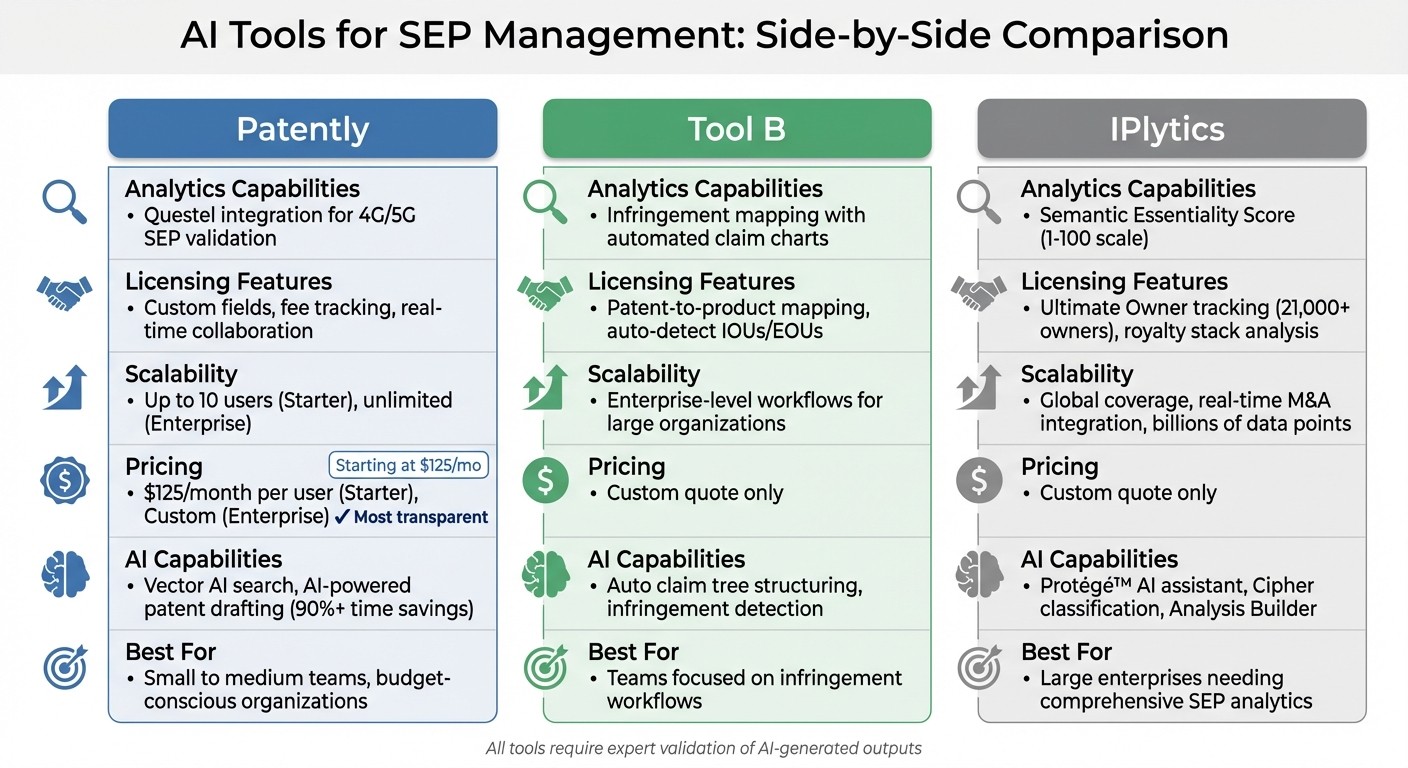
AI Tools for SEP Management: Feature and Pricing Comparison
This section dives into the strengths, limitations, scalability, and pricing of each platform to help shape your SEP management strategy. Tackling issues like over-declaration, under-declaration, and fragmented data integration, each tool presents its own mix of advantages and trade-offs in terms of cost and functionality.
Patently offers a straightforward pricing structure, starting with a free tier and moving to a Starter plan at $125 per user per month for up to 10 users. This makes it a practical choice for smaller teams or firms beginning their journey into AI-powered SEP analytics. Its "Patently License" module, enhanced by Questel's essentiality analysis, provides strong essentiality insights and a pricing approach that’s easy to understand.
Tool B shines in patent-to-product mapping, automatically generating claim charts to identify licensing opportunities and potential infringement. Its precision in this area makes it ideal for teams focused on infringement workflows. However, its pricing is available only via custom quotes, and its narrow focus may not meet the needs of teams seeking broader SEP portfolio analysis.
IPlytics specializes in SEP analytics through its Semantic Essentiality Score, which ranks patents on a scale of 1 to 100 based on their likelihood of being essential. This feature helps filter out over-declared patents and uncovers undeclared SEPs in technologies like Wi-Fi 6, offering a clearer view of the licensing landscape. While its advanced filtering capabilities are a strong point, its enterprise-level pricing could be a hurdle for smaller teams.
When it comes to scalability, the platforms differ widely. Patently’s lower tiers come with limits on family counts, with unlimited scalability only available in its Business+ and Enterprise plans. Tool B is designed for large organizations with enterprise-level workflows. IPlytics provides global coverage and real-time M&A integration, capable of processing billions of data points in milliseconds.
Here’s a quick comparison of the platforms:
Feature | Patently | Tool B | IPlytics |
|---|---|---|---|
Analytics | Questel integration | Infringement mapping; claim charts | Semantic Essentiality Score (1-100) |
Licensing | Custom fields; fee tracking | Patent-to-product mapping | Ultimate Owner tracking; royalty stack |
Scalability | Up to 10 users (Starter); unlimited (Enterprise) | Enterprise-level workflows | Global coverage; M&A integration |
Pricing | $125/mo/user (Starter); custom (Enterprise) | Custom quote | Custom quote |
AI Capabilities | Vector AI search; AI drafting | Auto-detect IOUs/EOUs; claim tree structuring | Protégé™ AI; Cipher classification |
While scalability is a concern for some platforms, all tools require expert validation of AI-generated outputs. It’s important to remember that AI-generated essentiality scores are tools for prioritization, not a substitute for expert review in making final decisions.
Conclusion
Choosing the right AI tool for SEP and licensing management comes down to aligning its features with your team's specific needs, budget, and workflow. Each platform offers distinct advantages depending on the size and focus of your operations.
Patently, priced at $125 per user per month, is a great starting point for smaller teams. Its tiered pricing model allows flexibility as your team grows. For larger, enterprise-level needs, Tool C provides scalability and advanced features designed for more complex operations.
If your team prioritizes infringement workflows and patent-to-product mapping, Tool B stands out with its automated claim chart generation, saving valuable time. However, its custom pricing and narrower focus may not appeal to organizations seeking broader portfolio analysis. This highlights the importance of matching a tool's strengths to your specific licensing challenges.
Tool C, on the other hand, employs its Semantic Essentiality Score to efficiently filter out non-essential declarations, offering a unique approach to SEP management.
"AI-based SEP determination may not be as accurate as an expert spending hours... but it has the advantage of repeatability, scalability and objectivity."
– Tim Pohlmann, Ph.D., Managing Director Americas, LexisNexis Intellectual Property Solutions
It’s important to remember that AI-generated essentiality scores should always be validated by experts to ensure accuracy and reliability in licensing decisions. Whether you choose an entry-level option like Patently or a more robust solution for handling complex, multi-jurisdictional portfolios, the right platform can simplify workflows and help control costs. By combining AI-driven insights with expert judgment, these tools can make SEP management and licensing negotiations more efficient and effective.
FAQs
How can AI tools simplify managing Standard Essential Patents (SEPs)?
AI tools simplify the management of Standard Essential Patents (SEPs) by using advanced analytics to provide clear, data-driven insights. One of their key benefits is identifying genuinely essential patents, which helps cut through the confusion caused by over-declarations or unverified claims. For instance, AI can predict SEP essentiality, allowing users to pinpoint which patents are crucial for technologies like 4G and 5G. This makes licensing discussions smoother and more straightforward.
These tools tap into extensive SEP databases and use AI-powered semantic search to assist with tasks like portfolio evaluation, identifying licensing opportunities, and negotiating rates. They also shed light on overlaps among licensors, patent pools, and standards, enabling stakeholders to make smarter decisions while avoiding risks such as disputes or over-licensing.
By enhancing accuracy and efficiency, AI-driven platforms offer a practical solution for tackling the challenges of SEP licensing and valuation.
What should I look for in an AI tool for managing SEP and licensing data?
When selecting an AI tool to manage Standard Essential Patent (SEP) and licensing data, there are a few important factors to keep in mind to ensure it aligns with your needs. First, data quality is non-negotiable. The tool should be capable of processing large, accurate, and dependable datasets to help analyze patent landscapes and SEP contributions effectively.
Next, look for advanced analytics capabilities. Tools that offer features like semantic search, patent landscape visualization, and detailed SEP insights can provide the clarity you need for smarter decision-making.
The platform’s usability is another key aspect. An intuitive interface, smooth integration with your current workflows, and strong data visualization features can make a big difference in boosting productivity. Lastly, think about the tool’s scalability and its ability to meet legal standards. It should be flexible enough to grow with your portfolio while staying compliant with regulations.
By weighing these factors, you can find a tool that not only simplifies SEP management but also helps guide strategic choices effectively.
How do AI-generated essentiality scores influence SEP licensing negotiations?
AI-generated essentiality scores are becoming a critical tool in SEP licensing negotiations. These scores, like Semantic Essentiality Scores (SES), provide an objective, data-driven way to evaluate how closely a patent’s claims align with a specific standard's specifications. By focusing on patents with higher essentiality, these assessments help parties zero in on the most relevant patents, leading to more accurate royalty calculations and balanced licensing terms. They also help reduce disputes over patents that may not be essential.
In large patent portfolios, AI tools can identify key patents, allowing organizations to prioritize their licensing strategies and make negotiations more efficient. This not only cuts down on time and legal expenses but also promotes greater transparency in the SEP licensing process. As AI continues to evolve, its ability to assess essentiality will further refine and streamline licensing discussions.