Top Patent Filing Regions for AI Innovations
Intellectual Property Management
Jan 28, 2026
Regional policies and industry focus explain why five regions—led by China, the US, Japan, South Korea, and Europe—dominate AI patent filings and shape global AI IP.

Artificial intelligence (AI) is transforming industries worldwide, and patent filings reflect this rapid growth. In 2024, 3.7 million patent applications were submitted globally, with AI-related innovations leading the charge. Five regions dominate AI patent filings: China, the United States, Japan, South Korea, and Europe (EPO), accounting for 85.5% of global filings. Here's a quick breakdown:
China: Leads with 49.1% of global AI patent filings, driven by government incentives and tech giants like Tencent and Baidu.
United States: Second in volume, excels in high-value international patents and innovation quality.
Japan: Focuses on robotics and industrial AI, with a strong patent grant rate.
South Korea: Known for AI hardware and semiconductors, supported by robust government policies.
Europe (EPO): Prioritizes ethical AI frameworks and Industry 4.0, with strong support for SMEs and researchers.
This article dives into the strengths, trends, and strategies shaping AI patent activity in these regions.
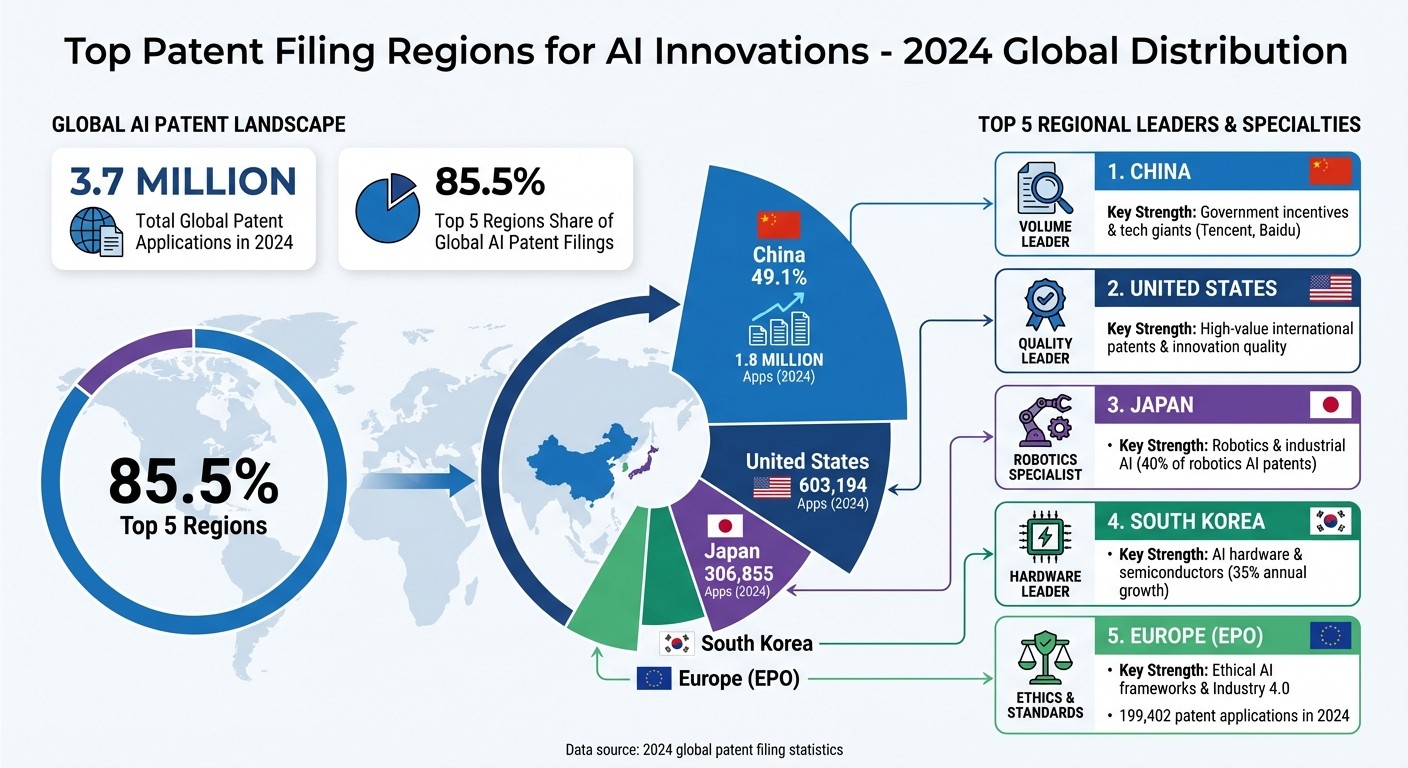
Global AI Patent Filing Distribution by Top 5 Regions in 2024
1. China
Volume of AI-related patent filings
China dominates the global stage in AI patent filings, accounting for 49.1% of applications in 2024. The National Intellectual Property Administration of China (CNIPA) received an impressive 1.8 million patent applications in 2024, marking a 9% increase from the previous year. Between 2014 and 2023, Chinese inventors submitted 38,210 GenAI-related inventions, a figure that is six times higher than what the United States filed during the same period. These numbers underscore China's growing influence in the AI sector, driven by its focus on innovation and strategic policies.
China’s top three AI companies - Tencent, Ping An Insurance, and Baidu - lead the world in GenAI patent applications. Tencent takes the top spot with 2,074 inventions, followed by Ping An Insurance with 1,564, and Baidu with 1,234. In 2023, China issued 920,797 patents, a staggering number compared to the 315,245 patents granted in the U.S. during the same year.
Government incentives and funding for AI innovation
China’s dominance in AI patents is no accident - it’s fueled by aggressive government policies and massive R&D investments. The country’s gross expenditure on R&D skyrocketed from $40.8 billion in 2000 to nearly $786 billion in 2024, reflecting a 13.1% annual growth rate, the highest globally. This aligns with China’s ambitious goal of becoming the global leader in AI by 2030.
One key area of focus is achieving independence in semiconductor technology. Over 60% of China’s AI patent filings are related to chip technologies, aiming to reduce reliance on foreign suppliers.
Presence of AI research institutions and industries
China’s AI ecosystem thrives not just on patent filings and government support but also on a strong combination of corporate innovation and academic excellence. The country is home to 47% of the world’s top AI researchers, with the Chinese Academy of Sciences ranking fourth globally for GenAI inventions. Remarkably, over 80% of AI-related patents in China come from its major tech companies.
China also leads in patent activity relative to its economy, with 4,977 resident applications per $100 billion of GDP in 2024 - the highest ratio worldwide. By 2030, the market value of China’s core AI industry and related sectors is expected to hit $1.4 trillion. Interestingly, only 6.9% of Chinese patent applications were filed abroad in 2024, highlighting a strategic focus on safeguarding innovations within its vast domestic market instead of prioritizing international patent filings. This domestic focus often necessitates advanced patent analysis to navigate the dense IP landscape.
2. United States
Volume of AI-related patent filings
In 2024, the United States Patent and Trademark Office (USPTO) received 603,194 patent applications, ranking as the second-highest globally. Of these, American applicants filed 231,536 patents abroad. A deeper dive by the USPTO's Artificial Intelligence Patent Dataset (AIPD), which analyzed 15.4 million documents spanning 1976 to 2023, revealed a striking trend: AI-related patent filings by U.S. organizations jumped from less than 5% in 1980 to over 20% by 2018. This rapid growth highlights the expanding role of AI in driving U.S. innovation and economic progress. Such robust filing activity also reflects the strong governmental support for digital advancements.
Government incentives and funding for AI innovation
The U.S. has carved out a niche in computer technology and digital communication - essential pillars for AI development. Computer technology alone accounted for 13.2% of all global patent filings and demonstrated an impressive annual growth rate of 10.3% between 2013 and 2023. Remarkably, it was the only field to achieve double-digit growth during that decade. High research and development (R&D) spending further bolsters the U.S.'s competitive edge. For instance, between 2020 and 2021, American innovators created 165,570 international patent families, representing 20.6% of the global total. This focus on securing high-value international protections underscores the country’s strategic approach to maintaining leadership in AI and related technologies.
Presence of AI research institutions and industries
U.S. innovators dominate non-resident patent filings in 12 of the top 20 global intellectual property (IP) offices. In 2024 alone, the USPTO issued 4,570 more patents than in 2023, reflecting the nation's strong domestic and international innovation output. The U.S. also boasts a resident patent-to-GDP ratio of 1,053 per $100 billion in 2024, a figure that underscores its mature innovation ecosystem. Interestingly, while economic growth has outpaced the increase in domestic patent filings, AI innovation remains vibrant, cutting across a variety of technology sectors, geographic areas, and inventor demographics.
Strength of intellectual property frameworks
The U.S. intellectual property system leverages advanced tools for startups and established firms to refine and improve patent processes. For example, the USPTO employs machine learning technologies like "BERT for Patents" to enhance the identification and classification of AI-related patents. Additionally, insights from the AIPD 2023 update, released in early 2025 by the Office of the Chief Economist, provide valuable data for researchers and policymakers tracking AI invention trends. The U.S. also prioritizes international patent protection, with American inventors consistently leading in filings abroad since surpassing Japan in 2013. This combination of domestic and international strategies is crucial for sustaining the U.S.'s position as a global leader in AI innovation.
3. Japan
Volume of AI-related Patent Filings
Japan has carved out a distinct niche in the global AI landscape, focusing on industrial and technological specialization. It ranks third in the world for AI patent applications and remains one of the "Big Five" intellectual property offices. In 2024, the Japan Patent Office (JPO) processed 306,855 patent applications, reflecting a 2.2% rise from the previous year. Out of these, around 26,400 were AI-related filings. However, Japan’s share of global patent families has decreased over the past decade, dropping from 12.8% in 2013 to 8.4% in 2023, largely due to China’s rapid growth in this area.
Japan’s approach to AI innovation is marked by a focus on specific sectors. In 2022, the country filed about 10,300 domestic AI-related applications, with 3,000 of those targeting AI Core Technology (classified as G06N). Unlike the U.S. and China, which lean heavily toward computer technology, Japan excels in areas like electrical machinery, energy systems, and robotics. For instance, Japan holds a commanding 32.1% share of global fuel cell technology patents and nearly 40% of robotics-related AI patents worldwide. This targeted expertise is supported by proactive government policies that emphasize quality over quantity in patent filings.
Government Incentives and Funding for AI Innovation
Japan’s commitment to AI innovation dates back to the 1980s, with early investments in expert systems and AI research. Today, the JPO continues to champion AI development by offering resources like "Patent Examination Case Examples" tailored specifically for AI technologies. These guidelines aim to simplify the patenting process for applicants, including small businesses, individuals, and academic institutions.
Rather than pursuing general-purpose AI, Japan channels its efforts into integrating AI within established industries such as robotics, industrial automation, and consumer electronics. This focused strategy is evident in the country’s high patent grant rate for AI inventions - 70%, compared to China’s 55% overall rate and 32% for AI-specific patents. Between 2019 and 2025, Japan secured 66,667 AI patents. To further accelerate innovation, the JPO offers expedited examination programs for cutting-edge technologies. This deliberate, sector-specific funding strategy fosters collaboration between academia and industry, reinforcing Japan’s leadership in industrial applications of AI.
Presence of AI Research Institutions and Industries
Japan’s AI patent activity is largely driven by its industrial powerhouses. Companies like Toyota, SoftBank, Fanuc, Hitachi, and Sony are at the forefront, focusing on integrating AI into physical systems and advanced mobility solutions rather than prioritizing software-only applications. This focus aligns with Japan’s long-standing expertise in precision manufacturing and robotics, which is now evolving into advanced AI-driven automation.
The country ranks second globally in patent-to-population ratio, with 1,913 resident applications per million people in 2024, and patent-to-GDP ratio, with 4,150 resident applications per $100 billion GDP - trailing only China in both metrics. Japanese applicants are also increasingly seeking international patent protection, ranking second worldwide for foreign filings with 181,963 applications in 2024. In terms of emerging trends, filings for technologies like Convolutional Neural Networks have steadily grown since 2014, while applications referencing "Transformers" surpassed those for deep reinforcement learning by 2020. Additionally, generative AI technologies, including ChatGPT, began significantly influencing AI-related inventions around 2023–2024, marking a shift in the nature and volume of patent activity.
4. South Korea
Volume of AI-related Patent Filings
South Korea holds the fourth spot globally in AI patent applications, following China, the U.S., and Japan. The country has cemented its reputation as a leader in AI-driven consumer electronics, semiconductor technology, and smart devices. In 2024 alone, South Korea contributed 6.6% of all patent applications submitted to the European Patent Office (EPO), with a total of 13,107 filings.
Notably, South Korea's patent filings grew by 4.2% in 2024, far outpacing China (0.5%), the U.S. (-0.8%), and Japan (-2.4%). AI semiconductor filings saw an impressive 35% annual growth, spearheaded by industry giants like Samsung and SK Hynix. Additionally, the country boasts a 65% approval rate for AI-related patents, a figure that surpasses the rates in both the United States and Europe.
In January 2026, Samsung Electronics continued to dominate, securing 7,054 granted patents in the U.S., making it the top patent holder for 2025. Other South Korean companies also made their mark, with Samsung Display ranking fifth (2,859 patents) and LG Electronics securing the tenth spot (2,284 patents) in the U.S.. At the EPO, Samsung Electronics reclaimed its position as the top patent applicant in 2024, filing over 5,000 European patent applications and overtaking competitors like Huawei. This momentum reflects both strong corporate performance and robust government support.
Government Incentives and Funding for AI Innovation
To sustain this growth, South Korea implemented the AI Basic Act in January 2026, consolidating 19 regulatory proposals to enhance the nation's AI competitiveness. This legislation serves as the foundation for advancing South Korea's position in AI innovation.
The government has also established a National AI Committee and an AI Safety Research Institute to oversee standards development and ensure ethical guidelines are followed. These initiatives have streamlined the patent process for South Korean companies, contributing to high approval rates and accelerating the pace of patent filings.
Presence of AI Research Institutions and Industries
South Korea's leadership in AI patents is largely fueled by its industrial giants, particularly in the AI hardware and semiconductor sectors. Samsung Electronics, a consistent presence on Clarivate's Top 100 Global Innovators list for 15 consecutive years, leads the charge in AI hardware advancements. The country boasts eight organizations in the Top 100 Global Innovators for 2026, with Samsung Electronics and LG Electronics earning "all-time recipient" recognition.
A major area of focus for South Korea is Physical AI, which integrates autonomous reasoning into robotics and edge computing systems. Companies like SK Hynix and Samsung are driving a 35% annual growth in AI semiconductor patent filings, emphasizing chips designed for deep learning and neuromorphic computing. LG Display, meanwhile, re-entered the Top 100 Global Innovators list in January 2026, reflecting a renewed emphasis on high-quality patents for AI-enhanced displays and consumer tech.
South Korean firms are also expanding into satellite connectivity, filing patents for satellite-compatible chipsets and non-terrestrial network protocols to enable global AI-driven communication. The adoption of the Unitary Patent system by South Korean companies nearly doubled, rising from 9.7% in 2023 to 18.9% in 2024, highlighting a growing focus on international patent protection.
5. India
Volume of AI-related Patent Filings
India's rise in the AI patent landscape adds an interesting layer to the global picture, standing as the fifth-largest contributor to AI-related patent filings worldwide. It follows major players like China, the United States, Japan, and South Korea. Between 2010 and 2025, India recorded more than 86,000 AI-related patents, a number that underscores its growing role in this field. Notably, filings during 2021–2025 were seven times higher than those from 2010–2015, showcasing the country’s accelerating pace.
Generative AI plays a prominent role in India’s patent activity, making up 28% of its total AI-related patents - far above the global average of 6%. Beyond this, Machine Learning forms the backbone of over 55% of AI filings, while Computer Vision and Natural Language Processing collectively account for more than 90% of the portfolio. Despite this progress, India’s patent grant ratio for AI remains relatively low at 0.37%, significantly trailing behind countries like China and the United States.
Government Incentives and Funding for AI Innovation
India's innovation ecosystem has seen a substantial boost in recent years. In 2023 alone, patent filings surged by 17.2%. A key driver of this growth has been domestic innovation, with resident filers making up 60.1% of applications in 2024 - a sharp increase from just 24.8% in 2013. The Indian Patent Office hit a major milestone in FY24, granting over 100,000 patents for the first time, a threefold jump compared to the previous year. Meanwhile, the patent-to-GDP ratio improved significantly, rising from 144 in 2013 to 381 in 2023, with annual patent grant growth reaching an impressive 149.4%.
Presence of AI Research Institutions and Industries
India’s AI focus leans heavily toward transportation, which accounts for over 70% of all AI patent filings. While this targeted approach reflects strategic prioritization, it also highlights a narrower industrial scope compared to regions with diversified AI portfolios. Domestic filings are largely driven by educational institutions, startups, and small-to-medium enterprises (SMEs). However, these groups face challenges in securing patents, with educational institutions achieving a grant ratio of just 1%, compared to a much higher 40% for enterprises.
"While India has made steady progress in strengthening its intellectual property regime, with increased filings and a more responsive Indian Patent Office, long timelines for patent approvals and quality patents remain key concerns when compared to advanced economies."
Rajesh Nambiar, President, Nasscom
Tamil Nadu leads the way in patent activity, contributing 10.4% of India's total filings in FY24. On the global stage, India’s patent growth rate of 19.1% in 2024 far outpaced the United States (0.8%) and Japan (2.2%), making it the only country among the top 20 globally to sustain consistent growth over the last decade.
This steady upward trajectory cements India’s position as a key player in the global AI patent ecosystem, reflecting its growing influence in shaping the future of AI innovation.
6. Taiwan
Volume of AI-related Patent Filings
Taiwan has carved out a notable position in the global AI patent landscape, securing third place in the Top 100 Global Innovators 2026 list. With 12 organizations making the cut, Taiwan trails only Japan (32) and the United States (18), while outperforming Germany and South Korea, which each have 8 organizations represented. This achievement highlights Taiwan's shift from sheer volume in patent filings to a focus on high-value, strategically significant AI inventions - a strategy often referred to as "precision innovation." This shift is supported by the adoption of top patent tools that enable firms to identify and protect high-impact IP.
These 12 leading innovators from Taiwan contribute to 16% of the world's most impactful AI inventions. This is a striking accomplishment, especially as global AI patent filings have surged, doubling repeatedly since 2019 and surpassing 1 million specifications. Taiwan's success isn’t just about numbers - it’s backed by a strong local ecosystem that supports and nurtures innovation at every level.
Presence of AI Research Institutions and Industries
Taiwan’s strength in AI innovation is deeply rooted in its high-tech manufacturing and semiconductor industries. These sectors not only drive research but also translate AI advancements into commercial success. A recent example of this is Silicon Motion, which made its debut on Clarivate's Top 100 Global Innovators list in January 2026, recognized for its impactful contributions to AI technology.
"Leading innovators are investing in AI as it redefines research, engineering, and commercial execution, actively shaping the future."
Maroun S. Mourad, President, Intellectual Property, Clarivate
Taiwan’s approach prioritizes quality over quantity, with organizations meeting rigorous international standards for patented innovation and invention strength. This focus has cemented Taiwan’s position as a key player in advancing high-impact AI technologies. As AI continues to revolutionize both traditional engineering fields and commercial applications, Taiwan’s strategic emphasis ensures it remains at the forefront of this transformation.
7. Europe (EPO)
Volume of AI-Related Patent Filings
The European Patent Office (EPO) holds its place as the fifth-largest patent office worldwide in terms of application volume, trailing behind China, the U.S., Japan, and South Korea. In 2024, the EPO handled 199,402 patent applications, with 16,815 of those in computer technology - a 3.3% increase compared to the previous year.
Although Europe's share of global patent applications dropped to 9.7% in 2024 from 12.9% a decade ago, the EPO continues to be a key player in offering high-quality patent protection for a market encompassing about 700 million people. The office currently manages over 2,000 European patents focused on artificial neural networks. Interestingly, 43% of EPO applications come from its 39 member states, while the remaining 57% originate from nations outside Europe, primarily the U.S., Japan, China, and South Korea. These numbers highlight Europe's strategic importance in the global patent landscape.
Government Incentives and Funding for AI Innovation
The European Union has introduced initiatives like the EU AI Act to establish a framework for AI safety and trust, alongside the European Chips Act, which supports AI hardware development.
In April 2024, the EPO introduced fee reductions for micro-enterprises, individual inventors, non-profits, universities, and public research institutions, making the patenting process more accessible. Additionally, the EU plans to provide startups and small-to-medium enterprises (SMEs) with access to a network of AI-focused European supercomputers, enabling them to train models without the high costs typically associated with such resources. Tools like the EPO's "Deep Tech Finder" are also available, helping over 100 European startups specializing in AI gain visibility with investors.
Presence of AI Research Institutions and Industries
Europe's innovation ecosystem thrives not only on patent filings but also on its dynamic research institutions and smaller enterprises. A significant portion of European innovation comes from smaller entities - 22% of patent applications from Europe are submitted by SMEs or individual inventors, and 7% by universities and public research organizations. The Fraunhofer Institute, a prominent public research organization, is among the top 25 applicants in computer technology at the EPO. Major European companies like Royal Philips, Siemens, and Ericsson also play a prominent role in AI patenting.
Germany and France dominate patent filings in Europe, with France experiencing an 18.2% increase in computer technology filings in 2023 and Germany seeing a 13.5% rise. The UK has made impressive progress, with a 200% surge in AI patents since 2018, while Switzerland and the Netherlands are emerging as key innovation centers.
Strength of Intellectual Property Frameworks
The launch of the Unitary Patent system in 2023 marked a significant step forward for intellectual property protection in Europe. This system allows inventors to secure patent protection across 18 EU Member States with a single request, reducing both costs and administrative hurdles. By 2024, 28,000 Unitary Patent requests were filed, accounting for 25.6% of European patents - a 53% increase compared to 2023. The system has been particularly popular among European SMEs and universities, with a remarkable uptake rate of 57.5%.
"As the Draghi and Letta reports warn, to stay competitive globally, Europe must enhance its innovation ecosystem and do more to help inventors scale up and commercialise their inventions, especially in critical areas such as green technologies, AI and semiconductors."
António Campinos, President, European Patent Office
Through its centralized granting process, the EPO ensures streamlined, high-quality patent protection across up to 45 countries.
Patent ownership for AI models heavily concentrated in Mainland China, says Clarivate analyst

Factors Behind Regional Dominance
Several key factors have fueled the global dominance of certain regions in AI development. Government funding plays a leading role, with massive financial investments reshaping the global AI landscape. For instance, China launched a $47.5 billion semiconductor fund in 2024 to bolster its AI hardware independence. Meanwhile, private AI investment in the U.S. soared to $109.1 billion that same year, dwarfing China’s $9.3 billion in private funding. India also made waves by pledging $1.25 billion to its "IndiaAI" initiative, which led to a staggering 400% increase in AI patent filings over five years. Other nations followed suit, with France committing €109 billion and Canada allocating $2.4 billion to AI-related efforts, marking a shift toward multi-billion-dollar initiatives.
Robust intellectual property (IP) frameworks are another driving force behind innovation. In July 2024, the U.S. Patent and Trademark Office (PTO) confirmed that AI-generated inventions could be patented if they demonstrated practical applications. Japan maintains a high 70% patent grant rate, while China, despite a lower 32% approval rate for AI-specific patents, compensates with an enormous volume of filings.
University-industry collaborations also play a pivotal role by turning academic research into tangible patents. For example, OpenAI, with Microsoft as a key investor, shifted from prioritizing trade secrecy to actively patenting its innovations. By early 2024, the organization had six U.S. patents (three granted, three pending). The Chinese Academy of Sciences has been a global leader, publishing over 600 patent families since 2014 and unveiling its "Zidong Taichu 2.0" large language model in 2023. Notably, eight of the top 10 research organizations worldwide for generative AI patenting are based in China. However, U.S.-affiliated research continues to receive significantly more citations, highlighting its greater perceived impact.
Adaptive regulation is another factor that sets leading regions apart. In 2024, the U.S. Federal Government introduced 59 AI-related regulations - double the number from 2023 - to build a "Responsible AI" ecosystem. The European Union launched its AI Action Plan in April 2025, which streamlined regulations and provided high-performance computing resources to enhance competitiveness. South Korea, with a 65% AI patent approval rate, stands in stark contrast to the U.S., where the annual approval rate hovers around 15%. These regulatory efforts underscore the strategic approaches regions are taking to maintain their competitive edge.
"The rise in international patents and trademarks demonstrates that U.S. innovation leadership is not a birthright. We must invest deeply in cultivating the best talent... in being the global leaders for core strategic technologies."
Dario Gil, Chair of the National Science Board's External Engagement Committee
Lastly, regional specialization has allowed countries to carve out niches in specific AI domains. China has excelled in areas like computer vision and generative AI, Japan has focused on robotics and control systems, and South Korea leads in speech processing and semiconductor development. This targeted approach enables each region to develop deep expertise in specific fields rather than spreading resources too thin across all areas of AI development.
Using Patently for Geographic Patent Intelligence

Tracking AI patent activity across different regions can be challenging due to diverse filing systems and language barriers. Patently simplifies this task with its geographic analytics tools, allowing patent professionals to differentiate between "office data" (where a patent application is filed) and "origin data" (the residence of the first-named applicant). This distinction is essential for pinpointing true domestic innovation hubs versus regions that are simply popular for filing patents.
The platform also excels in patent family tracking, grouping related applications for the same invention across various jurisdictions. This eliminates double-counting and ensures a more accurate view of geographical patent coverage. For example, this feature is particularly useful when analyzing AI-related patents filed across multiple offices - like the USPTO, CNIPA, JPO, KIPO, and EPO - to secure international protection.
Patently’s semantic search, powered by Vector AI, leverages natural language processing (NLP) and machine translation to perform effective cross-jurisdictional searches. This enables users to query patents in multiple languages and compare filings, such as those from China’s CNIPA with applications in the United States.
The platform also facilitates regional benchmarking by evaluating regions based on factors like talent, infrastructure, and enterprise adoption. Using tools like the Relative Specialization Index (RSI), patent teams can identify countries with a strong focus on specific AI subfields. For instance, China is recognized for its strength in computer vision, while South Korea leads in speech processing.
Beyond advanced search capabilities, Patently supports strategic decision-making for global filing strategies. Its geographic analytics tools provide visual insights into filing trends across major intellectual property offices, helping teams determine where to file based on regional activity and competitive landscapes. This data-driven approach replaces guesswork with actionable intelligence, offering clarity on where AI innovations are being most actively protected.
Conclusion
Global AI patent filings highlight some striking trends: China dominates in volume, the U.S. excels in quality - its patents are cited nearly seven times more often - and India is emerging as a major player with six consecutive years of double-digit growth, now outpacing traditional leaders like South Korea in annual filings. These patterns shed light on each region's strategic priorities.
China focuses heavily on computer vision and generative AI, Japan leads in robotics and industrial automation, South Korea emphasizes speech processing, and Europe concentrates on Industry 4.0 and ethical AI frameworks. These areas of specialization reflect each region's economic strategies in the global AI race, offering businesses valuable insights for directing R&D investments, planning market entry, and assessing freedom-to-operate opportunities.
Patent data acts as an early warning system for technological shifts and competitive risks, often surfacing well before products hit the market. With AI-related patent litigation climbing 25% annually and global AI patent grants increasing by 56% between 2020 and 2024, staying on top of these trends is no longer optional. The regions leading in patent filings today are paving the way for the future AI economy, making it crucial for businesses to keep a close eye on these developments in this fast-changing landscape.
FAQs
Why does China lead the world in AI patent filings?
China has emerged as a powerhouse in AI patent filings, thanks to a mix of strong government backing, a booming tech sector, and a focus on scaling innovation. The country has developed a state-driven innovation framework that emphasizes speed and quantity, giving it a major share of global AI patents - especially in areas like generative AI.
Tech giants such as Huawei, Baidu, and Tencent play a central role in this effort, filing large numbers of patents as part of a broader national goal to lead in AI technology. China's vast domestic market also plays a key role, providing fertile ground for research and development, which accelerates progress and supports technological breakthroughs. This deliberate emphasis on patent volume and technological advancement has solidified China's position as a global leader in AI intellectual property.
What makes U.S. patents for AI innovations stand out globally?
U.S. patents in the field of AI are notable for their focus on groundbreaking research and the influence they have on future advancements. This is evident in the higher number of forward citations they receive, which highlights their role in shaping upcoming innovations.
Moreover, the U.S. invests heavily in machine learning infrastructure and maintains rigorous patent examination processes. These efforts help ensure that patents are both high-quality and original. Unlike other regions that may prioritize quantity, the U.S. places greater importance on developing intellectual property with lasting value and impact.
How do government incentives influence AI innovation in different regions?
Government incentives play a crucial role in advancing AI by fueling research, development, and patent creation. These incentives often come in various forms, such as funding initiatives, tax benefits, grants, and policies aimed at easing financial and regulatory challenges for businesses and researchers. Regions with strong government backing tend to experience a surge in AI-related patent filings and technological progress.
By attracting top talent and global investments, these programs create a competitive atmosphere that drives advancements in AI. Areas with well-thought-out policies and comprehensive support systems often rise as leaders in AI innovation, influencing trends in both patent activity and technology. In essence, government incentives help build thriving ecosystems that support the ongoing evolution of AI.