Ultimate Guide to SEP Analytics for 5G
Intellectual Property Management
Jan 28, 2026
Identify truly essential 5G SEPs, cut licensing risk and costs with AI-driven analytics, semantic search, expert verification, and data curation.

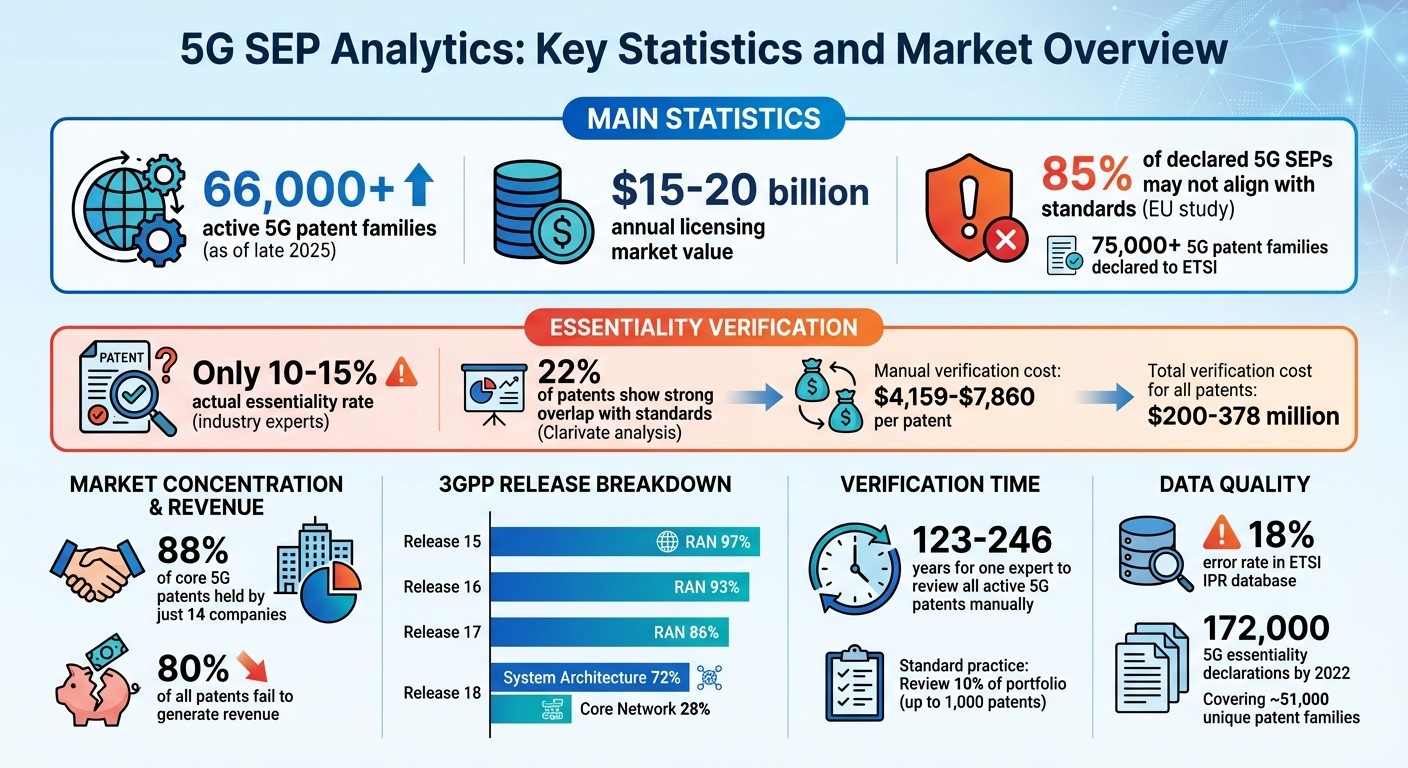
5G technology relies heavily on Standard Essential Patents (SEPs), which protect the core innovations enabling its functionality. However, not all declared SEPs are genuinely necessary - an EU study found that up to 85% of declared 5G SEPs may not align with the standards. This inefficiency inflates licensing costs and complicates negotiations.
Key takeaways:
Over 66,000 active 5G patent families exist as of late 2025, with Chinese companies like Huawei and ZTE leading in declarations.
The annual licensing market for 5G SEPs is valued between $15 billion and $20 billion.
SEP analytics help identify valuable patents, verify their relevance, and ensure compliance with FRAND (Fair, Reasonable, and Non-Discriminatory) terms.
Manual essentiality verification is costly, ranging from $4,159 to $7,860 per patent, but is crucial for accurate analysis.
SEP analytics tools like Patently License and Vector AI simplify the process by using AI to verify essentiality, analyze patent portfolios, and streamline licensing decisions. As 5G evolves into 5G-Advanced and 6G, these tools will be indispensable for navigating the complex landscape of wireless standards and patent management.
5G SEP Analytics: Key Statistics and Market Overview
5G Standards and SEP Declarations
5G Standards and 3GPP Technical Specifications
The Third Generation Partnership Project (3GPP) is at the heart of 5G standardization. It’s a collaboration between seven regional Standards Development Organizations (SDOs), including ETSI in Europe, ATIS in the United States, and CCSA in China. While 3GPP itself isn’t a legal entity, it acts as a partnership that develops the Technical Specifications (TS) and Technical Reports (TR) that define how 5G networks function.
3GPP organizes its work through three Technical Specification Groups (TSGs): RAN, SA, and CT. These groups handle all aspects of 5G technical standards. Here’s what each group focuses on:
Radio Access Network (RAN): Manages the radio interface and technologies like massive MIMO.
Service and System Aspects (SA): Designs overall architecture and features like network slicing.
Core Network and Terminals (CT): Focuses on protocols for core networks and ultra-reliable low-latency communication (URLLC).
These specifications are updated quarterly during TSG plenary meetings. Once a release reaches "frozen" status, it’s considered technically complete.
RAN specifications dominate the 5G patent landscape. For example, in Release 15, RAN accounted for 97% of all declarations, followed by 93% in Release 16 and 86% in Release 17. Within RAN, the RAN1 and RAN2 working groups alone contribute 93% of the total 5G Standard Essential Patent (SEP) share. However, Release 18 marks a shift: System Architecture now represents 72% of early declarations, while Core Network and Terminals account for the remaining 28%.
This structured process of standardization directly shapes how SEP declarations are made.
How SEP Declarations Work
Once technical standards are established, companies must navigate the SEP declaration process while adhering to FRAND commitments.
Companies declare patents they believe are essential to specific Technical Specifications in the ETSI IPR Online database. These declarations are linked to particular TS numbers. For instance, TS 38.331, which governs New Radio Resource Control, has the highest number of SEP declarations. This linking system helps manufacturers identify the patents required for specific 5G features.
The declaration process is tied to FRAND commitments, which aim to balance accessibility to essential technology with fair rewards for innovation. However, there’s a key limitation: companies can self-declare patents as essential without independent verification. By 2022, around 172,000 5G essentiality declarations had been made, covering roughly 51,000 unique patent families.
"Entities may declare any patent they believe is essential without independent validation. The number of declarations alone doesn’t reflect the true value or relevance of a patent."
Vince Paul Juguilon, Parola Analytics
The ETSI IPR database has its challenges. It lacks advanced search capabilities, and inconsistencies in formatting make it harder to assess licensing risks accurately. In fact, the data contains an estimated 18% error rate.
Accurate and reliable SEP declarations are critical for meaningful 5G analytics and informed licensing decisions.
Common Challenges in SEP Analytics
Verifying Patent Essentiality
One of the biggest hurdles with Standard Essential Patent (SEP) declarations is that most of them aren’t actually essential. Organizations like ETSI, which oversee standards like 5G, don’t verify whether a declared patent is truly necessary to implement the standard. Instead, they rely entirely on what the patent holder claims. This creates a significant mismatch between what’s declared and what’s genuinely required.
For example, an EU study revealed that about 85% of declared 5G SEPs aren’t essential. Some industry experts believe the actual essentiality rate could be even lower - somewhere between 10% and 15%. Clarivate analysts Gaurav Sawant, Parijat Oak, and Ed White conducted a detailed review in February 2023, analyzing over 14,300 declared patent families with at least one granted patent. Their findings? Only 22% of those patents had a strong overlap with the standards, making them "core" to 5G.
Why do companies over-declare? It’s often a strategic move to inflate their perceived market share or gain an edge in licensing negotiations. But verifying whether a patent is essential isn’t easy. It involves mapping each patent claim to specific sections of the 3GPP standards - a process that’s both time-consuming and error-prone. Quick reviews lasting 20–30 minutes tend to produce false positives, while rigorous claim charting, which takes 1–2 days per patent, is far more accurate. However, this thorough approach isn’t cheap. The cost? Anywhere between $4,159 and $7,860 per patent. For the 45,000 active 5G patent families, this could add up to a staggering $200–$378 million.
"SEP determination is complex and too often subject to systematic bias... Cleaned and curated patent declaration data can serve as one reference point among others... [but] such evidence must be thoroughly evaluated to make accurate assumptions about the essentiality, value and market share of a given SEP portfolio."
Tim Pohlmann, Ph.D., Managing Director Americas, LexisNexis Intellectual Property Solutions
Beyond the essentiality issue, the sheer volume of SEP declarations and their varying quality make the task even more challenging.
Managing Large Volumes of SEP Data
If verifying individual patents is already tough, the sheer number of declarations makes the job overwhelming. Right now, there are over 75,000 5G patent families declared to ETSI. That’s a massive increase compared to earlier generations like 3G and 4G.
The problem isn’t just the volume - it’s also the accuracy and consistency of the data. Inaccurate or poorly formatted declarations inflate the numbers and make essentiality verification even harder. To put the scale into perspective, it would take one expert 123 to 246 years to rigorously review all the active 5G patents. This means manually analyzing every patent isn’t just impractical - it’s impossible. Instead, IP professionals rely on statistical sampling, often reviewing at least 10% of a portfolio (up to 1,000 patents) to get reliable insights.
Data quality issues further complicate things. The ETSI IPR database, for example, has inconsistent formatting and limited search capabilities, making it difficult to assess licensing risks accurately. As a result, professionals often describe self-declared data as "easy to make - but hard to trust". To address these challenges, many now turn to expert-curated databases and double-blind reviews to minimize bias and extract meaningful insights .
GSLC Tim Pohlmann Welcome Remarks - SEP determination using AI
How Patently Supports 5G SEP Analytics
Managing the complexities of over 64,000 declared 5G patent families is no small feat. Patent professionals need tools that cut through the noise and focus on what truly matters. Patently steps up to this challenge with AI-driven features crafted specifically for Standard Essential Patent (SEP) analysis. These tools simplify the process, turning challenges into actionable insights.
AI-Powered SEP Data Analysis
Patently License, developed in collaboration with Questel, offers a "True Essentiality" filter. This feature ensures that patents deemed essential for 5G are verified by technical experts from Questel's Concur IP. The result? Reliable, trusted data that highlights high-value patents, saving companies time and resources.
Another powerful tool, Patently Know, dives deep into patent families, uncovering connections between related patents and simplifying the navigation of complex patent rights.
"Patently License with Questel brings a powerful True Essentiality filter so you can focus on the ones that matter."
Patently
Beyond current needs, these tools also forecast trends in sectors like IoT, automotive, and healthcare for 4G/5G, while preparing users for the shift to 6G. This forward-looking approach equips stakeholders for the next wave of standards evolution.
Semantic Search with Vector AI
Traditional keyword searches often fall short when it comes to technical nuances or regional phrasing differences. Enter Patently's Vector AI, which enables full-sentence searches by interpreting the underlying technical meaning. This capability ensures users can find the right 5G SEPs, even when terminology varies.
Patently’s system analyzes an immense dataset - over 82 million patent families and 135 million individual patents - mapping each patent to 226 distinct fields for thorough retrieval. For instance, a user leveraged relevance-based Elastic Search AI to identify 300 relevant patents in less than five minutes.
"With Elastic, it's like having a patent attorney with decades of experience guiding every search."
Andrew Crothers, Creative Director, Patently
By combining semantic searches with exact matches, filters (e.g., priority dates or assignees), and real-time data updates, Patently ensures its 5G SEP analytics remain precise and up-to-date.
Collaboration and Reporting Tools
Effective SEP analysis demands teamwork among attorneys, licensing teams, and technical experts. Patently’s project management tools make collaboration seamless with customizable workspaces and secure data sharing. Teams can structure their 5G SEP research hierarchically, track progress, and create tailored reports to support negotiations.
Features like essentiality filters spotlight key patent families, while advanced metrics reveal global ownership trends. Export options further enhance both internal planning and external negotiation efforts.
Future Trends in 5G SEP Analytics
As wireless standards grow more complex, SEP analytics must keep pace with advancements in AI and technology. For patent professionals, staying ahead means understanding where the industry is heading and adapting accordingly.
AI's Expanding Role in Patent Analytics
AI has become a cornerstone for managing SEP data. Brian Lavallée from Ciena highlights its importance, stating, "AI won't just be beneficial to 5G, it will be a necessity". The numbers underline this shift: forecasts predict 5G IoT connections will grow at a staggering CAGR of 59% between 2024 and 2030, surpassing 800 million connections.
One area where AI is making a significant impact is automated essentiality verification. For example, in January 2026, LexisNexis IPlytics released its "Who is Leading the 5G Patent Race?" report. Collaborating with over 30 ETSI-declaring companies, the report achieved a 99.9% data accuracy rate by cross-referencing declarations with internal records.
Additionally, 3GPP is laying the groundwork for AI/ML management through TS 28.105. This standard oversees the lifecycle of machine learning models, covering everything from training to deployment and inference. It also ensures that analytics tools evaluate not only patent relevance but also the reliability and security of the AI models themselves. These advancements are setting the stage for the future of 5G-Advanced and the early development of 6G.
Looking Ahead to 5G-Advanced and 6G
The challenges of 5G are evolving as 5G-Advanced and 6G standards emerge, requiring fresh approaches to SEP strategies. The transition to 5G-Advanced (Release 18 and 19) is already reshaping the landscape. Notably, 72% of technical specification declarations in early 5G-Advanced development originated from System Architecture (SA) working groups rather than the traditional Radio Access Network (RAN) groups. This shift reflects a growing emphasis on service-based and AI-integrated requirements.
When it comes to 6G, the stakes are even higher. Nokia describes 6G as a leap forward, stating it will "leverage new technological advancements in cloud computing, proliferation of AI and a data-driven design". The projected capabilities of 6G illustrate its potential:
Feature | 5G / 5G-Advanced | 6G (Projected) |
|---|---|---|
Peak Data Rate | 10 Gbps | 1,000 Gbps |
Latency | Milliseconds | Microseconds |
Device Density | 1 million per sq km | 10 million per sq km |
Core Design | AI-supported (NWDAF/MDAF) | AI-native (Every NF AI-powered) |
Patent professionals need to keep a close eye on 3GPP Release 19, which will outline the transition from 5G-Advanced to initial 6G specifications. Key areas of focus include Terahertz (THz) communication, AI-driven cognitive networks capable of self-healing and self-optimizing, and quantum-safe cryptography. With commercial 6G expected by 2030 and major breakthroughs anticipated as early as 2028, now is the time to craft forward-thinking SEP strategies for the next generation of wireless technology.
Conclusion
SEP analytics plays a crucial role in the world of 5G technology. By November 2023, over 75,000 5G patent families had been declared to ETSI. However, the real challenge lies not in the sheer volume of patents but in identifying which ones are genuinely essential. With only 37%–41% of declared patents meeting essentiality criteria, IP professionals must dig deeper than just patent counts to assess the true strength of a portfolio.
The stakes are high, both financially and strategically. A staggering 88% of core 5G patents are held by just 14 companies, while roughly 80% of all patents fail to generate revenue. This makes precise essentiality analysis a critical factor in FRAND negotiations, managing risks, and shaping strategic decisions. As Questel emphasizes:
"Manual essentiality analysis is a must to extract transparent and reliable 5G SEP insights and assess the relative strengths of 5G portfolios of SEP owners"
.
To tackle these challenges, robust and technology-driven solutions are indispensable.
Patently addresses these issues with its AI-powered tools designed specifically for 5G SEP analysis. Tools like Vector AI semantic search and automated claim charting help quickly pinpoint relevant SEPs and align them with 3GPP specifications. In collaboration with Questel, Patently delivers precise essentiality analysis, filtering out declared SEPs to identify those that align with the standards.
Patently also offers collaborative features, allowing IP teams to share insights and receive automatic updates every 30 days. For licensing negotiations, Patently License provides critical data on SEP ownership, geographic coverage, and technology domains - key factors in determining fair royalty rates.
As the industry moves toward 5G-Advanced and 6G, the increasing complexity of wireless standards makes mastering advanced SEP analytics tools today essential for staying ahead in the future.
FAQs
How do SEP analytics tools help manage and reduce 5G licensing costs?
SEP analytics tools play a key role in managing and cutting down licensing costs for 5G technologies. These tools verify the essentiality of patents, ensuring that licensing agreements are grounded in accurate and relevant patent data. This helps businesses avoid paying for patents that aren't essential and supports fairer negotiations.
Moreover, these tools are instrumental in determining FRAND (Fair, Reasonable, and Non-Discriminatory) rates. They enable parties to negotiate agreements that align with fair market values. By reducing disputes and clarifying licensing terms, SEP analytics tools make the process smoother, lower risks, and help businesses get the most value while staying aligned with industry standards.
What are the key challenges in determining the essentiality of 5G SEPs?
Determining which 5G Standard Essential Patents (SEPs) are genuinely vital to the 5G standard is no easy task. The sheer volume of patent declarations creates a significant challenge in identifying the ones that are truly essential.
On top of that, this process often requires manual analysis. While automated tools exist, they don't always deliver the level of precision needed for licensing agreements or legal disputes. As a result, this can lead to inefficiencies and make it harder to extract dependable insights that are crucial for informed decision-making.
How will the shift to 5G-Advanced and 6G affect SEP strategies?
The shift toward 5G-Advanced and 6G technologies is set to transform how businesses approach Standard Essential Patents (SEPs). As 5G-Advanced pushes network performance and capabilities to new heights, companies will need to adjust their SEP strategies to meet updated standards. This ensures their patents maintain relevance and value in a rapidly evolving tech environment.
Looking ahead, 6G promises groundbreaking advancements like AI-powered networking, the use of the terahertz spectrum, and integrated sensing technologies. These developments are expected to trigger a wave of patent activity, emphasizing the importance of actively managing SEP portfolios. Companies will need to evaluate the essentiality of their patents and fine-tune their licensing strategies to remain competitive in this next phase of wireless innovation.
Focusing on areas such as AI integration and advanced spectrum use will be key for organizations aiming to secure their place in the future of wireless connectivity.