Top Tools for Hybrid Patent Search Optimization
Intellectual Property Management
Apr 22, 2026
Compare top hybrid patent search tools that blend Vector AI and Boolean filters to boost recall, speed searches, and improve accuracy.
In 2026, hybrid patent search tools are reshaping how intellectual property professionals conduct research. These tools combine Vector AI for semantic understanding and Boolean methods for precise filtering, making patent searches faster and more accurate. Key benefits include:
Increased recall: Up to 40% more relevant results by bridging terminology gaps.
Time savings: Reduces analysis time by up to 50%.
Improved accuracy: Cuts false negatives by 30–60%.
Here’s a quick rundown of the best tools available:
Patently: Combines semantic search with Boolean filters, supports real-time updates, and offers multilingual capabilities.
PatSeer: Features AI-generated summaries, advanced Boolean tools, and a massive database of 172+ million records.
IPRally: Uses Graph AI for technical structure analysis and offers multilingual semantic search.
NLPatent: Employs large language models for conceptual analysis and integrates proximity rules in Boolean queries.
Cypris: Combines AI with a proprietary R&D ontology, supporting patent and non-patent literature searches.
Orbit Intelligence: Offers claim-level semantic analysis and customizable ranking.
Patentfield: Features high-speed AI classification and image-based prior art search.
Each tool has unique strengths, so your choice should align with your specific research needs, such as database coverage, analysis features, or integration with workflows. Below is a comparison to help you decide.
Quick Comparison
Tool | Key Features | Database Coverage | Best For |
|---|---|---|---|
Patently | Real-time updates, multilingual semantic search | 107 jurisdictions | Semantic and real-time patent searches |
PatSeer | AI summaries, Boolean reranking | 172+ million records | Large-scale research and Boolean refinement |
IPRally | Graph AI, multilingual search | 125 million patents | Technical structure analysis |
NLPatent | LLM-based semantic engine, proximity rules | Conceptual analysis and litigation research | |
Cypris | Patent and non-patent literature integration | 500+ million documents | Competitive intelligence and broad searches |
Orbit Intelligence | Claim-level semantic ranking, customizable filters | 100 million patents | Claim-focused analysis |
Patentfield | Image-based search, high-speed AI classification | Major global patent offices | Visual prior art and bulk classification |
These tools address challenges like terminology mismatches and inefficient workflows, making them essential for modern patent research. Choose one that fits your goals, whether it's prior art analysis, freedom-to-operate or novelty searches, or patent landscaping.
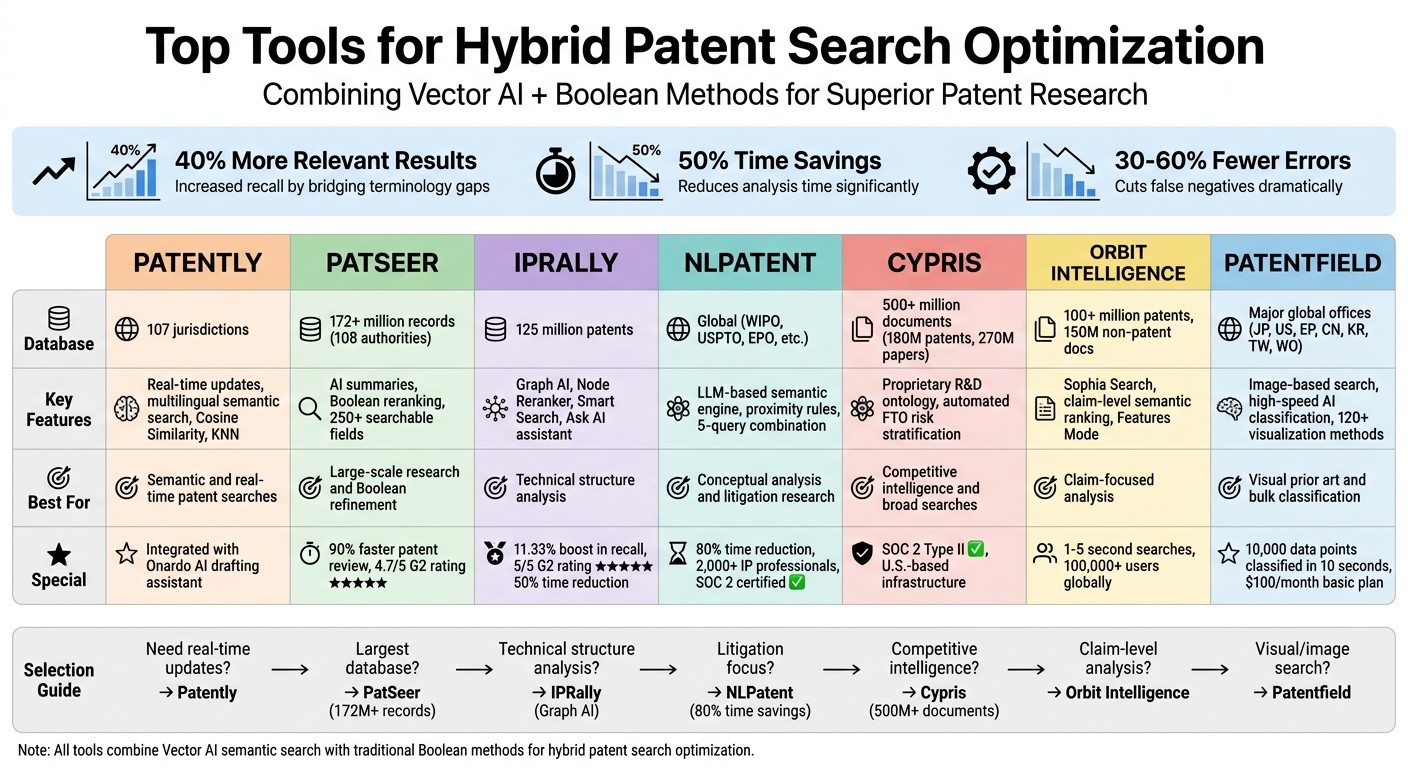
Hybrid Patent Search Tools Comparison: Features, Database Coverage, and Best Use Cases
How Enterprises Uses Generative AI for Patent Search, Drafting & Classification | IP Author Webinar
1. Patently
Patently combines advanced Vector AI semantic search with traditional Boolean filtering to deliver a powerful patent search experience. Built on the Elastic Search AI Platform, it uses natural language processing (NLP) and transformer models to convert patent text into vectors, capturing meanings that go beyond exact keywords.
Vector AI Capabilities
Patently's Vector AI employs Cosine Similarity and K-Nearest Neighbors (KNN) to measure the closeness of vectors, making it easier to identify patents with similar concepts, even when different terminology is used. Instead of relying on complex Boolean strings, users can input plain language descriptions like "In-ear headphones with noise isolating tips" to find relevant results. It also supports multilingual searches, bridging terms like "Bremssystem" and "brake system" by analyzing context.
"This powerful addition [Vector AI] has positioned Patently as one of the most innovative platforms for semantic patent search and is core to our technology stack."
Jerome Spaargaren, Founder and Director, Patently
This semantic search seamlessly integrates with traditional filtering methods, creating a well-rounded search platform. This versatility makes it a strong contender among the top patent tools currently available for IP professionals.
Integration of Traditional Search Methods
Patently doesn’t stop at semantic search. It blends traditional search techniques to refine results further. For instance, combining a natural language query with filters - such as a priority date before 2000 and limiting results to Sony applications - helped narrow down 300 results to the desired patents in under five minutes. Additionally, it includes a forward and backward citation browser, allowing users to trace how technologies have developed over time.
Database Coverage
Patently indexes patent data from 107 jurisdictions, including major ones like the USPTO, EPO, WIPO, and CNIPA. The platform has shifted from monthly batch updates to real-time data intake, giving users immediate access to the latest filings. This real-time feature is especially useful for freedom-to-operate analyses, where newly published applications could influence clearance decisions.
Optimization Benefits
Patently enhances its hybrid search workflow by prioritizing relevance over keyword density, making it easier to quickly identify critical prior art. The Vector AI search is also integrated into Onardo, generative AI patent drafting tools like Onardo, streamlining the prior art search process while drafting patent specifications. For optimal results, users can apply priority date filters after the initial semantic search to exclude documents published after the invention's conception date.
2. PatSeer
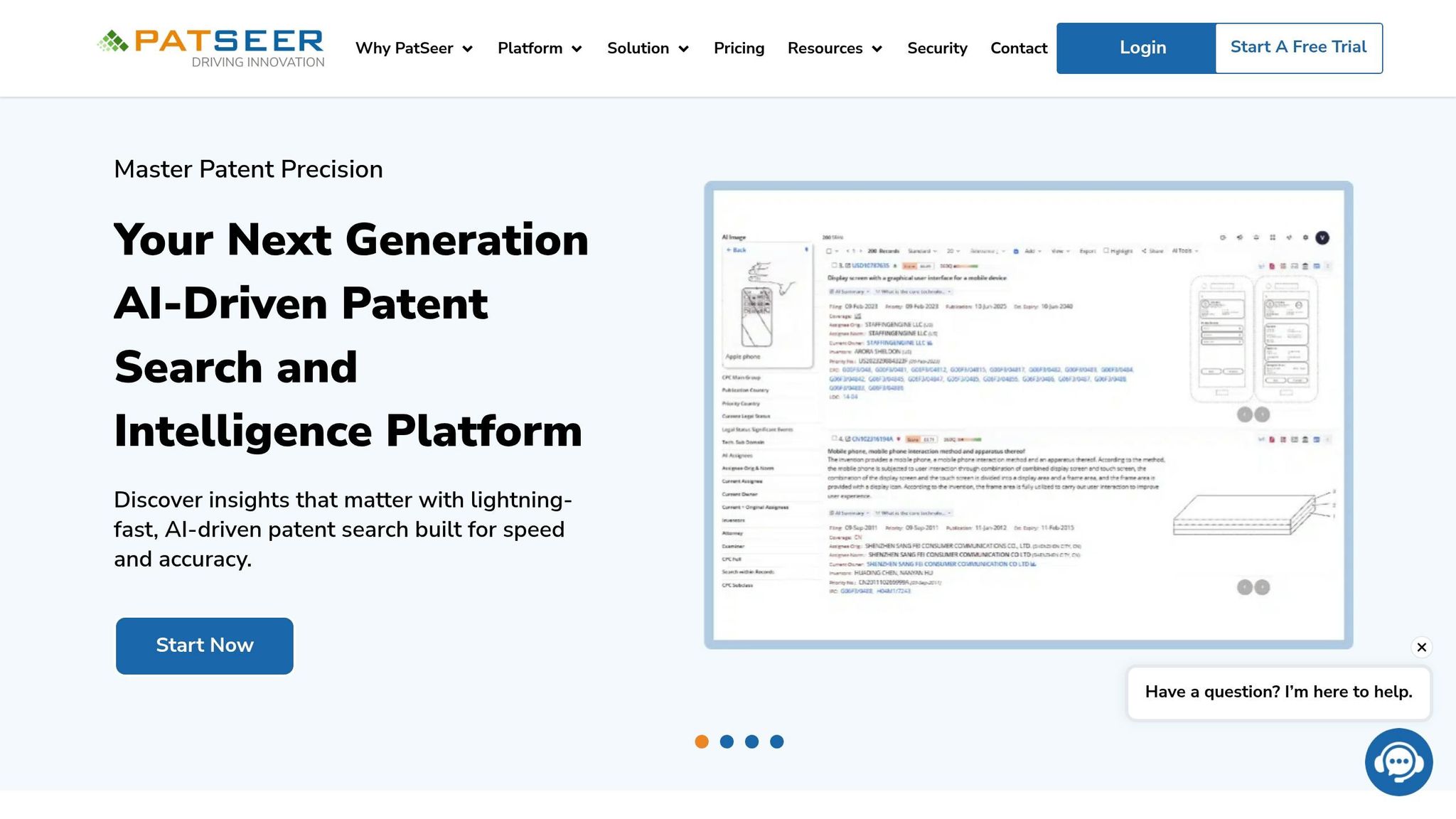
PatSeer is a powerful tool designed to make patent research both thorough and efficient. It blends AI-powered insights with traditional search strategies, offering a hybrid approach that caters to a wide range of research needs. With a database of over 172.5 million records from 108 patent authorities, PatSeer provides one of the largest collections available for patent research. The platform is updated several times a week, ensuring users have access to the most recent filings, legal status updates, and reassignment details.
Vector AI Capabilities
PatSeer’s AI Search takes a contextual approach, analyzing the meaning behind text rather than relying solely on exact keyword matches. Users can input free-text descriptions or even entire paragraphs, and the system identifies relevant prior art by interpreting the semantic context. Another standout feature is the AI-Generated Patent Summaries, which break down the "WHAT, HOW, and WHY" of inventions. This allows users to quickly grasp complex documents in under 30 seconds, cutting patent review time by over 90%.
Additionally, the PatAssist AI Assistant handles intricate technical queries with advanced reasoning capabilities. The platform also includes an AI Classifier that organizes patents and non-patent literature into custom categories based on user feedback, streamlining the research process even further.
Integration of Traditional Search Methods
PatSeer doesn’t just rely on AI; it enhances its capabilities with traditional Boolean search techniques. Using its Boolean Search Reranking feature, the platform refines search results by ranking them based on their relevance to a specific record or text. With support for over 250 searchable fields, proximity operators, and command-line searches, it gives users precise control over their queries.
For added precision, the AI Refine feature narrows results to specific technical areas, while the Relevant Record Recommender ensures no critical prior art is missed by suggesting contextually similar patents. This combination of AI and traditional methods creates a well-rounded research tool.
Optimization Benefits
PatSeer’s hybrid approach not only saves time but also ensures comprehensive and accurate results. Its ability to query both patent databases and non-patent literature offers a complete view of prior art. The platform is built with enterprise-grade security, holding ISO 27001:2022 and SOC 2 Type 2 certifications, and it does not use customer data or search activity to train its AI models.
With a 4.7/5 rating on G2 and recognition as a "Leader" in Patent Research Software, PatSeer is trusted by more than 10,000 users worldwide. This reputation reflects its ability to balance cutting-edge AI with the precision of traditional search methods, making it a go-to tool for patent research.
3. IPRally
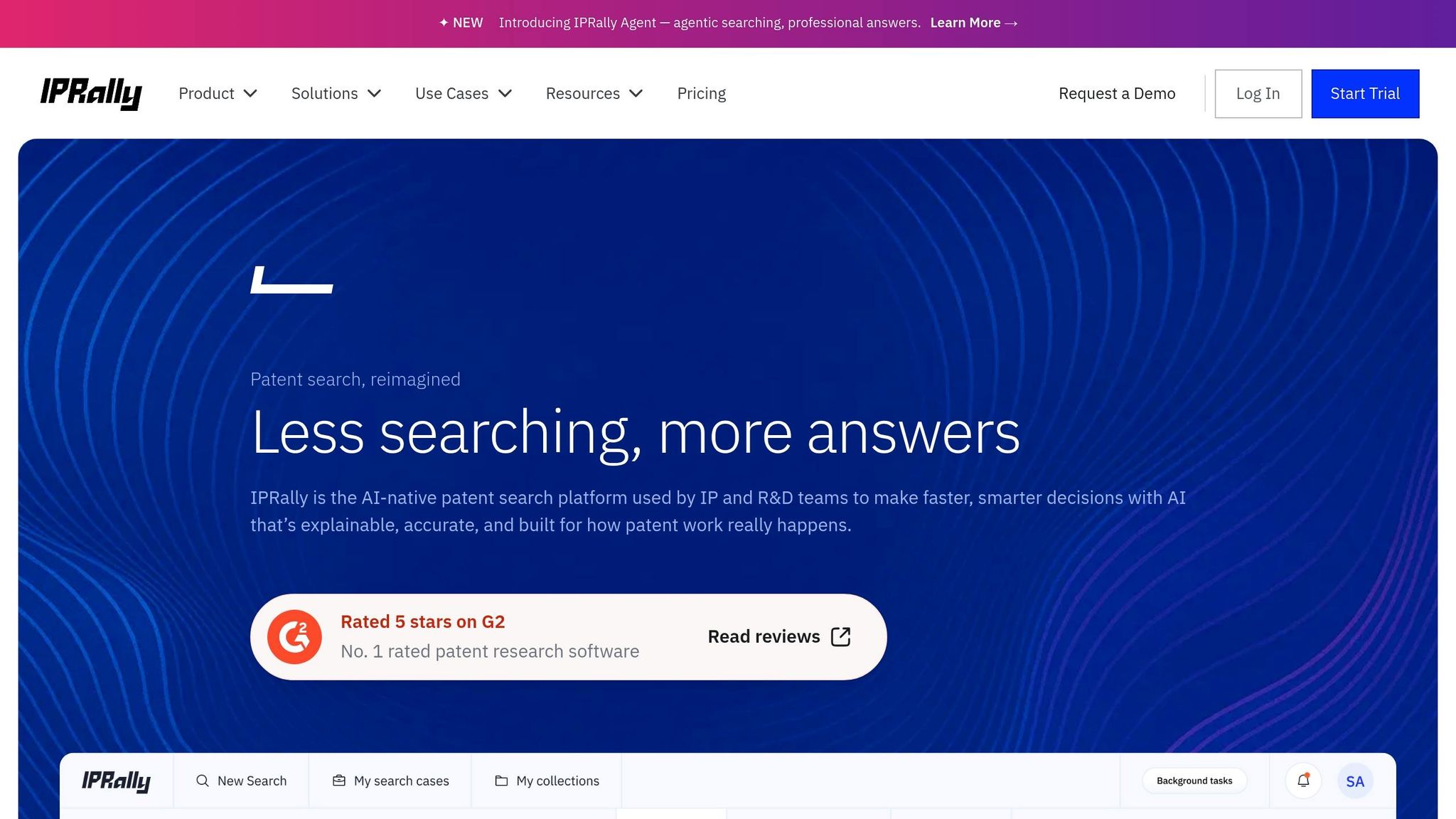
IPRally uses Graph AI to transform patent text into knowledge graphs, breaking down inventions into nodes (technical elements) and edges (relationships). This Graph Neural Network is trained on millions of patent examiner citations, mimicking how patent experts analyze technical structures rather than relying solely on keyword matching.
Vector AI Capabilities
IPRally’s advanced graph-based approach is bolstered by Vector AI, which enhances search precision by focusing on semantic details at the node level. Instead of comparing entire documents, it matches specific invention features. The Node Reranker further improves results, achieving an 11.33% boost in recall for the top five search results and cutting the number of documents needing review by 20%.
The platform also offers Smart Search, allowing users to combine text, images, PDFs, and Office documents into a single technical query. For more advanced needs, the Ask AI assistant can answer detailed technical questions or summarize multiple patents at once. Notably, for intricate inputs like chemical patent claims, the graph parsing service operates 3–5 times faster than traditional methods.
Integration of Traditional Search Methods
IPRally incorporates Boolean search capabilities to refine results using bibliographic data, such as assignees or keywords. Users can apply Boolean filters alongside AI-generated findings, creating a hybrid search experience. Andreas Cehlinder from IPRally highlights this feature:
"Boolean searching is now available alongside our proprietary graph search in IPRally!"
This blend of AI and traditional search tools enables users to handle 95% of their search and monitoring tasks within a single platform.
Database Coverage
IPRally’s database includes approximately 125 million patent publications from major jurisdictions. It updates weekly, adding around 200,000 new records, which become searchable within 21 days of publication. The platform supports machine translation for 10 languages - such as German, French, Chinese, and Japanese - with a limit of 5,000 characters per input.
Optimization Benefits
Businesses using IPRally report substantial time savings. For example, Ypsomed, a medical technology company, reduced its Freedom-to-Operate study time by 50%. Similarly, AWA, an IP firm, halved its search and review time, enabling patent attorneys to focus on deeper analysis.
IPRally has earned a 5/5 rating on G2, making it the highest-rated patent research software for user satisfaction. The platform is also ISO 27001 certified and GDPR compliant, with AI trained exclusively on patent data. By combining Graph AI with Boolean filters, IPRally delivers a powerful hybrid search solution for precise and efficient patent research.
4. NLPatent
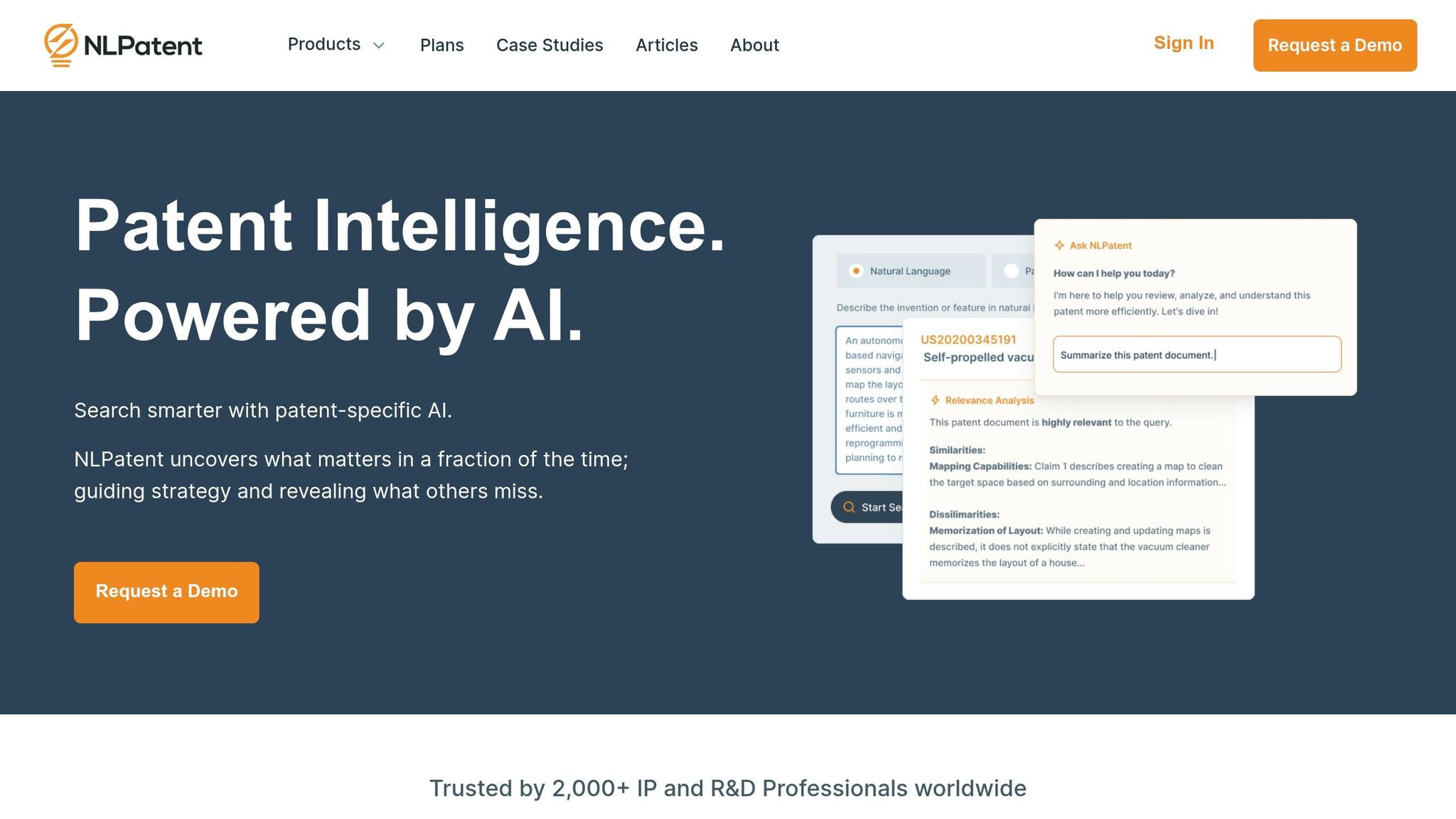
NLPatent employs proprietary large language models to revolutionize patent analysis. Instead of relying on basic keyword searches, the platform delves into the conceptual meanings of individual patent sections, offering a deeper understanding of each document. With its Natural Language search, users can input plain language descriptions to find relevant results. Meanwhile, the Patent Number search examines the full specification of a document to identify similar patents. These AI-powered tools enable advanced features like Relevance Analysis and Refinement, which iteratively improve search accuracy.
Integration of Traditional Search Methods
NLPatent combines its cutting-edge semantic engine with tried-and-true traditional search techniques. It integrates large language model (LLM)-based semantic search with Boolean logic and keyword filtering. The platform supports advanced search functionalities, such as proximity rules (WITHIN, WITHINF), wildcards (?, !, *), and field-specific searches targeting Titles, Abstracts, Claims, and Descriptions.
Users can combine up to five different queries, mixing semantic and keyword-based searches to capture both broad conceptual ideas and precise technical details. This hybrid approach makes it easier for professionals to uncover crucial information while ensuring specific terminology or assignees are accounted for. John Holley, a Partner at Boies Schiller Flexner, highlights its effectiveness:
"Not only does NLPatent replicate the strongest traditional search results, it also surfaces critical prior art that conventional methods miss. It's been a silver bullet in my litigation practice."
Database Coverage
NLPatent ensures access to a wide range of global patent data, covering major offices like WIPO, USPTO, EPO, and those in countries such as Canada, China, Japan, Korea, India, Germany, the UK, France, and more. The database is updated every Saturday, ensuring users always have the latest filings. While searches are conducted in English, the platform provides machine translations for patents published in other languages. For Premium Tier users, there’s the added advantage of searching non-patent literature (NPL), and all users can manually add NPL or specific prior art to refine their results further.
Optimization Benefits
By blending AI's speed with the precision of traditional filters, NLPatent significantly reduces the time required for patent searches - by as much as 80%. It’s already trusted by over 2,000 IP and R&D professionals. Matt Barton, Partner at Forresters IP, underscores its reliability:
"NLPatent provides unmatched precision, which is essential to success in opposition and appeal work. It's become an indispensable part of my practice."
The platform is SOC 2 certified, ensuring a high standard of data security. It doesn’t use customer data to train its models and employs Retrieval-Augmented Generation (RAG) to enhance relevance analysis, minimizing AI errors and delivering accurate results.
5. Cypris
Vector AI Capabilities
Cypris takes AI-driven patent analysis to another level by refining the hybrid search approach with its own unique methods. It combines top-tier AI models like OpenAI, Anthropic, and Google with a proprietary R&D ontology specifically designed for intellectual property (IP). This allows Cypris to accurately interpret complex patent language and map claims directly to technology architectures without relying solely on keywords. One standout feature is its automated Freedom to Operate (FTO) risk stratification, which categorizes patents based on their technical relevance.
For example, in a March 2026 study on LLZO-based composite electrolytes, Cypris uncovered a deliberate patent fencing strategy by Solid Energies, Inc. It identified four granted U.S. patents (including US-12463245-B2 and US-12283655-B2) and one application tied to the technology architecture. By contrast, competitors like ChatGPT and Microsoft Co-Pilot found no filings, and Claude flagged only one.
Integration of Traditional Search Methods
Cypris blends global innovation data with internal documents and institutional knowledge, combining semantic search with traditional patent analysis. This hybrid approach ensures findings are verifiable with specific patent numbers and metadata, rather than relying on pattern recognition alone. In a competitive intelligence test conducted in March 2026 on bio-based polyamides, Cypris delivered over 100 patent citations and identified emerging players - insights completely missed by general-purpose AI tools.
Database Coverage
The platform boasts access to an extensive database of over 500 million documents. This includes:
180+ million patents spanning 150+ countries
270+ million academic papers from 20,000 journals
85,000 market news sources
Such comprehensive coverage allows Cypris users to conduct detailed prior art searches and competitive intelligence analyses across both patent and non-patent literature.
Optimization Benefits
Cypris doesn’t just excel in AI and data integration - it also prioritizes security and efficiency. It is SOC 2 Type II certified and uses U.S.-based infrastructure, avoiding offshore data routing, which makes it ideal for government and defense research organizations. By significantly reducing research time, Cypris transforms patent searches from weeks-long endeavors into tasks completed in days. Chuck Wright of NOV highlighted this efficiency:
"What took weeks now takes days in searching and collecting vital information to make decisions on technologies."
In a controlled study from 2026 focused on solid-state battery technology, Cypris identified over 40 relevant active U.S. patents. In comparison, Claude found only 12, and ChatGPT managed just 7.
6. Orbit Intelligence
Vector AI Capabilities
Orbit Intelligence leverages Sophia Search, an AI-powered semantic search engine that uses neural embeddings to interpret patent concepts beyond just keywords. Results are categorized into levels like "Perfect", "Excellent", "Good", "Moderate", or "Weak" to provide clarity and precision. Its Features Mode automatically extracts technical details from input text and pinpoints their disclosure in patent documents [34,37].
The tool also provides claim snippets to explain feature disclosure. Users can assign weights - High, Medium, or Low - to these extracted features, which directly impacts how results are sorted based on their technical importance. The platform operates quickly, with semantic mode searches taking just 1–5 seconds, while Features Mode (analyzing up to 50 results) is completed in 1–2 minutes [34,37]. Another key feature, Sophia Query, converts natural language queries into Boolean searches, automatically integrating synonyms and IPC classes. This integration bridges AI-driven tools with traditional search methods, enhancing efficiency.
Integration of Traditional Search Methods
Orbit Intelligence combines AI capabilities with traditional patent search techniques for a more refined experience. Users can set prefilters - like date ranges, jurisdictions, or classifications - via the Advanced Search form before initiating semantic analysis. This reduces the time spent on irrelevant results [34,37].
"Orbit Intelligence offers the best syntax options in the market, allowing users to combine Boolean and proximity operators within the same query for more precise searches."
– Questel
While AI generates the initial search parameters, users can fine-tune their queries by adding specific keywords, classes, inventors, assignees, or statuses. In Features Mode, AI-driven "Features Matches" take precedence over standard semantic rankings, providing clearer insights into why certain patents rank higher [34,37]. This hybrid approach ensures a balance of advanced technology and traditional precision.
Database Coverage
Orbit Intelligence provides access to a massive database of over 100 million patents, 17 million designs, and 150 million non-patent documents, including clinical trials and scientific papers. The platform covers patent offices representing more than 99.7% of global patent applications, including the five largest offices (China, United States, Japan, South Korea, and Europe), which together account for 85% of worldwide filings. Impressively, over 97% of Questel's patent collection is available in English - either natively or through pre-translation - making it easier to search Asian patent documents. This extensive coverage is trusted by over 100,000 users globally.
Optimization Benefits
Orbit Intelligence maximizes efficiency with its comprehensive data coverage and credit-based system for premium features. Advanced plans provide 20–40 monthly credits for Features Mode, with optimal results achieved using 500–3,000 character inputs [34,35,37]. Essential users, however, can perform unlimited semantic searches without needing credits [34,35,37].
The platform also includes a one-click report feature, allowing users to select up to 10 results and instantly generate a prior art report in Excel. These reports include a feature disclosure table across different publication stages [34,37]. Users can upload images (.jpg, .png), documents (.pdf), or free text to create synthetic text for AI searches. By combining AI-driven tools with precise traditional methods, Orbit Intelligence delivers powerful results for professional patent searchers who require both depth and accuracy.
7. Patentfield
Patentfield stands out by blending advanced Vector AI with traditional search tools to deliver highly accurate and relevant patent results. This hybrid approach combines the power of AI-driven semantic analysis with expert search techniques, offering a comprehensive solution for patent research.
Vector AI Capabilities
Patentfield leverages machine learning trained on 10 million patents to identify conceptual relationships. For instance, searching for "solar panel" might also return patents related to "photovoltaic power generation panel". The platform enhances these capabilities with a Similar Image Search feature, which uses vector-based analysis to find patents with comparable drawings or designs. Users can input complex image sets - like six-view design drawings or combinations of external and internal structures - to discover visually related prior art.
Another standout feature is its High-Speed AI Classification, allowing users to train custom models with 10,000 data points in as little as 10 seconds. These models can then classify and sort up to 100,000 patents almost instantly. Additionally, Patentfield offers Supervised AI Scoring, enabling users to label patents as "positive" or "negative" based on descriptions or patent numbers. This custom scoring system ranks search results by technical relevance. The platform also integrates generative AI tools like GPT and Claude to summarize documents, extract keywords for technical problems and effects, and analyze trends across up to 10,000 patents.
Integration of Traditional Search Methods
Patentfield's hybrid approach seamlessly combines AI-driven semantic search with professional-grade tools. With its Advanced Search and Score system, users can navigate more than 100 traditional fields using Boolean operators and proximity tools. Features like Near, Fuzzy, and Command Searches provide precision, while over 40 scoring conditions allow users to refine results further by incorporating citation data and Japanese Patent Office (JPO) prosecution history.
The platform also excels in analysis, offering more than 120 visualization methods, including citation maps for up to 5,000 patents, patent timelines, and cross-tabulation reports. This combination of AI and traditional search ensures accuracy and depth throughout the research process.
Database Coverage
Patentfield provides extensive coverage across major patent offices, including Japan (JP), the United States (US), Europe (EP), China (CN), South Korea (KR), Taiwan (TW), and WIPO (WO). Japanese patent data is available from 1971 (OCR format), with full digital records starting in 1993, while US patent records date back to 1976. The platform also integrates worldwide bibliographic data through DOCDB and legal event information via INPADOC, covering over 100 countries with historical records reaching as far back as 1782. For international research, Patentfield provides machine translations in Japanese for US, EP, WO, TW, CN, and KR patent data. Users can also bulk download up to 100 original PDFs from the JPO (since 1971) and USPTO (since 1976).
Optimization Benefits
Patentfield’s hybrid design minimizes irrelevant results by filtering out linguistically similar but unrelated documents, while also emphasizing newly published, relevant patents. The Basic Plan, priced at $100/month, includes unlimited searches for key jurisdictions, 10,000 teacher data slots, 50 weekly parameter tuning sessions, Excel export of 1,000 results, and email alerts.
Tool Comparison Table
Selecting the ideal hybrid patent search tool means understanding how each platform combines Vector AI technology with traditional search methods. Here's a breakdown of the key features, database coverage, and standout advantages of the supported platforms:
Tool | Vector AI Features | Traditional Search Integration | Database Coverage | Key Advantages |
|---|---|---|---|---|
Patently | Semantic search using Vector AI; Forward/Backward citation exploration | Filters and classification-based search | USPTO, EPO, WIPO, and other major global authorities | Includes project management tools, SEP analytics for 4G/5G, and collaborative workflows |
PatSeer | AI-powered tools like AI Summaries, AI Refine, AI Recommender, Semantic Mapping, and AI Classifier | Combines AI with Boolean logic | Over 172 million records from 108 authorities | Reduces patent review time by up to 90%; highly rated with a 4.7/5 score on G2 |
IPRally | Graph AI for patent representation, semantic matching, and claim comparison | Portfolio-level searches with expert tools | Major global patent offices | Provides deeper insights into invention relationships beyond standard vector search |
Cypris | Multimodal search supporting image uploads and technical diagrams | Federated search across patents and non-patent literature | Patent databases, academic journals, and technical standards | Merges patent and non-patent literature searches seamlessly |
Orbit Intelligence | AI-assisted patent scoring and relevance ranking by claim elements | – | 100+ million documents | Customizable ranking based on user-defined claim elements |
This table highlights the unique strengths of each platform in enabling efficient hybrid patent searches. Each tool offers a distinct approach to combining advanced AI features with traditional methods, catering to different user needs. For comprehensive searches in 2026, consider platforms that cover databases like USPTO, EPO, WIPO, CNIPA, JPO, KIPO, and INPI. Testing these tools with real-world queries tailored to your requirements is a smart step before committing to a specific platform.
Conclusion
Hybrid patent search tools are transforming how prior art is analyzed in 2026. By merging Vector AI's semantic capabilities with traditional Boolean methods, these tools uncover 30–60% more relevant prior art compared to keyword-only searches, significantly lowering the chance of missing critical references. This powerful combination of AI-driven semantic search and time-tested Boolean techniques forms the backbone of the solutions discussed here. These advancements highlight the importance of selecting a tool that aligns seamlessly with your patent workflow.
Each tool mentioned in this article offers its own set of advantages. Integrated platforms ensure workflow continuity, keeping search intelligence intact throughout drafting, prosecution, and portfolio management - this helps maintain essential contextual reasoning across the patent lifecycle. On the other hand, standalone tools are particularly effective in litigation scenarios where deeper retrieval capabilities are essential.
Before committing to a platform, consider running a five-query benchmark. Include natural language queries, cross-domain concepts, and specific claim elements to test the tool's efficiency. Also, ensure it covers major patent offices such as CNIPA, EPO, and WIPO to prevent any blind spots. For pre-filing searches, prioritize tools with zero-retention policies to safeguard attorney-client privilege.
The best tool for you will address your specific workflow challenges. If Boolean query refinement consumes hours of your time, an AI-native platform that processes natural language could cut formulation time by 60–70%. If your workflow struggles with gaps between search and drafting, an integrated platform that maintains relevance mapping throughout the process can offer long-term efficiency gains. Use your own data to evaluate these tools and find the solution that fits your needs perfectly.
FAQs
What is a hybrid patent search?
A hybrid patent search merges traditional keyword-based techniques with advanced AI-driven methods, such as Vector AI, to improve the discovery of prior art. By incorporating semantic search - which relies on natural language processing (NLP) and vector embeddings - it can uncover conceptually similar prior art that standard keyword searches might overlook. This combination leads to greater accuracy, efficiency, and depth, making it a valuable tool for tasks like patentability assessments, infringement analyses, and other key patent-related processes.
When should I use Vector AI vs. Boolean search?
Vector AI is a powerful tool when you need to identify prior art that’s conceptually similar, even when the terminology or language varies. It’s all about understanding the meaning behind the text, not just matching keywords. This makes it especially useful for uncovering related ideas that might not be immediately obvious through traditional methods.
On the other hand, Boolean search is your go-to for pinpoint accuracy. It works best for searches that rely on specific keywords or metadata. If you’re looking for something straightforward and exact, Boolean search is the way to go.
By combining these two methods, you can cover all bases. Vector AI can help you discover prior art that traditional searches might overlook, while Boolean search ensures precision in filtering through results. Together, they make for a more thorough and efficient patent search process.
How can I benchmark a hybrid search tool before buying?
To evaluate a hybrid search tool effectively, focus on three key areas: retrieval quality, database coverage, and workflow support.
Start by testing sample queries to see how the tool performs. Compare the relevance of results from its semantic search capabilities (like Vector AI) against more traditional search methods. This will help you gauge how well it understands and delivers on your needs.
Next, check the database's scope. Does it include the jurisdictions that are most important to your work? Also, verify whether it accommodates specific workflows, such as those required for prosecution or licensing tasks.
Lastly, take a close look at user feedback. Insights on accuracy, speed, and usability can reveal whether the tool aligns with your expectations and is practical for daily use.