Top 7 AI Tools for Multilingual Patent Search
Intellectual Property Management
Apr 21, 2026
Compare seven AI platforms for cross-language patent searches, translations, and semantic prior-art discovery to reduce missed prior art.
Searching patents in multiple languages is challenging, especially with over 70% of patents published in non-English languages. AI tools now simplify this process by combining advanced translation, semantic search, and global patent databases. Here’s a quick guide to the top patent tools for multilingual patent searches:
Patently: Offers semantic AI search and on-demand translations for patents across 100+ jurisdictions.
Patsnap: Features concept-based search and neural machine translation tailored for patents.
Derwent Innovation: Includes expertly curated patent data and multilingual translations.
Orbit Intelligence (Questel): Provides AI-powered search with extensive patent and non-patent literature.
PatSeer: Combines hybrid search models and language support for efficient analysis.
Lens.org: A free platform linking patents with scholarly research, offering multilingual search tools.
Espacenet: A free service from the EPO with powerful translation features and access to global patent data.
Quick Comparison
Tool | Jurisdictions Covered | Translation Features | Best For |
|---|---|---|---|
Patently | 100+ | AI-driven translations | Integrated patent workflows |
Patsnap | 116+ | Neural machine translation | IP management and analysis |
Derwent | 109+ | Human-curated translations | Precision in life sciences |
Orbit | 100+ | Advanced multilingual search | Portfolio management |
PatSeer | 108+ | Multi-language support | Collaborative patent research |
Lens.org | 95+ | Basic machine translation | Academic and early-stage research |
Espacenet | 90+ | Patent Translate (Google NMT) | Free preliminary searches |
These tools help bridge language gaps, reduce missed prior art, and streamline global patent research. Choose based on your needs - whether it’s robust AI capabilities, cost-free access, or deep jurisdictional coverage.
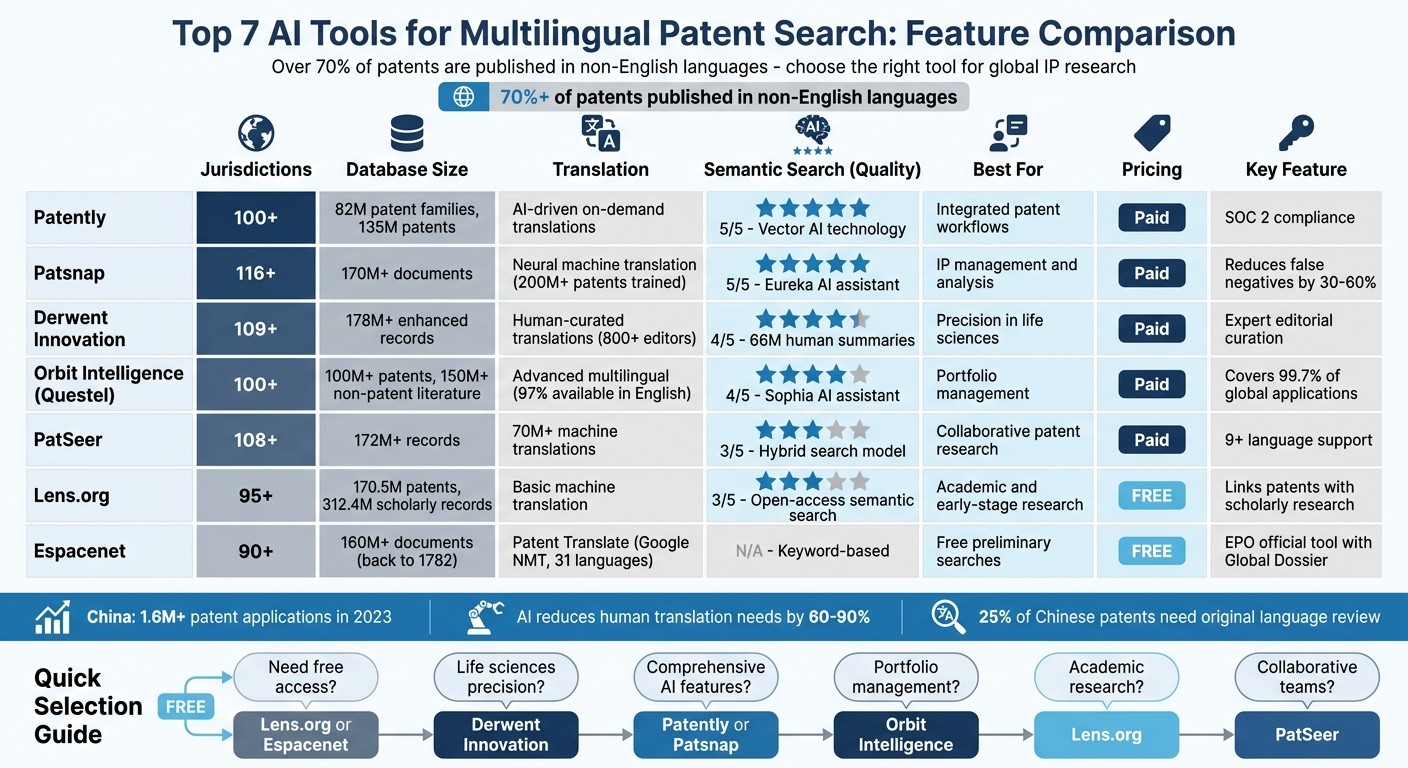
Comparison of Top 7 AI-Powered Multilingual Patent Search Tools
1. Patently
Patently is a platform tailored for patent professionals, offering access to patent data from over 100 jurisdictions. It overcomes translation hurdles and includes full-text data from major patent offices like the USPTO, EPO, China, Japan, and Korea. Additionally, it covers bibliographic records from regional authorities such as ARIPO, the Gulf Cooperation Council, and offices in Africa, Asia, and Latin America. With a vast database of 82 million patent families and 135 million individual patents, Patently ensures extensive global coverage for prior art searches.
Semantic AI Search
Patently’s Vector AI technology goes beyond traditional keyword searches. Instead of relying on complex Boolean strings, users can input natural language descriptions. This allows for searches based on features, applications, or technical problems. For example, in October 2024, an IP professional searched for "In-ear headphones with noise isolating tips", applying a priority date filter set before 2000. The semantic engine identified 300 relevant results, enabling the user to locate key Sony patents in under five minutes with relevance-based sorting.
"With Elastic, it's like having a patent attorney with decades of experience guiding every search." - Andrew Crothers, Creative Director, Patently
Patently also groups patents into "Genetic families", organizing them by subject matter rather than formal priority rules. This approach provides a clearer view of how technologies evolve over time. Additionally, its Forward & Backward (FAB) citation browser helps users trace citation generations, revealing connections that might be missed with standard keyword searches. Alongside its semantic search capabilities, Patently addresses language barriers with advanced translation tools.
Machine Translation Capabilities
Patently offers on-demand machine translations for non-English documents. Translated titles and abstracts are displayed directly in search results, enabling swift assessments of foreign-language patents. The platform highlights relevant terms using keyword-in-context (KWIC) within translated text, covering titles, abstracts, claims, and descriptions. To maintain consistency across its global collections, Patently uses 226 field mappings and has implemented real-time data intake, ensuring immediate access to the latest patent filings worldwide.
2. Patsnap
Patsnap provides access to a vast collection of over 170 million patent documents from more than 116 jurisdictions worldwide. This includes full-text indexing from major patent offices like the USPTO, EPO, WIPO (PCT), CNIPA (China), JPO (Japan), KIPO (South Korea), and INPI (France). The database is packed with over 2 billion structured data points, covering patents, scientific literature, litigation records, and various technology sectors. In addition to patents, it includes over 250 million data points related to innovation, academic research, and chemical or biological information.
Semantic AI Search
Patsnap uses a domain-specific language model trained on a wealth of patent, legal, and scientific texts to go beyond basic keyword searches. It captures concepts even when different terms are used to describe the same technology (like "biodegradable" versus "compostable"). This approach helps bridge vocabulary gaps, saving time and improving accuracy. For example, IP teams have reported cutting prior art review time by up to 50% for complex technology searches, while also reducing false negatives by 30% to 60% compared to traditional keyword-only methods.
The platform’s Eureka AI assistant turns static keyword searches into dynamic, interactive dialogues. This allows users to refine their queries iteratively, improving the relevance of results by 15% to 25% over time. Users can enter natural language queries in any supported language without needing to pre-select technical terms. This efficiency is also transforming other workflows, such as generative AI patent drafting for legal teams. Patsnap also complements this semantic search with robust machine translation capabilities.
Machine Translation Capabilities
Patsnap’s neural machine translation system, trained on over 200 million patents, ensures accurate translations of foreign-language documents into English. It effectively handles complex IP-specific terminology, avoiding the common errors seen in standard translation tools.
"PatSnap's breadth of data is unrivalled, pulling patent, non-patent literature, and chemical information globally. This has helped me tremendously when analyzing different jurisdictions and simplified the reading of foreign language patents." - Noel Rudie, Director of Innovation, Michael Foods
3. Derwent Innovation (Clarivate)
Derwent Innovation is powered by the Derwent World Patents Index (DWPI), a resource built on decades of editorial expertise. The platform includes over 178 million enhanced patent records from 109 jurisdictions, with full-text data available for 76 jurisdictions, including major players like China, Japan, and Korea. To support this, over 800 patent editors work to summarize, index, and translate patents into English. Here’s a closer look at some of its standout features.
Multilingual Coverage (Jurisdictions/Documents)
The database simplifies research by grouping related patent publications into over 70 million invention families, reducing duplicates and making workflows more efficient. Beyond patents, it integrates 73 million+ curated non-patent literature publications from over 13,600 journals through the Web of Science. Additionally, it provides access to patent litigation data from over 140 jurisdictions, including information from Darts-ip. This extensive coverage is trusted by 40 global patent and trademark offices for their own searches.
Semantic AI Search
Derwent’s AI Search tool uses advanced models like language transformers and colBERT, trained on over 66 million human-authored patent summaries. This specialized approach enhances the ability to find non-English patent records. Users can conduct searches using natural language queries, with the tool prioritizing the most relevant results at the top. Susan Johnson, a Patent Agent and IP Researcher at Boston Scientific, shared her experience:
"With Derwent AI Search, the most relevant records are at the top of the list, which helps me save a lot of time when evaluating patentability".
Machine Translation Capabilities
The platform offers full-text translations for key jurisdictions like China, Korea, and Japan. Derwent’s editorial team handles patent publications from 60 authorities, translating them into English and standardizing inventor and assignee data. This process enhances search accuracy and reliability. Dr. Ilan Riess, a Patent Attorney at Ehrlich Group, highlighted the quality of the data:
"You can feel the difference in the data. It's clean, complete and gives you confidence".
Integration with Global Patent Authorities
Derwent goes beyond translation and search by offering tools that clarify patent ownership. Features like Optimized Assignee and Ultimate Parent simplify understanding corporate structures and ownership. The platform also tracks litigation across 140+ jurisdictions and provides seamless access to non-patent literature through the Web of Science. Importantly, Clarivate ensures that AI inputs remain private, safeguarding sensitive invention details and ensuring they’re not used for training general models.
4. Orbit Intelligence (Questel)
Orbit Intelligence offers access to over 100 million patents and 17 million designs, covering offices responsible for 99.7% of global applications. It provides detailed data from the "Big Five" IP offices - China, the USA, Japan, Korea, and the European Patent Office - which collectively handle 85% of global applications. Beyond patent data, the platform includes over 150 million non-patent literature records, such as clinical trials, scientific publications, and research grants.
Multilingual Coverage (Jurisdictions/Documents)
Orbit Intelligence ensures comprehensive document access across major jurisdictions, including the US, China, Japan, and key European offices. It supports industrial design data from 70 jurisdictions and boasts a scientific literature database with over 160 million records. Users can search both original language texts and machine-translated documents. Historical patent drawings are also available, dating back to 1880 for the US and 1920 for the UK. This broad multilingual functionality addresses the global needs of IP professionals.
Semantic AI Search
With its robust language support, Orbit Intelligence integrates advanced semantic search capabilities. At the core is Sophia, an AI-powered assistant that facilitates natural language searches in any language. These inputs are translated into English queries, enriched with synonyms and IPC classes. Sophia Search uses neural embeddings to compare natural language inputs (optimal length: 500–3,000 characters) with patent family embeddings, ensuring precise and comprehensive results. The Features Mode further enhances search by extracting technical details from input text and pinpointing specific disclosures within patent documents, complete with relevant excerpts.
Machine Translation Capabilities
The platform ensures that over 97% of records are available in English, either natively or through high-quality translations, while original language texts remain searchable. It includes official English abstracts for more than 32 million records, improving the accuracy of search results. Full-text translations are provided for non-English jurisdictions, particularly enhancing access to patent data from China, Japan, and Korea. Additionally, users can customize the interface and patent display language to facilitate collaboration across international teams. The Sophia Query AI assistant accepts multilingual search inputs, automatically generating detailed English queries with synonyms and IPC classes.
5. PatSeer
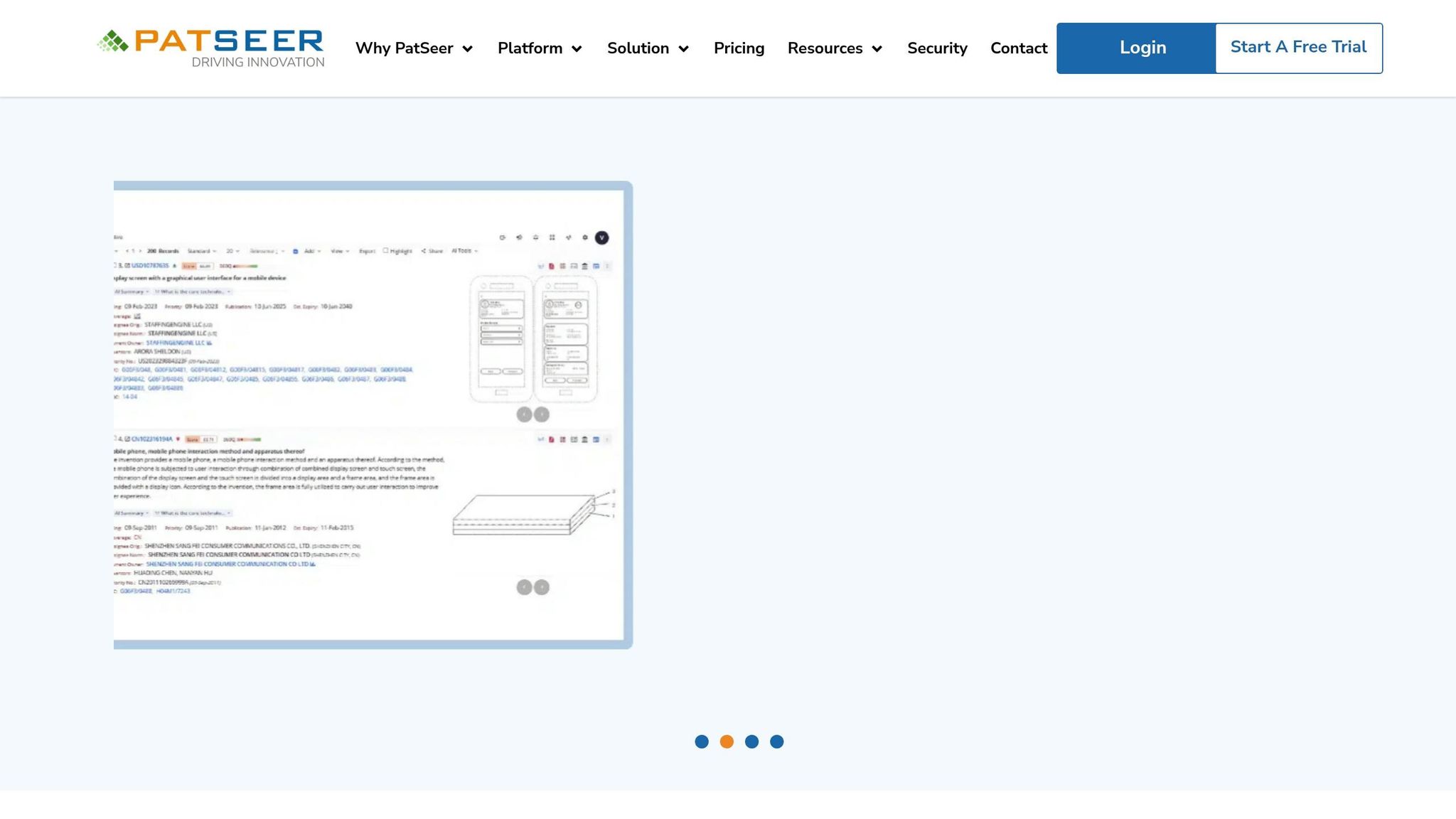
PatSeer offers access to an extensive database of over 172 million patent records sourced from 108 patent authorities and 86 design authorities worldwide. This includes more than 134 million full-text records and 70 million machine translations, making it a go-to platform for AI-enabled patent analysis. It covers major jurisdictions like the USPTO, EPO, WIPO, CNIPA (China), JPO (Japan), and KIPO (South Korea), along with regional bodies such as ARIPO and OAPI.
Multilingual Coverage (Jurisdictions/Documents)
PatSeer supports searches in over nine languages, making it easier to navigate non-English prior art. It provides access to 70.6 million machine translations for patent records and 63 million for scientific publications. The platform also accommodates non-Latin characters, enabling efficient searches across Asian patent offices.
Semantic AI Search
PatSeer combines Boolean logic with semantic AI in its hybrid search model. The PatAssist copilot assists users by suggesting search strategies and expanding queries. Tools like AI Rerank, AI Refine, and AI Recommender use semantic similarity to deliver highly relevant results. As one Lead Patent Analyst at a Fortune 500 Technology Company shared, "Yesterday, I found a prior art in PatSeer that I couldn't find elsewhere". The Semantic Suggester further enhances precision by identifying related technical keywords, ensuring users can fine-tune their searches effectively. These features, paired with advanced translation tools, simplify the process of global patent review.
Machine Translation Capabilities
PatSeer simplifies international patent research with automatic translations from key jurisdictions such as China, Japan, and Korea. A Head of R&D IP Strategy at a Global Medical Device Manufacturer remarked, "In one case, in less than a minute, we were able to find an obstructing analogue that an American patent attorney couldn't find before... That's quite commendable". This functionality ensures users can quickly and efficiently access relevant global patent information.
6. Lens.org
Lens.org stands out as a free, open-access platform, offering access to over 170.5 million patent records and 312.4 million scholarly records from more than 95 jurisdictions. It bridges the gap between patent data and scholarly research, making it easier to explore the scientific groundwork behind technical inventions. This trend of integrating AI-powered tools into global patent discovery is reshaping how information is accessed and utilized. Michael Kock, former Head of Intellectual Property at Syngenta, shared his thoughts on the platform:
"The Lens is a brilliant tool to create IP transparency and enable open innovation strategies around digital sequence information. It provides a utility which otherwise can only be achieved with expensive subscription tools".
Multilingual Coverage (Jurisdictions/Documents)
Lens.org provides bibliographic data from over 95 jurisdictions, with full-text access available for major patent authorities like the USPTO, IP Australia, the EPO, and WIPO/PCT. The platform supports multilingual searches, offering its interface in six languages: Arabic, Chinese, English, French, Russian, and Spanish. Additionally, it organizes records into 95.7 million simple patent families, indexing 18.6 million patent applicants and 1.6 million patent owners, making navigation more straightforward.
Semantic AI Search
The platform uses advanced AI techniques like Similarity Search to find patents with related technical content by matching patterns and concepts. Lens.org also incorporates the MetaRecord (MeR) framework and the open LensID identifier to resolve ambiguities in digital records. This approach maps connections between patents, scholarly articles, and biological sequences. Through PatCite, users can explore a reversible citation graph that links patents to the academic research underpinning them, revealing how innovations transition from the lab to the marketplace. Diogo Machado, Senior Consultant at Technopolis-Group, highlighted the platform's significance:
"The matching of its rich bibliometric data with patent data makes it the leading data source for anyone working in science and technology".
Machine Translation Capabilities
Lens.org employs machine translation to localize its platform, supported by native speaker verification and a user feedback system to address inaccuracies. For researchers in biology, the platform offers PatSeq, a database containing 552.1 million DNA, RNA, and protein sequences disclosed in patents - the largest publicly available resource of its kind. These multilingual and semantic tools make Lens.org a powerful resource for navigating complex patent landscapes and set the stage for examining other advanced patent search platforms.
7. Espacenet
Espacenet, a free tool provided by the European Patent Office (EPO), is a standout option for multilingual patent searches. With access to over 160 million patent documents from more than 90 patent-granting authorities worldwide (as of April 15, 2026), it offers a wealth of information. Its records stretch back to 1782 and are updated daily with data from national patent offices. The platform covers 39 European Patent Organisation member states, which include all 27 EU members plus 12 additional European countries.
Multilingual Coverage (Jurisdictions/Documents)
Espacenet's database is grounded in the WIPO PCT minimum documentation but goes further, thanks to the EPO's inclusion of earlier records and additional jurisdictions. It features full-text search capabilities in English, French, and German, along with bibliographic data spanning two centuries of patent history. Users can also access specialized information, such as Cooperative Patent Classification (CPC) symbols and examiner-prepared references to cited documents. These features make it a powerful resource for multilingual patent searches.
Machine Translation Capabilities
Espacenet takes language support to the next level with its "Patent Translate" feature, developed in collaboration with Google. Using Neural Machine Translation trained on millions of patent documents, it excels at handling the technical vocabulary commonly found in patents. The service supports translations between English and 31 other languages, including key patent-filing languages like Chinese, Japanese, Korean, and Russian. For added reliability, users can hover over translated text to view the original, allowing sentence-by-sentence verification.
Integration with Global Patent Authorities
Espacenet connects seamlessly with major patent authorities through its Global Dossier feature, which provides access to "file wrappers" from IP5 offices (EPO, JPO, KIPO, CNIPA, USPTO), as well as WIPO and the Canadian Intellectual Property Office (CIPO). Additionally, its Common Citation Document (CCD) consolidates prior art citations from international offices onto a single page, simplifying the process of reviewing prior art. This integration ensures a streamlined and efficient approach to patent searches and analysis.
Feature Comparison Table
Below is a detailed comparison of the top multilingual patent search tools, highlighting key features like database size, semantic search efficiency, translation quality, and integration options.
Tool | Database Coverage | Semantic Search Quality | Translation Capabilities | Integration with Patent Offices | Best Use Case |
|---|---|---|---|---|---|
Patently | 170M+ documents, 107 jurisdictions | 5/5 – Domain-trained AI models | AI-powered machine translation with SOC 2 compliance | 100+ offices, including CNIPA, JPO, KIPO, USPTO, and EPO | Integrated drafting and prosecution workflows |
Patsnap | 170M+ documents, 100+ offices | 5/5 – Patent-specific NLP with "Eureka" AI assistant | Neural machine translation across major languages | 100+ offices | Comprehensive multilingual patent search for IP management |
Derwent Innovation | 90M+ documents with DWPI enhancement | 4/5 – Human-curated abstracts for precision | Manually enhanced abstracts in English | 50+ jurisdictions, focused on IP5 offices | Life sciences and chemical fields requiring precision |
Orbit Intelligence (Questel) | 100M+ documents, 100+ authorities | 4/5 – AI-powered relevance scoring | Advanced machine translation with precise claim-element ranking | 100+ offices with portfolio management features | In-house IP portfolio management |
PatSeer | 100M+ documents, 100+ offices | 3/5 – Standard semantic matching | Multi-language support with basic translation | 100+ patent authorities | Collaborative search and analysis for mid-sized markets |
Lens.org | 100M+ documents, 95+ offices | 3/5 – Open-access semantic search | Basic machine translation | 95+ offices with open data access | Academic research and early-stage searches |
Espacenet | 120M+ documents, 100+ jurisdictions | N/A – Primarily keyword-based | Patent Translate (Google Neural MT) supporting 31 languages | Global Dossier access to IP5, WIPO, and CIPO | Free preliminary searches and citation reviews |
Key Insights
Semantic search: Tools like Patently and Patsnap use domain-trained AI to significantly reduce false negatives in prior art searches by up to 60% compared to keyword-only methods. This is particularly useful for bridging language barriers in cross-language patent searches.
Chinese patents: With over 1.6 million invention applications filed in China in 2023 alone, robust CNIPA integration is critical. It's worth noting that 25% of Chinese patents contain technical details that are best understood in the original language.
Each tool offers distinct strengths, so the right choice depends on your specific needs, such as advanced translation, precision in niche fields, or integration for streamlined workflows.
Conclusion
In today’s competitive landscape, multilingual patent search is a must for IP professionals. With more than 70% of global patent literature published in non-English languages and China alone contributing over 1.5 million patent filings annually, limiting searches to English leaves significant blind spots. These gaps can undermine years of R&D efforts, making it essential to adopt tools that overcome language barriers effectively.
For professionals involved in patent drafting and prosecution, Patently offers a powerful solution. It combines domain-specific semantic search with SOC 2 compliance, advanced multilingual translation, and seamless workflow integration. Its extensive data coverage and efficient portfolio management provide a clear view of the global patent landscape, enabling users to navigate complex databases with confidence.
"The strongest patents come from the most complete searches - and the most complete searches are multilingual." - PatentScanAI
To ensure the best results, start by testing with a five-query benchmark that includes natural language searches, cross-domain concepts, foreign language technologies, narrow claim elements, and broad landscape queries. Then implement a hybrid workflow - using AI for rapid triage to cut down human translation needs by 60% to 90% while reserving certified human translation for critical claim-level reviews in high-stakes scenarios. Additionally, leverage language-neutral tools like CPC and IPC classification codes to avoid missing key disclosures due to translation gaps. By adopting this approach, Patently empowers IP professionals to achieve thorough and precise patent searches with ease.
FAQs
How can I quickly benchmark a multilingual patent search tool?
To evaluate a multilingual patent search tool, start by examining its database coverage, semantic search capabilities, and language processing features. Pay close attention to tools leveraging natural language processing (NLP) to identify relevant prior art and manage foreign-language documents by translating them into English using AI. During a trial or demo, test these aspects thoroughly to gauge the tool's speed, accuracy, and overall effectiveness for multilingual patent searches.
When should I choose human translation over AI translation?
When absolute precision, a deep grasp of context, or careful handling of legal and technical terms is required, human translation is the way to go. This is particularly critical for tasks such as drafting patents, conducting legal analyses, or working with intricate technical documents, where even the smallest mistake can lead to major issues.
How can CPC/IPC codes improve cross-language prior art searches?
CPC and IPC codes streamline cross-language prior art searches by categorizing patents according to their technological focus instead of their language. This organized system improves the ability to locate relevant prior art across different countries and languages, making the search process more thorough and effective.