AI Tools for Patent Landscape Mapping
Intellectual Property Management
Apr 20, 2026
AI speeds patent landscape mapping using semantic search, visualizations, citation analysis, and live collaboration.

AI tools are transforming the way patent landscape mapping is done. These tools streamline the process of analyzing patent data, offering faster, more accurate insights compared to manual methods. By using techniques like semantic search and data mining, they reveal patterns and opportunities that traditional methods often miss. Here's what you need to know:
Semantic Search: AI interprets patent text contextually, identifying related patents even when terminology differs. This eliminates reliance on keyword-based searches.
Visualization: Complex patent data is converted into visual formats like 3D maps and heatmaps, making trends and gaps easier to spot.
Dynamic Updates: Unlike static reports, AI tools provide real-time updates, ensuring decisions are based on the latest data.
Collaboration Features: Shared workspaces and dashboards improve coordination between teams, from R&D to legal.
Use Cases: These tools help with competitive analysis, R&D planning, and tracking market and technology trends.
Platforms like Patently combine advanced semantic search, citation analysis, and project management features to simplify patent analysis. They allow teams to focus on innovation while minimizing risks and uncovering new opportunities. AI-driven patent tools are no longer optional - they're a necessity for staying ahead in today’s fast-paced innovation landscape.
Techscaper LLM: AI-Powered Technology & Competitor Landscape Analysis
Core Features of AI Patent Landscape Mapping Tools
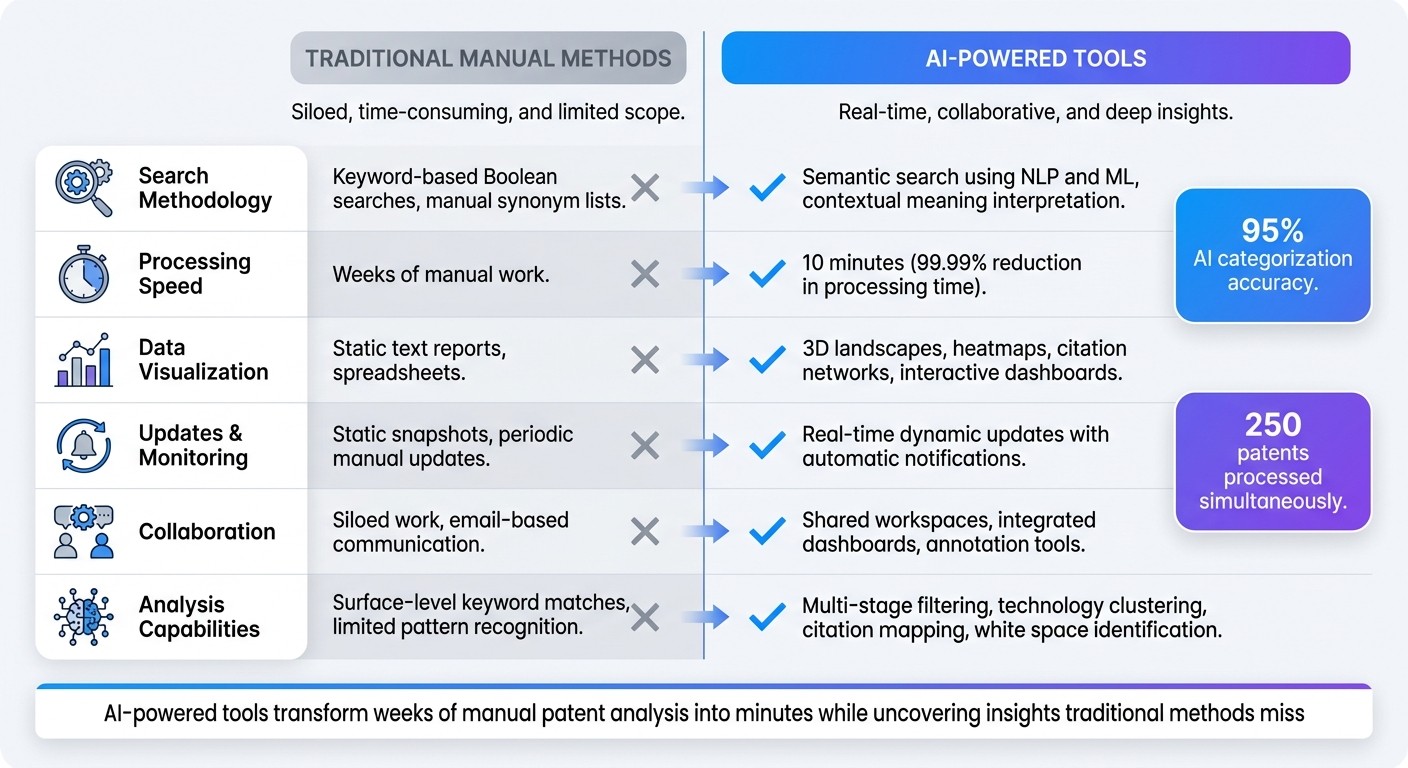
AI vs Traditional Patent Landscape Mapping: Key Features Comparison
AI-driven patent landscape tools are reshaping how organizations analyze and interpret patent data. These tools tackle the limitations of traditional manual searches by offering faster, more accurate insights while uncovering connections buried within vast patent databases.
Semantic Search and Data Mining
Semantic search takes patent analysis to the next level by using Natural Language Processing (NLP) and Machine Learning (ML) to grasp the meaning and context of patent text, not just match keywords. Some platforms boast a staggering 99.99% reduction in processing time, turning weeks of manual work into a quick 10-minute task. These tools apply multi-stage filtering to sift through millions of patents, narrowing down to the most relevant ones. This refined data then forms the foundation for deeper insights, like citation mapping and technology clustering, making complex analysis much more manageable.
Visualization and Analytics
Once the data is filtered, AI tools transform it into easy-to-digest visuals. Dense patent documents are converted into formats like 3D landscapes, heatmaps, and citation networks. These visuals highlight trends and connections that traditional keyword searches would miss. For instance, clustering patents based on technical similarities can pinpoint innovation hotspots and reveal untapped "white space" areas for future R&D. A notable example is PatentLens’s 2026 analysis of Patent US-9008369-B2, which showed its 100% success rate in a Markman hearing. The tool identified Magna Electronics, the patent owner, as a "settlement magnet", signaling a preference for licensing deals over courtroom battles. This kind of integration with litigation data helps organizations evaluate enforceability and freedom-to-operate risks directly within the platform.
Collaborative Project Management
Modern AI tools go beyond static reports by offering interactive dashboards that update automatically with new patent filings. These dashboards integrate seamlessly with existing IP docketing and R&D systems, ensuring smooth workflows across teams. Shared workspaces and annotation tools create a unified space for engineers and patent attorneys to align on strategy. Real-time notifications about new filings or changes keep everyone on the same page, enabling better decision-making in the ever-evolving patent landscape.
Patently: AI-Powered Patent Landscape Mapping
Patently brings together essential tools for patent professionals, offering a streamlined way to analyze patent data and collaborate on strategic decisions. By integrating Vector AI semantic search, citation analysis, and project management features, the platform simplifies patent landscape mapping. Let’s dive into the standout features that make Patently a go-to solution for patent analysis.
Vector AI Semantic Search
At the heart of Patently is its advanced semantic search capability. Using Vector AI, the platform transforms patent text into vectors, allowing it to match concepts rather than just keywords. This eliminates the need for manually creating synonym lists. Instead, users can input natural language descriptions, and the system identifies patents based on contextual meaning, not just exact word matches.
What’s more, the platform automatically clusters patents based on technical similarities. This feature helps users pinpoint innovation hotspots and uncover potential "white space" opportunities - areas ripe for R&D investment. It’s a game-changer for anyone tired of wrestling with traditional Boolean search methods.
Forward and Backward Citation Browser
The Forward and Backward Citation Browser is another powerful tool, designed to trace the evolution of technologies and map relationships between patents. By visualizing citation patterns, users can identify "hub" patents - those with extensive citation networks that often signify groundbreaking innovations in a field. This feature helps teams quickly grasp which patents are driving technological progress and which companies are leveraging specific innovations.
Project Management and SEP Analytics
Patently also excels in project management, offering shared workspaces for IP attorneys and R&D teams. These workspaces include integrated annotations and dashboards, making collaboration seamless and productive.
For those involved in Standard Essential Patent (SEP) analysis, the platform delivers access to over 4 million pages of standards documents and more than 1 million images, tables, and formulas. Its SEP analytics tools break down claim limitations into four categories: Normative (explicitly required by the standard), Implied (a natural way to meet requirements), Informative (described but not mandatory), and Contextual (indirectly relevant). This granular classification provides teams with the detailed insights they need for licensing negotiations and portfolio valuation.
Additionally, Patently generates claim charts on a limitation-by-limitation basis, offering the evidentiary depth required for litigation or licensing strategies. These evidence-backed tools ensure users have the data they need to make informed decisions.
Use Cases for AI in Patent Landscape Mapping
AI-powered patent landscape mapping is becoming a game-changer for businesses, offering practical benefits in a variety of scenarios. Here's how organizations are leveraging these tools in real-world applications.
Competitive Intelligence
Patent landscapes have shifted from static snapshots to dynamic, continuously updated maps that evolve as new filings emerge. This advancement allows businesses to anticipate competitor strategies instead of merely reacting to product launches. AI tools link patents to specific assignees and inventors, uncovering where competitors are focusing their R&D efforts or changing strategic direction.
Patently's semantic search capabilities shine here, uncovering hidden threats that traditional Boolean searches might miss - especially when competitors use unconventional technical language. Teams can identify new patent filers in their industry, spotting up-and-coming startups or academic spinouts before they gain traction as significant rivals. Additionally, AI helps differentiate between critical "hub" patents and less impactful filings, offering a clearer picture of which competitors pose real strategic challenges.
Armed with these insights, R&D teams can proactively address potential patent conflicts and refine their strategies.
R&D Planning
Incorporating patent landscape mapping into the early stages of product development helps R&D teams avoid costly missteps. By analyzing potential overlaps with existing patents early on, teams can ensure "freedom to operate" before committing significant resources. This proactive approach reduces the likelihood of redesigns or intellectual property disputes. AI-driven heatmaps also highlight areas of limited patent activity - so-called "white space" opportunities - guiding teams toward less saturated, high-potential markets.
Revisiting the patent landscape at critical development milestones is equally important. By tracking new filings from competitors or startups, teams can validate that identified "white space" opportunities remain viable. Cross-referencing these insights with research publications or hiring trends further ensures the commercial feasibility of new ventures. This ongoing monitoring transforms patent awareness from a one-off task into a strategic tool that informs both timing and direction for innovation.
Market and Technology Trend Analysis
AI also plays a pivotal role in uncovering emerging market and technology trends. Its ability to identify conceptual links between patents - despite variations in terminology - reveals cross-industry applications that manual searches often overlook. For example, Natural Language Processing (NLP) might show how sensor technologies developed for wearables could be adapted for industrial safety applications. AI also monitors filing trends, shedding light on where competitors are intensifying their efforts, diversifying their portfolios, or quietly entering new markets, often long before products hit the market.
Conclusion
AI-powered patent landscape mapping has reshaped how professionals tackle competitive intelligence, R&D planning, and analyzing technology trends. Tasks that once required weeks of manual effort can now be completed in minutes, with AI-driven categorization reaching an impressive 95% accuracy. Today's advanced platforms can process up to 250 patents simultaneously, offering detailed portfolio insights.
The evolution from static reports to dynamic, real-time intelligence systems marks a major shift in strategy. This live data enables teams to identify gaps in the market, track competitor activity, and refine innovation strategies before obstacles arise. Patently takes this approach further, combining these advancements into a single, streamlined platform tailored for patent professionals.
With features like Vector AI semantic search, citation browsing (both forward and backward), and built-in project management tools, Patently bridges the gap between high-level portfolio insights and detailed claim analysis. It goes beyond simple keyword searches, understanding the technical nuances to uncover patents that traditional Boolean methods might overlook entirely.
In today’s fast-moving innovation environment, AI-powered tools are no longer optional - they’re essential. By blending speed, precision, and strategic insights, these tools transform patent analysis from a routine task into a proactive advantage. When integrated early in the R&D process and paired with continuous monitoring, they empower teams to make smarter decisions, guiding innovation and safeguarding investments. This ongoing approach ensures that patent intelligence remains a cornerstone of strategic innovation, rather than a one-time activity.
FAQs
How does semantic search find relevant patents without keywords?
Semantic search leverages natural language processing (NLP) to dig deeper into the concepts and context within invention descriptions. Unlike traditional keyword-based methods, it focuses on identifying and grouping patents by their core ideas. This approach delivers results that are not only more precise but also far more relevant.
What data should I include in a patent landscape map?
A patent landscape map provides a snapshot of critical data points to guide strategic analysis. It should include patent filings, detailing the number and timeline, to highlight emerging trends. Identifying key assignees or inventors helps pinpoint major players in the field. Mapping patent families and citation networks reveals relationships and identifies influential patents.
Beyond that, insights into technology trends, geographic distribution, and patent classifications can uncover innovation hubs and inform decisions in areas like R&D, licensing, or litigation. These elements combine to create a comprehensive view of the competitive and technological landscape.
How often should a patent landscape be updated?
Patent landscapes need regular updates to keep up with the rapid pace of innovation. Some experts suggest updating them as soon as new, relevant patents are filed. This approach ensures the landscape remains accurate and provides a clear view of ongoing developments in the patent world.