Top Patent Strategies for Green Tech Startups
Intellectual Property Management
Jun 22, 2026
Patent tactics for green tech startups: file revenue-driving inventions first, use fast-track/PCT routes, and align claims with funding and licensing.
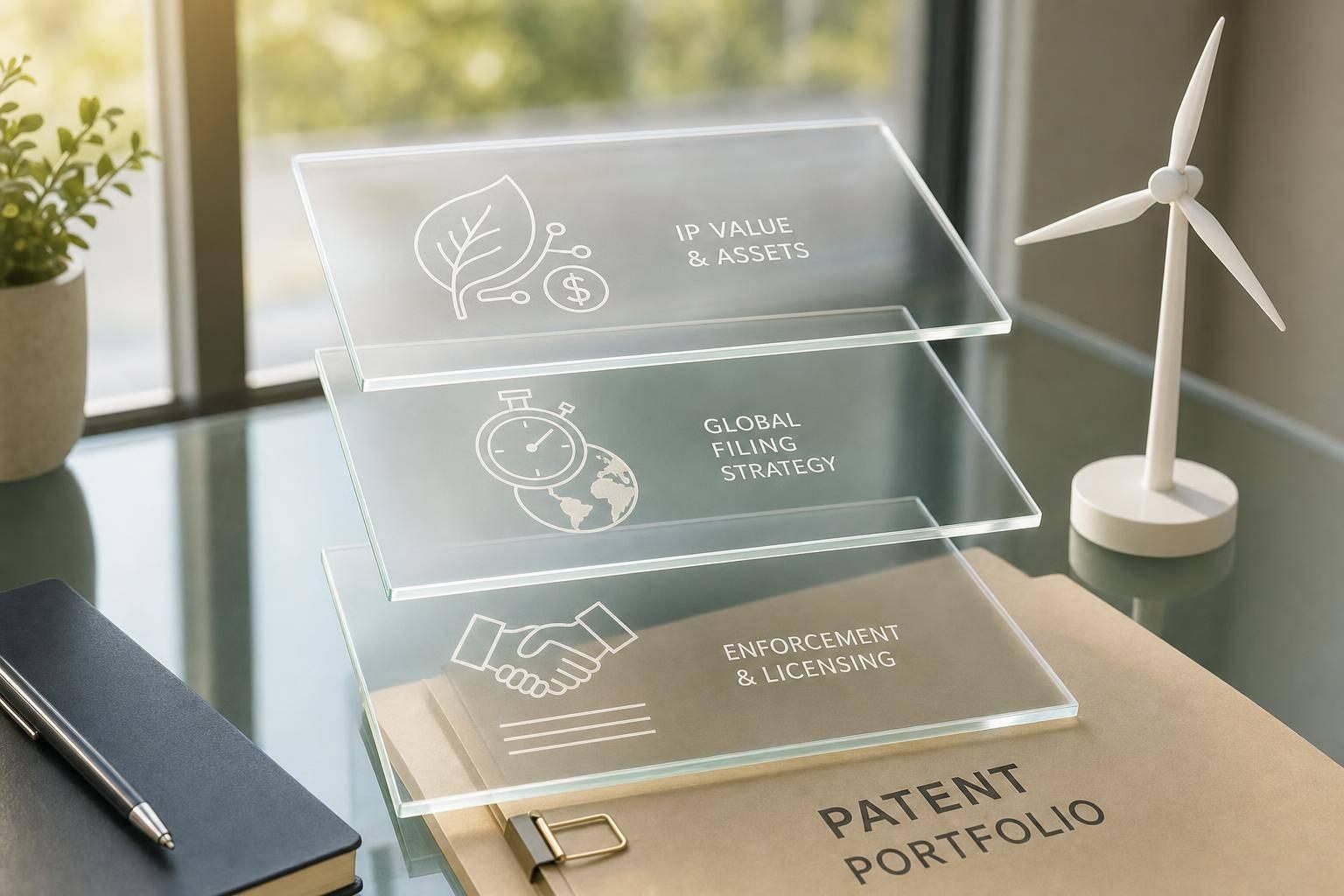
If you run a U.S. green tech startup, patent timing and claim scope can affect funding, licensing, and your chance to keep competitors out.
Here’s the short version: I’d focus on filing the right invention first, using low-cost fast-track paths where possible, choosing countries based on manufacturing and licensing plans, and tying patent work to grants, partner deals, and cash needs.
A few facts stand out:
China published about 555,000 green patent applications from 2016 to 2023, versus 157,000 in the U.S.
In FY2024, about 70% of challenged U.S. patents lost every instituted claim at PTAB
U.S. Track One is now the main fast-track option, with a 12-month disposition target and a $4,515 fee for large entities
Green tech patent value often sits in process steps, control systems, and manufacturing methods, not just the end product
If I were building this plan, I’d keep it simple:
File before any public disclosure
Start with inventions tied to revenue and policy-driven demand
Claim system control and cost-driving process steps first
Use the PCT to delay country-by-country costs
Pick national filings based on manufacturing, supply chain, licensing, and enforcement
Set clear IP terms in licenses and joint development deals
Treat patents as part of financing, not just legal paperwork
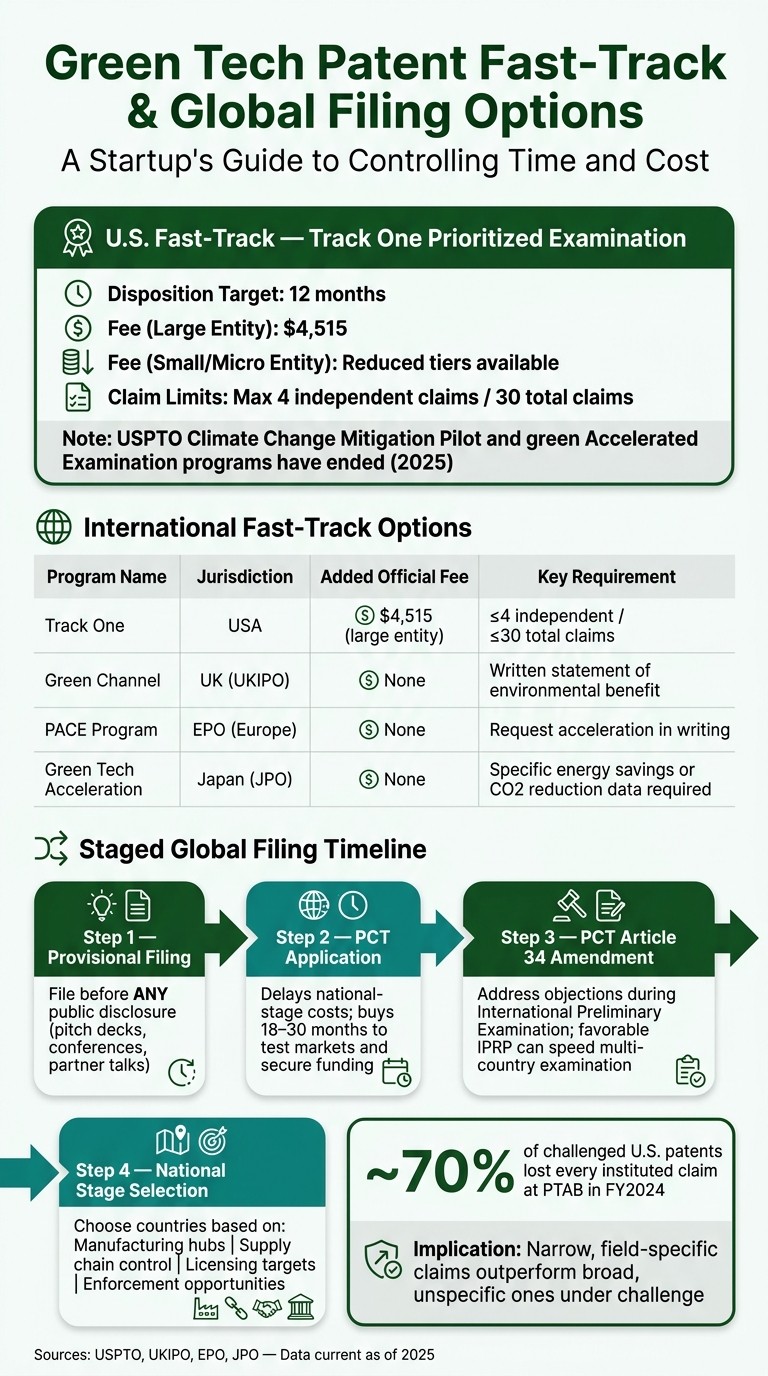
Green Tech Patent Strategies: Fast-Track Options & Global Filing Comparison
2026 Patent Strategy: How to Protect AI & Green Tech Innovations
Quick comparison
Area | What I’d do first | Why it matters |
|---|---|---|
Filing priority | File the invention tied to emissions cuts, uptime, efficiency, or cost | It links patents to buyer demand |
Claim focus | Target control layers, process steps, and production methods | These are harder to work around |
Prosecution speed | Use Track One, UK Green Channel, EPO PACE, or Japan programs when fit | It can cut delay and shape later filings |
Global filing | Use a provisional, then PCT, then select countries with business value | It helps control spend |
Partnerships | Lock down know-how, field-of-use, improvements, and license-back terms | It cuts deal risk |
Funding | Match filing dates to grants, investor talks, and R&D milestones | It keeps IP tied to cash planning |
In other words: don’t build a big patent stack just to look busy. Build a lean portfolio that supports sales, deals, and funding.
1. File where climate impact and market demand are clearest
File first on inventions tied to measurable emissions cuts, efficiency gains, or resilience gains with a clear path to revenue. If the invention solves a problem a utility, manufacturer, or government buyer already needs to fix, move that one to the front of the line. Once you know which invention matters most, claim the part of the system that drives performance and revenue.
Connect inventions to policy-backed commercial problems
Policy-backed demand pushes green tech filings, especially in EV charging, industrial decarbonization, and grid resilience. Draft patent applications to capture the exact gain: lower CO2 per unit, higher efficiency, longer uptime, or lower maintenance. Those points do more than support marketing. They help show why the invention matters in the market and what it may be worth to a licensing partner or investor.
After choosing the best filing target, shape the claims around the features that secure that value.
Prioritize system control claims and revenue-critical features first
The strongest green tech patents often cover how the system runs, not just what it produces: control software, battery management, smart charging, and grid orchestration. A competitor might swap out the hardware, but system-level claims can still make them work around your IP.
Invention Category | Examples | Why It Matters |
|---|---|---|
System Control Layers | Battery management, grid orchestration, thermal management software | Determines interoperability and performance |
High-Cost Process Steps | Catalysts, membranes, separation steps | Controls the economics that make the tech viable |
Policy-Driven Solutions | Carbon capture, recycling processes, emissions-reduction methods | Directly addresses regulatory mandates |
Manufacturing Processes | Proprietary production steps, material optimization | Protects the "how" and resists commoditization |
Broad, unspecific claims are easier to attack. In FY2024, about 70% of challenged U.S. patents lost every instituted claim at PTAB. Narrow, field-specific claims do a better job protecting the part of the stack that investors and licensees can monetize.
2. Use accelerated prosecution and staged global filing to control time and cost
Once the core invention is set, timing and jurisdiction shape what kind of patent coverage you can afford.
After you choose the main invention, use fast-track filings to lock in rights before competitors move in. In 2025, U.S. fast-track options changed. The USPTO ended its Climate Change Mitigation Pilot Program and paused its green-focused Accelerated Examination program. That leaves Track One Prioritized Examination as the main U.S. path. It offers a 12-month disposition guarantee and costs $4,515 for large entities, with lower fees for small and micro entities.
If cost is a bigger concern, there’s another path. You can use fast-track allowance in the UK or at the EPO, then lean on that result for a later USPTO PPH request. The UK Green Channel and the EPO's PACE program both speed up examination with no added official fee. Japan’s green-tech acceleration program is also free. That can be a smart way to move things along without paying U.S. fast-track fees right away.
Draft claims that support green-focused acceleration requests
For UK filings, include a clear written statement that explains the environmental benefit. You don’t need a long technical defense. A reasonable assertion is enough to qualify for the Green Channel.
Japan asks for more detail. Be specific about energy savings or CO2 reduction instead of describing the benefit in broad terms.
In the U.S., Track One comes with claim limits. Applications must stay within four independent claims and 30 total claims to remain eligible. That means the first filing should stay tight and centered on the core invention. Think of it as packing a carry-on, not trying to bring the whole closet. You can keep broader follow-on filings for later.
Choose PCT and national filings based on manufacturing, licensing, and enforcement targets

File a provisional before any public disclosure. That includes pitch decks, conferences, and partnership talks. Miss that window, and the damage can be hard to undo.
From there, use the PCT to delay national-stage costs while you test markets and line up funding. It buys time, which matters when budgets are tight and plans are still taking shape.
When it’s time to choose national filings, focus on places tied to:
Manufacturing
Supply chain control
Likely licensing deals
Likely enforcement opportunities
That approach keeps filing spend tied to business goals, not guesswork.
If you’re taking U.S. federal grant funding, the Bayh-Dole Act may also require substantial domestic manufacturing for non-exclusively licensed products. That can make the case for a U.S. filing even stronger.
You can also use the PCT’s Article 34 amendment process during the International Preliminary Examination phase to deal with objections before national stage entry. A favorable International Preliminary Report on Patentability may help speed examination in multiple countries.
That early filing base does more than protect the invention. It also gives you leverage when licensing and partnership talks start to heat up.
3. Use licensing, joint development, and government partnerships to scale faster
Once filings are in place, use them to move faster through outside IP, lab access, and the right partnership setup. A patent can do more than block copycats. It can help you trade IP access for faster commercialization.
License lab and university technology to cut development time
A patent license alone usually won’t get you to market. You also want know-how and trade-secret transfer, because that’s often what cuts development time.
With government-funded licenses, pay close attention to two terms. First, field-of-use restrictions. The license should cover all the uses you plan to pursue, not just the product in front of you today. Second, Bayh-Dole compliance, which requires substantial U.S. manufacturing for non-exclusively licensed products.
A few government partnership paths can help here:
CRADAs support co-development
SPPs let labs do reimbursable work
User Facility Agreements give you equipment access while you keep your IP
If you license in core technology, the next move is figuring out how to license out or co-develop what you build on top of it.
License out core components and structure joint development carefully
Non-exclusive licenses can expand reach. Exclusive, field-limited licenses can bring higher fees and stronger partner commitment.
Joint development needs clear rules from day one. Assign improvements, protect background IP, and secure a license-back for your company before the work starts. If you skip that step, things can get messy fast.
Strategy | Speed to Market | Control Level | Capital Needs | Common Risks |
|---|---|---|---|---|
Licensing-In | High (avoids R&D) | Low (subject to licensor terms) | Moderate (royalties/fees) | Field-of-use restrictions; U.S. manufacturing requirements |
Licensing-Out | Moderate | High (monetizes existing IP) | Low | Design-arounds by licensees; loss of trade secrets |
Joint Development | Moderate | Shared | High (shared R&D) | Ambiguous ownership of improvements; background IP disputes |
Patent Pools | High (one-stop shop) | Low | Low (transactional) | Loss of exclusivity |
Patent pools can make sense when a field gets crowded. In May 2024, LG Energy Solution and Panasonic Energy launched Tulip Innovation, a pool covering 5,000 lithium-ion battery patents to streamline licensing for the electric vehicle industry. That kind of setup can speed access, but you give up some exclusivity in return.
4. Connect patent activity to funding and portfolio operations
Patent work is a capital allocation call. It shouldn't sit off to the side as a legal task. File the provisional before any pitch, demo, or partner meeting. That first filing date gives you something solid to work from when you're lining up grant deadlines, investor talks, and R&D milestones.
Patent value tends to grow when filings map to the features that drive revenue and the moments when the company needs capital. In plain terms, the portfolio should follow the business, not drift away from it. For later-stage companies, patents can also help with IP-backed lending and IP-insured debt, which gives founders another route to use the portfolio to access capital. And if the startup takes federal funding, Bayh-Dole manufacturing rules need to shape filing plans and milestone timing early.
That same discipline matters in portfolio operations too. If search and drafting drag, filings can fall out of step with product development fast.
Use AI tools to search, draft, and prioritize green tech filings
Use AI to keep search, drafting, and docketing tied to funding targets and R&D milestones. This matters even more in green tech, where AI use in patent activity is still low. Only about 1% of energy-related patents reference AI, so prior-art search and claim drafting still carry a lot of weight.
Patently brings together Vector AI search, AI-assisted drafting, and project management so teams can keep filings lined up with active R&D.
Conclusion: Build an investment-ready green patent portfolio
Taken together, these moves turn patenting into a tool for funding and commercialization. A green tech portfolio creates value not because it has more patents, but because it lines up with revenue, policy, and claim scope that can hold up under pressure. In plain English: your filing scope should match market demand and your plans for growth across countries.
The same idea applies to licensing and partnerships. Those deals can speed up commercialization, but your position gets stronger when you own process choke points. And when a portfolio is built around claims tied to revenue, it becomes easier to finance, license, and defend when tough challengers show up.
Volume matters less than staying power. The best portfolios are selective, commercial, and built to make it through diligence. For green tech startups, the goal isn’t to file more patents. It’s to get more leverage from each filing.
FAQs
Which invention should we patent first?
Prioritize inventions that support your core revenue model and deliver clear customer value, like better efficiency, more speed, or lower cost.
Put your focus on innovations that are hard for competitors to copy and easy to spot if someone infringes on them.
Skip filing first on niche features or short-life technologies. Instead, time filings around key development stages, such as prototyping and launch.
When should a green tech startup use the PCT?
A green tech startup should use the Patent Cooperation Treaty (PCT) when it wants to keep the door open for patent protection in other countries without paying all the filing costs right away.
That matters because the PCT gives startups more time. Instead of rushing into country-by-country filings early, they can delay those costs and make smarter global filing choices later, after they’ve built more market traction and locked in the funding they need.
How do patents help with grants and fundraising?
Patents can help green tech startups win funding and grants because they show an idea is new, workable, and hard to copy. To many investors, a solid patent portfolio points to future value. That can support a startup’s valuation and give founders a better position in negotiations.
Patents can also help startups get non-dilutive funding, such as government grants and innovation programs. Many of these programs look favorably on companies with a clear intellectual property plan.