Vector AI for SEP Portfolio Optimization
Intellectual Property Management
Jun 23, 2026
Use vector AI to semantically map patents to standards, cut early SEP screening time up to 70%, and surface undeclared assets while experts decide legal status.

SEP review gets hard fast: cellular declarations top 1,000,000 patents, studies say up to 85% of declared assets may not map cleanly to the standard, and early AI-led review can cut screening time by up to 70%.
If I boil this article down to the core point, it’s this: vector AI helps me sort SEP portfolios by meaning, not just matching words. That makes it easier to map patents to standards, group related families, spot undeclared assets, and focus legal review on the patents most likely to matter.
Here’s the short version:
Embeddings turn patent and standards text into vectors, so similar ideas can match even when the wording is different.
Semantic search beats keyword-only review when claims, specs, and standards use different terms for the same concept.
Clustering and classification help triage portfolios by grouping overlap, ranking families, and flagging patents tied to Wi-Fi, video codecs, 4G, or 5G.
Metadata still matters: family mapping, legal status, owner data, citations, and SSO records help narrow the list to assets that are active and worth review.
AI scores are triage tools, not legal rulings. Lawyers and subject-matter experts still decide legal status, SEP status, and FRAND issues.
At portfolio scale, this matters because some owners hold 10,000+ patents, and review often spans the U.S., UK, China, and Germany.
One data point stands out: Unified Patents’ OPAL reported 0.999 F1 for 5G and 0.998 for LTE using vectorization methods on patent text. That does not settle legal questions. But it does show why patent teams are shifting from keyword search to meaning-based review using top patent tools.
Quick comparison:
Criteria | Keyword search | Vector AI search |
|---|---|---|
Match logic | Exact terms | Meaning similarity |
Wording changes | Often missed | Better handled |
Undeclared SEP spotting | Limited | Better for triage |
Early review burden | High | Lower |
Final legal decision | Not provided | Not provided |
So if I’m reading this article for the answer upfront, it’s simple: vector AI helps patent teams rank, group, and review SEP portfolios with less manual drag, while expert review still makes the final call.
Agentic AI – Patent Expert Co-Pilot Framework for (SEP) Licensing & Litigation Intelligence
How Research Frames SEP Portfolio Optimization
Once patents are embedded, the next step is figuring out which assets matter most to the standard and to licensing calls. That’s the core of SEP portfolio optimization: identifying which patents map to a standard, and which ones should be pushed up the list, licensed, or cut. In cellular alone, there are more than 1 million declared patents, which leads to millions of claim-to-standard comparisons.
Key Decision Variables in SEP Portfolio Review
Researchers review SEP portfolios through a few main lenses: standards relevance, essentiality, family grouping, jurisdictional coverage, and pruning priority. That sounds simple on paper. In practice, it gets messy fast.
Parallel SEP disputes now play out across the UK, US, China, and Germany, which makes manual review hard to scale. And when major contributors hold portfolios with more than 10,000 patents, the workload jumps from heavy to plain unworkable without AI-driven, portfolio-scale review.
Where Keyword-Only Review Falls Short in SEP Analysis
Keyword-only search has a blind spot. It often misses equivalent technical wording, citation links, and patent family context.
That’s why research frameworks are moving past exact-term matching and leaning more on semantic retrieval, citation analysis, family grouping, and technology-domain clustering. In standards such as Wi-Fi and video codecs, broad declarations are common, so vector search can help surface undeclared SEPs and make aggregate licensing exposure easier to see.
Those signals then feed into the semantic search, clustering, and metadata methods used next.
Vector AI Methods Used in SEP Analysis
Those decision variables come to life through three methods: semantic search, clustering, and citation- plus metadata-based scoring.
Semantic Search and Similarity Scoring for Standards Mapping
Embedding-based semantic search turns patent claims and standards text into vectors, then ranks patents by meaning-based similarity instead of plain keyword overlap. That matters because two documents can describe the same idea in very different words.
Metadata filters tighten the set before scoring. Analysts can narrow by assignee, jurisdiction, filing date, or family size, which cuts noisy matches and gives them a cleaner starting point for SEP candidate screening against a target standard.
Clustering and Classification for Overlap and Prioritization
After patents are ranked, clustering groups them by technical theme. This helps surface duplicate coverage, related inventions, and patent families that need a closer look. In practice, that makes it easier to rank families for essentiality review and pruning.
Automated classification pushes this a step further. Using positive training sets built around specific standards, such as Wi-Fi 6 or HEVC, classification models can flag patents tied to those standards even if they were never officially declared to standards bodies. That can point to undeclared assets, which may create both compliance risk and licensing upside.
Clustering and classification don't make a legal call on their own. What they do offer is repeatable triage, so teams know where to dig deeper.
How Citation and Metadata Analysis Complements Vector Methods
Vector similarity shows a patent's technical focus. Citation and metadata analysis shows how that patent fits into the rest of the portfolio.
Vector scores point to candidate relevance. Metadata then checks whether the asset is active, owned, and mapped the right way. Legal status and ownership data help keep review centered on enforceable, controlled assets.
Legal status data, including grant, maintenance, and expiration, filters for active assets. Ownership data matters too, especially when an ultimate owner model rolls up subsidiaries and affiliates. That helps identify the real licensing party and can also surface PAE risk.
Research also points to a major over-declaration issue in cellular. Studies suggest that up to 85% of declared patents in that sector may not be truly essential to the standard. Cross-checking SSO declaration records against vector-based similarity scores is one of the most direct ways to spot that gap.
Metadata Category | Role in SEP Review | Impact on Decision Support |
|---|---|---|
Patent Family Mapping | Groups related filings | Prevents double-counting; clarifies global coverage |
Legal Status/Events | Tracks grants, expirations, maintenance | Filters review to enforceable assets |
Ultimate Owner Data | Consolidates subsidiaries and affiliates | Identifies true licensing counterparts and PAE risks |
SSO Declarations | Links patents to technical specs | Provides the legal basis for essentiality claims |
Forward Citations | Measures technical impact | Identifies high-value core patents |
These signals feed the next stage of portfolio value and compliance analysis.
Research Findings on Portfolio Value and Compliance
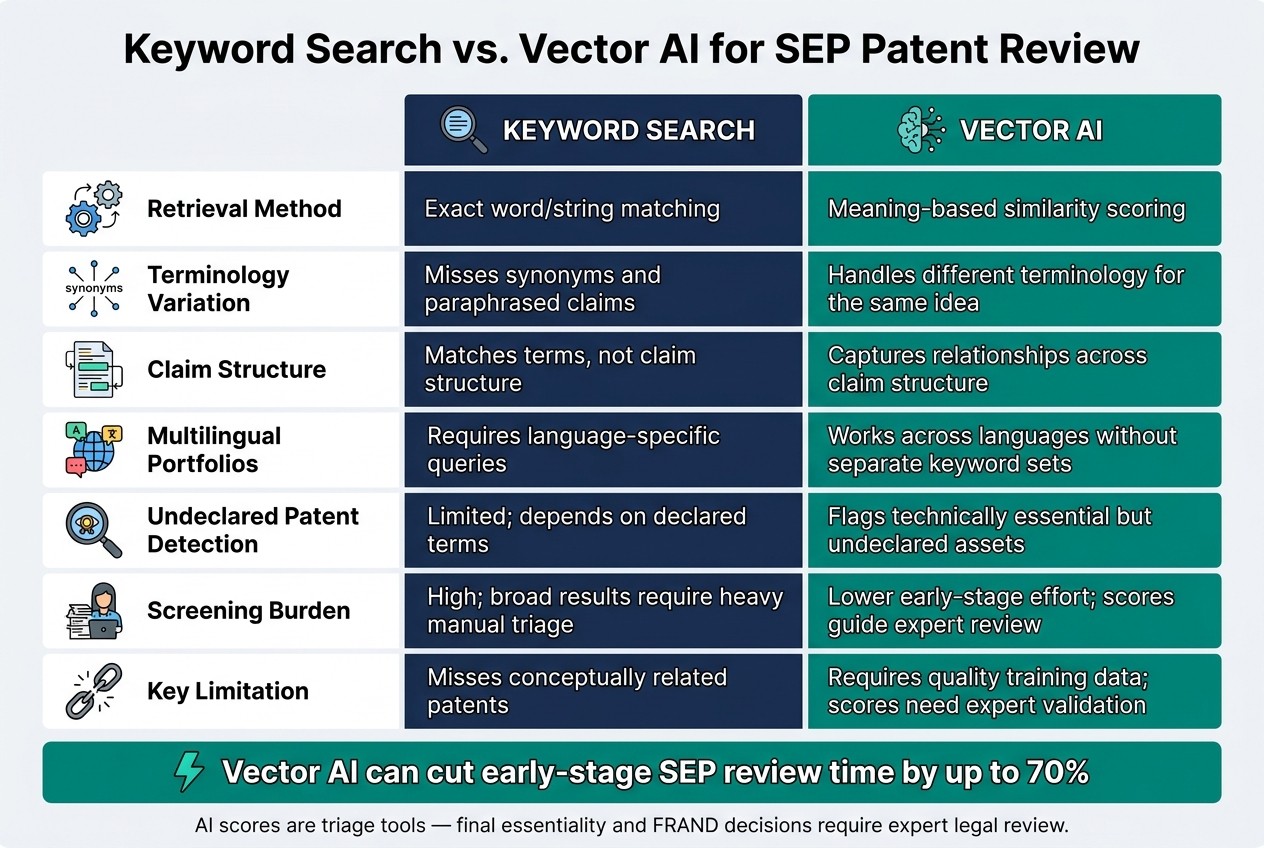
Keyword Search vs. Vector AI: SEP Patent Review Compared
What the Evidence Shows About Efficiency and Decision Support
Once candidate patents are mapped and ranked, the next step is seeing what vector methods do in practice. The research points to three big shifts: faster early review, broader search coverage, and better support for decision-making.
Published technical reports consistently find that vector-based semantic search can cut early-stage essentiality review time by up to 70% while maintaining or improving accuracy. That matters because early SEP review can turn into a slog fast. Semantic search looks for meaning, not just matching words, so it can surface related assets that exact-match queries often miss. The result is a cleaner picture of portfolio exposure across jurisdictions.
That broader view also helps teams spot risks they may not have seen at first. For companies moving into SEP-heavy sectors like automotive or smart metering, it can help identify unknown licensors, including patent assertion entities, and assess exposure.
AI-generated essentiality scores, often shown on a 1–100 scale, help teams sort patents for expert review. But they are a triage tool, not a final answer. Manual validation still has to happen.
How to Read Compliance-Related Gains Carefully
This is where some teams get ahead of themselves. The main gain is better input for legal review, not a legal ruling.
AI tools can improve consistency and documentation in SEP analysis, but they do not determine legal essentiality or FRAND compliance. Those calls still depend on expert legal judgment. What the research backs is more modest, but still useful: vector methods improve the quality of the material going into legal review, which helps teams focus attention where it matters most.
Keyword Search vs. Vector-Based Semantic Search: A Comparison
The table below shows why semantic retrieval tends to work better than exact-match search for SEP screening.
Criteria | Traditional Keyword Search | Vector-Based Semantic Search |
|---|---|---|
Retrieval method | Exact word/string matching | Meaning-based similarity scoring |
Terminology variation | Misses synonyms and paraphrased claims | Handles different terminology for the same idea |
Claim structure | Matches terms, not claim structure | Captures relationships across claim structure |
Multilingual portfolios | Requires language-specific queries | Works across languages without separate keyword sets |
Undeclared patent detection | Limited; depends on declared terms | Flags technically essential but undeclared assets |
Screening burden | High; broad results require heavy manual triage | Lower early-stage effort; scores guide expert review |
Key limitation | Misses conceptually related patents | Requires quality training data; scores need expert validation |
Putting Vector AI to Work in Patent Workflow Systems
A Research-Aligned Workflow for SEP Portfolio Review
These gains matter most when they slot into a review process a team can run again and again. For SEP review, Vector AI works best inside a straightforward pipeline: ingest patent families, patent text, standards text, and metadata; normalize families; deduplicate records; then search, cluster, validate, and rank the results.
That matters because SEP review can get messy fast. If the inputs aren't cleaned up first, even good search can send people down the wrong path. A clear workflow keeps the process tight and makes it easier to move from broad screening to expert review without losing the thread.
Where Patently Fits in the Workflow
A patent platform can put that pipeline to work in one place. Patently is built around this kind of structured process. Its Vector AI semantic search runs across a dataset of more than 82 million patent families and 135 million individual patents, with each one mapped to 226 distinct fields.
At that scale, teams can screen large SEP portfolios fast and cut the pile down to the families that need close review. Instead of bouncing between tools, they can keep the work in one system.
Patently also includes a citation browser and team project tools, so reviews, notes, and decisions stay together. Its SEP analytics module supports 4G/5G SEP review.
Conclusion: What Vector AI Changes in SEP Portfolio Optimization
Vector AI speeds SEP discovery and triage, while leaving essentiality and FRAND decisions to experts.
FAQs
How does vector AI find undeclared SEPs?
Vector AI finds undeclared Standard Essential Patents by using semantic search to spot concept-level links between patent claims and technical standards, instead of leaning on manual, keyword-based declarations.
It maps patent claims to specific parts of technical specifications, which helps teams find patents tied to a standard even when those patents were never formally declared. That cuts down on noise and brings forward patents with a high chance of being essential.
What data matters most beyond vector scores?
Beyond vector scores, the data that matters most is patent metadata and the details inside each claim. That means looking at signals like inventor history, claim-to-standard mapping, geographic coverage, ownership structure, and legal status.
You also need to test validity against prior art. A patent might look strong on paper, but if earlier filings weaken it, that changes the picture fast. The goal is to confirm the patent can hold up under legal scrutiny.
Can AI determine SEP essentiality or FRAND compliance?
Yes. AI can help with these assessments by handling complex technical analysis at scale.
Patently uses Vector AI for semantic mapping. That lets it line up patent claims with technical standards, which helps teams check essentiality and estimate likelihood scores.
For FRAND compliance, AI analytics can review licensing programs, market data, and rate benchmarks to spot pricing anomalies or inconsistencies.
AI makes these reviews easier to scale. But the final legal and licensing calls still need human judgment.