Best Practices for AI-Driven SEP Analysis
Intellectual Property Management
Mar 1, 2026
AI best practices for SEP analysis: use semantic search, multi-source data, citation mapping, XAI and team workflows to speed essentiality checks and improve defensibility.

AI is transforming how Standard Essential Patents (SEPs) are analyzed, making it faster, more accurate, and scalable. Here's what you need to know:
SEPs are critical for interoperability in technologies like 5G, Wi-Fi 6, and video compression codecs. However, up to 85% of declared SEPs may not meet the necessary criteria.
AI tools simplify SEP analysis by automating claim mapping, essentiality ratings, and citation-supported claim charts. Tasks that once took weeks can now be completed in minutes.
Key strategies for using AI include leveraging multiple data sources, applying semantic search for better claim matching, automating citation analysis, and using team-based project management tools.
AI ensures better data quality by detecting inconsistencies and improving transparency through explainable AI (XAI) systems.
AI-assisted reports save time and money, offering tailored outputs for technical teams, executives, and legal professionals.
This article explores how to integrate AI into SEP workflows, reduce analysis time by 70%, and improve accuracy for licensing, litigation, and R&D planning.
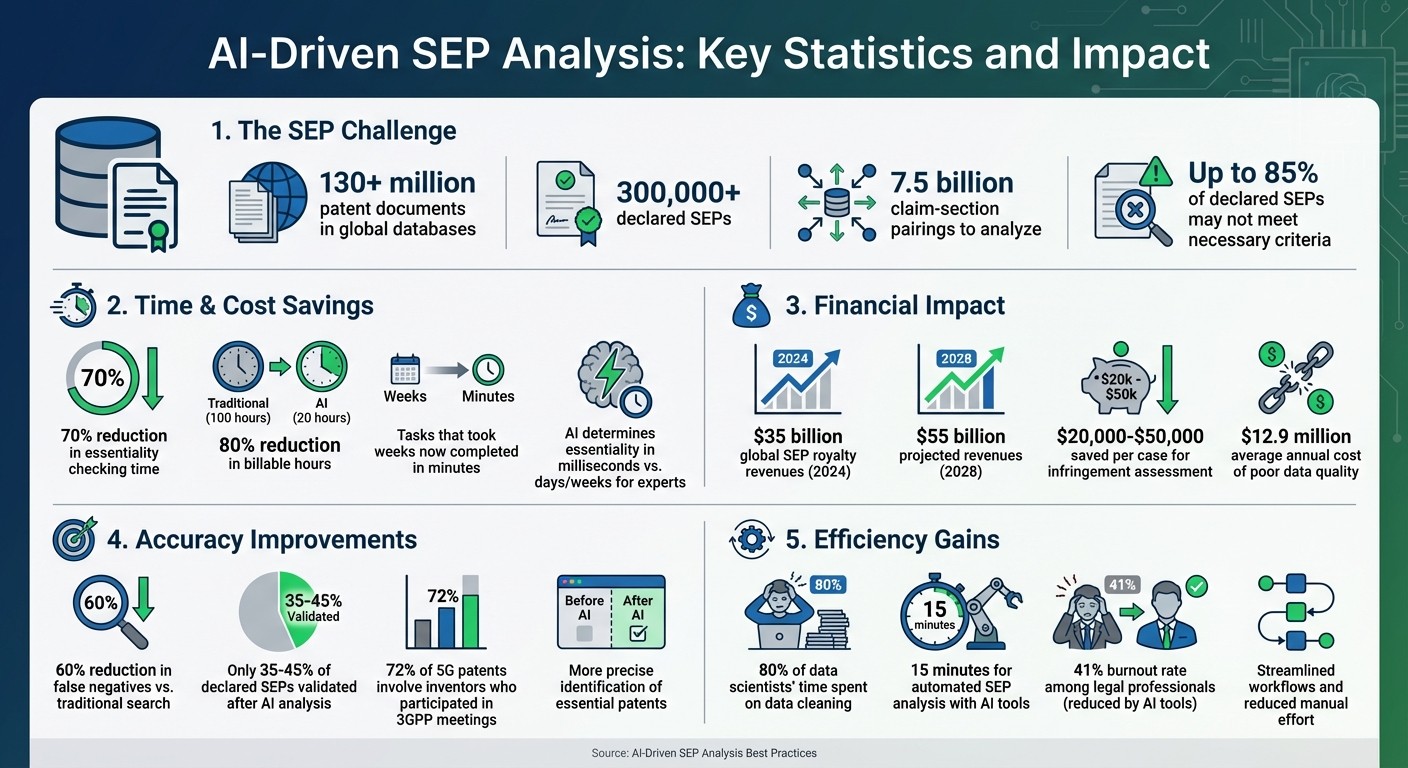
AI-Driven SEP Analysis: Key Statistics and Impact Metrics
Analyzing SEP(Standard Essential Patent) With AI Agent In A Single Prompt
Best Practices for AI-Driven SEP Analysis
Integrating AI into SEP workflows can reduce essentiality checking time by about 70% while ensuring only 35–45% of declared SEPs are validated. These strategies are designed to help patent professionals tackle the complexities of managing SEP portfolios effectively.
Use Multiple SEP Data Sources
Relying on just one data source for SEP analysis can leave gaps. AI platforms address this by indexing critical SDO data, such as ETSI and IEEE, to provide a broader view. For instance, research shows that 72% of all 5G-declared patents involve at least one inventor who participated in relevant 3GPP standards meetings. AI can map these inventors and applicants to specific meetings or technical contributions, offering insights into true essentiality.
In cases where SDOs like IEEE or ITU allow blanket declarations without listing specific patents, AI-powered semantic search becomes indispensable. This tool identifies potentially essential patents that may not have been formally declared. Given that global SEP royalty revenues surpassed $35 billion in 2024 and are projected to hit $55 billion by 2028, having comprehensive data and accurate semantic search capabilities is critical for matching patent claims to standards.
Apply Semantic Search to Match Patent Claims
Traditional keyword searches often miss the mark in SEP analysis because patent claims typically use broad legal language, while standard specifications are written in precise technical terms. Semantic search overcomes this by converting patent claims and standard sections into vectors within a conceptual space, enabling comparisons based on meaning rather than keywords.
"A sophisticated AI algorithm can determine essentiality in milliseconds, whereas an expert will require days or sometimes weeks and months to come to the same decision."
Tim Pohlmann, Ph.D., Managing Director Americas at LexisNexis Intellectual Property Solutions
With over 300,000 declared SEPs and 7.5 billion claim–section pairings, manual analysis is simply not feasible. Tools like Patently's Vector AI use transformer-based models to grasp technical intent across different terminologies, reducing false negatives by up to 60% compared to traditional search methods.
Automate Citation Analysis and Mapping
Citation mapping helps reveal the structure of the SEP landscape. AI tools streamline this process by mining backward references, identifying newer works citing seed patents, and creating visual networks where node size reflects citation frequency. For example, a study conducted between August and November 2024 by Canada's Drug Agency Research Information Services team found that while traditional manual searches achieved a sensitivity of 0.986, AI tools like Lens.org - covering over 272 million scholarly records and 155 million patent records - reached 0.816 sensitivity for simpler topics, all while reducing the workload.
AI also uses co-citation and bibliographic coupling to uncover related patents with shared references, highlighting dependencies that aren't immediately obvious. Starting with high-quality seed patents, such as core essential patents or primary standard specifications, is key. Visual timelines can then track when specific "essential" features emerged during the standard's development. Beyond data mapping, effective teamwork is essential to make the most of these insights.
Set Up Team-Based Project Management
SEP analysis requires collaboration across legal, technical, and business teams. AI-driven project management tools - offering features like hierarchical categorization and granular access controls - help ensure consistency while maintaining confidentiality. Platforms like Patently allow teams to organize SEP reviews by technology standard, litigation matter, or licensing negotiation. Customizable fields help track essentiality ratings, claim chart progress, and review assignments.
This collaborative approach minimizes redundant efforts, which is especially important when analyzing over 100,000 declared patent families for 5G alone. Integrated project management tools also allow law firms and enterprises to share annotations and insights in real time, all while safeguarding client confidentiality.
Create AI-Assisted Reports and Exports
AI platforms can generate structured claim charts that include citation-backed mappings, essentiality ratings, and technical excerpts.
"Without a carefully-crafted claim chart, a patent has little value."
Kelce S. Wilson, Attorney at Grable Martin Fulton, PLLC
Exporting these outputs in various formats is essential since different stakeholders have different needs. Technical teams might prefer detailed CSV files for in-depth analysis, while executives often require concise PDF summaries. AI-assisted report generation ensures consistency across these outputs while allowing for customization. Some advanced systems even include interactive AI chat agents, enabling IP teams to ask follow-up questions about claim charts or clarify essentiality ratings in real time. This makes the analysis accessible, even for those with limited AI experience.
Maintaining Data Quality and Transparency
Ensuring reliable patent evaluations through SEP analysis depends heavily on clean data and clear AI decision-making. In this field, where accurate essentiality assessments are crucial for licensing and litigation, poor data quality can cost organizations an average of $12.9 million each year. Data scientists, on average, dedicate 80% of their time to data cleaning. This underscores why automating data governance is crucial for scaling AI-driven workflows in SEP analysis.
Use AI for Data Governance
AI-powered tools for data governance play a key role in identifying and addressing anomalies or inconsistencies in SEP datasets in real time, preventing flawed data from compromising essentiality reports. Automated data profiling and observability systems can quickly detect irregularities, trace their origins, and link data changes to model outcomes. For instance, AI can resolve issues like duplicate inventor records (e.g., "John A. Smith" versus "J. Smith") or standardize inconsistent formats such as "USA" versus "United States", ensuring uniformity in reporting.
In the context of SEP analysis, AI can also process complex technical documents, extract meaningful metadata, and connect business terms with technical specifications - essential for accurate claim mapping. Intelligent rule recommendation systems analyze data patterns to propose validation rules tailored to the unique characteristics of each dataset, eliminating the need for manual rule creation. This capability is particularly useful for tracking patent ownership changes or mapping patents to evolving technical standards like 3GPP releases for 5G. While data integrity is critical, transparency in AI decision-making is equally important for building trust in SEP evaluation.
Focus on Model Transparency and Continuous Improvement
One major concern among patent professionals is the "black box" nature of AI decisions in SEP analysis. Explainable AI (XAI) addresses this issue by offering clear and understandable explanations for AI-driven essentiality ratings and claim mappings. As Chris Parsonson emphasizes:
"Providing clear, understandable explanations for AI decisions is vital to fostering trust and acceptance among legal practitioners".
Equally important is the need for continuous improvement, as patent laws and technical standards are constantly evolving. AI models must be regularly updated to incorporate new patents, legal rulings, and changes in standards like 5G or Wi-Fi specifications. Feedback loops - where experts review and refine AI outputs - help improve taxonomies and enhance accuracy. Patently, for example, employs a human-in-the-loop approach, where AI acts as a "drafting accelerator", but patent professionals retain control over final decisions. By combining transparency with ongoing refinement, AI-driven SEP analysis remains dependable and defensible, whether for licensing negotiations or litigation.
Key Features of AI Platforms for SEP Analysis
With over 130 million patent documents in global databases, traditional search methods can't keep up. To handle the complexity of Standard Essential Patent (SEP) analysis, platforms need to combine advanced semantic tools, collaborative features, and reliable outputs. Here's a closer look at the features that help patent professionals navigate this challenging landscape.
Analytics and Semantic Search Capabilities
Advanced semantic search, powered by large language models (LLMs), automatically maps varied patent language to technical standards. This significantly cuts down analysis time. For instance, an Am Law 100 firm reported an 80% reduction in time spent, dropping from 100 billable hours to just 20.
Key features include standardized essentiality ratings - Normative, Implied, Informative, and Contextual - that provide structured evidence for licensing discussions. Some platforms also offer portfolio-scale heatmaps, which highlight patents with strong licensing potential or vulnerability to invalidity challenges within large portfolios. Tools like Patently's Vector AI can perform automated SEP analysis in as little as 15 minutes, making it a game-changer for efficiency.
Customizable Collaboration and Management Tools
Effective platforms provide flexible hierarchies, robust access controls, and features like text pinning to preserve human edits during updates. This is particularly valuable considering the high burnout rate - 41% - among legal professionals, as these tools help reduce unnecessary cognitive strain.
Interactive AI chat agents enable real-time follow-ups on essentiality ratings. Features such as two-column views, organizing evidence by claim phrase, streamline the process of verifying how patent claims align with technical standards. Additionally, audit-ready documentation that tracks edit history and maintains evidence mapping ensures the defensibility required for litigation.
Report Generation and Data Integration
Platforms must support quick, audience-specific report generation. For example, one cybersecurity company saved $20,000 to $50,000 per case by evaluating infringement risks internally using an AI platform.
Seamless integration with internal databases, document management systems, and docketing software eliminates data silos and aligns IP activities with broader business goals. Platforms should support multiple export formats and APIs for smooth integration with existing systems. For companies managing sensitive trade secrets, SOC 2 certification and workspace-level data segregation are essential.
Patently’s platform, for instance, simplifies report generation with citation-backed claim charts and integrates external datasets, including global patent databases and technical standards. These features complement the workflow efficiencies described earlier, making them indispensable for SEP analysis.
Conclusion
AI is reshaping the way patent professionals handle SEP analysis and draft patent applications. By moving from manual keyword searches to semantic understanding, teams can now process thousands of patents in just minutes instead of weeks. Considering the sheer volume of over 130 million patent documents in global databases, this evolution isn't just helpful - it’s a necessity for staying ahead.
The practices discussed here - such as using diverse data sources and ensuring transparent AI governance - offer a roadmap for combining speed with precision. For instance, in June 2025, an Am Law 100 firm demonstrated this balance by cutting cycle times by 80%, reducing 100 billable hours to just 20 without sacrificing quality. Similarly, a cybersecurity company managed to save between $20,000 and $50,000 per case by leveraging AI to assess infringement risks internally.
A human-in-the-loop approach is key: AI handles data processing and pattern recognition, while human expertise provides the critical legal judgment. Tools like Patently simplify this process by integrating automated standards searches, semantic claim mapping, and citation-supported reporting into one streamlined system.
With these advancements, the focus has shifted from debating whether to adopt AI-driven tools to determining how quickly these best practices can be implemented to maintain a competitive edge.
FAQs
How do I validate whether a declared SEP is truly essential?
To determine if a declared Standard Essential Patent (SEP) is genuinely essential, AI-powered tools can analyze patent claims and compare them to relevant standards. These tools deliver structured insights, including essentiality ratings such as Normative, Implied, or Informative, along with excerpts from the standards for reference.
Pairing AI-driven analysis with expert review enhances accuracy. The combination of AI confidence metrics and human validation helps pinpoint patents that are most likely to be genuinely essential.
What’s the best way to use semantic search for claim-to-standard matching?
To tackle this effectively, rely on AI-driven semantic search tools specifically trained on patent data. These tools excel at analyzing invention descriptions and technical features, making your search process more efficient. Once you have the results, take the time to manually review the top matches to ensure their accuracy and relevance.
For even better precision, combine semantic search with detailed claim charts and technical standard databases. This approach not only helps pinpoint patents critical to specific standards but also simplifies SEP analysis workflows, making the entire process more streamlined.
How can I make AI-driven essentiality ratings defensible for licensing or litigation?
To create reliable AI-driven essentiality ratings, prioritize transparency, accuracy, and human oversight. Leverage tools that offer structured evidence, such as claim charts and excerpts from applicable standards. Ensure that the ratings are grounded in up-to-date patent data and reflect the latest standards. Clearly document the methodology, including the criteria and data sources used, to strengthen credibility. By pairing AI analysis with expert validation, you can achieve dependable ratings suitable for licensing or legal disputes.