Explainable AI in Patent Search: How It Works
Intellectual Property Management
Jun 20, 2026
How explainable AI highlights matching patent passages to speed prior-art review and show why results match.

Here’s the short answer: explainable AI makes semantic patent search easier to review because it shows why a patent matched your query, not just that it matched.
If I were screening prior art, novelty, or landscape results, I’d want three things right away:
Meaning-based ranking, not word overlap alone
Highlighted passages that show the match
A repeatable review flow for keeping, rejecting, or refining results
Patent text often uses different wording for similar ideas. That’s why semantic search can help find art that keyword search may miss. But a high similarity score by itself is not enough. I still need to see whether the overlap is about the same function, structure, or mechanism.
So the main point is simple:
Semantic search helps find more possible matches
Explainability helps me judge those matches faster
Human review still makes the final call
A useful explanation layer usually shows:
matched concepts
highlighted text passages
saliency or relevance signals
plain-English summaries of the overlap
clues that a result is off-topic even if the rank looks high
That changes the review process in a direct way. Instead of reading every result from top to bottom, I can start with the evidence, check whether it lines up with the claim scope, and then decide what to do next.
Quick Comparison
Aspect | Raw semantic search | Explainable AI search |
|---|---|---|
What I get | Ranked results | Ranked results plus reasons |
Review effort | More full-text reading | More focus on key passages |
Trust in results | Lower if score stands alone | Higher when text support is shown |
Best use | Initial retrieval | Retrieval plus screening |
Final decision | Human review | Human review |
In short, AI-enabled patent analysis does not replace patent judgment. It helps me get to the parts of the document that matter first, so I can review results with more focus and keep a clear record of why a match stayed in or dropped out.
How Explainable Semantic Search Works
From Search Query to Semantic Ranking
Enter a natural-language query, and the system ranks patent text based on meaning similarity. Semantic search often improves recall compared with keyword-only methods. The ranking step finds the most likely matches. Then the explanation layer shows the evidence behind those results.
What the Explanation Layer Shows
After ranking, the next step is figuring out which parts of the patent drove the result. The system uses saliency scores to point to the terms, passages, or concepts that pushed the similarity score higher. Those signals appear as highlighted passages, relevance ratings (high, medium, or low), and concept links that show overlapping ideas.
The explanation layer also helps with mechanism-level differences, not just similarities. That matters a lot in patent review. A document can score high at first glance, but the explanation may show that the underlying mechanism differs from your invention. When that happens, you can rule it out fast instead of digging through the full patent.
Where Patently Fits Into This Workflow
Patently's Vector AI handles semantic ranking, and its explanation layer shows why each document surfaced in the same review workflow. That makes the results easier to screen before moving into claim-level analysis.
How to Read and Use the Explanations
Review the Evidence Behind Each Match
After ranking, the next move isn't to search harder or switch to top patent tools. It's to check why each result showed up.
Use the explanation layer to judge each match before you open the full patent. Start with the highlighted passages and matched concepts. Those pieces show what drove the result and whether the relevance score makes sense.
Then look at the AI Explain summary to confirm the technical overlap in plain English. A high rating only means something when the highlighted text backs it up. If the passage feels thin or drifts off-topic, dig deeper. Saliency scores help cut review time by pointing you to the most relevant nodes in a long patent, so you don't have to scan the whole thing by hand.
Once the evidence is clear, you can decide whether to keep the match, reject it, or tighten the search.
Refine the Search When Explanations Show Weak Matches
Weak matches usually reveal themselves fast. The highlighted passages and concept links simply don't line up with the query.
When that happens, narrow the query to the concepts that matter most. In plain terms, let the explanation tell you what went wrong, then use that signal to improve the next search.
Raw Results vs. Explainable Results: A Comparison
The difference is simple: raw results need interpretation. Explainable results give you evidence.
Feature | Raw Semantic Results | Explainable AI Results |
|---|---|---|
Clarity | Users must infer why a document ranked. | Provides clear answers on why a document was retrieved and where concepts overlap. |
Review Speed | Slower; requires full-text review. | Faster; highlights relevant nodes or paragraphs, simplifying the result graph. |
Confidence | Lower; the ranking is harder to trust. | Higher; traceable evidence and relevance ratings build user trust. |
Raw results show rank. Explainable results show evidence.
How to Apply Explainable AI in Patent Review Workflows
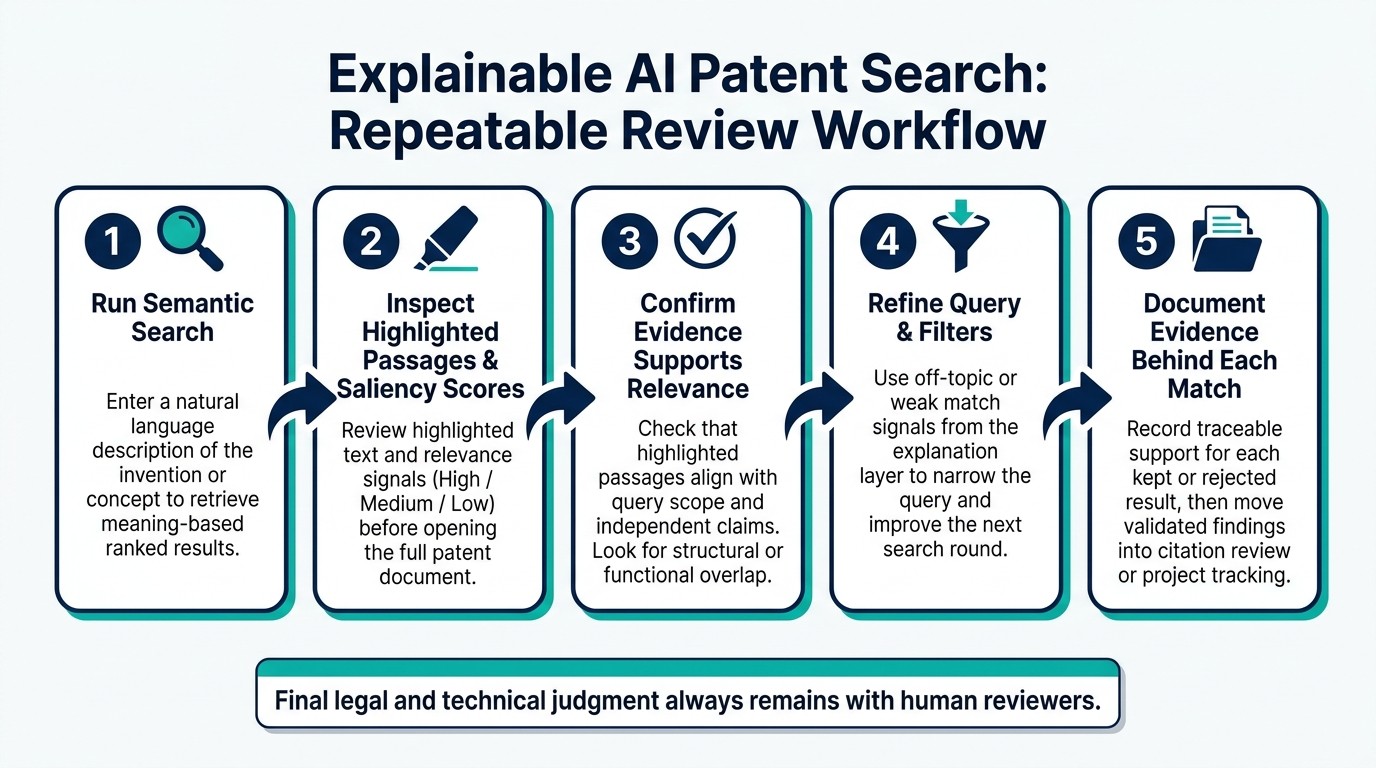
Explainable AI Patent Search: Step-by-Step Review Workflow
Use It for Prior Art, Novelty, and Landscape Review
Explainable AI helps with prior art, novelty, and landscape review because it shows why a result matched. That matters a lot in patent work. A high score alone doesn't tell you much, but highlighted evidence does.
Across all three tasks, explanation signals bring the most relevant passages to the surface right away. That cuts down on full-text review and helps you focus on the parts that matter first. The same evidence-based logic should shape each step of the review process.
Follow a Repeatable Review Sequence
A steady review process keeps things organized and easier to check later. The sequence below works across prior art, novelty, and landscape review:
Run the semantic search using a natural language description of the invention or concept.
Inspect the highlighted passages and saliency scores before reading the full patent.
Confirm that the evidence supports relevance by checking that the highlighted text lines up with the query.
Refine the query and filters based on off-topic matches.
Document the evidence behind each match for later review.
When you work this way, each decision has traceable support instead of just a score. After you validate a result, move it into citation review or project tracking.
Connect Explainable Search to Patently Workflows
Carry validated findings into citation review and project management. Then check whether those explanations stay consistent and traceable across searches.
How to Evaluate Quality, Limits, and Next Steps
Check Relevance Consistency and Traceable Evidence
After you screen and refine the results, the next step is simple: figure out which matches are worth a closer look. Once retrieval is done, check which results actually fit the scope of your claim.
Start with the highlighted passages. Do they show technical overlap? Do they line up with your independent claims? That matters because surface similarity can be misleading. Two documents may talk about the same broad topic and still describe very different mechanisms.
What counts as true relevance here? Structural or functional overlap that matters for patentability.
A strong result set usually shows a pattern. The highlights keep pointing back to the same core concept. A weak set looks different. The highlights feel scattered, loosely related, or tied to side issues instead of the main idea.
Advantages and Limitations: A Comparison
This is where explainable search tends to help most, and where human review still has the final say.
Feature | Explainable AI Search | Manual Review |
|---|---|---|
Transparency | High - shows reasoning and evidence highlights | Variable - depends on reviewer notes |
Speed | Results in seconds or minutes | Slow - days or weeks of manual sifting |
Limitations | Possible noise and model training lag | Can miss relevant art during manual sifting |
Primary Role | Discovery and evidence surfacing | Final legal and technical judgment |
Semantic search will often recall more relevant art than keyword-only search. But higher recall, by itself, doesn't prove relevance.
Conclusion: Key Takeaways for Patent Teams
Use explainability to check results faster, document evidence more clearly, and keep final judgment with legal and technical reviewers. Then move the strongest, fully explained matches into citation review and project tracking.
FAQs
How accurate are AI explanations in patent search?
AI can make patent searches more accurate because it looks at the conceptual meaning of a document, not just exact keyword matches. That matters a lot in patents, where two filings can describe the same idea with very different wording. A standard search might miss that. An AI-based search is better at surfacing prior art that sits just outside the obvious terms.
Explainable AI helps by showing clear, on-demand reasoning for why a document was pulled into the results. So instead of feeling like a black box, the system gives you a plain-English path from query to match. And when these models are fine-tuned with patent-specific data, they can line up closely with human annotations, which makes the output easier to review and trust.
Can explainable AI improve claim-level relevance?
Yes. Explainable AI can improve claim-level relevance because it turns patent claims into numerical vectors that reflect legal and technical meaning, not just keyword matches.
Patently uses this approach to rank results against specific claim elements. It also highlights evidence at the limitation level, which helps professionals spot functional overlaps and see the boundaries set by terms like comprising or consisting of.
What makes a high-ranked result off-topic?
A high-ranked result can look off-topic when the system treats the query and the document as conceptually close, even when the page doesn’t line up with what the user meant.
This tends to happen for a few common reasons: vocabulary mismatch, limits in keyword-based methods, or bad vector alignment that creates a false sense of mathematical closeness.