How AI Maps Patent Citation Networks
Intellectual Property Management
May 1, 2026
AI-powered mapping and analysis of patent citations to identify key patents, white-space opportunities, and competitive trends.

AI simplifies the complex process of analyzing patent citation networks with specialized tools, which are large graphs showing how patents reference each other. These networks help track innovation, identify influential patents, and find opportunities for new inventions. Here's how AI transforms this process:
Automates Citation Mapping: AI uses natural language processing (NLP) and graph neural networks to map relationships between patents quickly and accurately.
Cleans and Standardizes Data: AI organizes messy patent records by aligning classifications, removing duplicates, and normalizing assignee names.
Identifies Key Patents: By calculating metrics like In-Degree and PageRank, AI highlights patents with the most influence or strategic importance.
Finds Innovation Gaps: AI detects "white-space opportunities" by analyzing gaps in citation networks and trends in emerging technologies.
Supports IP Strategy: Real-time updates and visual maps help professionals make informed decisions about R&D, licensing, and competitive intelligence.
AI enables faster, more accurate analysis, saving time and uncovering insights that would be hard to find manually.
How AI Builds Patent Citation Networks
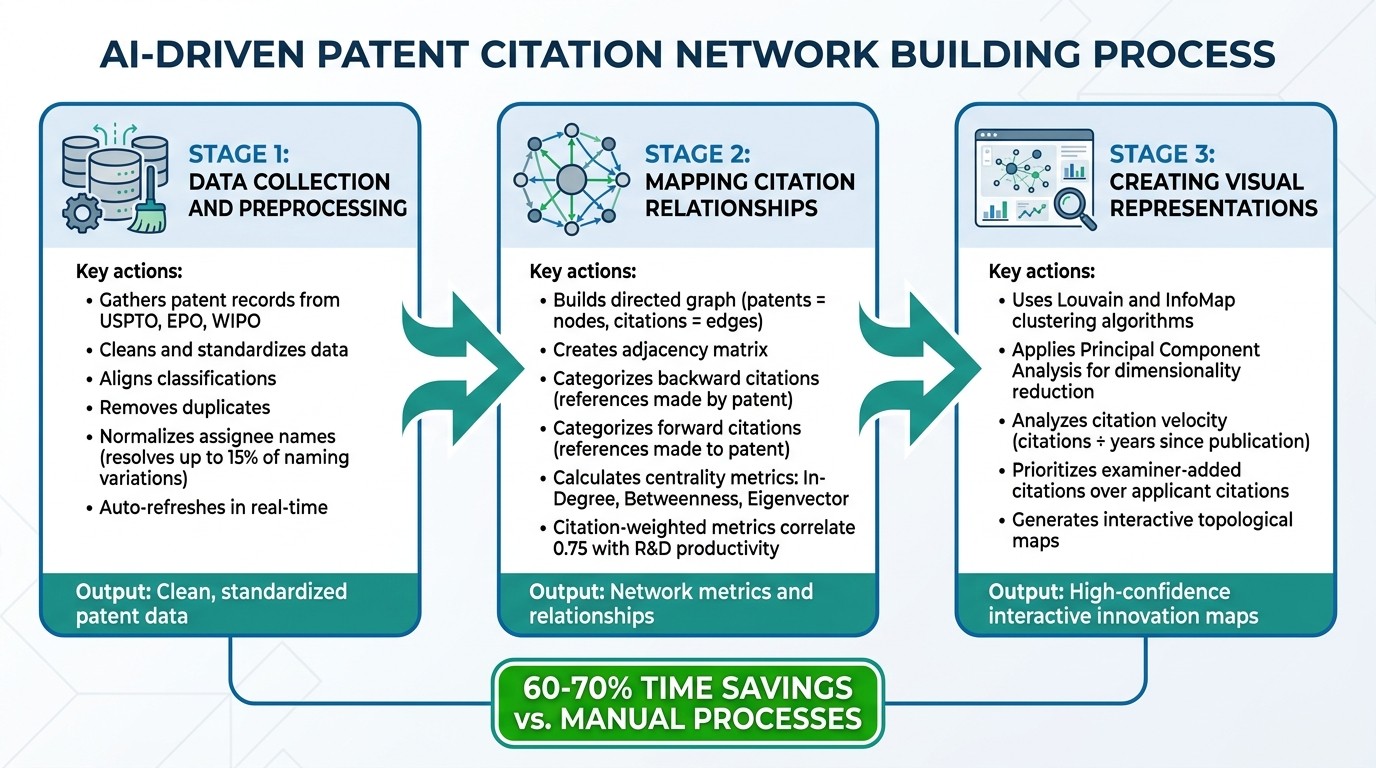
AI Patent Citation Network Mapping: 3-Stage Process from Data Collection to Visual Analysis
AI takes the complex, time-consuming task of analyzing patent citations and turns it into a streamlined process, much like generative AI patent drafting tools, creating a detailed map of technological connections. What would take months for human analysts is now achievable in a fraction of the time.
Data Collection and Preprocessing
The process begins with AI gathering patent records from major databases like the USPTO, EPO, and WIPO. However, raw patent data is far from ready-to-use. It’s often riddled with inconsistencies: different classification systems across jurisdictions, variations in assignee names, and duplicate entries within patent families. AI steps in to clean and standardize this data. It aligns classifications, removes duplicates, and normalizes assignee names - even grouping subsidiaries under their parent companies. This step is crucial because failing to consolidate assignee data can lead to underestimating the size and scope of a patent portfolio.
What sets AI systems apart from traditional methods is their ability to refresh automatically. As new patents are published, these systems update in real time, turning static reports into dynamic dashboards. This ensures that the data foundation remains accurate and up-to-date, paving the way for mapping citation relationships.
Mapping Citation Relationships
With clean data in hand, AI builds a directed graph, where patents are represented as nodes and citations as edges. These relationships are captured in an adjacency matrix, where a "1" indicates a citation. AI then categorizes citations into two types: backward citations (references made by the patent) and forward citations (references made to the patent).
To uncover the strategic importance of patents, the system calculates centrality metrics like In-Degree, Betweenness, and Eigenvector. These metrics help identify influential patents, key bridges within the network, and core technologies driving innovation and advanced SEP analytics. The importance of these metrics is well-documented; for instance, citation-weighted patent metrics have been shown to correlate strongly (0.75) with R&D productivity in economic studies. This analysis lays the groundwork for creating interactive visual maps.
Creating Visual Representations
Using the network metrics, AI generates interactive visual maps tailored for IP professionals. Clustering algorithms such as Louvain and InfoMap group related inventions into communities, while dimensionality reduction techniques like Principal Component Analysis simplify the data for easier interpretation. These tools transform the citation network into a topological map, highlighting not just individual patents but the broader innovation ecosystems they belong to.
To add depth, AI analyzes citation velocity - measured as total citations divided by the number of years since publication - to spotlight recent inventions gaining traction. Additionally, the system prioritizes examiner-added citations over those submitted by applicants, ensuring a clearer and more reliable picture of technological overlap. The result? A high-confidence, interactive map that reveals the intricate web of innovation at a glance.
How AI Analyzes Patent Citation Networks
After mapping citation networks, AI takes the next step: analyzing the data to uncover insights that can guide strategic decisions. By transforming citation patterns into meaningful information, AI helps intellectual property (IP) professionals make informed choices.
Clustering and Community Detection
AI employs clustering algorithms to group patents into communities based on citation behaviors and shared technological traits. For example, the Louvain method identifies tightly-knit clusters by optimizing modularity, while InfoMap analyzes the flow of information as if it were a random walk, showing how knowledge circulates within the network. This analysis builds on the earlier visualization process, creating a smooth transition from mapping to actionable insights.
To deepen its analysis, AI uses Social Network Analysis (SNA) to calculate centrality metrics, which highlight the strategic importance of individual patents within these clusters. Research shows that citation-weighted patent metrics can predict R&D productivity, with correlation coefficients as high as 0.75 in economic studies.
Metric | Strategic Meaning | Primary Use Case |
|---|---|---|
In-Degree | Reflects technological authority | Pinpointing licensing targets and competitor impact |
Betweenness | Indicates a bridging role between clusters | Identifying opportunities for convergence and interdisciplinary innovation |
Eigenvector | Measures influence, factoring in neighbors' importance | Differentiating critical patents ("crown jewels") from less impactful ones |
PageRank | Shows global knowledge flow position | Ranking portfolios for mergers, acquisitions, and valuation |
Note: These metrics are derived from methodologies detailed in.
By examining these clusters and metrics, AI can identify patents that act as central pillars of innovation.
Finding Core Patents
AI leverages the PageRank algorithm - originally designed for ranking web pages - to assess patent networks. This method models knowledge flow on a global scale, helping rank portfolios for valuation purposes. By combining PageRank with citation velocity and prioritizing examiner-added citations, AI identifies core patents that anchor entire technology domains. Some systems even calculate an h-index for patents, similar to the metric used in academic publishing, to evaluate the productivity and citation impact of an organization's intellectual property.
This level of precision in identifying core patents lays the groundwork for uncovering areas ripe for innovation.
Identifying White-Space Opportunities
AI pinpoints white-space opportunities by studying gaps and connections in citation networks. Patents with high betweenness centrality often sit at the crossroads of disconnected clusters, revealing areas where technologies converge or where innovation potential is untapped. For instance, in the pharmaceutical industry, the focus has shifted from analyzing single patents to examining layered "patent thickets" using citation networks to uncover uncontested spaces.
AI also employs text clustering, an unsupervised learning technique, to group similar patents based on their titles and abstracts. This helps identify emerging technology frontiers and potential new opportunities. When a gap is flagged in the citation network, AI cross-references it with competitor trends and research data to ensure the opportunity is commercially viable.
Practical Applications for IP Professionals
Patent citation networks, powered by AI, are transforming how IP professionals approach patent search, R&D, and competitive intelligence. These tools are reshaping workflows and enabling smarter, data-driven decisions.
Improving Patent Search and Prior Art Analysis
Citation networks bring a new dimension to prior art searches by uncovering relationships that traditional keyword searches might miss. By analyzing backward citations (which trace foundational technologies) alongside forward citations (which measure a patent's influence), professionals can identify pivotal patents and related invention families that impact patentability.
Unlike static, one-off reports, these networks provide real-time updates, ensuring analyses stay current. However, it’s crucial to cross-check AI results with industry literature to ensure nothing is overlooked.
This enhanced approach not only improves search accuracy but also lays the groundwork for more informed R&D strategies.
Supporting R&D and Innovation Planning
Citation insights are increasingly used to predict technology trends and guide research investments. For example, in March 2026, Rotterdam-based GetFocus showcased its AI forecasting platform, which evaluates citation cycle times and knowledge flows to predict the potential success of technologies. Organizations like NASA, Procter & Gamble, and the U.S. Department of Defense have already adopted this platform. Stefano Bartolucci, a scientist at Procter & Gamble, highlighted its impact, stating that it allows the company to test ideas in hours rather than weeks or months.
"The only thing you need to know about how fast a tech will get better is how quickly does it iterate - make new generations of itself - and how quickly do those get cited by new generations of inventions?"
– Jard van Ingen, CEO, GetFocus
Companies like Philips and Quirin are also leveraging this technology. In early 2026, Philips used GetFocus' platform to guide investments in new medical technologies, while Quirin applied it to accelerate research in early-stage cancer detection. For IP teams, monitoring shifts in filing patterns and assignee concentrations within citation networks can reveal emerging competitors or signal shifts in technology.
Conducting Competitive Intelligence
AI-driven citation maps are becoming essential tools for competitive intelligence. These maps reveal where competitors are focusing their R&D efforts and can even hint at market moves before new products are announced. By tracking forward citation growth and filing patterns, companies can identify when competitors are exploring new technology domains and predict their next moves.
Regularly monitoring forward citations also helps identify potential collaborators, licensees, or new competitors. Observing changes in assignee concentration can uncover whether a newcomer is quietly gaining influence in a specific area. As a result, IP strategies are evolving from reactive approaches to proactive, continuous monitoring of citation networks, enabling companies to anticipate market changes more effectively.
Conclusion
AI has revolutionized the way patent citation networks are mapped and analyzed, completing tasks that once took hours in just minutes. This shift can save up to 60–70% of time on manual processes, making workflows far more efficient.
With real-time updates, citation networks now stay current as new patents are filed, allowing for continuous analysis. This speed advantage helps teams quickly identify emerging competitors, uncover untapped opportunities, and refine R&D strategies as technological landscapes shift.
But it’s not just about speed. AI brings deeper insights by going beyond simple keyword matching. By analyzing conceptual relationships and normalizing assignee names - resolving up to 15% of naming variations - these tools provide sharper competitive intelligence and more accurate prior art searches.
Integrating citation mapping into daily workflows is critical. Combining backward citation analysis with forward impact assessments provides a comprehensive view of innovation - tracking where ideas originate and how they evolve over time.
Today’s dynamic patent landscapes demand real-time, data-driven decisions. Platforms like Patently enable IP professionals to integrate these capabilities seamlessly, empowering smarter strategic planning at every stage.
FAQs
How accurate are AI-generated patent citation maps?
AI-powered patent citation maps leverage machine learning and natural language processing to pinpoint relevant connections with impressive precision. These tools can identify up to 50% more relevant prior art while cutting research time by 60–70%, offering a significant advantage for patent professionals looking to streamline their work.
What patent data do I need to build a citation network?
To build a patent citation network, you'll need detailed information about patents and their citations. This involves gathering data on both backward citations (patents referenced by a given patent) and forward citations (patents that reference it). Essential details to collect include patent identifiers, filing dates, assignees, and technological classifications. With this information, AI tools can trace relationships between patents, highlighting how they shape advancements and drive innovation over time.
How can citation networks reveal white-space opportunities?
Citation networks shine a light on opportunities in unexplored areas by pinpointing regions with minimal or no patent activity. Using AI tools, these networks are mapped and analyzed to reveal connections between patents, showing both clusters of activity and untouched zones. This approach allows IP professionals to direct their innovation efforts toward underdeveloped technological areas, opening doors for fresh inventions and gaining an edge in the market.